Introduction
In recent years, migration and asylum in Greece have emerged as one of the most significant human rights challenges in Europe. Situated along the eastern borders of the European Union, Greece has become one of the principal entry routes for asylum seekers and migrants fleeing crisis-affected regions in Asia and, particularly, Africa. Against this backdrop, humanitarian organizations, human rights groups, and civil society activists have played a vital role in providing humanitarian assistance, documenting migrants’ circumstances, and following up on potential violations of their rights. However, numerous reports published in recent years have documented mounting legal, administrative, and security pressures on these organizations and migrant rights defenders. This trend has raised serious concerns about the shrinking space for civil society, the criminalization of humanitarian assistance, and the weakening of mechanisms for monitoring the conduct of border authorities.
Critics argue that stringent measures targeting humanitarian workers not only obstruct effective support for vulnerable individuals but may also undermine asylum seekers’ ability to access protection and security and enjoy their right to human dignity. Greek authorities, meanwhile, justify these measures as necessary for border management, combating migrant smuggling and the facilitation of irregular entry, and maintaining public order. This tension between the state’s security imperatives and its human rights obligations has made the pressure exerted on humanitarian organizations and migrant rights defenders in Greece a highly contentious issue at both the domestic and international levels.
Incidents
- Trial of a Group of Activists on Lesbos
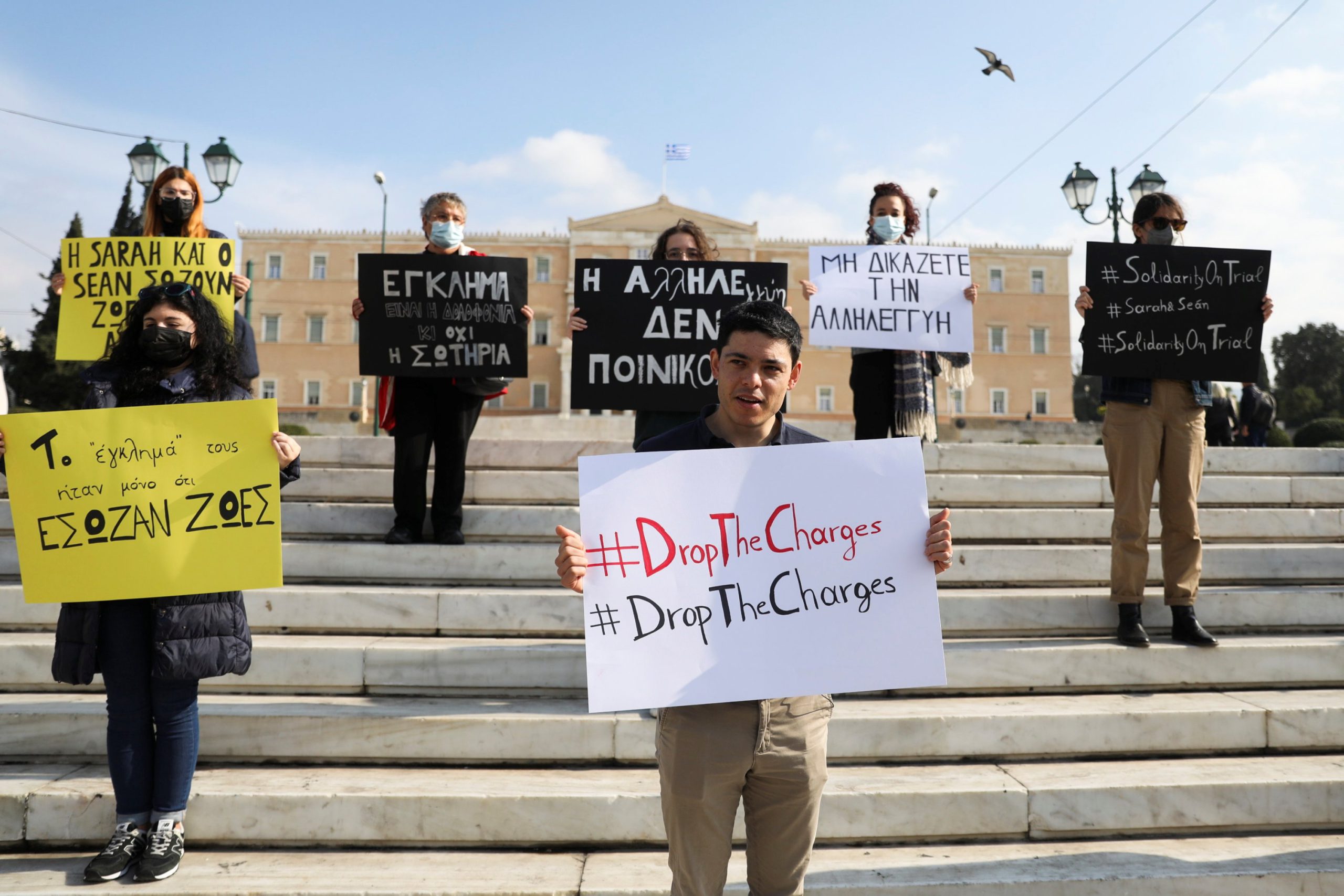
In 2015, up to approximately 10,000 asylum seekers and migrants undertook the perilous sea crossing from Turkey to Lesbos each week. That same year, at least 805 people, including 271 children, died or went missing in the Aegean Sea. Against this backdrop, Emergency Response Centre International (ERCI), a small nonprofit organization, began conducting search-and-rescue operations to support local authorities who were facing overwhelming pressure[1]. Subsequently, several humanitarian workers and volunteers associated with the organization were prosecuted on Lesbos for their involvement in maritime rescue operations and assistance to refugees. Prosecutors ultimately charged 24 individuals affiliated with ERCI in a case that transformed life-saving assistance to migrants and asylum seekers into criminal offenses carrying potential prison sentences of up to 20 years.
Although Greek immigration legislation provides protections for humanitarian activities in certain circumstances, including exemptions from criminal penalties for activities such as rescuing people at sea and transporting individuals in need of international protection, subject to legally prescribed conditions, prosecutors in the Lesbos rescue workers’ case characterized the group’s search-and-rescue activities as facilitating the illegal entry of migrants and participating in a criminal organization. This interpretation ultimately did not result in the defendants’ conviction[2]. The case, in which Seán Binder and Sarah Mardini were among the most prominent defendants, was widely regarded by human rights organizations as a notable example of the criminalization of humanitarian assistance to migrants in Greece. Human rights groups had warned that the prosecution was politically motivated and that efforts to save lives at sea had been wrongly characterized as migrant smuggling[3].
- The Case of Seán Binder
The case of Seán Binder concerns a German-Irish humanitarian worker who had been involved in maritime rescue operations and assistance to refugees and migrants on the Greek island of Lesbos since 2017. In 2018, he spent more than three months in pretrial detention. On 13 January 2023, a court in Mytilene dismissed most of the lesser criminal charges, including espionage and the unlawful use of radio frequencies, on procedural and legal grounds. The reasons for this decision included the failure to translate charging documents for non-Greek defendants, ambiguity surrounding the espionage allegations, and the repeal of the statutory provisions underpinning certain charges. Nevertheless, proceedings concerning more serious allegations, including facilitating the illegal entry of migrants, membership in a criminal organization, and money laundering, remained ongoing. These proceedings ultimately concluded with the defendants’ acquittal in January 2026[4].
On 16 January 2026, one day after the acquittal, Seán Binder spoke to Ireland’s national broadcaster, RTÉ, about the nature of the charges and the consequences of the prosecution:
“The foundation of the smuggling charge was that we did search and rescue. The accusation of spying was that we used WhatsApp. The fact that we were charged with money laundering stems from the fact that we raised money to buy laundry machines, it was farcical. So, the only real outcome of all of this is that it has stopped people from engaging in search and rescue. It has been enough to scare them away from the shoreline, and that’s the point[5].”
Despite the acquittal of Binder and his co-defendants, criticism of the Greek judicial authorities persisted. From 2018 until January 2026, these individuals faced prolonged criminal proceedings that could have resulted in prison sentences of up to 20 years had they been convicted. The continuation of these proceedings for more than seven years had significant consequences for the defendants’ personal lives, financial circumstances, and professional futures. Following his acquittal, Binder emphasized that the prolonged proceedings had not only left his own life in a state of uncertainty for years but had also exerted a broader chilling effect on humanitarian activities in the Aegean Sea by discouraging individuals from participating in search-and-rescue operations[6]. In another part of the same interview with the Irish broadcaster, Binder stated:
“I have been unable to continue with my life in many respects, although when I went to prison and I met people who were even more adversely affected by the criminal justice system, it encouraged me to retrain as a barrister[7].”
- The Case of Sarah Mardini
Sarah Mardini, a former Syrian swimmer and refugee whose life story, together with that of her sister, was portrayed in the Netflix film The Swimmers, was among the most prominent figures in the Lesbos rescue workers’ case. In 2015, Sarah Mardini fled the Syrian civil war alongside her younger sister, Yusra Mardini, who was also a swimmer. Just 15 minutes into their journey, the boat’s engine stopped working. Sarah and her sister entered the water and began pushing the boat. Recalling the experience, she stated: “It was scary… even if you’re professional swimmer,” adding, “I just didn’t want to die.” After three and a half hours, they managed to bring the boat and all its passengers safely to Greece[8].
The following year, Yusra Mardini competed as a member of the first-ever Refugee Olympic Team at the Rio de Janeiro Olympic Games in Brazil. After settling in Germany, her older sister returned to Lesbos to undertake volunteer humanitarian work[9]. In 2018, Greek authorities arrested Sarah Mardini alongside Seán Binder and other associated activists, bringing charges against them that included facilitating the illegal entry of migrants, espionage, money laundering, and membership in a criminal organization. Mardini, whose volunteer activities on Lesbos included distributing water and blankets to asylum seekers, was arrested on 21 August 2018. She spent approximately 107 days in pretrial detention, including the first two weeks on Lesbos and the remainder at Korydallos Prison near Athens. She was eventually released in early December 2018 on bail of €5,000[10].
The judicial proceedings continued for several years, until she was finally acquitted alongside 23 other defendants in early 2026. Following the verdict, an emotional Mardini declared:
“Saving human lives is not a crime. We never did anything illegal because if helping people is a crime, then we are all criminals[11].”
- The Case of Tommy Olsen
The case of Tommy Olsen, the Norwegian founder of Aegean Boat Report, represents a significant example of how pressure on migrant rights activists has expanded beyond frontline humanitarian assistance to encompass human rights documentation and reporting. Aegean Boat Report is an organization dedicated to monitoring and documenting migration in the Aegean Sea. Its principal activities include monitoring the arrival of migrant boats, receiving and following up on distress messages from people at sea, documenting alleged unlawful pushbacks, and providing verified information to journalists, lawyers, United Nations bodies, and humanitarian organizations. Olsen faced serious criminal charges brought by Greek authorities in connection with his documentation and dissemination of information concerning migrant boat arrivals, emergencies in the Aegean Sea, and allegations of unlawful pushbacks of asylum seekers. These charges included participation in and membership of a criminal organization, facilitating the entry of third-country nationals into Greek territory, and repeatedly facilitating the unlawful stay of third-country nationals for financial gain, among other allegations[12].
On 14 May 2024, an investigating judge on the Greek island of Kos issued an arrest warrant for Tommy Olsen. Subsequently, a European Arrest Warrant was issued against him on 3 December 2025 and registered in the European SIRENE system on 5 December of the same year. On 16 March 2026, Norwegian police arrested Olsen at his home in Tromsø pursuant to the warrant. However, on 15 May 2026, Norway’s Hålogaland Court of Appeal unanimously rejected his surrender to Greece. The court determined that the requirement of dual criminality, under which the conduct forming the basis of an extradition request must constitute a criminal offense under the laws of both countries, had not been satisfied in this case. The court also considered specific indications of a risk that Olsen’s right to freedom of expression, protected under Article 10 of the European Convention on Human Rights, could be violated[13].
Despite the Norwegian judiciary’s refusal to surrender Olsen, the criminal proceedings against him in Greece continued. His case came before a court on the island of Rhodes on 6 October 2026, but the hearing was adjourned until 6 April 2027. Olsen, who denies the allegations against him, did not attend the October hearing in person and was represented in court by his lawyer. The continuation of these proceedings demonstrates that, although the Norwegian court’s decision prevented his surrender, it did not bring the criminal prosecution against him in Greece to an end[14].
- The Case of Dimitrios Choulis
Dimitrios Choulis is a criminal defense and human rights lawyer based on the Greek island of Samos. For more than a decade, he has represented asylum seekers and refugees facing prosecution simply for seeking safety. Since 2010, he has challenged the misuse of criminal law against people on the move, advocating for their fundamental rights and protection under national and international law[15]. The case of Dimitrios Choulis concerns the political and media pressure directed against this Greek human rights lawyer following his representation of a survivor of the deadly maritime incident that occurred near the island of Chios on 3 February 2026. The incident involved a collision between a boat carrying asylum seekers and migrants and a Hellenic Coast Guard vessel, resulting in 15 deaths and 24 injuries, including injuries to 11 children. Accounts of how the incident occurred differed between the Greek authorities and several survivors.
Choulis, together with another defense lawyer, undertook the legal representation of a 31-year-old Moroccan national who had survived the incident and faced charges including facilitating the illegal entry of migrants and causing a maritime accident. The defendant denied the allegations, maintaining that he had merely been a passenger on the boat. Thanos Plevris, Greece’s Minister of Migration and Asylum, accused Choulis and the Human Rights Legal Project of aligning themselves with migrant smugglers[16]. Human rights organizations, however, regarded these accusations as an attempt to discredit and intimidate lawyers representing migrants. Choulis is one of the founders and principal lawyers of the Human Rights Legal Project. According to its official website, the organization is committed to promoting a safe and dignified migration and asylum system in the European Union that protects the human rights of all individuals[17]. Nevertheless, as in the other cases examined in this report, Choulis has also faced pressure, public vilification, and accusations from the Greek government.
Challenges and Responses
- The Persistent Challenge of Managing Migrants and Asylum Seekers in Greece
One of the fundamental challenges underlying the pressure exerted on humanitarian workers and migrant rights defenders is Greece’s longstanding difficulty in managing migration and asylum. Located along the European Union’s external borders and the Mediterranean and Aegean maritime routes, the country continues to experience a steady influx of asylum seekers and migrants undertaking dangerous journeys. According to data from the Office of the United Nations High Commissioner for Refugees (UNHCR), a total of 41,696 asylum seekers and migrants arrived in Greece by sea in 2025, with children accounting for 20 percent of arrivals. Crete, receiving 47 percent of arrivals, was the principal maritime entry point, followed by the Dodecanese Islands at 18 percent, Samos at 12 percent, Lesbos at 10 percent, and Chios at 8 percent[18]. The increase in arrivals, particularly along the route from Libya to Crete, placed considerable pressure on reception facilities and local administrative capacities. On 11 July 2025, the Greek Parliament adopted a provision by 177 votes to 74, suspending the registration of asylum applications for three months for individuals arriving in Greece by sea from North Africa and providing for their return without the registration of their claims. The measure drew strong criticism from human rights organizations, which argued that restricting access to asylum procedures could violate the principle of non-refoulement, which prohibits the forcible return of individuals to situations where they face serious risks[19].
Within this context, the tightening of immigration legislation, including longer detention periods and increased penalties for certain individuals without legal status, indicates that the Greek government’s response has increasingly shifted toward deterrence and criminalization. For instance, Greek Law No. 5226/2025, adopted in September 2025, introduced stricter provisions concerning irregular residence and the return of third-country nationals. The law provides for prison sentences ranging from two to five years and fines of at least €5,000 for unlawful residence. It also allows administrative detention during return procedures to be extended to a maximum of 24 months. Furthermore, the legislation provides for the use of electronic monitoring within return procedures. The application of these measures is subject to the relevant statutory conditions and should not be understood as an automatic consequence of the rejection of an asylum application[20]. Critics argue that this approach has blurred the distinction between combating migrant smugglers and targeting humanitarian workers, lawyers, and human rights monitors, particularly when reporting the presence of individuals at risk or assisting them in accessing asylum procedures is interpreted as criminal conduct.
These concerns acquired new dimensions following the adoption of Greek Law No. 5275/2026 in February 2026. Under Articles 15 and 16 of this law, membership in a registered non-governmental organization (NGO) constitutes an aggravating circumstance in relation to certain offenses involving the facilitation of the unlawful entry or residence of third-country nationals. Furthermore, under Article 24(8) of the Greek Immigration Code, as amended in 2026, the Minister of Migration and Asylum may order the removal of a registered NGO from the official registry following the initiation of criminal proceedings against one of its members for certain specified immigration offenses. Such removal requires a reasoned ministerial decision establishing the responsibility of the organization’s management in connection with the alleged conduct, even where no final criminal conviction has yet been issued against the member concerned. Critics have challenged this provision on the grounds that the criteria for attributing responsibility to an organization are insufficiently clear and that restrictions may be imposed before criminal liability has been conclusively established. In addition, the law makes the re-registration of a removed organization conditional upon the final and irrevocable acquittal of the accused individual.
Nevertheless, according to explanations provided by the Greek government to the Venice Commission, removal from the registry does not necessarily entail a complete prohibition on an organization’s activities. Rather, it restricts the organization’s access to Greek government or European Union funding and its ability to operate within facilities administered by the Ministry of Migration and Asylum. The Greek government, for its part, has justified these legislative amendments as measures intended to strengthen oversight, ensure organizational accountability, and combat the facilitation of irregular migration[21]. Consequently, migration management in Greece has developed into a multifaceted crisis that challenges the state’s capacity to manage arrivals while simultaneously placing pressure on asylum seekers’ rights, the ability of civil society organizations to operate, and mechanisms for independent oversight of border authorities.
- Domestic Responses
In a report titled “Tragedy in Chios,” the Greek news outlet NEWS24/7 examined the response of Dimitrios Choulis, the defense lawyer representing a 31-year-old Moroccan national accused of migrant smuggling, following the deadly collision between a migrant boat and a Hellenic Coast Guard vessel and the subsequent capsizing of the boat near the island of Chios. According to the outlet, Choulis accused Greece’s Minister of Migration and Asylum of subjecting him to political and media attacks solely for carrying out his professional duties and defending an accused individual. Choulis maintained that the presumption of innocence had effectively been disregarded in the case and that the government had publicly portrayed the defendant as guilty before the judicial investigation had concluded. He further emphasized that at least several passengers on the boat had not identified the Moroccan defendant as either the operator of the vessel or a smuggler in their official statements. Instead, they had described him, like the other passengers, as a migrant who had paid for his own passage. The minister, by contrast, alleged that certain political parties and migrant rights organizations were attempting to discredit Greece’s border enforcement personnel by accusing the Coast Guard of wrongdoing. The significance of this report lies in its demonstration that the debate surrounding the Chios incident extended beyond the investigation of a maritime accident[22] and developed into a broader controversy concerning the presumption of innocence, the right to defense, the independence of lawyers, and political pressure on migrant rights defenders in Greece.
In another significant judicial development, Greece’s Council of State announced the findings of its review of regulations governing the registration of NGOs working in the fields of migration and asylum on 16 September 2026. While the court upheld the compatibility of the general requirement for NGO registration with the right to freedom of association, it found several implementing provisions to be inconsistent with constitutional standards. Among the provisions deemed incompatible with the right to freedom of association was the discretionary authority granted to the Secretary-General responsible for the reception of asylum seekers to approve or reject NGO registration applications based on an assessment of their activities. The court also found the legal basis for establishing a separate registry of NGO members to be unconstitutional because it delegated the determination of essential registration requirements and member eligibility criteria to implementing regulations. The general requirement for organizations to disclose information about their financial supporters, as well as the two-year prohibition on re-registration in certain cases of removal from the registry, was also subject to constitutional objections. In addition, the Council of State referred questions concerning the compatibility of certain registration requirements with European Union law and personal data protection rules to the Court of Justice of the European Union[23].
- International Responses
In a report published by The Guardian, the newspaper examined the positive response of human rights organizations to the acquittal of humanitarian workers in the Lesbos case. According to the report, the acquittal of 24 humanitarian workers and activists by a court on Lesbos was welcomed by international human rights organizations. The case, which the European Parliament had described as one of the most significant examples of the “criminalization of solidarity” in Europe, had attracted considerable attention from human rights organizations over the years. Before the verdict was delivered, Human Rights Watch had characterized the charges as a distortion of humanitarian and life-saving activities and called for their dismissal. Following the judgment, the organization regarded the defendants’ acquittal as confirmation of the legitimacy of their humanitarian activities, while emphasizing that the prolonged prosecutions had effectively brought many rescue operations in the Aegean Sea to a halt. Amnesty International, which had closely monitored the proceedings, also expressed hope that the verdict would send a clear message to Greece and other European countries: defending human rights and assisting people at risk should be protected and recognized, rather than punished[24].
In a separate report, The Guardian also examined an alleged unlawful pushback of asylum seekers from the island of Samos, a case in which Dimitrios Choulis, an immigration lawyer based on the island, played a significant legal role. The report recounted the experience of a Palestinian family who, after arriving on Samos, hid in the mountains for several days to avoid being returned to Turkey before eventually reaching Choulis’s office. Drawing on images published by Aegean Boat Report and accounts of the rescue of several members of the same group in Turkish waters, Choulis considered the case to constitute compelling evidence of the forced return of asylum seekers. The report also cited organizations such as the United Nations High Commissioner for Refugees (UNHCR), which expressed concern about the available evidence and indicated that it could point to an unlawful pushback from Samos. Greek authorities, however, denied any wrongdoing and maintained that Coast Guard operations were conducted in accordance with international law[25]. The significance of this report lies in its demonstration that Choulis’s professional activities were not limited to defending migrants accused of smuggling but also encompassed legal action concerning alleged unlawful pushbacks of asylum seekers. This background highlights the broader scope of his human rights work, although the specific political attacks examined in the present report arose primarily from his representation of the defendant in the Chios maritime incident.
The International Rescue Committee (IRC) also warned against the criminalization of humanitarian workers in Europe during one of the hearings in the Lesbos case in 2023. The organization emphasized that individuals who take action to assist refugees and migrants at risk, particularly those facing the danger of drowning at sea, should not be prosecuted as criminals. The IRC described the trial as a troubling example of a broader trend across Europe in which human rights defenders and civil society activists face judicial and political pressure instead of receiving protection and recognition for their work. In its report, the organization highlighted the role of civil society organizations in delivering services such as accommodation, child protection, healthcare, psychosocial support, and social integration programs. It called on the Greek authorities to drop the charges against Sarah Mardini, Seán Binder, and the other defendants. According to the organization’s representatives, convicting these activists could have established a dangerous precedent and created a chilling effect on humanitarian activities throughout Europe. The IRC further emphasized that assisting people in need is not a crime and that the European Union should adopt a more humane and dignity-centered approach to the migration crisis in the Mediterranean[26].
Meanwhile, the international human rights organization Front Line Defenders issued a report strongly criticizing the Greek government’s treatment of humanitarian workers and individuals supporting asylum seekers. Referring to the European Arrest Warrant issued against Tommy Olsen and the public targeting of human rights lawyer Dimitrios Choulis by Greece’s Minister of Migration and Asylum, the organization characterized these measures as part of a systematic pattern of intimidation, discrediting, and judicial harassment directed against migrant rights defenders. According to Front Line Defenders, activities such as notifying the police, Coast Guard, migration authorities, UNHCR, and oversight bodies about the presence of migrants or individuals at risk at sea should not be treated as facilitating unlawful entry or migrant smuggling. The organization also raised concerns about recent amendments to Greek immigration legislation, warning that they could turn humanitarian activities, NGO membership, and assistance to people stranded at sea into grounds for aggravating criminal charges. Noting that several comparable cases in previous years had resulted in acquittals or the dismissal of charges, Front Line Defenders emphasized the importance of distinguishing legitimate humanitarian and human rights activities from criminal conduct. It also warned against the unjustified use of criminal justice mechanisms against migrant rights defenders. The organization called on Greek authorities to comply with their European and international obligations and refrain from bringing unfounded charges against human rights activists[27].
The Council of Europe’s Venice Commission also expressed serious concerns regarding restrictions on NGOs and the criminal liability of their members in its urgent opinion on the 2026 amendments to Greek immigration legislation. Emphasizing the need to maintain an appropriate balance between migration management and the freedom of civil society organizations to operate, the Commission observed that certain provisions concerning the facilitation of irregular migration lacked sufficient clarity and foreseeability. The Commission further considered the aggravation of criminal liability solely on the basis of membership in registered NGOs to be incompatible with the principles of legal certainty and individual criminal responsibility. It called on Greek authorities to establish clearer exemptions for life-saving rescue operations and humanitarian assistance and to restrict enhanced penalties to circumstances in which an abuse of position or breach of trust had been specifically established. The Commission also stressed the necessity of an independent and reasoned decision before responsibility for an individual’s conduct could be attributed to an organization[28].
Finally, the US-based nonprofit platform Inkstick Media examined the case of the Lesbos activists within the broader context of increasing pressure on humanitarian workers, asylum seekers, and migrant rights defenders in Greece in a report titled “How Greece Put Both Migration and Solidarity on Trial.” Focusing on the prosecution of 24 humanitarian activists before the court in Mytilene, including Sarah Mardini and Seán Binder, the report illustrated how activities such as translation, distributing blankets, providing first aid, and rescuing people at risk of drowning had been redefined as criminal conduct under charges including facilitating the unlawful entry of migrants and membership in a criminal organization. The report’s authors situated the case within an increasingly restrictive environment in which Greek border policies, allegations of unlawful pushbacks of asylum seekers, and the declining presence of rescue personnel in the Aegean Sea had created more precarious conditions for migrants. The report further emphasized that the prolonged judicial proceedings had left the defendants’ lives in a state of uncertainty for years, even before their eventual acquittal, and had exerted a chilling effect on humanitarian activities. From the publication’s perspective, the Lesbos case was not merely the prosecution of a group of humanitarian workers. Rather, it represented a test of Greece’s and Europe’s commitment to the rule of law, human dignity, and the protection of civic solidarity in the face of the migration crisis[29].
Conclusion
An examination of developments concerning the activities of humanitarian organizations and migrant rights defenders in Greece reveals the emergence of a combination of judicial, legislative, and political pressures whose consequences extend beyond individual cases and have affected civil society’s capacity to perform its protective and monitoring functions. The acquittal of 24 humanitarian workers in the Lesbos case, following more than seven years of criminal proceedings, demonstrates that even prosecutions ultimately resulting in acquittal can exert a chilling effect on humanitarian activities by creating prolonged uncertainty and imposing substantial personal and organizational costs. In the case of Tommy Olsen, the continuation of criminal proceedings in Greece, despite the Norwegian court’s refusal to authorize his surrender, illustrates how these pressures have extended into the sphere of independent documentation and reporting on the situation of migrants. Meanwhile, the political attacks directed against Dimitrios Choulis have raised similar concerns regarding the independence of the legal profession and the protection of the right to defense. Furthermore, the amendments to Greek immigration legislation in 2025 and 2026, particularly the introduction of aggravated penalties associated with NGO membership and the possibility of removing such organizations from official registries before their members have been finally convicted, indicate that some of these restrictions have shifted from individual measures into legislative and administrative frameworks. Taken together, these developments suggest that the central challenge is not merely a conflict between border control and humanitarian assistance, but rather the risk that criminal and administrative mechanisms will increasingly encroach upon legitimate humanitarian activities, independent monitoring, and effective access to legal protection.
From the perspective of international law, assessing these developments requires simultaneous consideration of Greece’s obligations under the law of the sea, international refugee law, and international human rights law. Article 98 of the United Nations Convention on the Law of the Sea (UNCLOS) and Regulation 33 of Chapter V of the International Convention for the Safety of Life at Sea (SOLAS) establish a binding legal framework for rendering assistance to persons in distress at sea. Furthermore, under Article 3(a) of the Protocol against the Smuggling of Migrants by Land, Sea and Air, the procurement of a financial or other material benefit constitutes an element of the definition of migrant smuggling. Accordingly, assistance provided exclusively for humanitarian purposes, without any intention to obtain such a benefit, does not fall within the Protocol’s definition of migrant smuggling. Nevertheless, this distinction does not, in itself, preclude the application of domestic criminal legislation to conduct that satisfies the statutory elements of an offense, and any prosecution must comply with human rights safeguards and the principle of legality in criminal law.
Moreover, the suspension of access to asylum procedures and allegations of unlawful pushbacks must be assessed in light of the principle of non-refoulement, as enshrined in Article 33 of the 1951 Convention relating to the Status of Refugees, Articles 18 and 19 of the Charter of Fundamental Rights of the European Union, Article 3 of the European Convention on Human Rights, and the prohibition of collective expulsion established under Article 4 of Protocol No. 4 to that Convention. With regard to civil society activities, Articles 10 and 11 of the European Convention on Human Rights, protecting freedom of expression and freedom of association, together with Articles 6 and 7, concerning the right to a fair trial and the principle of legality in criminal law, provide essential standards for assessing the legitimacy and proportionality of the restrictions imposed. In addition, Principles 16 and 18 of the United Nations Basic Principles on the Role of Lawyers emphasize the protection of lawyers against improper interference and intimidation, as well as the necessity of distinguishing lawyers from the positions and allegations associated with their clients. On this basis, although the Greek state possesses the authority to combat migrant smuggling and prosecute genuinely criminal conduct, the exercise of that authority must respect the principles of legality, necessity, proportionality, and individual criminal responsibility, together with guarantees of fair trial, and must not result in unjustified restrictions on legitimate humanitarian and human rights activities.
To address the existing situation, the Greek government and Parliament should undertake a targeted review of Articles 15 and 16 of Law No. 5275/2026 and remove mere membership in an NGO as an aggravating factor in criminal liability, ensuring that enhanced penalties may be imposed only where specific criminal conduct and an actual abuse of organizational position have been established. An explicit and foreseeable statutory exemption should also be introduced for search-and-rescue operations, reporting emergencies involving persons at sea, and humanitarian assistance undertaken without criminal intent. With regard to administrative oversight, the removal of organizations from official registries should be subject to clearly defined legal criteria, a reasoned assessment of organizational responsibility, and effective review by an independent judicial authority. Organizations should also have access to judicial remedies, including interim measures to prevent the irreversible consequences of administrative decisions. Reforming NGO registration regulations in accordance with the judgment of the Greek Council of State and the recommendations of the Venice Commission should likewise be treated as a priority. In the area of border management, genuine and continuous access to the registration of asylum applications and individualized assessments of the risks associated with return must be guaranteed. Furthermore, an independent mechanism should be established or strengthened to investigate alleged unlawful pushbacks and fatal maritime incidents, with the participation of independent oversight bodies. This mechanism should have access to operational evidence, including vessel positioning data, radio communications, and recorded footage, and should publish reasoned findings while respecting applicable confidentiality requirements. In addition, safeguarding the independence of lawyers and human rights defenders requires effective mechanisms for addressing threats, intimidation, and improper interference with the performance of their professional duties. Implementing these reforms could strengthen oversight and accountability of executive and judicial authorities while preserving the state’s legitimate authority to manage its borders, thereby reducing the risk that humanitarian assistance and legal representation become subject to prosecution and disproportionate restrictions.
References
[1] Van Esveld, B., & Cossé, E. (2025, December 3). Solidarity on Trial in Greece. HRW. From: https://www.hrw.org/news/2026/01/15/humanitarians-cleared-of-bogus-charges-in-greece
[2] Van Esveld, B., & Cossé, E. (2026, January 15). Humanitarians Cleared of Bogus Charges in Greece. HRW. From: https://www.hrw.org/news/2026/01/15/humanitarians-cleared-of-bogus-charges-in-greece
[3] Van Brunnersum, S. (2025, December 4). Greece: Humanitarian workers on trial. Info Migrants. From: https://www.infomigrants.net/en/post/68530/greece-humanitarian-workers-on-trial
[4] Mellon, G. (2026, January 16). Seán Binder acquitted of all charges in court in Greece. Garden Court Chambers. From: https://gardencourtchambers.co.uk/sean-binder-acquitted-of-all-charges-in-court-in-greece/
[5] Ryan, O. (2026, January 16). Seán Binder tells of ‘enormous relief’ at being found not guilty of people smuggling in Greece. The Irish Times. From: https://www.irishtimes.com/ireland/2026/01/16/sean-binder-tells-of-enormous-relief-at-being-found-not-guilty-of-people-smuggling-in-greece/
[6] Front Line Defenders. (2026, February 6). Greece: Court Acquits Seán Binder, Athanasios (Nassos) Karakitsos, and 22 Other Human Rights Defenders of All Felony Charges. Front Line Defenders. From: https://www.frontlinedefenders.org/en/case/greece-court-acquits-sean-binder-athanasios-nassos-karakitsos-and-22-other-human-rights-1
[7] RTE. (2026, January 16). Irish humanitarian says charges in Greece were ‘farcical’. RTE. From: https://www.rte.ie/news/ireland/2026/0116/1553423-sean-binder/
[8] Gültekin, E. (n.d). Sarah Mardini. 1000 Dreams. From: https://1000dreamsproject.com/story/sarah-mardini/
[9] Balaskas, P., & Gatopoulos, D. (2026, January 15). Syrian swimmer among activists cleared by Greek court of aiding migrant rescues. AP News. From: https://apnews.com/article/greece-court-migration-trial-mardini-db069c553029504a3f5b31281b3628bb
[10] Assedel. (2025, March 26). Sara Mardini “a human, an activist, and a refugee”. Assedel. From: https://assedel.org/sara-mardini-a-human-an-activist-and-a-refugee/
[11] Rowlands, L. (2026, January 16). Syrian swimmer Sarah Mardini cleared by Greek court over migrant rescues. Al Jazeera. From: https://www.aljazeera.com/news/2026/1/16/syrian-swimmer-sarah-mardini-cleared-by-greek-court-over-migrant-rescues
[12] FIDH. (2026, March 31). Norway / Greece: Aegean Boat Report founder, Tommy Olsen, arrested in Norway, following an arrest warrant issued by the Greek authorities. FIDH. From: https://www.fidh.org/en/issues/human-rights-defenders/norway-greece-aegean-boat-report-founder-tommy-olsen-arrested-in
[13] HRW. (2026, May 19). Norway: Court Blocks Activist’s Extradition to Greece. HRW. From: https://www.hrw.org/news/2026/05/19/norway-court-blocks-activists-extradition-to-greece
[14] Olsen, T. (2026, October 6). Press statement. Aegean Boat Report. From: https://aegeanboatreport.com/2026/10/06/press-statement/
[15] Front Line Defenders. (n.d). Dimitrios Choulis. Front Line Defenders. From: https://www.frontlinedefenders.org/be/node/9201
[16] Cossé, E. (2026, February 16). Greece Continues Its Relentless Assault on Civil Society. HRW. From: https://www.hrw.org/news/2026/02/16/greece-continues-its-relentless-assault-on-civil-society
[17] Human Rights Legal Project. (n.d). Our Vision. Human Rights Legal Project. From: https://www.humanrightslp.eu/who-we-are-hrlp
[18] UNCHR. (2025, September). Sea Arrivals Dashboard. UNCHR. From: https://www.unhcr.org/sites/default/files/2025-11/greece-sea-arrivals-dashboard-september-2025.pdf
[19] AP News. (2025, July 11). Greek parliament passes suspension of asylum claims despite international criticism. AP News. From: https://apnews.com/article/migration-greece-libya-asylum-un-europe-council-760d2d0a4d3dc2d95cd37503a4f301f5
[20] Smith, H. (2025, September 3). Greece passes draconian legislation with prison terms for rejected asylum seekers. The Guardian. From: https://www.theguardian.com/world/2025/sep/03/greece-passes-draconian-legislation-with-prison-terms-for-rejected-asylum-seekers
[21] Expert Council on NGO Law. (2026, March 18). Opinion on the law of Greece “Law on the Promotion of Legal Migration Policies” (CONF/EXP(2026)3). Council of Europe. From: https://rm.coe.int/coe-expert-council-greece-opinion-march-2026/48802affcd
[22] News24/7. (2024, February 10). Tragedy in Chios: Lawyer says he was targeted by Plevris because he was doing his job. News24/7. From: https://www.news247.gr/ellada/tragodia-sti-xio-dikigoros-katangellei-stoxopoiisi-apo-ton-plevri-epeidi-ekane-ti-douleia-tou/
[23] Refugee Support Aegean. (2026, September 17). NGO Registry: Greek Council of State declares main tenets unconstitutional, refers case to the Court of Justice of the European Union. Refugee Support Aegean. From: https://rsaegean.org/en/ngo-registry-greek-council-of-state-declares-main-tenets-unconstitutional/
[24] Smith, H. (2026, January 16). Rights groups hail acquittal after seven years of aid workers prosecuted during Greece refugee crisis. The Guardian. From: https://www.theguardian.com/world/2026/jan/16/greece-refugee-crisis-aid-workers-people-smuggling-acquittal
[25] Fallon, K. (2021, June 29). Greece accused of refugee ‘pushback’ after family avoid being forced off island. The Guardian. From: https://www.theguardian.com/global-development/2021/jun/29/greece-accused-of-refugee-pushback-after-family-avoid-being-forced-off-island
[26] IRC. (2023, January 13). As aid workers face trial in Lesvos, the IRC warns against the demonisation of humanitarians in Europe. IRC. From: https://www.rescue.org/eu/press-release/aid-workers-face-trial-lesvos-irc-warns-against-demonisation-humanitarians-europe
[27] Front Line Defenders. (2026, February 24). Greece must stop the judicial harassment and intimidation of migrant rights defenders. Front Line Defenders. From: https://www.frontlinedefenders.org/ar/node/9202
[28] Venice Commission. (2026, October 13). Greece – Urgent opinion on the 2026 legislative amendments concerning the registry of non-governmental organisations, the registry of NGO members and the criminal liability of registered NGO members (CDL-AD(2026)023). Council of Europe. From: https://rm.coe.int/greece-urgent-opinion-on-the-2026-legislative-amendments-concerning-th/48802e44de
[29] Fallon, K., & Grillmeier, F. (2026, April 3). How Greece Put Both Migration and Solidarity on Trial. Inkstick. From: https://inkstickmedia.com/how-greece-put-both-migration-and-solidarity-on-trial/