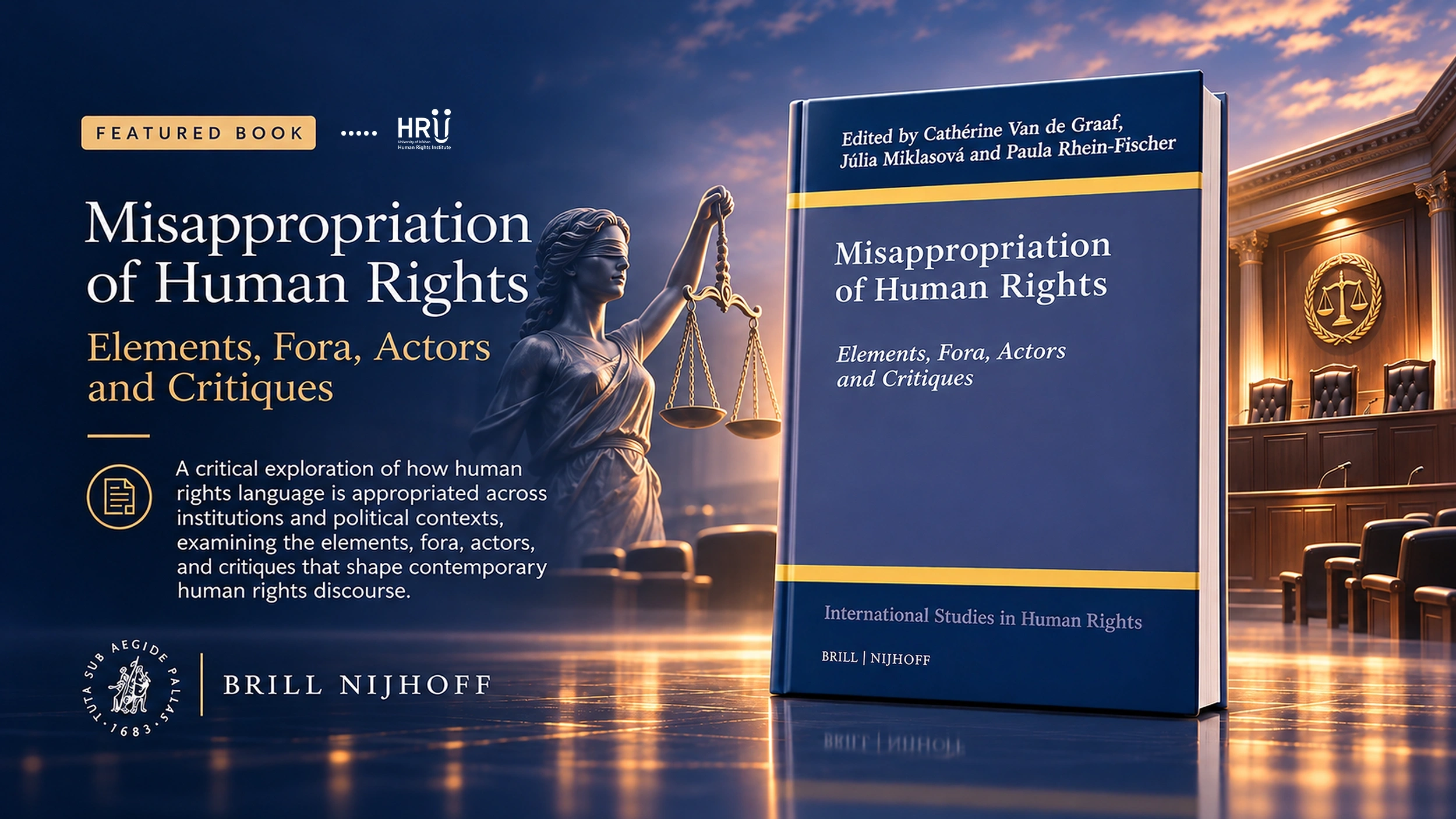
Book Title: Misappropriation of Human Rights: Elements, Fora, Actors and Critiques
Editors: Cathérine Van de Graaf, Júlia Miklasová, and Paula Rhein-Fischer
Publisher: Brill Nijhoff
Publication Year: 2026
The invocation of human rights in political positions and legal arguments does not necessarily translate into the effective protection of human rights and freedoms. At times, concepts and mechanisms originally developed to safeguard human dignity are employed to justify restrictions, exclude certain groups, or evade accountability. Against this backdrop, a fundamental question arises: how can legitimate differences in the interpretation of human rights be distinguished from their instrumental exploitation?
Misappropriation of Human Rights: Elements, Fora, Actors and Critiques takes this question as its starting point and examines how human rights language is employed across political, judicial, and institutional arenas. Bringing together legal and social science perspectives and drawing on case studies from diverse contexts, this edited volume analyses the roles of states, international institutions, and other actors in shaping the understanding and application of human rights. It also addresses the limitations of the concept of misappropriation, particularly the difficulty of distinguishing it from legitimate legal disagreements and alternative interpretations shaped by diverse cultural and social contexts. In addition to a separate introduction and epilogue, the book is organised into three parts comprising twelve chapters. It moves from examining the elements of human rights misappropriation to exploring the fora and actors involved, before turning to theoretical critiques of the concept itself. In doing so, the volume seeks to illuminate the relationship between human rights, power, and politics, foster a more nuanced understanding of how human rights language is used, and strengthen its capacity to protect human rights.
Structure and Chapter Contents
- Introduction
The introduction, written by Júlia Miklasová, Paula Rhein-Fischer, and Cathérine Van de Graaf, conceptualises human rights misappropriation as the use of human rights language and mechanisms to weaken legal protections, exclude certain groups, and evade accountability. The authors examine how states, political movements, and non-governmental organisations can employ human rights concepts to advance repressive objectives. The strategies discussed include selectively prioritising certain rights, denying particular groups the protection of human rights, distorting legal obligations, and resisting independent oversight. The central challenge lies in distinguishing such misappropriation from alternative interpretations, vernacularisation, or legitimate criticism of human rights. The authors emphasise that misappropriation is an analytical category that does not, in itself, entail specific legal consequences. They generally regard bad faith as one of its constituent elements, while acknowledging the difficulty of establishing it and the need to examine the context, conduct, and recurring patterns of behaviour of the actors involved. The introduction also connects this discussion to human rights populism, the instrumental use of rights, and the authoritarian exploitation of democratic institutions. At the same time, it takes seriously the risks of value-laden judgements, the predominance of Western interpretations, and the neglect of cultural diversity. The volume therefore adopts an interdisciplinary approach to examine both the manifestations of human rights misappropriation and the validity and limitations of the concept itself.
- Chapter One: Misappropriation or Vernacularisation in the Global South? The ‘Family Love Alliance’ and the Modernist Islamic Appropriation of Human Rights in Indonesia
Chapter One, written by Ignatius Yordan Nugraha, examines how human rights concepts are reinterpreted in different cultural and religious contexts through a case study of the Family Love Alliance in Indonesia. Invoking religious values and the need to protect the family, the Alliance petitioned Indonesia’s Constitutional Court to expand the criminalisation of certain sexual relations, including sexual relations outside marriage and consensual same-sex relations between adults. The petition was rejected in 2017. The chapter’s central concern is the distinction between human rights misappropriation and vernacularisation, the process through which universal concepts acquire new meanings in light of local values and experiences. Within this framework, the Alliance’s understanding of human rights is closely connected to its interpretation of Islamic teachings, fitrah (human nature), and individual and social responsibilities. The chapter emphasises that differences between this understanding and prevailing international interpretations are not, in themselves, sufficient to establish bad faith or the instrumental exploitation of human rights. Similarly, similarities between certain positions advanced by the Alliance and those of other political movements should not obscure the distinctive historical and social context of Indonesia. An examination of the Alliance’s anti-colonial discourse further demonstrates that engagement with universal human rights is accompanied by questions concerning the origins of these rights and the ways in which they are interpreted. From this perspective, understanding local interpretations requires attention to their internal logic, underlying beliefs, and historical circumstances. The chapter concludes that vernacularisation offers a more productive analytical framework for explaining this experience, allowing for a more nuanced understanding of the diversity of human rights interpretations across the Global South.
- Chapter Two: Formalising the Right to Freedom of Assembly in Russia
Chapter Two, written by Elena Lipatova and Melaniya Maslova, demonstrates how the right to freedom of assembly in Russia, despite its formal recognition in the Constitution, is restricted through legislative provisions and administrative and judicial practices. The central argument is that the apparent acceptance of human rights language can coexist with the practical erosion of the very rights it purports to protect. Requirements concerning prior notification of assemblies, the extensive discretion afforded to administrative authorities in determining their time and location, and other procedural obstacles limit the effective exercise of the right to freedom of assembly. In some cases, charges of disobeying police orders are also used as a means of prosecuting participants in public assemblies. Courts frequently fail to examine the lawfulness of such orders, instead relying on police reports as the basis for their decisions. An examination of judicial decisions reveals that references to the case law of the European Court of Human Rights are often selective, emphasising the permissible restrictions on assemblies while disregarding the safeguards established by the same judgments. This practice has continued even after Russia ceased to be a member of the Council of Europe. As a result, legislative, executive, and judicial institutions reinforce one another’s practices, creating an appearance of compliance with international human rights standards while undermining their substantive protection.
- Chapter Three: Beyond LGBT Rights: Russia’s “Traditional Values” Statecraft
Chapter Three, written by Cai Wilkinson, examines how the discourse of “traditional values” has become a central component of Russia’s domestic and foreign policies. Although the discussion begins with regulations concerning sexuality and gender, its primary focus is on the relationship between these policies, the regulation of social life, the consolidation of political power, and the redefinition of sovereignty. According to the chapter’s analysis, the emphasis on family, the protection of children, and national identity has gradually become embedded in an extensive body of legislation and strategic policy documents. Through this process, the state assumes an increasingly prominent role in determining the norms governing private life and the social responsibilities of citizens. The chapter explains this development through the concept of moral sovereignty, understood as the assertion of the state’s authority to define and enforce society’s moral norms over and above international standards and obligations. This understanding is closely associated with the portrayal of Russia as a “civilisation-state” and the emphasis on its independent position in the international order. In foreign policy, the defence of traditional values also provides a basis for coalition-building and challenging the liberal international order. From the chapter’s perspective, the significance of these policies extends beyond disagreements over particular rights and reflects a broader contest over the authority to determine social and international norms. The chapter concludes that examining human rights misappropriation requires simultaneous attention to the domestic consequences of such policies and the wider geopolitical objectives they serve.
- Chapter Four: The Strategic Deployment of ‘Hate Speech’ in Turkey: Misappropriation of Human Rights?
Chapter Four, written by Elif Çelik, examines the use of the concept of “hate speech” in Turkey and demonstrates how a mechanism intended to combat discrimination can be transformed into an instrument for restricting criticism and dissent. The central issue concerns the selective enforcement of legal provisions and the influence of political priorities on determining the boundaries between permissible expression and prohibited speech. Focusing on Article 216 of the Turkish Penal Code, particularly its provisions concerning incitement to hatred and hostility and the denigration of social groups or religious values, the chapter analyses the consequences of conceptual ambiguity and selective enforcement. By contrast, complaints brought by certain groups targeted by hate speech do not receive effective judicial protection. The chapter also emphasises the need to distinguish criticism and the expression of opinions from incitement to discrimination, hostility, or violence. Another part of the analysis examines the roles of the Human Rights and Equality Institution of Türkiye and the Radio and Television Supreme Council, whose decisions, according to the evidence presented in the chapter, sometimes align with the political sensitivities of the governing authorities. Selective references to international human rights standards can also lend an appearance of legal legitimacy to such decisions. Even when certain judgments are overturned by higher courts, the chilling effects of prosecution and punishment on freedom of expression are not necessarily eliminated. The chapter concludes that this pattern displays characteristics of human rights misappropriation, insofar as the language of rights protection is employed to justify control over the public sphere and restrict the plurality of viewpoints.
- Chapter Five: Russia’s Arguments to Justify the War in Ukraine and Their Abuse of Human Rights Appeals
Chapter Five, written by Egbert Fortuin, Henrike Jansen, Wiktor Pawłowski, and Levina de Wolf, examines Russia’s arguments for justifying its invasion of Ukraine, focusing on the use of human rights language and international law. Central to the analysis are Russia’s claims that it sought to protect the Russian-speaking population and prevent an alleged “genocide” in the Donbas region, claims that are intertwined with historical narratives and security concerns in official speeches. Drawing on argumentation and communication theories, the chapter evaluates the credibility of the evidence presented, the relevance of the premises to the conclusions drawn, and the ways in which these claims are communicated. According to the analysis, Ukraine’s language policies and political disputes are portrayed in ways that suggest much broader claims about threats to the very existence of Russian-speaking communities. The use of emotionally charged legal terminology, without demonstrating that the relevant legal criteria have been met, plays a central role in this process. Attacks on the credibility of critics, references to alleged violations by Western countries, flawed analogies, and the accumulation of irrelevant material further divert attention from the examination of evidence. The chapter identifies this pattern as part of a propaganda strategy that portrays Russia as a defender of human rights and presents military action as a protective necessity. Within this framework, the rights of Russian-speaking populations become a geopolitical issue, while legal language lends an appearance of legitimacy to political claims. The chapter concludes that identifying human rights misappropriation requires careful scrutiny of the facts, the meaning of legal terminology, and the coherence of the arguments advanced, since invoking human rights does not, in itself, establish the validity of a justification.
- Chapter Six: Alternative and Competing Narratives in the International Human Rights System
Chapter Six, written by Rosa Freedman, examines the competition between different narratives within the international human rights system and demonstrates how certain states seek to reshape the functioning of human rights institutions through their participation in them. The discussion begins with the principle of universality and the entitlement of all individuals to fundamental rights. The chapter distinguishes between the use of political mechanisms to expand human rights protections, the weakening of specific rights, and the broader erosion of the human rights system. Coalition-building, bloc voting, the introduction of resolutions, and attempts to influence monitoring mandates are identified as key instruments of this competition within the United Nations Human Rights Council. Disagreements concerning the relationship between the protection of individual rights and the protection of the family, cultural values, and religious beliefs also constitute important areas of contestation.
Another part of the chapter focuses on initiatives advanced by China, examining the implications of prioritising economic development and intergovernmental cooperation when such approaches are accompanied by weakened oversight and accountability. The analysis also considers the roles of government-affiliated organisations, the media, and efforts to influence academic institutions in promoting competing human rights narratives. The motivations of states are not uniform and may range from historical and regional considerations to economic interests and attempts to prevent scrutiny of domestic human rights violations. The chapter’s central argument is that human rights language can sometimes be employed to weaken the very protections that the international human rights system was established to guarantee.
- Chapter Seven: Misappropriating the Legacy of Nuremberg: The Putin Regime’s Campaign to Redefine Human Rights and Defend the Perpetrators of Atrocity Crimes
Chapter Seven, written by Robert Horvath, examines the political exploitation of the legacy of the Nuremberg Tribunal and concepts of international criminal justice in Russian policy. The central argument is that Russia, while presenting itself as a defender of the struggle against racism and the prevention of genocide, has simultaneously challenged the legitimacy of international accountability mechanisms. The chapter identifies concerns about the potential prosecution of officials for their involvement in various events as an important factor shaping this approach. It then demonstrates how accusations of bias against the International Criminal Tribunal for the former Yugoslavia (ICTY), together with support for individuals accused or convicted before the Tribunal, have been reflected in diplomatic positions and the activities of aligned organisations.
In the war in Georgia and subsequently in Ukraine, the language of genocide prevention and civilian protection was invoked to justify military intervention. According to the chapter’s analysis, criminal investigations and media initiatives also contributed to reinforcing these narratives, despite the absence of credible judicial findings substantiating the claims advanced. At the same time, opposition to certain international initiatives recognising and condemning the Srebrenica genocide, including Russia’s veto of a proposed United Nations Security Council resolution in 2015, can be examined as an example of a selective approach to accountability mechanisms. The chapter concludes that the instrumental use of the language of justice can undermine judicial institutions, distort the meaning of legal concepts, and shield perpetrators of atrocity crimes from accountability.
- Chapter Eight: ‘The True Rights-Bearers’: Victimhood and Citizenship in the Construals of the Legal Subject
Chapter Eight, written by Adriane Sanctis de Brito, Luciana Silva Reis, Ana Silva Rosa, and Mariana Amaral, examines the role of narratives of victimhood in claiming rights and redefining citizenship in Brazil. Drawing on the selection and qualitative analysis of 407 public documents, the study investigates the legal arguments advanced by three conservative groupings associated with agricultural and livestock interests, religious demands, and firearms and public security policies. A common feature of these groups is their portrayal of themselves or those they represent as victims whose rights are under threat. In the field of public security, the image of the “law-abiding citizen” and the police officer in need of protection is employed to justify expanded access to firearms and reduced oversight of security forces. In the agricultural sector, producers and landowners are portrayed as victims of environmental restrictions and policies concerning the demarcation of Indigenous lands. In the religious sphere, the defence of religious freedom and the protection of families and children are linked to narratives of threat and the need for state protection. The chapter demonstrates how this pattern can establish a distinction between “the true rights-bearers” and groups portrayed as posing a threat. Consequently, the enjoyment of rights becomes dependent on individuals’ identities and social positions, while the state is increasingly directed towards the selective protection of particular groups. At the same time, the authors emphasise that the politics of victimhood is not exclusive to any particular political movement and may, under certain circumstances, contribute to overcoming marginalisation. The chapter’s principal conclusion is that the assessment of these narratives should focus on their implications for equal citizenship, social pluralism, and the universal protection of rights.
- Chapter Nine: Misappropriation of Human Rights as an Empty Frame
Chapter Nine, written by Işıl Aral, critically examines the concept of “human rights misappropriation” from the perspective of discourse analysis and questions how scholars construct it as a human rights crisis. The central argument is that, without a clearly defined standard for the correct interpretation of human rights, the concept risks becoming an “empty frame” whose meaning is determined by the researcher’s own judgement. The chapter explores this problem across three dimensions: legal, temporal, and spatial. In the legal dimension, ambiguity concerning the rights at issue and their precise substantive content makes it difficult to distinguish alternative interpretations from misappropriation. In the temporal dimension, the narrative of human rights progress followed by regression associated with the rise of populist movements is critically examined, since the history of human rights has consistently been characterised by achievements and shortcomings occurring simultaneously. In the spatial dimension, a predominant focus on non-Western countries risks diverting attention from the shortcomings of Western states and institutions. From this perspective, the selection of countries, historical periods, and evaluative criteria is not neutral but influences the conclusions reached. The chapter emphasises that the purpose of this critique is neither to deny violations committed by states nor to abandon their examination, but rather to expose the assumptions underlying academic narratives. It concludes that studying the uses of human rights language must encompass not only the conduct of states but also the production of knowledge and the role of researchers in defining the meanings of crisis, progress, and misappropriation.
- Chapter Ten: Misappropriation: Who Fills the Space? An Examination of Misappropriation in Euthanasia Cases
Chapter Ten, written by Eve Lister, examines cases concerning euthanasia and end-of-life decision-making to assess the effectiveness of the indicators used to identify human rights misappropriation. The central question is whether concepts such as dignity, repression, exclusion, and deliberate distortion provide sufficiently clear criteria for determining when misappropriation has occurred. The chapter demonstrates that variations in legislation and judicial decisions concerning euthanasia make it difficult to rely on the criterion of “departing from established rights”. Moreover, both proponents and opponents of euthanasia can invoke the right to life, human dignity, and individual autonomy to defend differing positions. For some, dignity is closely associated with the ability to make decisions about the end of one’s life, while for others, it requires effective support for continued living and protection against social and economic pressures. The perspectives of persons with disabilities are also diverse, and their experiences and demands cannot be reduced to a single understanding of the issue. Accordingly, the existence of disagreement or polarisation does not, in itself, constitute evidence of the distortion of rights. Ambiguity in the proposed indicators may allow those assessing particular cases to treat their own cultural or normative interpretations as the standard for identifying misappropriation, even when acting in good faith.
- Chapter Eleven: A Change from Within: Beyond Human Rights
Chapter Eleven, written by Dorjana Bojanovska Popovska, examines human rights misappropriation within the broader context of strategies aimed at concentrating political power and transforming democratic institutions. Its central argument is that certain actors can fundamentally alter the meaning and functioning of existing legal concepts and institutions from within, while preserving their formal structures. Focusing on European experiences, the chapter demonstrates how appeals to national sovereignty and constitutional identity can be employed to restrict supranational oversight and the implementation of international judicial decisions. Similarly, reducing democracy to the holding of elections and the exercise of majority rule can facilitate the disregard of social pluralism and legal safeguards. The reinterpretation of the rule of law and shared values can also transform mechanisms originally designed to constrain political power into instruments supporting the expansion of governmental authority. Another part of the chapter examines the restructuring of the public sphere and the political exploitation of cultural and religious identities and symbols in defining the boundaries of belonging and citizenship. At the same time, selective support for aligned civil society organisations and restrictions on independent organisations alter the balance of civic participation. Transnational networks and government-organised non-governmental organisations (GONGOs) also contribute to legitimising these transformations. The chapter concludes that understanding the erosion of rights and democracy requires examining the interconnections between these strategies, since the transformation of legal concepts and institutional functions can undermine safeguards against the abuse of power without formally dismantling the institutions themselves.
- Chapter Twelve: Conclusions
Chapter Twelve, written by Cathérine Van de Graaf, Paula Rhein-Fischer, and Júlia Miklasová, brings together the book’s findings to clarify both the analytical potential and the limitations of the concept of “human rights misappropriation”. The central challenge lies in distinguishing the deliberate instrumentalisation of human rights from alternative interpretations, legitimate criticism, or vernacularisation. The chapter proposes four elements for identifying misappropriation: the affirmative use of human rights language, the distortion of fundamental norms enjoying broad consensus, the involvement of politically powerful actors, and the deployment of human rights language in bad faith to undermine the human rights system. The authors emphasise that the substantive content of the right concerned and the precise nature of its distortion must be clearly identified to prevent assessments from becoming matters of subjective judgement. Bad faith may also be inferred by examining the broader context, selective references to legal standards, the deliberate creation of ambiguity, and recurring patterns of conduct. The phenomenon is neither confined to non-Western countries nor associated exclusively with any particular political movement, and its origins are not limited to recent developments, although digital technologies have increased its speed and reach. The chapter cautions against the indiscriminate application of the concept and the neglect of local interpretations, emphasising the importance of considering alternative explanations. The roles of corporations, transnational networks, and major technology companies are also identified as promising areas for future research. Ultimately, the authors argue that this framework can serve as a valuable analytical tool when applied through an interdisciplinary and context-sensitive approach, provided that efforts to identify the manipulation of rights remain compatible with the recognition of legitimate disagreement and the evolution of human rights interpretations.
- Epilogue: (Mis)appropriation of Human Rights
Finally, the epilogue, written by Gráinne de Búrca and Katharine G. Young, revisits the conceptual framework of “human rights (mis)appropriation”, which the two scholars introduced in 2022, and situates the volume’s findings within a broader perspective. The authors regard the adaptability of human rights language as an essential feature that enables the recognition of previously overlooked harms, the extension of protections to marginalised groups, and the pursuit of justice. Nevertheless, this same adaptability can be exploited by states and other actors to redirect legal protections, exclude particular groups, and evade accountability. Highlighting the connections between authoritarianism, populist nationalism, and religious conservatism across different societies, they emphasise that this phenomenon is neither entirely new nor confined to any particular political movement or geographical region. The experiences of Russia and Indonesia, together with the disputes surrounding euthanasia examined in the book, further illustrate the difficulty of distinguishing deliberate misappropriation from good-faith vernacularisation and legitimate legal disagreement. Within this framework, the eight indicators previously proposed by the authors serve as warning signs of potential misappropriation rather than definitive criteria for establishing its occurrence. Drawing attention to the methodological diversity of the contributions, the epilogue also warns of the technological manipulation of human rights discourse, the implications of the growing use of artificial intelligence, and the possibility that the concept of “misappropriation” may itself be instrumentalised. The authors conclude that identifying such practices is a necessary but insufficient step towards strengthening human rights protection. It must be accompanied by an examination of safeguards within constitutional democracy, political economy, and the regulation of technology and the environment.
Conclusion
The significance of this book extends beyond identifying instances of the political exploitation of human rights to addressing a fundamental question: how can the language and mechanisms originally developed to constrain power and protect human dignity themselves become instruments for legitimising power, justifying exclusion, and undermining accountability? Drawing on an interdisciplinary approach and examining diverse experiences across different political and legal systems, the volume demonstrates that human rights misappropriation does not necessarily take the form of an explicit denial of rights. Rather, it may occur through the selective reinterpretation of norms, the transformation of institutional functions, and the use of ostensibly lawful mechanisms. What distinguishes this work, however, is its willingness to subject the very concept of “misappropriation” to critical scrutiny. By recognising the evolving nature of human rights, the diversity of cultural contexts, and the legitimacy of interpretative disagreement, the book cautions against turning the concept into a subjective standard for judging divergent understandings of rights. From this perspective, the volume is not merely a study of the instrumental exploitation of human rights but also a critical reflection on the relationship between rights, power, legitimacy, and the authority to interpret international norms. Its scholarly contribution lies in providing an analytical framework for examining these relationships while simultaneously exposing the limitations of that very framework. This approach underscores that safeguarding the credibility and effectiveness of the human rights system requires the careful and well-substantiated identification of deliberate misappropriation, recognition of the legitimate evolution of human rights norms, and sustained commitment to the principles of equal human dignity, the universality of rights, and accountability in the exercise of power.
Note
Van de Graaf, C., Miklasová, J., & Rhein-Fischer, P. (Eds.). (2026). Misappropriation of human rights: Elements, fora, actors and critiques. Brill. https://doi.org/10.1163/9789004763005