Introduction
Developments in the international system during the post-colonial era have demonstrated that the end of colonial empires did not necessarily signify the end of their structural influence within global affairs, and this observation is particularly applicable to the United Kingdom. As one of the principal imperial powers of previous centuries, Britain has managed to preserve an extra-regional position within the global order through a network of overseas territories and legal, political, and institutional ties with its former colonies. Although Britain’s level of power in the international system has undeniably declined compared to the height of its empire, the country is still regarded as a major power in global politics.
These territories, while no longer defined within the framework of classical colonialism, remain under the ultimate sovereignty of London through distinct legal arrangements and, in many cases, play a decisive role in Britain’s maritime, security, and economic strategies. The geographical dispersion of these territories across key maritime chokepoints and sensitive geopolitical regions enables Britain to maintain direct or indirect involvement in global security, trade, and shipping dynamics. At the same time, these territories are closely intertwined with concepts such as self-determination, national sovereignty, and decolonization, and some of them have become subjects of legal and political disputes at the international level.
Focusing on prominent cases such as Chagos, Gibraltar, the Falkland Islands, and Bermuda, this report seeks to examine the geopolitical, economic, and cultural dimensions of Britain’s continued presence in these territories within the framework of the contemporary international order.
British Overseas Territories
The United Kingdom possesses a collection of overseas territories located across various regions of the world and diverse geopolitical spheres, including the Atlantic Ocean, the Indian Ocean, the Mediterranean Sea, the Pacific Ocean, and Antarctica (the Southern Ocean). These territories, which are largely remnants of the structure of the British Empire, are today administered under a framework distinct from classical colonialism and are formally designated as Overseas Territories. From a legal perspective, these territories remain under the ultimate sovereignty of the United Kingdom, yet they are not considered part of Britain’s metropolitan territory. Each territory possesses its own governance framework, degree of autonomy, and administrative structure. Britain retains responsibility for key matters such as defense, foreign policy, and, in some cases, the maintenance of institutional stability, while internal affairs are partially delegated to local authorities.
The geographical dispersion of these territories enables Britain to sustain a continuous presence along strategic maritime routes, within exclusive economic zones, and across sensitive geopolitical arenas. These territories also exist at the intersection of concepts such as sovereignty, territorial integrity, and the right to self-determination, with several of them becoming the subject of legal and political disputes at the international level. From this perspective, Britain’s overseas territories should not merely be viewed as administrative or geographical entities, but rather as significant components in the continuation of Britain’s extra-regional role within the contemporary international order.
Within this framework, analytical focus on several of the most strategically significant British overseas territories can provide a clearer understanding of London’s broader objectives and interests regarding these territories. These territories include:
- Chagos
The Chagos Archipelago consists of a group of small coral islands located in the central Indian Ocean, geographically situated between East Africa and South Asia. Until the 1960s, the archipelago formed part of the colony of Mauritius; however, in 1965 Britain detached it from Mauritius and established it as a separate territory under the name “British Indian Ocean Territory” (BIOT). This separation occurred on the eve of Mauritian independence and later became one of the most controversial examples of decolonization within the international system.
Between 1968 and 1973, the indigenous population of Chagos was forcibly and entirely expelled from the islands in order to facilitate the establishment of a joint British–United States military base on Diego Garcia Island. This forced displacement was carried out without the consent of the inhabitants, without guarantees of the right of return, and in conjunction with widespread violations of their economic, social, and cultural rights.
From a legal perspective, the status of Chagos has undergone significant developments in recent years. In 2019, the International Court of Justice declared that the separation of Chagos from Mauritius had been unlawful and that Britain was obligated to bring its colonial administration to an end as rapidly as possible. Furthermore, the United Nations General Assembly adopted resolutions recognizing Mauritian sovereignty over the archipelago. Nevertheless, Britain continues to exercise de facto control over the territory, while the Diego Garcia military base remains a key strategic asset in Western military operations across the Middle East, Africa, and Asia.
- Gibraltar
Gibraltar is a small yet highly strategic territory located at the southern tip of the Iberian Peninsula, at the entrance connecting the Mediterranean Sea to the Atlantic Ocean. The territory was ceded by Spain to Britain in 1713 under the Treaty of Utrecht and has remained under British sovereignty ever since. Gibraltar has a population of approximately 34,000 people and consists of a mixture of British, Spanish, Italian, Moroccan, and Jewish ethnic backgrounds. English is its official language, although Spanish is also widely spoken in everyday life.
Legally, Gibraltar is recognized as one of Britain’s Overseas Territories, although it enjoys a high degree of internal self-government. The territory possesses its own parliament, local government, and judicial system, while Britain retains responsibility for foreign affairs and defense. In multiple referendums, the people of Gibraltar have rejected the transfer of sovereignty to Spain, a fact that Britain consistently invokes as the legal basis for the continuation of British sovereignty.
Gibraltar’s significance derives primarily from its geopolitical location. Its port, financial services sector, tourism industry, and shipping-related activities constitute the principal foundations of the local economy. Nonetheless, Gibraltar has remained a longstanding point of dispute between Britain and Spain, and following Brexit, issues relating to borders, labor mobility, and its status in relation to the European Union have introduced new complexities into the dispute.
- Falkland Islands (Malvinas)
The Falkland Islands are a group of islands located in the South Atlantic Ocean, approximately 1,500 kilometers off the coast of Argentina, with a population of around 3,500 people. These islands have been under British control since the nineteenth century, although sovereignty over them has consistently remained a matter of dispute between Britain and Argentina. Argentina considers the islands an inseparable part of its national territory and refers to them as the “Malvinas.”
The demographic structure of the Falkland Islands is composed predominantly of inhabitants of British descent, and English is the official language. The territory possesses a local government, parliament, and a relatively autonomous administrative system, while responsibility for defense and foreign policy remains with Britain. In the March 2013 referendum, the overwhelming majority of Falkland Islanders voted in favor of maintaining British sovereignty, a development that London considers an exercise of the right to self-determination. Buenos Aires, however, challenges the legitimacy of the referendum.
From a strategic and geopolitical perspective, the Falkland Islands hold significant importance for Britain. The Falklands War of 1982 between Britain and Argentina, which resulted in London re-establishing control over the islands, remains a defining moment in the history of this dispute. The local economy is largely dependent on fishing and sheep farming, while in recent years oil and gas reserves have also been discovered in the surrounding maritime areas, although large-scale extraction has not yet commenced.
- Bermuda
Bermuda is an archipelago located in the North Atlantic Ocean, situated far from mainland Britain and east of the North American coastline. With a population of approximately 64,000 people, Bermuda is regarded as one of Britain’s oldest colonies and has remained under London’s sovereignty since the early seventeenth century, following the establishment of the first English settlement there in 1612. The demographic composition of Bermuda includes a majority population of African-Caribbean origin alongside individuals of European descent, and English serves as the official language.
From a legal and political standpoint, Bermuda is a British Overseas Territory with a high degree of internal self-government. The territory possesses an elected parliament, local government, and an independent judicial structure, while Britain remains responsible for defense and foreign affairs. Unlike certain other overseas territories, Bermuda is widely regarded in practice as one of the most stable and prosperous territories under British sovereignty.
Bermuda’s economy is heavily dependent on financial services and the insurance industry, and the territory is internationally recognized as one of the world’s major offshore financial centers. Tourism also plays a significant role in its economy. Nevertheless, Bermuda faces challenges such as social inequality, a high cost of living, and structural dependence on the global economy. The issue of independence has been raised repeatedly within the territory; however, in recent referendums and political developments, the prevailing public tendency has favored maintaining ties with Britain.
Geopolitical Interests
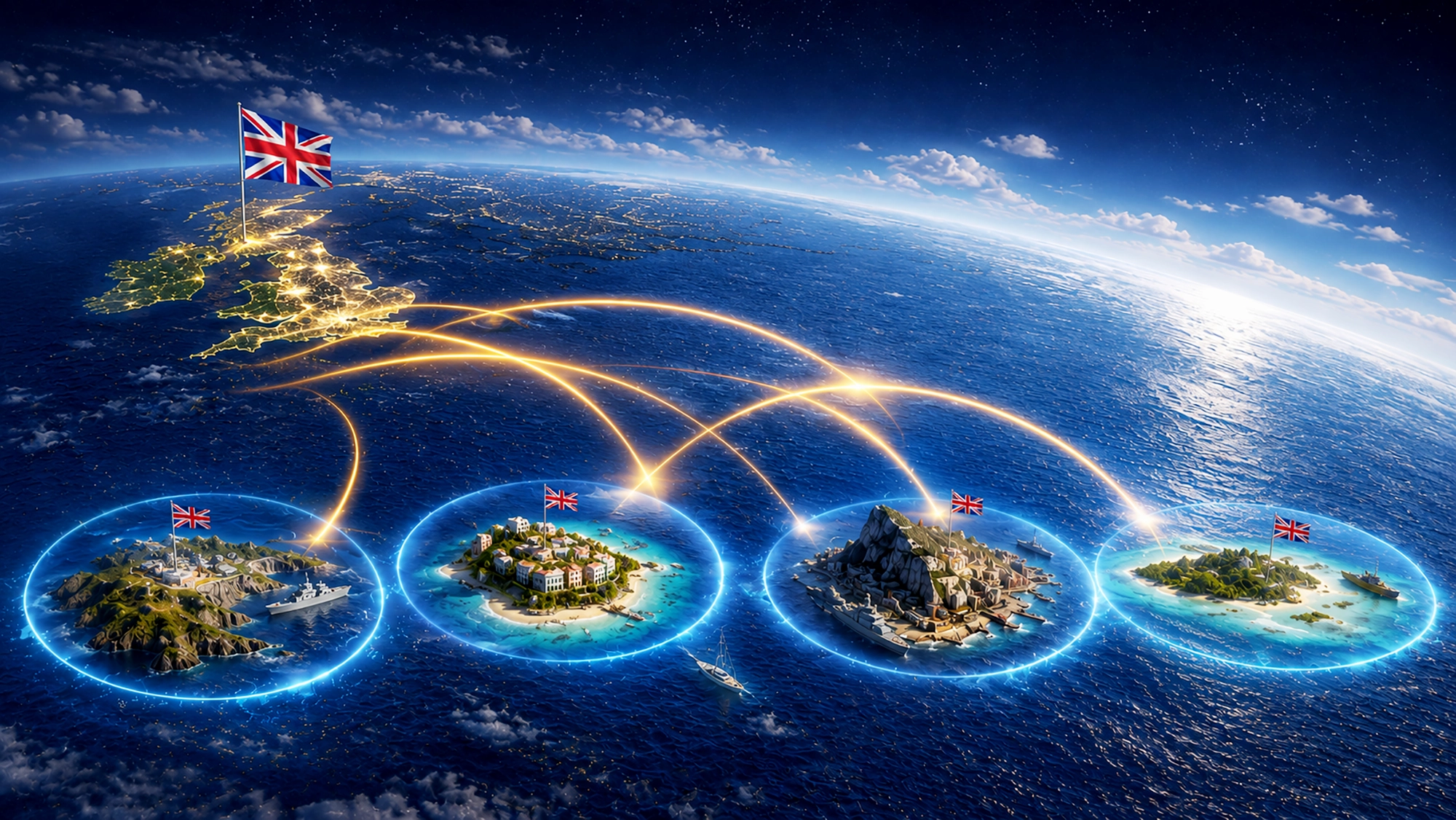
Britain’s overseas territories provide London with a geographically dispersed network of strategic points that facilitate an effective presence across key maritime chokepoints and sensitive geopolitical regions throughout the world. Chagos in the heart of the Indian Ocean, Gibraltar at the entrance connecting the Mediterranean Sea to the Atlantic Ocean, the Falkland Islands in the South Atlantic, and Bermuda in the North Atlantic each constitute part of the chain sustaining Britain’s extra-regional presence. This geographical dispersion enables Britain to play a role in the security dynamics of Europe, the Middle East, Africa, South America, and even the Indo-Pacific region.
From an operational perspective, the importance of these territories is highly significant. Gibraltar is situated along one of the busiest maritime straits in the world, through which a substantial portion of global energy and commodity trade between Europe, Africa, and the Middle East passes. Britain’s presence at this location provides capabilities for surveillance, logistical support, and participation in NATO missions in the Mediterranean. During regional crises, ranging from the Libyan conflict to tensions in the Eastern Mediterranean involving Lebanon and the Occupied Palestinian Territories, Gibraltar has functioned—alongside territories such as Cyprus—as a strategic support platform.
In the Indian Ocean, Chagos and the highly strategic military base on Diego Garcia occupy an entirely different position. This base has served as one of the most important deployment centers for British and United States air and naval forces in operations across the Middle East, Afghanistan, and even East Africa. From the Persian Gulf War to counterterrorism operations following 2001, Diego Garcia has played a decisive logistical and operational role. This position transforms Britain into an active actor within the security architecture of the Indian Ocean and the energy routes of the Persian Gulf, a region where competition among major powers, particularly the United States and China, continues to intensify.
In the South Atlantic, the Falkland Islands are not merely connected to the historical dispute with Argentina; they also serve as a platform for Britain’s presence in proximity to Antarctica (the Southern Ocean). This position enables London to maintain an influential role within the legal regime governing Antarctica and in future geopolitical calculations concerning natural resources in the region. Furthermore, control over the waters surrounding the Falklands ensures British presence along one of the strategic maritime routes linking the Atlantic and Pacific Oceans.
Bermuda also performs a complementary role in the North Atlantic. The territory lies along maritime and aerial routes connecting North America and Europe and holds security importance within the framework of Atlantic cooperation and NATO. Its location enables logistical and surveillance support across the North Atlantic, a region that has regained geopolitical importance in recent years due to increased Russian naval activity.
Taken together, these territories constitute a global network of strategic locations that enables Britain, despite its geographical limitations within Europe, to continue defining itself as a maritime power with global intervention and influence capabilities. This network, combined with Britain’s active NATO membership and permanent seat on the United Nations Security Council, allows the country to preserve and continuously reinforce its role within the contemporary international order.
Economic Interests
Beyond their military and security functions, Britain’s overseas territories possess considerable economic significance. Certain territories, such as Bermuda, have evolved into offshore financial centers and major hubs for insurance and international investment, particularly in maritime and shipping sectors, thereby playing an important role in attracting capital, facilitating global financial circulation, and interacting with advanced economies. These financial structures, while generating income for local economies, also establish deep economic linkages with the British financial system and reinforce London’s position as one of the world’s principal financial centers. This dynamic has contributed to Bermuda being regarded as one of the most prosperous among Britain’s overseas territories.
In cases such as the Falkland Islands, extensive fishing resources constitute one of the principal pillars of the local economy. The issuance of fishing licenses in surrounding waters has generated substantial and stable revenue for the territory. In addition, oil and gas reserves have been discovered beneath the seabed surrounding the Falklands in recent years, and there is speculation that extraction activities may commence in the future. The most significant discoveries include the Sea Lion Field and the Isobel Deep fields. Although large-scale commercial exploitation of these resources has not yet become fully operational and remains subject to economic and political considerations—particularly the dispute with Argentina and Buenos Aires’ claim of sovereignty over the Falklands—these energy reserves nevertheless occupy an important place in London’s strategic calculations and may substantially increase the territory’s economic value in the long term.
Similarly, the geographical position of territories such as Gibraltar enables the development of port operations, transit services, maritime refueling, and trade-related logistical activities. Located along one of the busiest maritime passages in the world, Gibraltar has become an important component within global transportation and logistics networks. Such a position should not merely be understood as a local advantage for the inhabitants of Gibraltar or the Iberian Peninsula in general, but rather within the broader framework of maritime economics, global transit, and international shipping.
Furthermore, attention must be given to the vast Exclusive Economic Zones (EEZs) generated by these territories. The combined maritime areas associated with Britain’s overseas territories provide the United Kingdom with one of the world’s largest maritime domains under sovereignty or control, alongside countries such as France and the United States. These maritime spaces provide access to fishing resources, offshore energy potential, prospective hydrocarbon reserves, and potentially, in the future, deep-sea mineral resources. In other words, the economic significance of these territories extends beyond their current resources and also lies in their future potential and in the strategic maritime spaces they encompass.
In some instances, the specific tax and legal frameworks governing these territories have transformed them into attractive jurisdictions for the registration of multinational corporations and international financial activities. This situation not only strengthens local economies but also creates networks of economic interdependence with London, thereby consolidating Britain’s role within the structure of the global economy. Consequently, beyond the classical extraction of resources—which historically constituted one of Britain’s principal motivations for expansion into various regions of the world, particularly the Middle East and the Indian subcontinent—the issue that now appears more significant is dominance over the circulation of goods, international transit routes, and global shipping networks. Such dominance becomes possible through control over overseas territories dispersed across different parts of the world.
Overall, Britain’s overseas territories are important not merely within the framework of their local economies, but also within the broader architecture of the global economy and in Britain’s grand strategy to preserve its status as a maritime and financial power.
Cultural Interests
In addition to their geopolitical and economic dimensions, Britain’s overseas territories also carry symbolic and identity-related functions. The continued linkage of these territories with Britain reflects the persistence of the historical legacy of the British Empire in a modern framework grounded in self-government. In many of these territories, the English language, the common law legal system, and parliamentary institutions have become entrenched as integral components of political and institutional identity, while cultural and educational ties with Britain remain active.
For example, in territories such as the Falkland Islands and Bermuda, educational systems are structured according to British standards, and many students pursue higher education at universities in the United Kingdom. This educational circulation reproduces generational and elite linkages between the territories and the metropolitan center. Beyond institutional frameworks, royal and ceremonial symbols also play a role in consolidating these connections. The British monarch is recognized as the head of state in these territories, representatives of the Crown (governors) are appointed, and official calendars, public ceremonies, and national occasions are aligned with British traditions. The presence of these symbols creates a form of historical and identity continuity that is not merely legal in nature, but also deeply rooted within local political culture and collective memory.
From the perspective of soft power, these territories constitute part of Britain’s global network of cultural influence. British media, educational systems, legal standards, and even sporting structures—including participation in the Commonwealth Games—provide mechanisms for reproducing British political values and norms. As a result, the connection with London is perceived not solely as a formal political relationship, but also as a cultural and identity-based bond. This is especially evident in territories such as Gibraltar and the Falkland Islands, where British identity has functioned as an active political element in referendums and public discourse concerning sovereignty disputes.
At the same time, these territories are not merely reflections of British identity; rather, they also represent arenas of interaction—and at times tension—between local identities and British identity. In some territories, such as Bermuda, the diverse demographic composition and the colonial legacy of slavery have generated debates surrounding historical justice and cultural independence. In the Falkland Islands as well, local identity, despite its close connection with Britain, possesses distinctive characteristics shaped by the territory’s unique geographical and historical experiences. Consequently, the cultural relationship between these territories and Britain is not a one-sided process, but rather a dynamic process of identity redefinition within the framework of political association.
At a broader level, these territories form part of Britain’s symbolic capital within the international system. The continuity of these relationships demonstrates that although the former empire has formally ceased to exist in the framework of classical colonialism, its influence continues through a network of cultural, educational, legal, and institutional ties. From this perspective, the overseas territories function as instruments for the reproduction of Britain’s cultural influence and historical legitimacy within the contemporary international order.
Conclusion
Britain’s overseas territories can be understood as a network of strategic points that collectively constitute the material and symbolic foundation of the United Kingdom’s continued global role. On the one hand, these territories are situated along vital maritime passages and within sensitive geopolitical regions, thereby enabling Britain to maintain security and operational presence across diverse theaters. On the other hand, through exclusive economic zones, financial services, fishing resources, and potential energy reserves, they establish structural linkages with the global economy.
Moreover, the persistence of British legal, educational, and symbolic frameworks within these territories has generated a form of cultural capital and soft power for London that reinforces its historical legitimacy and identity within the contemporary international order. At the same time, however, these territories face challenges arising from sovereignty disputes, independence movements, and pressures stemming from international law, all of which have introduced uncertainties regarding the future of this network.
Nevertheless, the combined geopolitical, economic, and cultural functions of these territories demonstrate that they continue to serve as active instruments within Britain’s broader strategy to preserve its status as a maritime and financial power in the twenty-first century.