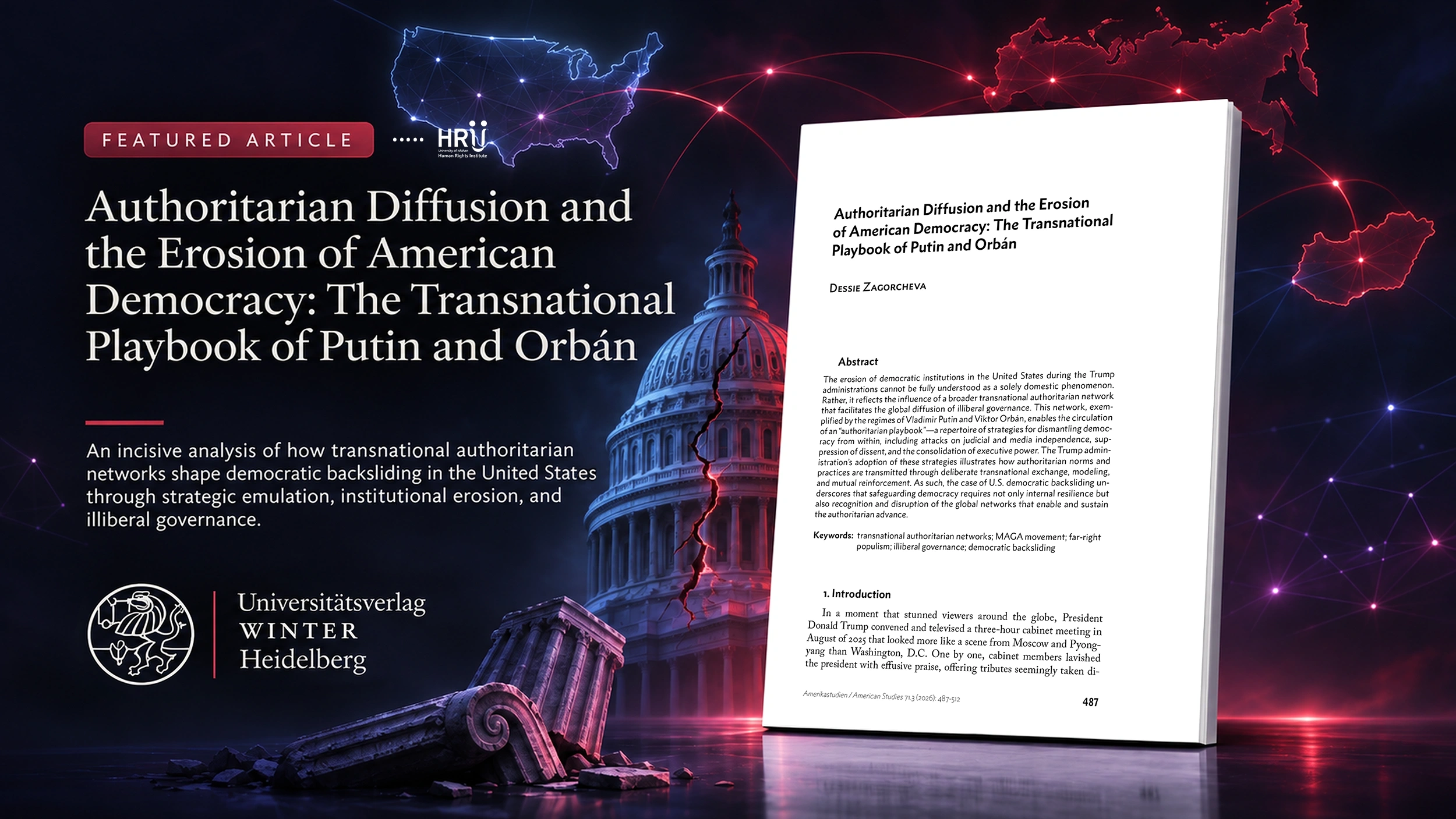
Article Title: Authoritarian Diffusion and the Erosion of American Democracy: The Transnational Playbook of Putin and Orbán
Author: Dessie Zagorcheva
Journal: Amerikastudien / American Studies
Publication Year: 2026
In recent decades, democratic erosion has become one of the major concerns in political studies, not only in countries with fragile political systems but also in some consolidated democracies. While a substantial body of research in this field has focused on domestic factors, such as political polarization, the weakness of democratic institutions, and the emergence of populist movements, the role of transnational connections and cooperation in the spread of authoritarian practices has also attracted increasing scholarly attention.
From this perspective, the article examines democratic erosion in the United States during the first and early second administrations of Donald Trump and seeks to clarify the role of transnational authoritarian networks in this process. By comparing Trump’s strategies with the models of governance adopted by Vladimir Putin in Russia and Viktor Orbán in Hungary, the author argues that the weakening of democratic institutions cannot be explained solely in terms of domestic developments within individual countries. Rather, the transnational circulation of ideas, experiences, and governance practices also plays a role in this process.
By highlighting the role of political parties, political movements, think tanks, advisers, and media figures, the article further extends the concept of authoritarian diffusion beyond interstate relations. Nevertheless, the author emphasizes that the influence of these networks depends on domestic conditions and the extent to which political elites are receptive to authoritarian strategies. Accordingly, the article underscores the need to consider both domestic and transnational factors when analysing democratic backsliding and developing strategies to counter it.
Introduction
In the introduction, the author opens the discussion by referring to examples of Donald Trump’s political conduct in 2025, including his echoing of Vladimir Putin’s views on mail-in voting. She examines these developments in the context of growing connections between nationalist populist forces in the United States and authoritarian actors in other countries.
In the author’s view, contemporary authoritarian leaders reinforce one another through the exchange of strategies, rhetoric, and institutional models. Such cooperation can provide the material, intellectual, and political support needed to weaken oversight institutions, restrict political dissent, and undermine the credibility of democratic processes.
Within this context, the author identifies the Make America Great Again (MAGA) movement as an example of authoritarian populism, highlighting characteristics such as personalized leadership, anti-institutional rhetoric, the delegitimization of political opponents, and election denialism to explain this characterization.
The introduction also emphasizes the study’s theoretical contribution. Unlike a substantial body of previous research that has focused on formal cooperation between authoritarian regimes, the article examines the role of informal networks and non-state actors, including political movements, think tanks, advisers, and media figures, in the transnational diffusion of authoritarian strategies.
Accordingly, after outlining the theoretical foundations and methodology of the study, the author introduces the authoritarian model in Russia and Hungary and subsequently examines the extent of its influence on political developments in the United States.
Theoretical Foundations of Authoritarian Diffusion
The theoretical literature on authoritarian diffusion, particularly the work of Thomas Ambrosio, examines how authoritarian norms, institutions, and practices are transmitted across countries. Such transmission may result from deliberate intervention by external actors or from the emulation of successful experiences elsewhere. Its mechanisms include the transfer of restrictive policies and laws, the promotion of illiberal norms, connections among elites, material support, and strategic alliances.
Within this framework, the concept of a “black knight” refers to an external actor that supports authoritarian regimes, strengthening their capacity to survive pressures for democratization. The studies reviewed identify Russia as a prominent example of a country that has both supported allied regimes and provided a model for the consolidation of power, including in Hungary.
In the literature examined, one of the principal motivations identified behind this policy is the preservation of Putin’s regime and the prolongation of its rule. The author also analyses Russia’s support for far-right parties and movements in Europe and the United States in relation to its geopolitical objectives, including weakening the cohesion of the European Union and NATO, alleviating the pressure of sanctions, and restricting financial and military assistance to Ukraine. Nevertheless, the author cautions that an excessive focus on external influence may obscure the importance of domestic factors and the choices made by political elites in the target state.
Building on the literature on authoritarian diffusion, more recent scholarship has focused on the concept of “transnational authoritarian networks.” While authoritarian diffusion may occur indirectly and even unintentionally through observation and emulation of the experiences of other countries, transnational authoritarian networks are based on active, deliberate, and strategic cooperation among different actors seeking to consolidate power and undermine democratic norms.
In addition to states, these networks encompass lawyers, political advisers, propagandists, media influencers, and oligarchs. They are held together less by ideological unity than by shared interests and opposition to democratic institutions. Financial, legal, technological, and military cooperation facilitates the circulation of tools among network members for countering domestic dissent and external pressures.
Extending this framework to the United States, the author emphasizes the role of non-state actors in adapting authoritarian strategies to domestic conditions. In her view, think tanks such as the Heritage Foundation and the Claremont Institute, along with coalitions associated with Project 2025, provide intellectual justification and political support for the expansion of executive power by portraying democratic institutions as sources of crisis and presenting strong leaders such as Trump as saviours.
Research Question and Methodology
The principal research question of the study is the extent to which the global authoritarian network, particularly the diffusion of the “authoritarian playbook,” has influenced the erosion of democratic institutions in the United States during the first and early second Trump administrations.
The dependent variable is democratic erosion, characterized by the weakening of institutional checks and balances, attacks on the judiciary and the media, and the consolidation of executive power. The independent variable is the influence of the global authoritarian network, understood as the transnational circulation of ideas, tactics, and support among authoritarian and authoritarian-leaning actors, particularly the regimes of Putin and Viktor Orbán.
The principal methodological challenge lies in distinguishing genuine diffusion from apparent similarities, since similar patterns of behaviour may arise from shared structural conditions without any actual transfer of experience or direct influence.
To address this issue, the author employs a qualitative comparative case analysis, proceeding through three methodological steps. First, similarities between the strategies employed by Trump and those adopted by Putin and Orbán are examined, including discrediting the media, politicizing the judiciary, manipulating electoral systems, and employing ethno-nationalist rhetoric.
Second, the empirical connections between Trump- and MAGA-related actors and foreign authoritarian forces are examined through public statements, institutional collaborations, financial and political support, and elite-level connections. The third step explains the mechanisms through which these strategies are transmitted, including international gatherings, think tanks, media platforms, and elite networks.
Through the triangulation of three categories of evidence—convergence in outcomes and strategies, the existence of concrete transnational linkages, and the identification of plausible diffusion mechanisms—the author seeks to move beyond merely observing correlations and to develop an evidence-based argument concerning the intentional and strategic diffusion of authoritarian governance practices into the American political landscape.
The Authoritarian Model
The authoritarian model refers to a repertoire of strategies designed to bring about the gradual transformation of democratic or semi-democratic regimes into autocracies. Its objective is to concentrate power in the hands of a single individual or a small group, weaken checks and balances, and eliminate political pluralism and accountability, while preserving the outward appearance of democratic institutions as a means of securing legitimacy.
A distinctive feature of this model is that the consolidation of power does not necessarily occur through military coups or the overt establishment of autocratic rule, but rather through gradual, ostensibly legal methods involving the manipulation of existing laws and institutions. In this way, the formal architecture of democracy is preserved, while the capacity of its institutions to constrain political power is progressively diminished.
The first component of this model involves capturing the political system by strengthening the ruling party, exerting legal and financial pressure on political opponents, and altering the rules of electoral competition. The second involves undermining judicial independence through the appointment of loyalists and the use of courts against critics. To illustrate these two components, the author refers to the dominance of the United Russia party and the marginalization of political opponents in Russia, as well as the lowering of the judicial retirement age in Hungary to facilitate the replacement of judges with loyalists.
The other two components of this model involve controlling the media and information and suppressing civil society and political dissent. By taking control of media outlets, pressuring them into self-censorship, and discrediting independent journalists, authoritarian regimes promote their preferred narratives and portray the continuation of their rule as a guarantor of stability. In the Hungarian case, the transfer of media ownership to pro-government business allies and the consolidation of hundreds of media outlets under the Central European Press and Media Foundation (KESMA) are identified as instruments of such control.
At the same time, restrictive laws and pressure from security forces hinder the activities of non-governmental organizations, activists, and protest movements, while political opponents are targeted through accusations such as affiliation with foreign powers. The author identifies Russia’s “foreign agents” law and the closure of the human rights organization Memorial as examples of this process.
The author also presents Hungary’s experience from 2010 until Orbán’s electoral defeat in April 2026 as an example of how this model can be adopted and adapted to the political and institutional structures of another country. Overall, the defining feature of this model is that it hollows out democratic institutions, depriving them of their substantive functions while preserving the outward appearance of democracy.
Democratic Erosion in the United States and Authoritarian Diffusion
The author emphasizes that democratic erosion in the United States began before Trump’s presidency but accelerated during his time in office. According to the data cited in the article, the United States’ score on the “Freedom in the World” index declined by eleven points between 2010 and 2020, six of which were lost during Trump’s first presidential term. In 2016, the Economist’s Democracy Index also classified the United States as a “flawed democracy” in response to intensifying political polarization, declining public trust, and a weakened political culture.
Problems such as partisan gerrymandering, legislative dysfunction, and the influence of special interest groups predated Trump’s presidency. Nevertheless, the author argues that Trump’s attacks on the media, his preference for personal loyalty over expertise in making appointments, the dismissal of career officials, and the weakening of oversight institutions further undermined the independence of government institutions and their capacity to function impartially.
The article then identifies the concentration of power in the executive branch, the circumvention of Congress, and disregard for judicial oversight as manifestations of the intensification of this process. False claims of widespread electoral fraud in the 2020 election and attempts to overturn its outcome, which culminated in the attack on the U.S. Capitol on 6 January 2021, are also regarded as indications of the erosion of the rules governing democratic competition.
The author subsequently examines the assessments of Steven Levitsky, Lucan Way, and Daniel Ziblatt concerning the state of democracy in the United States. In one of their studies, Levitsky and Way warned that the continuation of existing trends during Trump’s second presidential term could result in the United States ceasing to meet some of the fundamental criteria of liberal democracy.
In a more recent publication, these scholars, together with Ziblatt, analyse the situation in the United States through the concept of “competitive authoritarianism” and argue that the United States has entered a phase of competitive authoritarianism. This refers to a political system in which formal democratic institutions, including elections, legislatures, and opposition parties, continue to exist, but the conditions of political competition are systematically skewed in favour of those in power.
Within this framework, the “cost of opposing the government” constitutes an important indicator, as investigations, frivolous lawsuits, administrative penalties, and funding cuts can exert pressure on politicians, journalists, academics, and civil society institutions critical of the government. In the article’s assessment, these practices are consistent with contemporary authoritarian strategies and restrict the space for political dissent and competition.
The Application of the Concept of Authoritarian Diffusion to the American Case
In this section, the author emphasizes that similarities between Trump’s policies and the practices of authoritarian regimes are not, in themselves, sufficient to establish that authoritarian diffusion has occurred. Political actors may independently adopt similar strategies in response to similar problems. Evidence of inspiration and the transfer of experience must therefore be provided.
Given the lack of access to internal decision-making documents, the article draws on three categories of evidence: the prominence of Orbán’s model among American conservatives and their willingness to emulate it; extensive connections between conservative forces in the two countries; and convergence between the objectives, strategies, and outcomes of the Trump administration’s policies and those of the authoritarian model.
Within this context, the author presents the Heritage Foundation’s Project 2025 as an example of the influence of Orbán’s governance model on American conservatives. Although Trump distanced himself from the project during the 2024 presidential campaign, the author argues that the policies of his second administration largely correspond to its proposals, including the expansion of executive authority, the centralization of decision-making, and the replacement of government employees with loyalists.
The article then examines political, institutional, and media connections as channels through which this model is transmitted. The mutual admiration between Trump and Orbán, Orbán’s support for Republican political figures, the Heritage Foundation’s formal partnership with the Danube Institute in Hungary, and the participation of American conservatives in gatherings of the Conservative Political Action Conference (CPAC) in Hungary are among the forms of evidence cited by the author.
In this context, the author also refers to statements by Kevin Roberts, president of the Heritage Foundation, identifying Hungary’s experience of governance as a model to be followed, as well as the connections between the American conservative writer Rod Dreher and the Danube Institute.
In the author’s view, these connections have extended beyond rhetorical similarities between American and Hungarian conservatives, providing opportunities for the exchange of ideas, policy proposals, and experiences of governance, and consequently facilitating political emulation.
The article also highlights Tucker Carlson’s role in portraying Orbán’s regime favourably, particularly through his visit to Hungary and the production of a documentary about the country. According to the author, such activities make authoritarian practices more acceptable to American audiences by presenting them under the guise of defending cultural values and national sovereignty.
The author regards this body of evidence as supporting the argument that the convergence between the Orbán and Trump models is a product of transnational connections and learning rather than mere coincidence.
The Trump Model: Is the United States Moving towards Competitive Authoritarianism?
In this section, the author argues that the second Trump administration, drawing on the unitary executive theory, a stronger hold over the Republican Party, and the presence of loyalists, is pursuing the consolidation of presidential power more systematically than during Trump’s first term. The article examines this process through four strategies that resemble those employed by Putin and Orbán.
The first strategy involves capturing the political and administrative system. The large-scale dismissal of government employees, the removal of seventeen inspectors general across government departments in January 2025, and partisan gerrymandering, including in Texas, are presented as examples of this strategy. In the author’s view, these measures diminish the capacity for independent oversight and political competition.
The second strategy involves undermining the media and controlling information. This is pursued through the discrediting of critical media outlets, the issuance of Executive Order 14290 aimed at cutting federal funding for the public media organizations NPR and PBS, restrictions on journalists’ access, and the strengthening of sympathetic media outlets. These pressures result in increased self-censorship and reduced opportunities for public oversight of the government.
The third strategy involves undermining judicial independence. The article identifies the 2024 ruling of the U.S. Supreme Court in Trump v. United States concerning presidential immunity from criminal prosecution for official acts, politically aligned judicial appointments, legal pressure on judges, and disregard for certain court orders, particularly in relation to immigration, as factors diminishing the judiciary’s capacity to act as a check on executive power. In the author’s view, verbal attacks on judges also undermine public confidence in judicial impartiality.
The fourth strategy involves exerting pressure on civil society and political opponents, including universities, non-governmental organizations, law firms, and protesters. Funding cuts or suspensions, including the freezing of federal grants to Harvard University, threats to revoke tax-exempt status, retaliatory measures against law firms, and the deployment of federal forces during protests are among the examples discussed.
The author concludes that the combination of these strategies increases the “cost of opposing the government” and skews the conditions of political competition in favour of those in power while preserving formal democratic institutions—a situation that she analyses through the concept of “competitive authoritarianism.”
Conclusion
Ultimately, the author argues that the similarities between the Trump model and Orbán’s experience, ranging from the weakening of judicial and media independence to pressure on civil society and alterations to the conditions of electoral competition, are too extensive to be regarded as coincidental. Nevertheless, structural differences between the two countries make it difficult to fully replicate the Hungarian experience in the United States.
Prior to his electoral defeat in April 2026, Orbán had been able to use his two-thirds parliamentary majority to consolidate power and weaken oversight mechanisms, entrenching these changes within Hungary’s legal framework through repeated constitutional amendments. By contrast, given the difficulty of amending the U.S. Constitution, Trump has relied primarily on executive orders, which are less durable in legal terms, may face judicial challenges, and can be revoked by subsequent administrations.
The federal structure of the United States, the capacity of individual states to resist federal action, and the greater diversity of the media landscape also present obstacles to the consolidation of power. Accordingly, in the article’s assessment, the durability of democratic backsliding in the United States remains uncertain and depends on the ability of authoritarian forces to overcome institutional and societal resistance.
The article further emphasizes that external influence is neither the sole nor necessarily the most important factor contributing to democratic erosion in the United States. Partisan polarization, inequalities, institutional weaknesses, and the receptiveness of domestic political elites to authoritarian strategies play a crucial role in determining the success or failure of such influence.
For this reason, the author regards authoritarian diffusion as a two-way process, the understanding of which requires an examination of the interplay between domestic and international factors. In her view, the concept of authoritarian diffusion should be employed alongside other theoretical frameworks that account for the internal dynamics of individual countries. The transmission of these strategies also occurs primarily through political movements, non-state actors, digital media, and transnational alliances.
While emphasizing the importance of authoritarian networks, the author does not regard them as monolithic. She considers the portrayal of Trump and Orbán as mere puppets of Putin an oversimplification of relationships shaped by independent interests and political calculations. Diverging interests and personal rivalries can create divisions within these networks and provide opportunities for defenders of democracy.
Accordingly, the author emphasizes the need for further research into the motivations of authoritarian actors, the nature of relationships between state and non-state actors, and the sources of potential disagreements and divisions within transnational authoritarian networks. In her view, identifying the vulnerabilities of these networks can contribute to the development of more effective strategies for defending democracy.
Finally, the article argues that countering the spread of authoritarianism requires both strengthening domestic capacities and expanding transnational cooperation among democratic states and pro-democracy forces in other countries.
Note
Zagorcheva, Dessie. (2026). Authoritarian Diffusion and the Erosion of American Democracy: The Transnational Playbook of Putin and Orbán. Amerikastudien / American Studies, 71(3), 487–512. DOI: 10.33675/AMST/2026/3/11