Introduction
The history of Israel’s relations with Latin American countries reflects the interplay of political power, economic interests, military cooperation, and the politics of identity in international relations. With its experience of colonialism, foreign intervention, military rule, and social struggles, Latin America has long been an arena of competition over political independence and the definition of a desirable political order. Against this backdrop, the presence of external actors intersects with the economic and security needs of governments and the ideological orientations of political forces. Over time, Israel’s relations with the region have encompassed a range of diplomatic engagements, development cooperation, military ties, and technological exchanges. The political diversity of Latin American countries and shifts in power among different political movements have placed these relations on distinct and sometimes contradictory trajectories. Argentina, in particular, offers a significant case for examining these relations because of its political history and the prominent place of historical memory and human rights in its public life. Javier Milei’s rise to power and his emphasis on closer ties with Israel have raised questions about the relationship between foreign policy and far-right identity, as well as the far right’s understanding of freedom, security, and justice. When a foreign alliance is presented as a means of defending civilizational values, assessing such an alliance requires examining the extent to which the government upholds those same values in its domestic and international conduct.
Historical Roots of Israel’s Influence and Presence in Latin America
One of the historical foundations of Israel’s relations with Latin America was the diplomatic support extended by several governments in the region to the 1947 Partition Plan for Palestine. Thirteen Latin American countries voted in favor of the plan, while Argentina abstained. Following the establishment of Israel, agricultural cooperation, technical training, and development activities, including those undertaken through Israel’s Agency for International Development Cooperation (MASHAV), became instruments for expanding relations. MASHAV was established in 1958 at the initiative of then Prime Minister David Ben-Gurion and Foreign Minister Golda Meir, with knowledge transfer, training, and technical assistance at the core of its activities. Beyond their developmental functions, these forms of cooperation facilitated closer engagement with government institutions and skilled professionals in recipient countries and, from this perspective, can be analyzed within the framework of Israel’s public diplomacy. However, as assessments of MASHAV’s programs in subsequent periods indicate, participation in these initiatives did not necessarily translate into political alignment or support for Israel’s positions at the United Nations. The extent of technical cooperation, therefore, cannot in itself be regarded as an indicator of political influence.
The expansion of these forms of cooperation, however, did not result in a continuous and uniform improvement in Israel’s relations with all countries in the region. Following the Arab-Israeli wars of 1967 and 1973, several Latin American governments expanded their engagement with Arab countries, while criticism of Israeli policies and human rights violations became more prominent in international forums. One manifestation of this development was the 1975 vote on United Nations General Assembly Resolution 3379, which determined that Zionism was a form of racism and racial discrimination. The resolution was supported by Brazil, Cuba, Mexico, Grenada, and Guyana, while 21 other Latin American and Caribbean countries, including Argentina, either abstained or voted against it. In 1991, however, the General Assembly adopted Resolution 46/86, revoking the determination contained in Resolution 3379. Argentina also voted in favor of the latter resolution. These differing positions demonstrate that relations between Israel and the region did not undergo a uniform deterioration; increasing diplomatic distance in some countries coincided with the continuation or expansion of bilateral cooperation in others.
Against the backdrop of the Cold War, particularly during the 1970s and 1980s, these relations acquired broader dimensions through arms sales and military and security cooperation with governments in countries such as Argentina, El Salvador, Honduras, and Guatemala. In some countries, particularly Guatemala, this cooperation also encompassed counterinsurgency training and advisory services. The expansion of these relations was driven by the convergence of Israel’s search for arms export markets and political support with regional governments’ demand for military equipment and security expertise. In some instances, restrictions on direct US assistance also created opportunities for such cooperation. For example, a December 1982 report by The New York Times noted that 35 Dagger fighter aircraft had been delivered to Argentina before the Falklands War. Dagger was the Argentine designation for the Nesher aircraft, an Israeli adaptation of the French Mirage 5.
Israel’s relations with governments in the region were also intertwined with US foreign policy calculations. According to the aforementioned 1982 report, some US State Department officials welcomed Israeli assistance despite having limited knowledge of Israel’s activities in Central America. Meanwhile, in a 1986 report, the Middle East Research and Information Project (MERIP), drawing on a study of Israeli arms exports, explained that some Central American governments regarded stronger military ties with Israel as an opportunity to improve their relations with Washington and gain the support of pro-Israel political and social circles in the United States. This perception reflected the political calculations of certain arms-purchasing governments and did not necessarily imply that such objectives were achieved. These relations should therefore be understood as the product of an interaction among economic interests, geopolitical considerations, and the choices of host governments—an interaction whose nature and intensity varied across countries.
Following the end of the Cold War, economic and commercial cooperation gained greater importance alongside security relations. However, the rise of left-wing and center-left governments from the late 1990s through the 2000s influenced the political orientation of these relations. Their emphasis on foreign policy autonomy, opposition to hegemonic practices, and support for Palestinian rights led, in some cases, to a clear distancing from Israel. Venezuela and Bolivia severed diplomatic relations with Israel in response to the 2008–2009 Gaza War, whereas Brazil and Argentina recognized the State of Palestine in 2010 while maintaining their relations with Israel. These differences demonstrate that a left-wing political orientation alone did not determine the level of relations. The signing of the Israel–MERCOSUR Free Trade Agreement in 2007 also attested to the continuity of economic cooperation during a period in which major countries within the bloc were governed by left-wing administrations. During the 2010s, the appeal of Israeli technologies provided another basis for maintaining relations. The growing emphasis on innovation within MASHAV’s programs and the expansion of academic and commercial ties enabled some governments to pursue economic and technological cooperation while continuing to criticize Israel’s policies toward Palestinians. From this perspective, Israel’s presence in the region gradually came to rest on a more diverse range of military, developmental, and technological relations, and declining political alignment did not necessarily entail a reduction in all forms of cooperation.
The Andinia Plan
The “Andinia Plan” refers to a conspiracy theory that gained currency among certain ultranationalist movements in Latin America in the early 1960s. The narrative alleged the existence of an organized plan to establish a Jewish state in Patagonia, a region spanning southern Argentina and Chile. Among the sources cited by proponents of this theory was The Jewish State, a book by Theodor Herzl, one of the founders of political Zionism. In this work, published in 1896, Herzl considered Argentina and Palestine as two possible locations for the establishment of a Jewish state.
The Andinia narrative gained traction in the political climate following the abduction of Adolf Eichmann by Israeli agents in Argentina in 1960. While the Argentine government protested the violation of its territorial sovereignty, certain domestic political circles exploited the incident to further promote the narrative. More than four decades later, in September 2003, the publication of remarks attributed to Roberto Bendini, then Chief of the General Staff of the Argentine Army, concerning alleged efforts by Israeli groups to gain control over Patagonia’s resources sparked a political controversy. Argentina’s Ministry of Defense established a commission to investigate the veracity of these remarks, which ultimately concluded that insufficient evidence had been found to attribute discriminatory statements to Bendini. Nevertheless, the manner in which the investigation was conducted and the adequacy of the evidence examined also drew criticism from certain human rights organizations.
In this context, Walter Beveraggi Allende, an Argentine economist and nationalist writer, contributed to the revival and dissemination of the Andinia narrative within Argentina’s political discourse in 1971. Miguel Serrano, a Chilean writer, former diplomat, and proponent of neo-Nazi ideas, also reproduced this narrative in relation to the southern regions of Chile. Israel’s occupation of Arab territories during the 1967 war further enabled proponents of the Andinia theory to project the Palestinian experience onto the future of Patagonia and link concerns over territorial integrity to the portrayal of Jews as an internal enemy. It should be emphasized that the significance of examining the Andinia narrative lies not in establishing or disproving the existence of an Israeli territorial plan, but in understanding how the purported plan was portrayed in the historical discourse of certain far-right movements in Latin America. When contrasted with the overt support for Israel among segments of the contemporary Latin American right, this historical background illustrates the evolution and diversity of these movements’ ideological orientations.
Israel and Contemporary Far-Right Identity in Argentina
The ideological convergence between the far-right movement surrounding Javier Milei and Israel rests on the interconnected notions of economic freedom, the Judeo-Christian tradition, and the defense of Western civilization. Milei’s interest in Zionism and the Torah, his close relationship with Rabbi Axel Wahnish, and his overt use of Jewish symbols lend a religious dimension to this political orientation. Wahnish, one of Milei’s religious advisers, was subsequently appointed Argentina’s ambassador to Israel. Milei’s pronounced interest in Judaism and his political support for Israel led The Shul of Bal Harbour, a synagogue affiliated with the Chabad religious movement in the Miami area of the United States, to honor him as an “International Ambassador of Light” in April 2024. Rabbi Tzvi Grunblatt, who has led the Chabad movement in Argentina since 1978, welcomed Milei’s commitment to spiritual values and his willingness to express his religious beliefs publicly in an interview with the Jewish Telegraphic Agency (JTA).
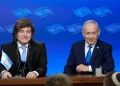
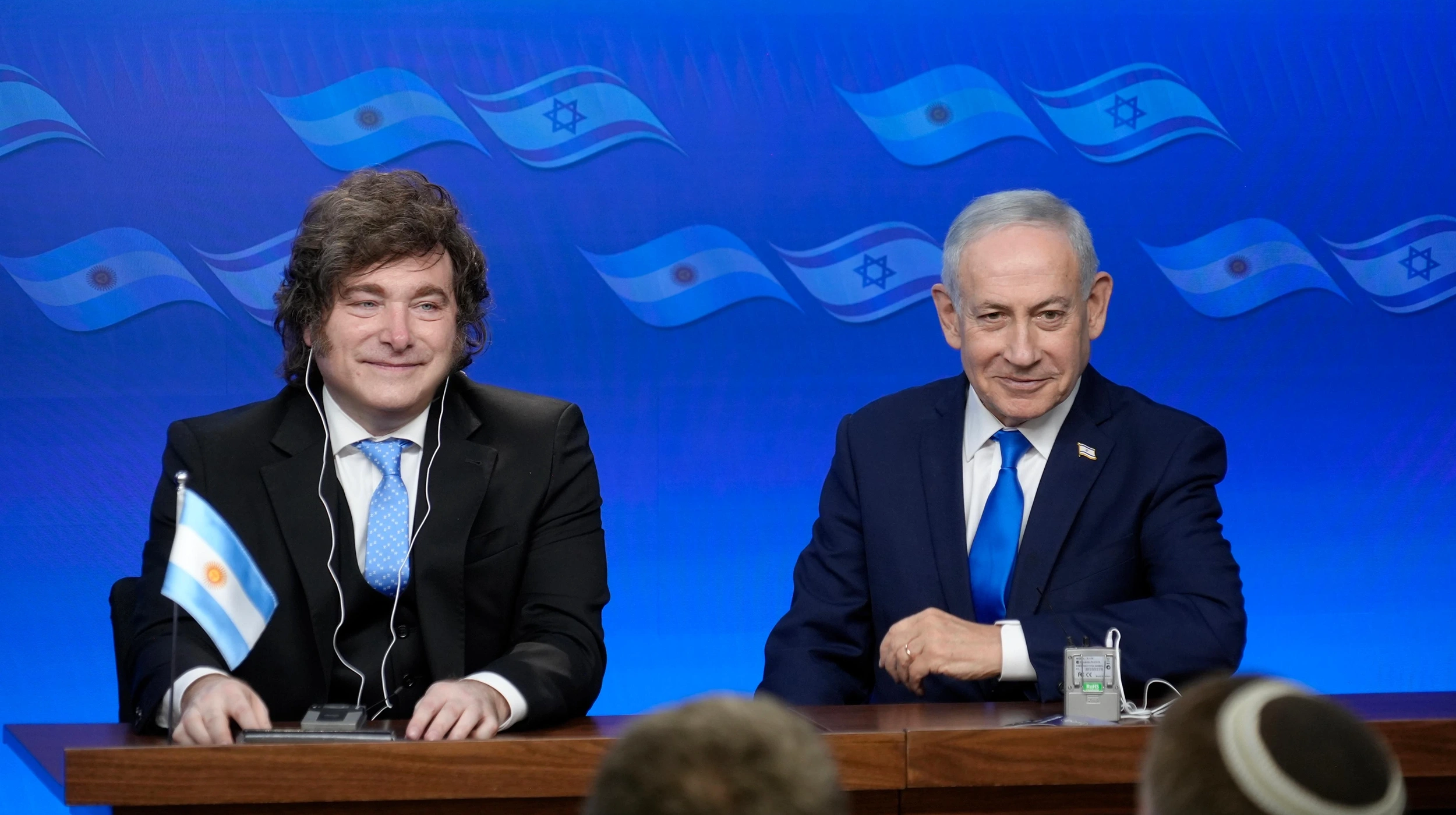
In his November 2025 address marking the anniversary of the Delegation of Argentine Jewish Associations (DAIA), Milei also linked the defense of private property and economic growth to Judeo-Christian values, presenting Israel as a successful embodiment of these values—a portrayal that also serves to legitimize his domestic economic agenda. The construction of this shared identity also relies on the identification of a common enemy. In his June 2025 remarks alongside Benjamin Netanyahu, Milei characterized fundamentalist Islamic terrorism as an external threat and what he calls “woke ideology” as a force eroding Western identity from within. Speaking in Israel, he stated that both nations, Argentina and Israel, had been victims of fanatical terrorism. He declared: “Since its establishment, Israel has been relentlessly attacked by the enemies of freedom, culminating in the recent and tragic events of October 7, among whose victims were Argentine citizens. This was the worst act of antisemitism since the Holocaust. Our people are all too familiar with the scourge of terrorism: it is the same enemy that shed the blood of innocent and defenseless civilians—Argentines, Israelis, Jews, and non-Jews—in Buenos Aires through two brutal attacks on the Israeli Embassy and the Jewish community center, leaving 114 people dead.”
It is worth noting that, after taking office, Milei intensified Argentina’s critical stance toward Iran and made opposition to what he describes as security threats emanating from Iran and its aligned groups a point of convergence with Israel in his foreign policy discourse. Disagreements between Argentina and Iran, however, have a much longer history and are particularly associated with the political and judicial controversies surrounding the 1994 bombing of the Argentine Israelite Mutual Association (AMIA) community center, a case in connection with which Iranian authorities have consistently rejected the allegations leveled against them. In this context, in his address on November 26, 2025, marking the 90th anniversary of the Delegation of Argentine Jewish Associations (DAIA) in Buenos Aires, Milei accused previous governments of attempting to cover up the aforementioned attacks through an agreement with Iran, while justifying his own administration’s cooperation with Israel within the framework of combating terrorism and antisemitism.
Milei, who describes himself as the most Zionist president in the world, stated during a speech in Miami that his grandfather had learned shortly before his death that his mother was Jewish. On this basis, Milei spoke of his family’s Jewish heritage. On June 12, 2025, in recognition of his political support for Israel, Milei received the Genesis Prize in Jerusalem, an award referred to by some media outlets as the “Jewish Nobel.” According to the Genesis Prize Foundation, he declined to accept the $1 million cash prize personally, with the funds instead designated for a nonprofit organization supporting the Isaac Accords initiative, which aims to expand Israel’s relations with Latin American countries.
Within this framework, opposition to the cultural left at home and support for Israel internationally constitute two dimensions of a broader ideological confrontation centered on drawing political boundaries with the left. From this perspective, support for Israel has become an identity-defining element of the movement, reinforcing its political differentiation from left-wing forces and governments while facilitating connections with transnational right-wing networks and pro-Israel religious organizations. As part of efforts to strengthen transnational ties among right-wing political movements, Milei welcomed Flávio Bolsonaro, a Brazilian senator and right-wing presidential candidate, to Buenos Aires on June 29, 2026, and expressed his support for Bolsonaro’s candidacy. However, Bolsonaro was defeated by Luiz Inácio Lula da Silva in the second round of Brazil’s presidential election on October 25, 2026.
In articulating this ideological confrontation, Milei stated: “For decades, much of our region has aligned itself with the enemies of Israel as a result of having fallen captive to a sinister ideology known as twenty-first-century socialism. It is an ideology that appears to be new but has its roots in a millennia-old struggle […] a struggle between those who honor good and those who worship evil, between Abel and Cain. That is why all left-wing and anti-capitalist governments made pacts with terrorism.” In another speech delivered at the Conservative Political Action Conference (CPAC) at the Hilton Buenos Aires on December 4, 2024, Milei emphasized the role of the conference in safeguarding the ideas of liberty, facilitating international coordination, and preventing infiltration by left-wing forces.
Foreign Policy, Security Cooperation, and Human Rights
The Milei administration’s support for Israel has been reflected in specific diplomatic and security decisions. Examples of this orientation include the Argentine government’s official opposition to the arrest warrants issued by the International Criminal Court (ICC) against Benjamin Netanyahu and Yoav Gallant on November 21, 2024, and Argentina’s vote against United Nations General Assembly Resolution ES-10/27 of June 12, 2025, entitled “Protection of civilians and upholding legal and humanitarian obligations,” concerning the situation in Gaza. Argentina’s representative justified the country’s opposition to the latter resolution by citing what the representative regarded as an imbalance in the attribution of responsibility, the absence of an explicit condemnation of the October 7 attack, and the lack of reference to the right of self-defense. Nevertheless, these positions demonstrate the extent to which the Milei administration has distanced itself from the approach adopted by the majority of General Assembly members toward the Gaza crisis. In the defense sector, the existing project to modernize Argentine tanks in cooperation with the Israeli company Elbit Systems continued, while strengthening counterterrorism cooperation and information sharing was placed on the agenda of security talks in November 2025. These talks took place during the visit of Israeli Foreign Minister Gideon Sa’ar to Argentina and his meeting with Patricia Bullrich, Argentina’s Minister of National Security.
The alignment of the Milei administration’s foreign policy with Israel has extended beyond its positions on the Gaza War and has also been reflected in diplomatic initiatives and bilateral agreements. During his visit to Israel in June 2025, Milei exchanged the texts of the Memorandum of Understanding in Defense of Freedom and Democracy and Against Terrorism and Antisemitism with the Israeli side, stating that his country’s foreign policy was founded on support for Israel, the preservation of Western civilization, and the fight against Islamic extremism. He declared: “Since taking office, I have advocated a League of Free Nations that fights, both at home and abroad, for the fundamental values that made the West great: the defense of life, liberty, and private property.” In an earlier speech at the Conservative Political Action Conference (CPAC) on December 4, 2024, Milei had similarly stated: “Argentina can be a beacon for the world, a beacon of beacons. We can set an example for a West that desperately needs to rediscover the ideas of liberty.” As part of this continuing process, the governments of Argentina and Israel announced the launch of the Isaac Accords initiative on April 19, 2026. Inspired by the Abraham Accords, this initiative provides a strategic framework for strengthening Israel’s relations with like-minded countries in the Western Hemisphere. According to the joint declaration issued by the two governments, its objectives, in addition to defending freedom and democracy and combating terrorism and antisemitism, encompass the expansion of security, economic, commercial, and technological cooperation, as well as the coordination of positions in international forums. From a foreign policy perspective, this initiative can be viewed as part of Israel’s efforts to expand its network of regional partners and strengthen its diplomatic standing in Latin America.
While the Milei administration justifies its convergence with Israel within the framework of defending freedom and democracy, human rights reports have consistently documented restrictions on peaceful protests, the expansion of surveillance powers exercised by security forces, and the weakening of institutions dedicated to truth-seeking and the preservation of historical memory in Argentina. According to Amnesty International, between the beginning of Milei’s presidency in 2023 and the end of 2025, more than 60 media professionals experienced harassment and violence perpetrated by the president or other senior government officials through traditional and social media. The organization also reported that, by the end of 2025, Milei had taken legal action against at least eight journalists for defamation and insult. Amnesty International further reported that, between December 2024 and November 2025, at least 1,341 cases of injuries allegedly caused by state agents had been documented, with 155 older persons and 184 media professionals among those injured. In a statement issued on March 19, 2026, United Nations human rights experts also warned of setbacks in transitional justice in Argentina resulting from government measures introduced since 2024. They identified restrictions on access to dictatorship-era records, the weakening of reparation mechanisms for victims, and the dismantling of institutions dedicated to preserving historical memory and searching for disappeared persons as threats to the rule of law and guarantees of non-recurrence. The experts called for the restoration of dismantled institutions and expressed concern over the possibility of pardoning military personnel convicted of international crimes.
From the perspective of international human rights law, the measures reported in Argentina must be assessed in light of the country’s obligations under the International Covenant on Civil and Political Rights (ICCPR) and the American Convention on Human Rights (ACHR). Articles 17, 19, and 21 of the Covenant, together with Articles 11, 13, and 15 of the American Convention, protect the right to privacy, freedom of expression, and freedom of peaceful assembly. Moreover, the weakening of truth-seeking mechanisms, restrictions on access to dictatorship-era records, and diminished support for victims of enforced disappearance raise concerns regarding Argentina’s fulfillment of its obligations to guarantee the rights to truth, justice, and reparation. At the international level, Argentina’s status as a State Party to the Rome Statute also obliges it to cooperate with the International Criminal Court in accordance with the provisions of the Statute. Political and ideological considerations in foreign relations should therefore not undermine the implementation of the state’s legal obligations.
Conclusion
The history of Israel’s relations with Latin America demonstrates that the expansion and continued presence of an external actor do not necessarily require political and ideological alignment with host governments. By diversifying the instruments of its engagement, ranging from development cooperation and arms exports to commercial and technological exchanges, Israel has been able to maintain relations with governments of differing political orientations. From this perspective, the significance of the Milei administration for Israel lies not in opening an entirely new avenue for cooperation, but in creating an opportunity to transform relations based primarily on mutual interests into a form of ideological convergence and to leverage that convergence to reshape regional relations. The Isaac Accords initiative can be understood as an effort to capitalize on this opportunity and extend it across Latin America.
At the ideological level, the contrast between the historical Andinia narrative and Milei’s contemporary discourse reveals a noteworthy dimension of the evolution of far-right movements. Whereas certain historical far-right movements in Latin America defined their national identity by portraying Jews as a threat to sovereignty and territorial integrity, the contemporary right surrounding Milei redefines Israel within the framework of defending Western civilization, capitalism, and Judeo-Christian values. This transformation demonstrates that the identity boundaries of the far right are not necessarily rooted in fixed ethnic and religious affiliations but may shift in response to the redefinition of political enemies and allies. Within this framework, Milei’s support for Israel, beyond its diplomatic function, plays a role in shaping the government’s political identity, distinguishing it from left-wing movements, and forging connections among like-minded political forces at the transnational level.
Ultimately, from a human rights perspective, the fundamental question is to what extent freedom, in the discourse of the Milei administration, is understood as a universal right and to what extent it is treated as a value contingent upon ideological affiliations and divisions. The Argentine government’s opposition to the issuance of ICC arrest warrants against Israeli officials and its vote against the General Assembly resolution on Gaza, alongside reported domestic restrictions on freedom of expression, peaceful assembly, and transitional justice, underscore the importance of examining this question. Although the available evidence is insufficient to establish a causal relationship between cooperation with Israel and human rights restrictions in Argentina, these two spheres provide a basis for assessing the consistency of the Milei administration’s understanding of freedom and accountability. It is precisely at this juncture that the fundamental distinction between the logic of human rights and that of ideological alliances becomes apparent: political alliances are founded on distinctions between allies and adversaries, whereas the universality of human rights requires that the enjoyment of rights and demands for accountability remain independent of where individuals and states stand within such political divisions.