Introduction
The adoption of the Israeli Parliament’s new law concerning the possible imposition of the death penalty on Palestinians has once again brought one of the most contentious dimensions of the relationship between security and human rights back to the center of attention. This legal development has taken place in a context in which the Israeli–Palestinian conflict, over recent decades, has consistently been accompanied by widespread allegations of violations of fundamental human rights; accordingly, any new measure in this sphere rapidly attracts international attention and scrutiny.
Against this backdrop, the renewed introduction of the death penalty cannot be regarded merely as an internal decision. Rather, it is assessed as part of a broader framework of policymaking toward the Palestinian population. From a human rights perspective, the central issue is not simply the existence or non-existence of capital punishment, but the manner in which it is applied within an unequal context. Where two populations—Palestinian and Israeli—exist alongside one another with different legal and political statuses and unequal access to mechanisms of justice, any new criminal law is inevitably exposed to the question of whether it will be implemented equally or, in practice, will target a specific group.
This issue becomes particularly sensitive in relation to Palestinians, a significant proportion of whom are subject to judicial systems different from those applied to Israeli citizens. At the same time, the return to the discourse of severe punishments within a conflict that has followed a relatively long historical trajectory in recent decades may have consequences beyond the criminal sphere. Such an approach may affect not only the human rights situation, but also political prospects, the possibility of reducing tensions, and even Palestinians’ perception of justice.
Within this framework, the law can be understood as part of a broader trend in which security-oriented solutions are gradually replacing approaches based on dialogue and balanced legal mechanisms.
Incidents
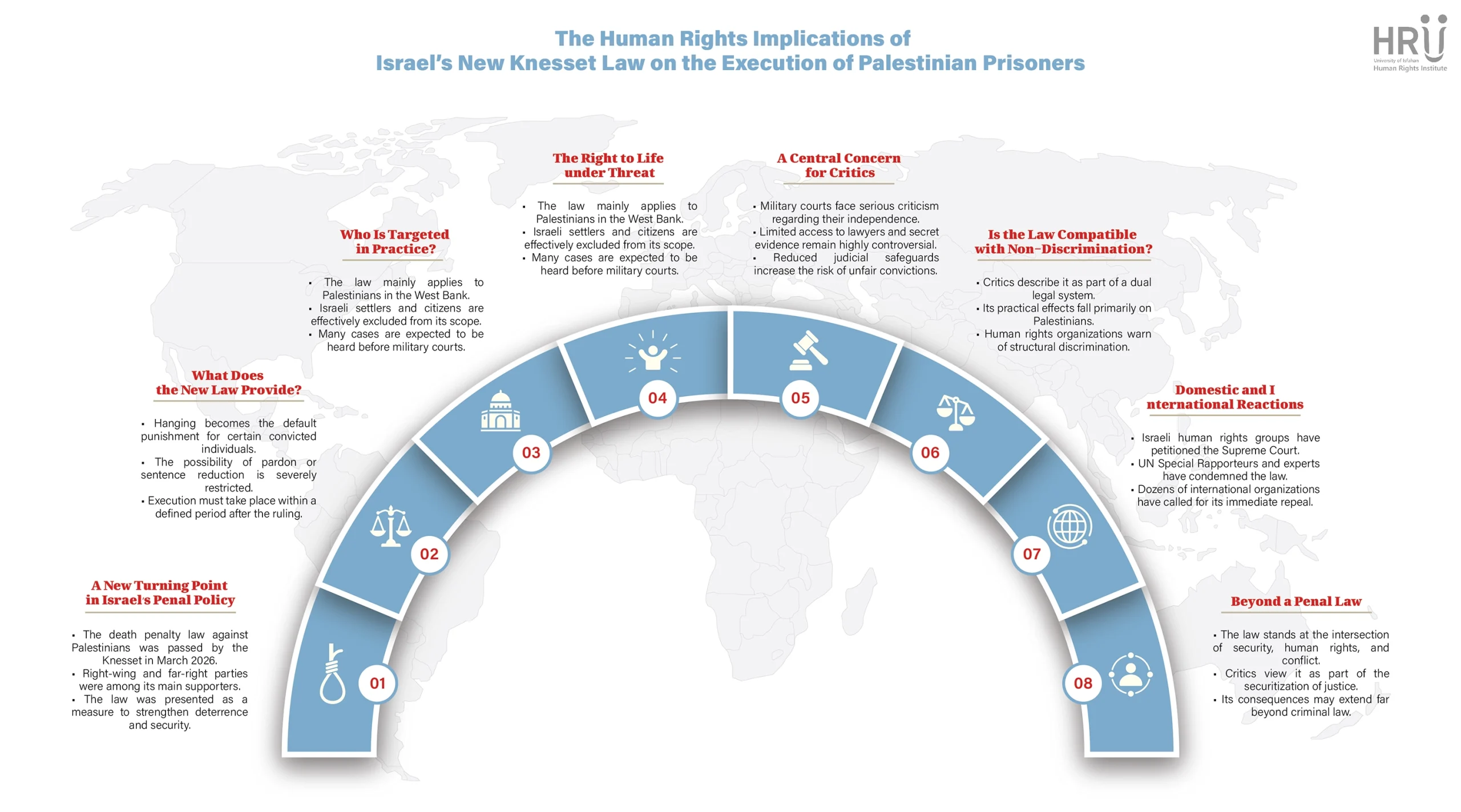
The law known as the “Death Penalty for Terrorists Law” was approved on Monday, 30 March 2026, in Israel’s 120-seat parliament by a vote of 62 in favor, including Benjamin Netanyahu himself, against 48 opposed[1]. Under this law, the death penalty by hanging is designated as the default punishment for Palestinians convicted in court.
The death penalty bill was introduced in the Knesset by members of the far-right Otzma Yehudit party and was also supported by representatives of Netanyahu’s Likud party and the conservative Yisrael Beiteinu party. Itamar Ben-Gvir, the leader of the far-right Otzma Yehudit party and Minister of National Security, was one of the principal figures advocating the revival of the death penalty. He turned the issue into a political campaign and, throughout this campaign, wore a gold pin in the shape of a noose on his lapel. Some critics have linked Otzma Yehudit’s push for the passage of this law to Israel’s upcoming elections later this year[2].
Yair Golan, leader of the opposition Democrats party, criticized the law, stating that it would lead to international sanctions. He said: “The death penalty law is an unnecessary law designed to get more likes for Ben-Gvir. This law will not contribute even slightly to Israel’s security[3].”
In general, the law is drafted in such a way that, in practice, it applies only to Palestinians, particularly in the West Bank and within the framework of military courts. The sentence is to be carried out by the Israel Prison Service (IPS) within a short period—up to 90 days after notification of the judgment—unless, by order of the prime minister in specific cases, it is postponed for up to 180 days. The law also does not require a binding precedential ruling, nor a request by prosecutors or a judicial panel; instead, it grants broad powers to military courts[4].
Under this new law, the death penalty applies to anyone who “intentionally causes the death of a person in the context of an act classified as terrorism.” The law also stipulates that, in such cases, no pardon shall be granted, effectively preventing any future political or legal intervention to mitigate or alter the sentence[5]. As noted above, only the prime minister may postpone the sentence, or, under very specific conditions, the death penalty may be commuted to life imprisonment.
The amendment to the military order states that an offender from the West Bank who commits a killing that is considered an act of terrorism under Israeli law “shall be sentenced to death, and only death.” However, the law contains one proviso: the military court hearing the case may impose life imprisonment instead if it finds “special reasons” for doing so. The law does not include any definition of what constitutes such “special reasons.”
The amendment explicitly states that the law does not apply to Israeli citizens or Israeli settlers residing in the West Bank who are subject to the Penal Law[6]. Experts believe that the presence of certain legal clauses and formulations in the bill makes the issuance of death sentences against Jewish extremists convicted of similar crimes almost impossible[7].
Challenges and Responses
- Violation of the Right to a Fair Trial
Alongside the many legal challenges that this law creates for Palestinians, one of the most significant and fundamental concerns relates to the denial of Palestinians’ access to a fair trial. Under the European Convention on Human Rights, everyone has the right, within a reasonable time, to a fair and public hearing by an independent and impartial tribunal. All persons charged with a criminal offence are presumed innocent until proven guilty; they have the right to defend themselves through legal counsel; they must be informed promptly, and in a language they understand, of the nature and cause of the accusation against them; and all accused persons must be given adequate time and facilities to prepare their defence, to defend themselves in person or through counsel of their own choosing, or, if they do not understand the language used in court, to receive the assistance of an interpreter free of charge[8].
Article 10 of the Universal Declaration of Human Rights also guarantees the right to a fair trial. A fair trial is possible only where an independent and impartial judge is present and where the case is heard publicly[9]. However, under the law adopted in Israel, in practice, a considerable number of individuals are tried before military courts—courts that have traditionally faced serious limitations in guaranteeing judicial independence and equality between the parties to proceedings.
The use of secret evidence, restrictions on access to legal counsel, and insufficient opportunities to examine and challenge evidence are among the obstacles that may undermine Palestinians’ right to an effective defence. Moreover, lowering judicial decision-making thresholds—including the possibility of issuing a sentence by a simple majority—heightens the risk of rushed and unfair judgments.
In such circumstances, the link between structural deficiencies in judicial proceedings and an irreversible punishment such as execution seriously intensifies human rights concerns. As a result, this law may severely undermine the fundamental principle of fair trial, which constitutes one of the pillars of international human rights law.
- Violation of the Prohibition of Discrimination
One of the most important challenges posed by this law is its conflict with the fundamental principle of non-discrimination in international law. For example, under the Charter of Fundamental Rights of the European Union, any discrimination on any ground—such as sex, race, color, ethnic or social origin, genetic features, language, religion or belief, political or any other opinion, membership of a national minority, property, birth, disability, age, or sexual orientation—is prohibited[10]. Rule 88 of the International Committee of the Red Cross (ICRC) also affirms this principle[11].
Although the text of the law does not explicitly refer to ethnicity or nationality, its structure and mode of application are designed in such a way that, in practice, it targets Palestinians, while Israeli citizens—particularly extremist settlers—remain outside its scope. This may constitute a form of discrimination in which a seemingly neutral rule produces disproportionate and unequal effects on a specific group in practice.
Within this framework, the creation of a system in which the death penalty is effectively applied only to one group may indicate structural discrimination and may even reinforce a dual legal system. Such a situation not only weakens the legitimacy of the criminal justice system, but may also deepen mistrust and social divisions within the context of a prolonged conflict.
- Domestic Reactions
The Jerusalem-based human rights organization HaMoked, together with six other related organizations in Israel, submitted a petition to the High Court of Justice. They called for the annulment of the Death Penalty for Terrorists Law and requested an interim order to suspend its implementation.
The law, which was passed by the Knesset, effectively targets Palestinians, particularly residents of the West Bank, and exposes them to mandatory capital punishment, while Jewish settlers are excluded from its scope. In the petition, the law is described as discriminatory, racist, and contrary to international law. It is argued that the law gravely violates the right to life and undermines the principles of fair trial and judicial independence.
The petition also emphasizes that, by removing key legal safeguards—including the possibility of sentence mitigation, pardon, review, and the requirement of a special majority—the law increases the risk that death sentences may be carried out on the basis of wrongful convictions. According to the petitioners, this law could turn Israel into one of the most severe death penalty regimes in the world. The High Court has also asked the government to submit its preliminary response by 24 May 2026[12].
The organization Adalah, known as a legal center defending the rights of the Arab minority in Israel, also took a position against the law targeting Palestinians and was among the organizations that, together with the previous group, submitted a petition to the High Court. According to information published on the organization’s official website, the law is discriminatory in nature and specifically targets Palestinians.
In this petition, the law is described as an example of “apartheid legislation” that violates the right to life, weakens the principles of fair trial and judicial independence, and increases the risk of unjust executions by eliminating legal safeguards such as the possibility of pardon, effective appeal, and consideration of individual circumstances. It is also emphasized that the law lacks any real deterrent basis and is instead rooted primarily in punitive and retaliatory motives.
From the perspective of international law, the application of such a law in the West Bank is considered to lack legal validity and to be inconsistent with the rules of humanitarian law and human rights law[13].
Finally, B’Tselem — The Israeli Information Center for Human Rights in the Occupied Territories — also addressed and reacted to the law on the execution of Palestinians. Yuli Novak, the organization’s Executive Director, stated:
“Israel has reached an unprecedented level of dehumanization of Palestinians and is now institutionalizing violent treatment against them through state law. Israel already systematically kills Palestinians without facing serious demands for accountability. Under the leadership of senior officials, the Israeli system is increasingly turning into a structure that normalizes killing and harming human beings.”
The statement further notes that Israel is already killing Palestinians on an unprecedented scale: since October 2023, at least 72,000 Palestinians have been killed in the Gaza Strip and more than 1,050 Palestinians have been killed in the West Bank. During the same period, more than 80 Palestinians have died in Israeli prisons—prisons that, according to the statement, have turned into a network of torture facilities where detainees are continuously subjected to violence and ill-treatment.
The death penalty law adds another official mechanism of killing to this set of practices[14].
- International Reactions
The Institute for Middle East Understanding (IMEU), based in Washington, conducted an interview with Suhad Bishara, a Palestinian lawyer and human rights advocate with experience litigating before the Israeli Supreme Court. Bishara explains that the law effectively operates through two tracks, both of which specifically target Palestinians: first, the imposition of mandatory executions in the military courts of the West Bank; and second, the inclusion of conditions within domestic courts that, in practice, also apply effectively to Palestinians.
She describes the law as part of a discriminatory and dual legal system in which Israeli settlers enjoy extensive protections, while Palestinians face unfair trials and extremely high conviction rates. According to her, the law follows earlier policies such as targeted killings and field executions, but now formally institutionalizes this violent approach within the law.
She also notes that the law has received significant support among Israeli politicians, reflecting a deepening process of dehumanizing Palestinians. At the international level, the law has been widely condemned; however, in the view of this expert, verbal condemnation alone is insufficient, and the international community must take practical measures to prevent its implementation[15].
The United Nations Special Rapporteur on Torture, Alice Jill Edwards, also expressed grave concern on 2 April 2026 over the adoption of the new death penalty law by the Israeli Knesset. She warned that the law could lead to serious violations of international law, including the absolute prohibition of torture.
She emphasized that the death penalty is rarely carried out without imposing severe suffering, and that especially in circumstances where there is evidence of ill-treatment and torture in detention, the risk of unfair convictions increases. In her view, this law, which primarily targets Palestinians, constitutes unlawful discrimination on the basis of ethnic identity or political opinion and undermines the principle of equality before the law.
Concerns have also been raised regarding the weakening of fair-trial guarantees, including the possible use of coerced confessions. Referring to the fact that Israel had previously, in practice, ceased carrying out executions, the UN official described the law as a serious regression from the global trend toward abolition of the death penalty. She called for the law to be reviewed and repealed by the Knesset and examined by the Israeli Supreme Court[16].
United Nations experts also stated on 2 April 2026 that Israel’s new death penalty law, which in practice targets only Palestinians, creates a discriminatory system of capital punishment and is manifestly inconsistent with Israel’s obligations under international law.
They described the law as a serious escalation in the discriminatory repression of Palestinians and stressed that any death penalty regime that is discriminatory in its purpose, structure, or implementation is incompatible with the right to life and the principle of equality before the law.
They further stated that the trial of civilians before military courts, widespread violations of fair-trial guarantees, and execution by hanging place the law in conflict with the absolute prohibition of torture and inhuman treatment. The experts warned that, by entrenching a dual legal system in which Palestinians are subject to military law while Israeli settlers remain outside it, the law strengthens structural discrimination and arbitrary deprivation of the right to life.
According to these experts, even the existence of formal safeguards or limited judicial discretion cannot make such a system compatible with the standards of international law. Ultimately, they called for the immediate repeal of the law by the Knesset and its annulment by the Israeli Supreme Court in order to prevent irreparable harm and the deepening of human rights violations[17].
On another level, the journalistic collective The Left Berlin, in an article titled “Israel, Apartheid, and the Death Penalty: A War on the Palestinian Right to Life,” addressed the issue under discussion in the present report. The article analyzes Israel’s new death penalty law not merely as a legal change, but as part of a broader structure of violence and discrimination against Palestinians.
The author argues that the law, which institutionalizes the death penalty primarily against Palestinians, is the logical continuation of a dual and apartheid-based system in which Palestinians are subjected to military courts lacking fair-trial standards, while settlers enjoy greater legal protections. In the author’s view, the novelty of this law lies in the “legalization” of violence that had previously existed in the form of military operations and targeted killings, and that is now formally embedded within the state’s legal structure.
The article also links this trend to the rise of far-right forces and international support, particularly from the United States, viewing it as a sign of the intensification of systematic discrimination and repression. Ultimately, while expressing general opposition to the death penalty, the author calls for the repeal of the law, increased international pressure on Israel, and a move toward a political system based on full civic equality as an alternative solution[18].
Subsequently, in a joint statement, dozens of international human rights and humanitarian organizations strongly condemned the adoption of the new death penalty law by the Israeli Knesset and described it as a discriminatory measure that, in practice, targets only Palestinians.
The law establishes the death penalty—particularly in the military courts of the West Bank—as a default punishment, while severely restricting defence rights, the possibility of appeal, and access to pardon. It also excludes Israeli settlers from its scope.
The signatories considered the law a violation of the right to life, the principles of fair trial, and Israel’s international obligations, including under the Geneva Conventions, the International Covenant on Civil and Political Rights, and the Convention against Torture. They also assessed it as part of a broader pattern of discrimination and apartheid against Palestinians.
Referring also to the intensification of policies such as settlement expansion, forced displacement, home demolitions, and wide-ranging restrictions, the organizations called for immediate and practical action by the European Union, including suspension of the trade component of its agreement with Israel. Among the most important signatories to this statement were organizations such as Amnesty International, Human Rights Watch, the International Federation for Human Rights (FIDH), and Oxfam[19].
Finally, a coalition of civil society and human rights groups issued a joint statement on 19 April 2026, strongly condemning Israel’s new death penalty law and describing it as a discriminatory measure against Palestinians.
These organizations emphasized that the law not only conflicts with fundamental human rights principles—especially the right to life—but must also be analyzed within the broader trend of escalating pressure and harsher policies against Palestinians.
The statement also refers to the alarming conditions in Israeli detention centers and prisons, citing reports of increased ill-treatment, torture, and deaths in custody. It further points to the continued use of administrative detention without charge and the prolonged detention of prisoners on the basis of secret evidence, describing these practices as violations of fair-trial principles.
According to these organizations, the continuation of such trends may deepen structural human rights violations and reinforce a climate of injustice among the Palestinian population. They also criticized the limited and inadequate responses of certain governments, particularly at the European level, and called for more practical and effective measures in response to these developments.
In this regard, it has also been reported that a number of Palestinian prisoners have launched an open-ended hunger strike in protest against the law and detention conditions, reflecting the intensification of dissatisfaction and tension within the detention system.
Overall, the statement assessed the new law as part of a deeply troubling trend toward the escalation of discriminatory policies and the weakening of human rights standards[20].
Conclusion
What emerges from an examination of this law and the broad reactions surrounding it is that we are not merely facing a change in criminal policy, but rather a redefinition of the role of law within the context of a structural conflict. The new death penalty law stands at the intersection of several major elements, including security, discrimination, and the exercise of sovereignty in the occupied Palestinian territories. For this reason, analyzing it solely within the framework of domestic law is insufficient.
The focus of reactions on concepts such as the right to life, fair trial, and the prohibition of discrimination demonstrates that this law is regarded less as a criminal justice instrument and more as an indicator of how power and access to justice are distributed within a dual legal system. From this perspective, the central issue is not merely the existence of the death penalty, but the manner in which it is targeted and implemented in an unequal context.
On the other hand, the scope and diversity of domestic and international reactions indicate that this law has rapidly moved beyond the level of a legislative decision and has become a normative issue within the international system. The simultaneous criticism voiced by human rights organizations, United Nations experts, and even some domestic actors in Israel points to a gap between the security logic of the law and accepted human rights standards.
Within this framework, the continued implementation of such laws may gradually undermine the credibility of international rules and contribute to the normalization of discriminatory patterns. Ultimately, this development should be analyzed as part of a broader trend in which legal instruments are increasingly placed in the service of consolidating particular political orders. This, in turn, creates deeper challenges for the future of human rights and international justice.
References
[1] De Ruiter, E. (2026, March 31). Israel’s parliament approves controversial death penalty law for West Bank Palestinians; Europe condemns. Euro News. From: https://parsi.euronews.com/2026/03/31/israel-passes-controversial-death-penalty-law-for-west-bank-palestinians-europe-condemns
[2] Krämer, T. (2026, March 30). An in-depth look at Israel’s new death penalty law. DW. From: https://www.dw.com/en/israel-passes-controversial-death-penalty-law/a-76586475
[3] Usher, S. (2026, March 31). Palestinians convicted of lethal attacks face death penalty under new Israeli law. BBC. From: https://www.bbc.com/news/articles/cp8dkd6lnjdo
[4] Arnaout, A. (2026, March 31). FACTBOX – Israel legalizes death penalty for Palestinian prisoners: What does new law say. Anadolu Ajansi. From: https://www.aa.com.tr/en/middle-east/factbox-israel-legalizes-death-penalty-for-palestinian-prisoners-what-does-new-law-say/3885796
[5] WAFA. (2026, March 30). Israeli Knesset approves law allowing death penalty for Palestinian prisoners. WAFA. From: https://english.wafa.ps/Pages/Details/168842
[6] offre, T. (2026, April 16). Israel’s new death penalty law: What does it actually change. Unpacked. From: https://unpacked.media/israels-new-death-penalty-law-what-does-it-actually-change/
[7] Kahn, C. (2026, March 31). Israel passes law that would sentence Palestinians who kill Israelis to death. Npr. From: https://www.npr.org/2026/03/31/nx-s1-5766362/israel-passes-law-that-would-sentence-palestinians-who-kill-israelis-to-death
[8] Council of Europe. (n.d). Right to a fair trial. The European Convention on Human Rights. From: https://www.coe.int/en/web/human-rights-convention/justice
[9] Utrecht University. (n.d). Universal Declaration of Human Rights, 75 Years. Utrecht University. From: https://www.uu.nl/en/education/universal-declaration-of-human-rights-75-years/udhr-in-words-and-images/udhr-articles-1-30/article-10-fair-trial
[10] European Union Agency for Fundamental Rights. (n.d). EU Charter of Fundamental Rights. European Union Agency for Fundamental Rights. From: https://fra.europa.eu/en/eu-charter/article/21-non-discrimination
[11] International Committee of the Red Cross. (n.d). Rule 88. Non-Discrimination. International Committee of the Red Cross. From: https://ihl-databases.icrc.org/en/customary-ihl/v1/rule88
[12] HaMoked. (2026, April 4). Human rights organizations to the HCJ: the death penalty law must be repealed, and an interim injunction issued to prevent its implementation pending a ruling; the law is racist, unconstitutional, and contrary to international law. HaMoked. From: https://hamoked.org/document.php?dID=Updates2528
[13] Adalah. (2026, March 31). Urgent Petition to Israeli Supreme Court Against the Death Penalty Law: Racist Legislation Enshrining Inhumane Punishment and Systemic Oppression. Adalah. From: https://www.adalah.org/en/content/view/11564
[14] BTSELEM. (2026, March 30). Israel turning execution of Palestinians into official state policy. BTSELEM. From: https://www.btselem.org/press_releases/20260330_israel_turning_execution_of_palestinians_into_official_state_policy
[15] IMEU. (2026, April 14). 5 Questions for an Expert: Israel’s New Death Penalty Law. IMEU. From: https://imeu.org/perspectives/apartheid/5-questions-for-an-expert-israels-new-death-penalty-law/465
[16] The Office of the High Commissioner for Human Rights. (2026, April 2). New Israeli death penalty law risks violating absolute prohibition of torture, says UN expert. The Office of the High Commissioner for Human Rights. From: https://www.ohchr.org/en/press-releases/2026/04/new-israeli-death-penalty-law-risks-violating-absolute-prohibition-torture
[17] The Office of the High Commissioner for Human Rights. (2026, April 2). Israel’s death penalty law constitutes discriminatory regime of capital punishment: UN experts. The Office of the High Commissioner for Human Rights. From: https://www.ohchr.org/en/press-releases/2026/04/israels-death-penalty-law-constitutes-discriminatory-regime-capital
[18] Akrawi, R. (2026, April 19). Israel, Apartheid, and the Death Penalty: A War on the Palestinian Right to Life. The Left Berlin. From: https://theleftberlin.com/israel-death-penalty/
[19] Amnesty International. (2026, April 2). EU/Israel: Adoption of death penalty law by the Israeli Knesset requires urgent EU measures – Joint statement. Amnesty International. From: https://www.amnesty.org/en/latest/news/2026/04/eu-israel-adoption-of-death-penalty-law-by-the-israeli-knesset-requires-urgent-eu-measures-joint-statement/
[20] The Malta Independent. (2026, April 19). Activist groups condemn newly passed Israeli death penalty law for Palestinians. The Malta Independent. From: https://www.independent.com.mt/articles/2026-04-19/local-news/Activist-groups-condemn-newly-passed-Israeli-death-penalty-law-for-Palestinians-6736288930