Introduction
The deteriorating conditions within several Australian detention centres and prisons have become a recurring subject of concern and scrutiny among professional human rights circles and oversight institutions. Published reports consistently highlight persistent structural deficiencies, including severe overcrowding, questions surrounding the proportionality of restrictive measures, the disproportionately high number of Indigenous inmates, gender-based inequalities among prisoners, the low age of criminal responsibility, and doubts over the adequacy of access to essential services such as healthcare and psychological support.
These challenges appear to be particularly acute and complex for certain vulnerable groups of detainees, notably individuals from Indigenous and local communities, as well as children and adolescents. Conversely, government authorities have launched a range of policies and investment plans aimed at improving infrastructure and reviewing operational protocols. Nevertheless, evaluations conducted by both domestic and international independent bodies indicate that a tangible gap persists between the stated objectives at the policy level and the realities observed in practice.
Incidents
- General Situation of Prisons
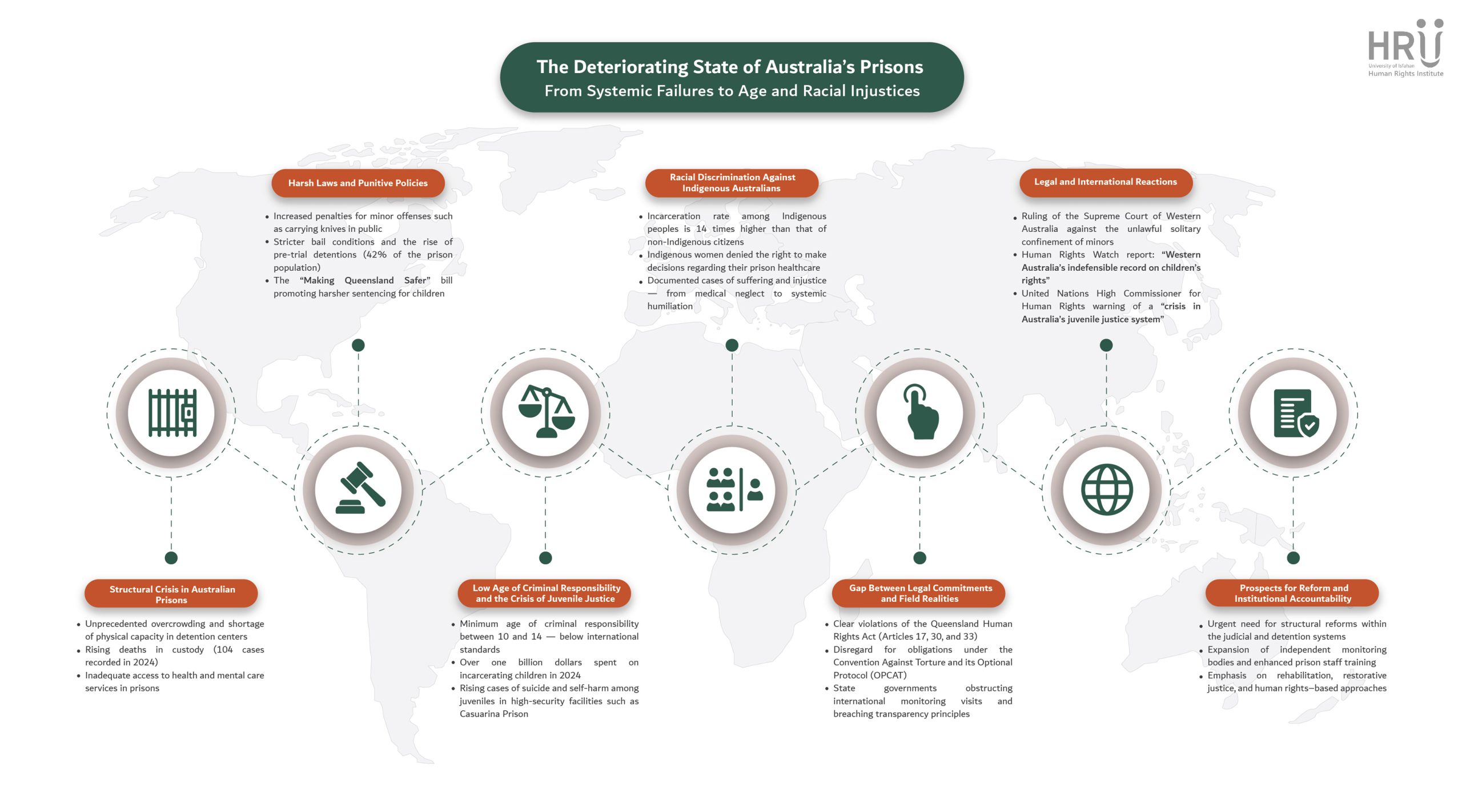
In recent years, prisons in Australia have evolved into a serious social and political issue. Despite the existing number and size of prisons, facilities remain insufficient to accommodate all convicted persons, resulting in chronic overcrowding and inadequate provision of basic services. Several states have initiated plans to construct large new correctional and rehabilitation centres to meet the growing inmate population, yet these projects remain far from completion[1].
Changes in criminal law have also contributed to both temporary and permanent overcrowding across Australian prisons. For instance, in the state of Queensland, the penalty for carrying a knife in public was raised from 12 to 18 months of imprisonment, and repeat offences may result in up to two years in prison. Moreover, the tightening of bail regulations has made it more difficult for detainees to obtain release, significantly increasing the number of individuals held in pre-trial detention. Currently, around 42 percent of all inmates fall into this category[2].
The Stronger Laws for a Safer Queensland (Adult Crime, Adult Time) Bill reflects this approach and is expected to further aggravate overcrowding, as it stipulates that children aged 10 and above who commit certain offences — such as theft, grievous bodily harm, or even some non-violent crimes — should receive the same penalties as adults. In Queensland, four main causes are cited for the rising prison population: an increase in property-related crimes, a higher number of custodial sentences handed down by the courts, a decline in parole grants, and the frequent violation of parole conditions leading to re-incarceration[3]. Two of these four reasons are directly linked to judicial reforms and amendments to criminal law itself.
In several states, prisons are so overcrowded that many inmates sleep on mattresses placed directly on the floor. According to Australia’s Minister for Justice in 2024, overcrowding has resulted in the deaths of 18 individuals in detention. In his words:
“The excessive density in our prisons endangers the safety of both staff and inmates and undermines our rehabilitation programmes and reintegration efforts[4].”
According to the Australian Institute of Criminology, during 2023–2024, there were 104 deaths in custody across the country: 76 occurred in prison custody, 27 in police custody or related operations, and 1 in a youth detention facility. Of these, 24 deaths involved Indigenous persons, while 80 were non-Indigenous[5].
- Lowering the Age of Criminal Responsibility
In Australia, the age of criminal responsibility remains below internationally recommended standards, and reforms in this area have been slow and inconsistent. In practice, policy emphasis in several jurisdictions continues to lean towards criminalising children and adolescents, resulting in increased pre-trial detention and confinement under conditions similar to those of adults.
According to the Productivity Commission, during 2023–2024, Australia spent more than one billion dollars incarcerating children[6]. Reports also indicate insufficient access to education, mental health services, and the continued use of restrictive practices. Historically, the age of criminal responsibility in Australia — as in the United Kingdom — was 10 years. Following sustained pressure from human rights and child protection organisations as well as public opinion, this threshold was raised to 12 in 2023 and to 14 in 2025, which still remains lower than in most other countries.
Nevertheless, the Australian judicial system maintains certain exceptions: under the revised law, 12- and 13-year-olds who commit serious and intentional violent offences[7] may still face criminal charges and be subject to detention — a provision that has drawn sharp criticism from human rights bodies. Furthermore, under the Youth Justice Act, children convicted of certain offences can face severe punishments, including life imprisonment[8].
The detention of minors under Australian criminal law has sparked widespread protests from human rights groups and public discontent among families, as it inflicts severe psychological harm on the children involved. Some of these young detainees have taken their own lives or died due to the harsh conditions. One such case involved a 17-year-old boy who died by suicide only two days after being held in the Casuarina Prison in Western Australia — a facility previously designated as a high-security unit. He became the second person to die in that prison[9]. According to his lawyer, the boy suffered repeated violations of his individual rights, including:
– Verbal abuse by prison staff,
– Excessive use of force, including chemical agents such as pepper spray, and
– Prolonged solitary confinement following incidents of self-harm and suicide attempts[10].
- The Disproportionate Incarceration of Indigenous Peoples
In the context of criminal behaviour and the administration of justice in Australia, Indigenous peoples have consistently faced systemic discrimination. Compared to non-Indigenous Australians, their actions and conduct are more frequently criminalised, resulting in disproportionately high rates of arrest and imprisonment. Within the judicial framework, Indigenous Australians are targeted at higher rates by law enforcement, subjected to harsher sentencing, and exposed to elevated levels of incarceration, deaths in custody, and excessive police surveillance[11].
Statistical data reveal that between 2012 and 2022, the age-standardised imprisonment rate among Indigenous Australians increased by 37 per cent, rising from 1,574 to 2,151 per 100,000 adults. During the same period, the ratio of Indigenous to non-Indigenous imprisonment rose from 12.1 to 14.3[12]. Furthermore, by March 2025, the number of Indigenous and Torres Strait Islander prisoners reached 16,876, showing an increase compared to March and December 2024[13] — despite Indigenous peoples representing only 2 percent of the national population[14].
The situation in certain states is particularly alarming. In New South Wales, for example, Indigenous Australians accounted for 31 percent of the adult prison population in 2024. This means that one in every 29 Indigenous men in the state was imprisoned, and approximately 66 percent of youth detention capacity was occupied by Indigenous young people[15].
Beyond the sheer numbers, Indigenous inmates face systematic discrimination in the provision of basic services, including healthcare and hygiene. For instance, in the state of Victoria, one Indigenous prisoner, after prolonged delays in receiving medical care, was forced to remove an ingrown toenail using a pencil sharpener and tweezers[16].
Gender also plays a significant role in the degree of discrimination experienced by Indigenous prisoners. Incarceration has substantially undermined Indigenous women’s right to self-determination, particularly concerning access to health services. Many Indigenous women report being deprived of the ability to participate in decisions about their treatment and to manage their own care in prison. The prison environment severely limits basic health choices that are taken for granted in the community — such as identifying one’s own health needs or purchasing over-the-counter medication. Women express feelings of helplessness and frustration over having to seek permission for even the most minor health issues[17].
These conditions, particularly those affecting Indigenous women, have provoked public outcry and strong criticism from state and federal officials. Commenting on the situation of female prisoners, David Southwick, the Shadow Minister for Corrections and Rehabilitation, stated:
“Keeping women locked in their cells for days on end — not because they’ve done something wrong, but because the system cannot find enough staff — is unacceptable, unsafe, and in no way an appropriate way to run a prison[18].”
Challenges and Responses
- Non-Compliance with Domestic and International Legal Obligations
One of the most serious challenges concerning the situation of prisoners—particularly Indigenous persons and children—in Australia’s detention system lies in the authorities’ recurrent failure to comply with both domestic and international legal instruments.
At the domestic level, in 2019, the state of Queensland became the third jurisdiction in Australia to enact its own Human Rights Act (Queensland Human Rights Act 2019). This law includes vital safeguards for detainees, especially juveniles, such as protection against torture and cruel, inhuman or degrading treatment or punishment (Article 17); the right to humane treatment when deprived of liberty (Article 30); specific rights of children in the criminal process (Article 33); and the protection of cultural rights (Article 27).
At the international level, Australia is a party to the Convention against Torture and Other Cruel, Inhuman or Degrading Treatment or Punishment (CAT) and its Optional Protocol (OPCAT). Under Article 16 of CAT, Australia is obligated to prevent all acts of cruel, inhuman or degrading treatment that fall short of torture and to criminalise such conduct under domestic law. Moreover, under the Optional Protocol, Australia has committed to establishing a national preventive mechanism to oversee detention facilities and to prevent ill-treatment[19]. however, the practical reality faced by detainees—especially minors and Indigenous persons—remains inconsistent with these obligations.
- Domestic Reactions
The Supreme Court of Western Australia, in a ruling delivered by Justice Paul Tottle, found that three juveniles had been repeatedly subjected to prolonged solitary confinement in a youth detention facility, in direct contravention of both the objectives and principles of the Youth Justice Act and the basic standards of humane treatment for children.
The court described these practices as evidence of a systemic failure, attributing them to chronic staff shortages and inadequate detention infrastructure. Justice Tottle cited one example in which a child was confined for more than 20 hours a day on 23 days out of a 31-day month, declaring that such deprivation of social interaction erodes children’s sense of social responsibility and defeats the rehabilitative purpose of the youth justice system.
He also rejected a government request to delay publication of the judgment for administrative reasons, citing the matter’s significant public importance. The court noted that this was the second finding of unlawful detention at Casuarina Prison within less than a year[20].
- International Reactions
Human Rights Watch, in its report titled “Western Australia’s Indefensible Record on Children’s Rights”, addressed the state’s criminal justice policies towards minors. The report documented at least 63 instances of self-harm and seven suicide attempts among detained children in Western Australia as of November 2024, and within the 18 months preceding February 2025, two children had died by suicide.
The report further stated that, on an average night in 2024, 82 children aged 10 to 17 were detained, with more than half held without conviction or sentence. Indigenous children were found to be 25 times more likely to be detained than their non-Indigenous peers. Among the most severe violations was the continued detention of minors in Unit 18 of the high-security Casuarina Prison, where, contrary to international norms, children were confined for over 22 hours a day, sometimes without adequate access to running water, sanitation, or promised social services[21].
The Guardian also published an alarming report in January 2023 on prison conditions across Australia. The article noted that, although Australia ratified the Optional Protocol to the UN Convention against Torture (OPCAT) in 2017, by January 2023 it had still failed to fully implement its obligations. Major states such as New South Wales, Victoria, and Queensland had not yet established independent National Preventive Mechanisms (NPMs), delaying compliance on the grounds of inadequate federal funding, while other jurisdictions had only taken limited steps.
The Australian Human Rights Commission warned that such failures tarnish the country’s international reputation, placing it alongside states such as South Sudan on the UN’s human-rights watchlist. The UN Special Rapporteur on Torture stressed that independent monitoring visits are a crucial preventive tool against torture and ill-treatment. In 2022, the UN Subcommittee on the Prevention of Torture (SPT) cancelled its mission to Australia after authorities in New South Wales and Queensland obstructed access to prisons and mental-health facilities.
From a human-rights perspective, the persistence of child solitary confinement, deaths in custody, and the over-representation of Indigenous peoples underscore the urgent need for effective monitoring. These realities reveal a stark contrast between Australia’s formal human-rights commitments and its actual practices in upholding human dignity within detention facilities[22].
Furthermore, the Office of the United Nations High Commissioner for Human Rights (OHCHR), in its report titled “Youth justice systems across Australia in crisis: UN experts” published on 19 May 2025, expressed grave concern over the state of youth justice in the country. Two UN independent experts on torture and the rights of Indigenous peoples strongly criticised Australia’s youth-justice systems, noting that a disproportionately high number of Indigenous children remain imprisoned.
The experts highlighted that several recent or proposed state laws—such as Queensland’s Stronger Laws for a Safer Queensland (Adult Crime, Adult Time) Bill—are inconsistent with fundamental child-rights principles. They reiterated that the primary objective must always be to keep children out of prison, warning that current punitive approaches risk creating a permanent underclass within Australian society. Detention facilities for minors, they emphasised, should prioritise education and rehabilitation to support child development.
The experts concluded that criminal-justice reform alone cannot curb antisocial or criminal behaviour and underscored that Australia’s current practices amount to violations of its international obligations, particularly those relating to:
– protection of children from torture and cruel, inhuman or degrading treatment;
– humane and dignified treatment at all times; and
– the principle of the best interests of the child in all decision-making processes[23].
Conclusion
Australia, a country that has long portrayed itself as a staunch advocate of universal human rights principles, has in recent years faced a series of deep structural challenges within its prison system. The worsening conditions of prisons and the plight of detainees—including overcrowding, the high rate of Indigenous incarceration, and the growing number of child and adolescent prisoners—have drawn strong criticism from both domestic and international human rights institutions.
Beyond these structural deficiencies, several legislative and policy developments have further exacerbated the situation. These include the historically low age of criminal responsibility—only partially revised under pressure from human rights bodies—as well as stricter bail provisions and the large number of individuals held in pre-trial detention. Moreover, multiple reports from independent monitoring agencies and civil society organisations have documented inadequate access to healthcare, poor sanitation, and psychological neglect within detention facilities, all of which jeopardise inmates’ physical and mental well-being.
Alarming levels of self-harm, suicide, and internal violence—particularly among Indigenous and juvenile detainees—remain a source of grave concern. Statistical evidence clearly indicates that the rate of imprisonment among Indigenous Australians is grossly disproportionate compared to other population groups. Although they constitute only a small fraction of the country’s total population, they account for a significant proportion of the prison population. Such disparity represents a blatant form of systemic discrimination and a violation of the principles of equality and non-discrimination enshrined in international human rights law.
Overall, these findings reveal a wide and persistent gap between Australia’s international human rights commitments and its practical realities in the administration of justice. While both the federal and state governments have introduced limited legal and infrastructural reforms, the prevailing approach remains heavily influenced by punitive and security-oriented policies rather than rehabilitation and restorative justice.
For Australia to restore its credibility as a defender of human rights, it must prioritise compliance with its domestic and international obligations, ensure independent monitoring of detention facilities, raise the minimum age of criminal responsibility to align with international standards, and adopt policies grounded in dignity, equality, and rehabilitation rather than repression.
References
[1] St. Vincents. (2019, May). New report paints sorry picture of Australian prisoner health. St. Vincent’s. From: https://www.svha.org.au/news/latest/new-report-paints-sorry-picture-of-australian-prisoner-health
[2] Walker, L. (2025, June 29). Australia prisoner numbers are at an all-time high, and changing bail laws are playing a part. ABC News. From: https://www.abc.net.au/news/2025-06-29/australia-s-prisoner-numbers-hit-all-time-high/105412038
[3] Queensland Ombudsman. (2024, February 21). Prison overcrowding and other matters report. Queensland Ombudsman. From: https://www.ombudsman.qld.gov.au/publications/ombudsman-investigative-reports/prison-overcrowding-and-other-matters-report
[4] Bourke, K. (2025, June 26). WA prison overcrowding figures reveal up to four inmates being crammed into a cell. ABC News. From: https://www.abc.net.au/news/2025-06-26/up-to-four-inmates-crammed-into-one-cell-in-wa-prisons/105461438
[5] Miles, H. & McAlister, M. & Bricknell, S. (2024). Death in Custody in Australia 2023-24: Statistical Report no. 49. Australian Government. From: https://www.aic.gov.au/publications/sr/sr49
[6] Wellauer, K. (2025, March 31). First nations human rights experts lodge UN complaint over racist tough-on-crime laws. ABC News. From: https://www.abc.net.au/news/2025-04-01/un-urged-to-rule-on-australias-youth-crime-laws/105116196
[7] Act Government. (2025, September 01). Raising the age of criminal responsibility. Act Government. From: https://www.act.gov.au/law-and-justice/law-reforms/raising-the-age-of-criminal-responsibility
[8] Messenger, A. (2024, November 28). Children will get sentences ‘more punitive than necessary’ under new crime law, Queensland LNP admits. The Guardian. From: https://www.theguardian.com/australia-news/2024/nov/29/children-will-get-sentences-more-punitive-than-necessary-under-new-law-queensland-lnp-admits
[9] Withers, C. (2024, September 20). Protesters call for immediate closure of Unite 18 juvenile wing in Perth Casuarina maximum security prison. ABC News. From: https://www.abc.net.au/news/2024-09-20/protesters-call-for-closure-of-unit-18-detention-wing/104368484
[10] Hennessy, A. (2024, September 04). Another child dies in western Australian youth detention. Human Rights Watch. From: https://www.hrw.org/news/2024/09/04/another-child-dies-western-australian-youth-detention
[11] Australian Human Rights Commission. (2024, November 01). Dismantling systemic racism – perspectives from First Nations people. Australian Human Rights Commission. From: https://humanrights.gov.au/about/news/media-releases/dismantling-systemic-racism-perspectives-first-nations-peoples
[12] Australian Institute of Health and Welfare. (2024, July 02). Health of people in prison. Australian Institute of Health and Welfare. From: https://www.aihw.gov.au/reports/australias-health/health-of-people-in-prison
[13] Australian Bureau of Statistics. (2025, June). Corrective Services, Australia. Australian Bureau of Statistics. From: https://www.abs.gov.au/statistics/people/crime-and-justice/corrective-services-australia/latest-release
[14] Human Rights Watch. (2018, February 06). I needed help, instead I was punished; Abuse and neglect of prisoners with disabilities in Australia. Human Rights Watch. From: https://www.hrw.org/report/2018/02/06/i-needed-help-instead-i-was-punished/abuse-and-neglect-prisoners-disabilities
[15] Allam, L. (2024, May 14). ‘We should all be furious’: Aboriginal people make up record 31% of adult prison population in NSW. The Guardian. From: https://www.theguardian.com/australia-news/article/2024/may/14/aboriginal-indigenous-australians-nsw-prisons-jail-population-highest-on-record
[16] Ore, A. (2024, March 06). Indigenous prisoner used pencil sharpener and tweezers on ingrown toenail after healthcare delay. The Guardian. From: https://www.theguardian.com/australia-news/2024/mar/06/indigenous-prisoner-pencil-sharpener-tweezers-ingrown-toenail-healthcare-delay-ntwnfb
[17] Kendall, S. & Lighton, S. & Sherwood, J. & Baldry, E. & Sulivan, E. A. (2020). Incarcerated Aboriginal Women’s Experiences of Accessing Healthcare and the Limitations of the Egual Treatment Principle. International Journal for Equity in Health, 19(48), 1-14. From: https://doi.org/10.1186/s12939-020-1155-3
[18] Smith, R. (2025, July 27). Shocking new claims about lockdowns, suicide attempts and ‘green water’ at Melbourne prison. Nationwide News. From: https://www.news.com.au/national/victoria/crime/shocking-new-claims-about-lockdowns-suicide-attempts-and-green-water-at-melbourne-prison/news-story/6e4b32742c92b49076a0ae8f98746f22
[19] Boffa, C. & Mackay, A. (2024). Hyperincarceration and Human Rights Abuses of First Nations Children in Juvenile Detention in Queensland and the Northern Territory. Current Issues in Criminal Justice, 37(1), 58-74. From: https://doi.org/10.1080/10345329.2023.2293317
[20] Zadvirna, D. & Sturmer, J. (2023, July 11). Youth detainees at Banksia Hill subjected to unlawful confinement on a frequent basis, WA Supreme Court finds. ABC News. From: https://www.abc.net.au/news/2023-07-11/wa-supreme-court-finds-youth-detainees-unlawfully-detained/102587138
[21] Hennessy, A. (2025, February 11). Western Australian’s indefensible record on children’s rights. Human Rights Watch. From: https://www.hrw.org/news/2025/02/12/western-australias-indefensible-record-childrens-rights
[22] Ore, A. (2023, January 19). Australia risks UN human rights blacklisting as states fail to meet prison obligations. The Guardian. From: https://www.theguardian.com/australia-news/2023/jan/19/australia-risks-un-human-rights-blacklisting-as-states-fail-to-meet-prison-obligations
[23] United Nations. (2025, May 19). Youth justice systems across Australia in crisis: UN experts. United Nations. From: https://www.ohchr.org/en/media-advisories/2025/05/youth-justice-systems-across-australia-crisis-un-experts