Introduction
Canada has long been known as a country welcoming to immigrants and a defender of human rights. However, behind this image lies a troubling reality: numerous reports point to serious human rights violations against asylum seekers with mental health disorders in Canadian immigration detention centers. Operated by the Canada Border Services Agency (CBSA), these facilities house thousands of migrants and asylum seekers who are often detained not for committing crimes, but for administrative immigration reasons.
Immigration detention in Canada has no legally defined time limit, meaning individuals can remain in custody for months—or even years—without a set release date. Such prolonged and indefinite detention is particularly harmful to people with mental health conditions, often exacerbating their psychological distress.
Well-documented findings from both international and Canadian organizations indicate that asylum seekers with psychiatric illnesses face discrimination and mistreatment in these centers. They are disproportionately held in provincial prisons rather than immigration facilities and are more likely to be subjected to solitary confinement. This environment has contributed, in recent years, to a pattern of suspicious deaths and suicides that has drawn increasing attention from media and human rights organizations.
This report highlights some of the most significant cases, the systemic challenges facing Canada’s immigration detention regime, and the domestic and international responses to these concerns.
Incidents
- The Suicide of Lucia Vega Jiménez
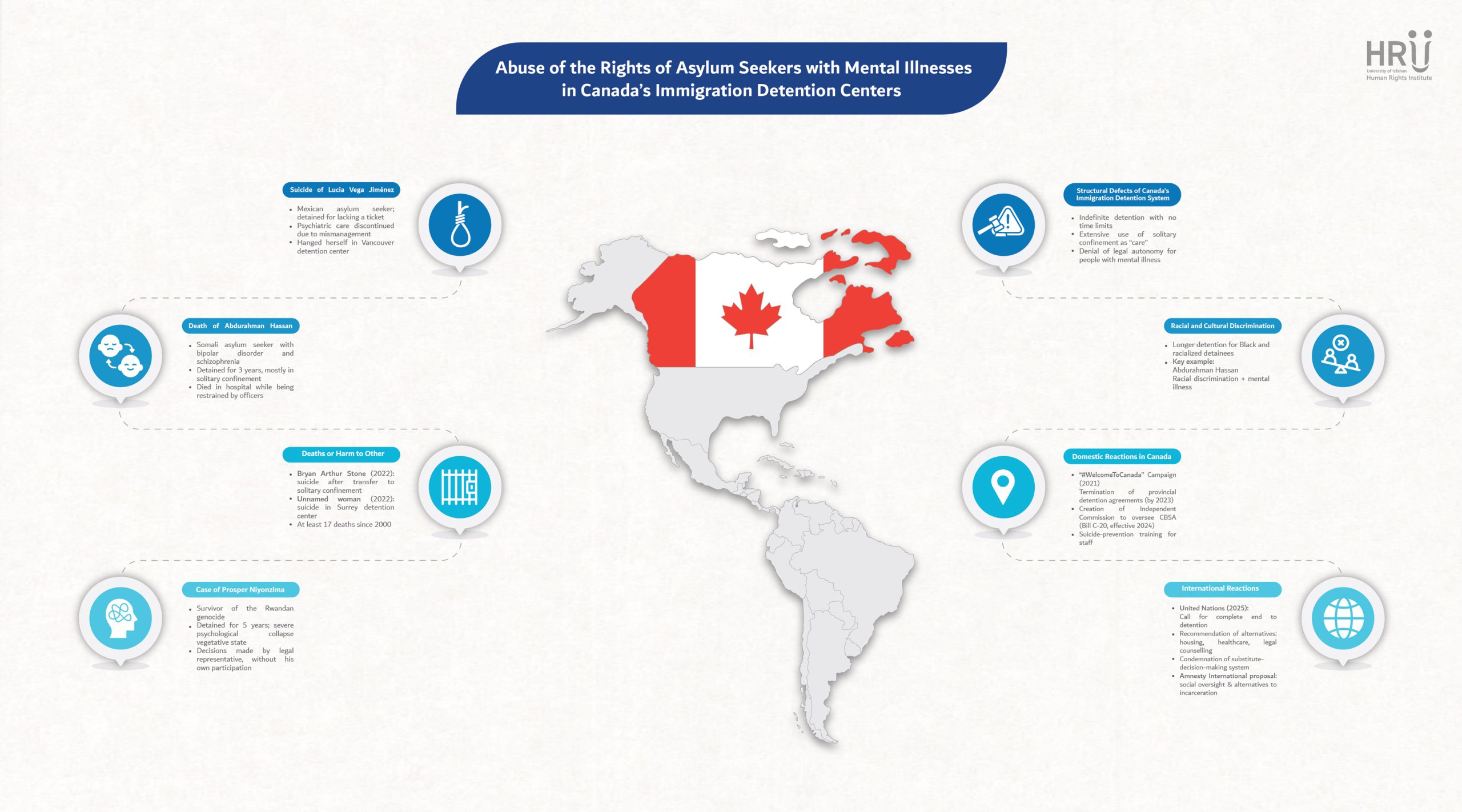
One of the most shocking cases is that of Lucia Vega Jiménez, a 42-year-old Mexican asylum seeker who died by suicide in Vancouver immigration detention in December 2013. Fleeing violence in Mexico, she had sought refuge in Canada, but was arrested for not possessing a valid train ticket at a Vancouver station and transferred to the CBSA detention facility at the airport.
Jiménez told fellow detainees that she feared being killed by criminal gangs if deported to Mexico. Medical records and testimonies from her cellmates indicated that her mental state deteriorated rapidly. A nurse at the Alouette correctional center even recommended that she be assessed and placed under psychiatric care. However, due to poor coordination between prison authorities and border agents, her psychiatric appointment was canceled, and no follow-up took place.
A CBSA officer later admitted during the inquest into her death that the agency was aware of Jiménez’s likely mental health problems, yet not only denied her access to specialized care but also rushed her deportation process[1]. On December 20, 2013, she hanged herself in the bathroom of her detention cell at the Vancouver Airport facility. She died in the hospital a few days later[2].
Initially, her death was not publicly disclosed by authorities. The incident only came to light after pressure from Vancouver’s Mexican community[3]. The tragedy sparked serious questions about CBSA’s negligence in responding to warning signs of a mental health crisis.
- The Death of Abdurahman Hassan
Another harrowing case is that of Abdurahman Hassan, a 39-year-old Somali asylum seeker. Hassan had lived in Canada since the 1990s and was granted refugee status[4]. He suffered from bipolar disorder and schizophrenia. Following several minor criminal convictions, the Canadian government issued a deportation order against him—to Somalia, a country he had never lived in and which remained engulfed in conflict.
Hassan was detained by immigration authorities in 2012 and, instead of being held in a designated immigration center, he was transferred to the maximum-security Central East Correctional Centre in Ontario[5]. His detention conditions were described as extremely harsh and inhumane. He spent a large portion of his three-year detention in solitary confinement, including one continuous period of 95 days.
Prison staff repeatedly warned that the facility was ill-equipped to house someone in Hassan’s condition and that he required specialized psychiatric care. Yet CBSA ignored these warnings. Moreover, his deportation remained practically impossible, as Canadian officers could not safely escort him to Somalia due to security concerns. Consequently, Hassan’s detention continued indefinitely, without any indication of when or if he would be released or deported[6]. This uncertainty further deteriorated his mental health.
In June 2015, after suffering a seizure in solitary confinement, Hassan was transferred to a hospital in Peterborough. He was under supervision by two police officers. On the night of June 11, 2015, he became severely agitated and exhibited erratic behavior. Four nurses and two officers intervened to restrain him. Witnesses reported that Hassan, already handcuffed and shackled, was pinned to the bed with a towel placed over his mouth. Moments later, his heart stopped, and he died.
His death, occurring on the third anniversary of his detention, once again raised alarms about how mentally ill detainees are treated in immigration custody. Hassan’s lawyer had emphasized in his final hearings before Hassan’s death that his client suffered from delusions and hallucinations, and did not understand the legal proceedings or the documents he was expected to sign for his deportation[7].
- Other Cases of Death or Harm Among Detainees with Mental Illness
Sadly, these two cases are not isolated. Similar incidents have occurred in recent years. In January 2022, Bryan Arthur Stone, a 56-year-old man living in Quebec and father of a young child, died by suicide after 53 days in detention at the Laval Immigration Holding Centre in Montreal. Reports indicated that he suffered from depression and had warned officials multiple times that he would take his own life if deported and separated from his child. Just four days before his death, he had already attempted suicide once. Instead of receiving psychological support, CBSA placed him in solitary confinement—a punitive measure that ultimately led to his death on January 28, 2022.
A more recent case occurred in December 2022, when an unnamed female asylum seeker committed suicide on Christmas Day at the Surrey Immigration Holding Centre in British Columbia. CBSA has not released any information regarding her identity or condition.
According to Human Rights Watch, at least 17 people have died in Canadian immigration detention since 2000—most of them held in provincial jails. This statistic reflects a disturbing pattern suggesting the potentially lethal nature of Canada’s detention system[8].
Moreover, even in cases where prolonged detention has not led to death, it has caused irreversible psychological harm. One such case is that of Prosper Niyonzima, a Rwandan genocide survivor who sought asylum in Canada. Between 2012 and 2016, he spent nearly five years in immigration detention. After about 16 months in custody, Niyonzima experienced a complete mental collapse, entering a catatonic state. Independent audits revealed that during the final three years of his detention, he remained nearly vegetative—unable to speak or participate in hearings, often staring silently at the wall.
Despite this, instead of releasing or treating him, the system appointed a designated representative to make decisions on his behalf. This representative, who never even met Niyonzima, advocated for his continued detention in hearings for two years without his informed consent. Effectively, he was stripped of his legal autonomy while in a medical crisis[9], highlighting how legal loopholes allow CBSA to keep individuals with mental health conditions in prolonged custody without their participation.
Challenges and Responses
- Structural Deficiencies in the Immigration Detention System
The aforementioned cases and similar incidents expose deep-rooted, structural flaws in Canada’s immigration detention regime. Chief among them is the indefinite nature of detention. Unlike many developed countries that impose time limits on immigration detention, Canada has no legal cap. According to Samer Muscati of Human Rights Watch, Canada is one of the few high-income countries where asylum seekers can be imprisoned for an indeterminate period. Such uncertainty can be profoundly destructive—especially for vulnerable individuals—exacerbating feelings of helplessness and despair. Many asylum seekers in Canadian custody have developed severe mental health issues or suicidal ideation at the very moment they were seeking refuge and safety.
Another major concern is the use of solitary confinement as a management tool. Experts have warned that solitary confinement can amount to psychological torture. Nevertheless, it is routinely applied to detainees with behavioral or mental health challenges[10]. Research has shown that CBSA often prefers to transfer detainees with mental illness to provincial jails, where solitary confinement can be imposed under the pretense of “special care.” In reality, however, psychiatric care in provincial prisons is grossly inadequate, and what is labeled “special care” often amounts to prolonged isolation.
An independent review conducted in 2020 on the treatment of mentally ill prisoners in Ontario found that solitary confinement was used disproportionately against individuals with mental illness, turning so-called medical care into a coded form of punishment[11]. The cases of Bryan Stone in Laval and Abdurahman Hassan in Ontario clearly illustrate that even when individuals exhibited symptoms of psychological distress—such as self-harm or agitation—they were placed in solitary confinement rather than receiving appropriate medical attention. The result was a worsening of their condition and, in some cases, death.
Another serious issue is the deprivation of legal agency and defense rights. Under current regulations, when a detainee is deemed mentally unfit to participate in their hearings, the Immigration and Refugee Board appoints a designated representative to make decisions on their behalf. While this system is intended to protect individuals with disabilities, it often results in the complete removal of their autonomy. As seen in the case of Prosper Niyonzima, he had no control over the proceedings affecting his fate. Meanwhile, his detention was routinely renewed.
There is little oversight over designated representatives, and they are not required to consult the detainee or obtain their consent. This system is highly prone to abuse. The UN Committee on the Rights of Persons with Disabilities has recently condemned this model and called for a shift toward supported decision-making frameworks in which individuals are included in decisions that impact their lives.
- Racial Disparities and Discrimination
Racial and cultural discrimination adds another layer of complexity. Statistics reveal that immigration detention in Canada disproportionately affects people of color, particularly Black individuals[12]. According to Amnesty International and Human Rights Watch, in 2019, the majority of detainees held for more than three months were from African nations. Black migrants are more likely to be held for extended periods and often in harsher conditions, such as provincial jails.
Abdurahman Hassan, as a Black man with a mental health condition, exemplifies the compounded discrimination faced by racialized individuals—racial profiling, psychiatric stigma, and the criminalization of mental illness. Even Canadian officials acknowledged this after his death. During the inquest, a lawyer from the Black Legal Action Centre emphasized that Hassan’s identity—as a Black asylum seeker with mental illness and a criminal record—directly influenced the harsh treatment he received.
- Domestic Reactions
The exposure of these issues and mounting public pressure have prompted responses from the Canadian government and relevant authorities. One of the most significant developments has been the move to end the use of provincial jails for immigration detention—facilities associated with the worst conditions and most egregious rights violations.
In October 2021, Human Rights Watch and Amnesty International launched the #WelcomeToCanada campaign, urging provincial governments to terminate their contracts with CBSA for holding migrants in jails. The campaign was a success: by the end of 2023, all 10 Canadian provinces had announced their intent to end these agreements[13]. The last province to do so was Newfoundland and Labrador, which confirmed it would no longer permit migrants and asylum seekers to be held in local correctional facilities[14].
This marked a significant human rights victory. As Amnesty International noted, ending the use of provincial jails could prevent tragedies like Abdurahman Hassan’s death. The coroner’s jury in his case also explicitly recommended the cessation of immigration detention in provincial jails. Now, the federal government is expected to provide resources so that immigration detainees are housed only in specialized immigration facilities—and only as a last resort.
Another step forward has been the effort to establish independent oversight of CBSA. For years, civil society groups such as the Canadian Council for Refugees called for the creation of a complaints body or oversight mechanism to investigate abuses by CBSA officers. In 2023, Parliament passed Bill C-20, which established the Public Complaints and Review Commission. This legislation came into effect in October 2024 and, for the first time, created a formal process for receiving and investigating complaints against CBSA staff, enhancing transparency and accountability.
This commission is part of Canada’s broader response to concerns over systemic racism and the lack of oversight in law enforcement agencies, including CBSA[15]. Although it will not solve every issue, it is a critical step toward public accountability.
CBSA has also begun revising some of its internal practices. Following the suicide of Lucia Vega Jiménez, the agency announced that mental health and suicide prevention training would become mandatory for contracted guards and staff, enabling them to better recognize warning signs. In British Columbia, border officials admitted that the absence of a dedicated immigration detention facility posed a serious problem. They expressed hope that, with proper funding, a center similar to those in Toronto and Montreal could be established in Vancouver to avoid sending asylum seekers to criminal jails. This acknowledgment signals a growing awareness that detaining vulnerable individuals alongside criminal offenders is ethically and practically unacceptable.
- International Reactions
At the international level, several bodies have issued strong critiques and clear recommendations regarding Canada’s immigration detention practices. In March 2025, the UN Committee on the Rights of Persons with Disabilities published a scathing assessment, calling for the complete abolition of immigration detention in Canada. The committee emphasized that the country must replace detention—especially for people with disabilities or mental health conditions—with community-based alternatives, such as housing support, mental health services, disability accommodations, and independent legal counseling[16].
This approach aligns with international human rights standards, which regard immigration detention as a last resort to be used only for the shortest time necessary. The UN Working Group on Arbitrary Detention has long advocated for the gradual elimination of immigration detention in countries including Canada.
Human rights organizations like Human Rights Watch and Amnesty International have recommended concrete measures such as expanding community supervision programs, utilizing financial guarantees, and adopting electronic monitoring as less harmful alternatives to incarceration. These measures can ensure compliance without subjecting vulnerable individuals to the dangers of confinement.
Furthermore, as noted earlier, the United Nations has firmly called for reforming Canada’s designated representative system, urging a shift to supported decision-making that respects the autonomy and legal capacity of persons with mental health or cognitive disabilities in legal proceedings.
Conclusion
The detention of asylum seekers with mental health disorders has become a point of contradiction between Canada’s stated values and its practical policies. While the country presents itself as a champion of refugee and migrant rights, dozens of asylum seekers have been held in detention conditions that clearly violate human dignity and fundamental rights.
Well-documented cases—such as the suicide of Lucia Vega Jiménez, neglected by officials; the tragic death of Abdurahman Hassan after enduring years in solitary confinement; and numerous others—demonstrate that the current system not only fails to protect vulnerable individuals but in fact exacerbates their trauma.
Nonetheless, recent strides toward transparency and public pressure have opened avenues for reform. The unequivocal recommendations of international bodies, advocacy efforts from Canadian civil society, and even statements by public officials—such as Alberta’s Minister for Public Safety, who noted:
“People who come to Canada to start over deserve a better welcome than being locked in a cell while sorting out paperwork” —
all reflect the growing consensus on the urgent need for a fundamental rethink of immigration detention in Canada.
While important steps have been taken—such as terminating provincial jail contracts, creating an independent oversight mechanism, and expanding staff training—these measures alone are not sufficient. Many experts and organizations have called for broader reforms, including:
- Imposing a legal time limit on immigration detention,
- Guaranteeing immediate access to medical and psychiatric care,
- Banning the use of solitary confinement for migrants altogether,
- Implementing non-custodial alternatives to detention.
Overall, recent reports sound a clear alarm for the Canadian government: to truly embody its proclaimed values of justice, equality, and humanitarianism, it must ensure that no asylum seeker is ever imprisoned simply because of their mental health condition.
References
[1] Paterson, J. (2014, October 6). Distressed, afraid, and alone: a tragic story slowly unfolds at the Lucía Vega Jiménez inquest. The Georgia Straight. From: https://www.straight.com/news/743596/distressed-afraid-and-alone-tragic-story-slowly-unfolds-lucia-vega-jimenez-inquest
[2] CityNews Vancouver. (2014, October 1). CBSA officer tells inquest more changes needed to prevent in-custody suicides. CityNews Vancouver. From: https://vancouver.citynews.ca/2014/10/01/cbsa-officer-tells-inquest-more-changes-needed-to-prevent-in-custody-suicides/
[3] Burgmann, T. (2014, September 29). Woman who killed herself in CBSA custody feared torture in Mexico: inquest. CityNews Kitchener. From: https://kitchener.citynews.ca/2014/09/29/woman-who-died-in-cbsa-custody-had-been-kicked-out-of-canada-before-inquest/
[4] Keung, N. (2023, February 9). Mindset of those present when immigration detainee died is key, inquest hears. Hiiraan Online. From: https://www.hiiraan.com/news4/2023/Feb/189866/mindset_of_those_present_when_immigration_detainee_died_is_key_inquest_hears.aspx
[5] Canadian Council for Refugees. (2023, February 10). BLAC, RLO, and the CCR pleased with the jury recommendations from the Abdurahman Hassan inquest. CCR. From: https://ccrweb.ca/en/media/jury-recommendations-abdurahman-hassan-inquest
[6] Muscati, Samer. (2023, March 6). Inquest Highlights Abuses in Canada’s Immigration Detention. Human Rights Watch. From: https://www.hrw.org/news/2023/03/06/inquest-highlights-abuses-canadas-immigration-detention
[7] Cain, P. (2015, June 19). Detainee who died last week had diabetes, asthma, severe mental illness. Global News. From: https://globalnews.ca/news/2064697/detainee-who-died-last-week-had-diabetes-asthma-severe-mental-illness/
[8] Muscati, Samer. (2023, January 27). Deaths Underscore Inhumanity of Canada’s Immigration Detention. Human Rights Watch. From: https://www.hrw.org/news/2023/01/27/deaths-underscore-inhumanity-canadas-immigration-detention
[9] Human Rights Watch. (2024, December 3). “It felt like everything in life stopped”: Legal capacity and rights violations against people with disabilities in Canada’s Immigration Detention System. Human Rights Watch. From: https://www.hrw.org/report/2024/12/03/it-felt-everything-life-stopped/legal-capacity-rights-violations-against-people
[10] Prison Insider. (2021, June 23). Canada: abuse, discrimination in immigration detention. Prison Insider. From: https://www.prison-insider.com/en/articles/canada-abus-et-discrimination-a-l-encontre-de-personnes-detenues-pour-des-raisons-liees-a-l-immigration
[11] Human Rights Watch. (2021, June 17). “I didn’t feel human there”: Immigration detention in Canada and its impact on mental health. Human Rights Watch. From: https://www.hrw.org/report/2021/06/17/i-didnt-feel-human-there/immigration-detention-canada-and-its-impact-mental
[12] Owusu-Bempah, A., Jung, M., Sbaï, F., Wilton, A. S., & Kouyoumdjian, F. (2021). Race and Incarceration: The Representation and Characteristics of Black People in Provincial Correctional Facilities in Ontario, Canada. Race and Justice, 13(4), 530-542. https://doi.org/10.1177/21533687211006461
[13] Amnesty International Canada. (2024, April 22). #WelcomeToCanada: Act now to stop the federal government from using prisons for immigration detention. Amnesty International Canada. From: https://amnesty.ca/activism-guide/welcometocanada-act-now-to-stop-the-federal-government-from-using-prisons-for-immigration-detention/
[14] National Newcomer Navigation Network. (2024, April 22). Human Rights Watch calls on all 10 provinces to end immigration detention in jails. Newcomer Navigation. From: https://www.newcomernavigation.ca/en/news/human-rights-watch-canada-all-10-provinces-to-end-immigration-detention-in-jails.aspx
[15] Senate-Gro. (2024, October 31). Oversight of CBSA and RCMP. Senate-Gro. From: https://senate-gro.ca/news/oversight-cbsa-rcmp/
[16] Muscati, S. (2025, March 27). UN Committee Criticizes Canada’s Immigration Detention Practices. Human Rights Watch. From: https://www.hrw.org/news/2025/03/27/un-committee-criticizes-canadas-immigration-detention-practices