Introduction
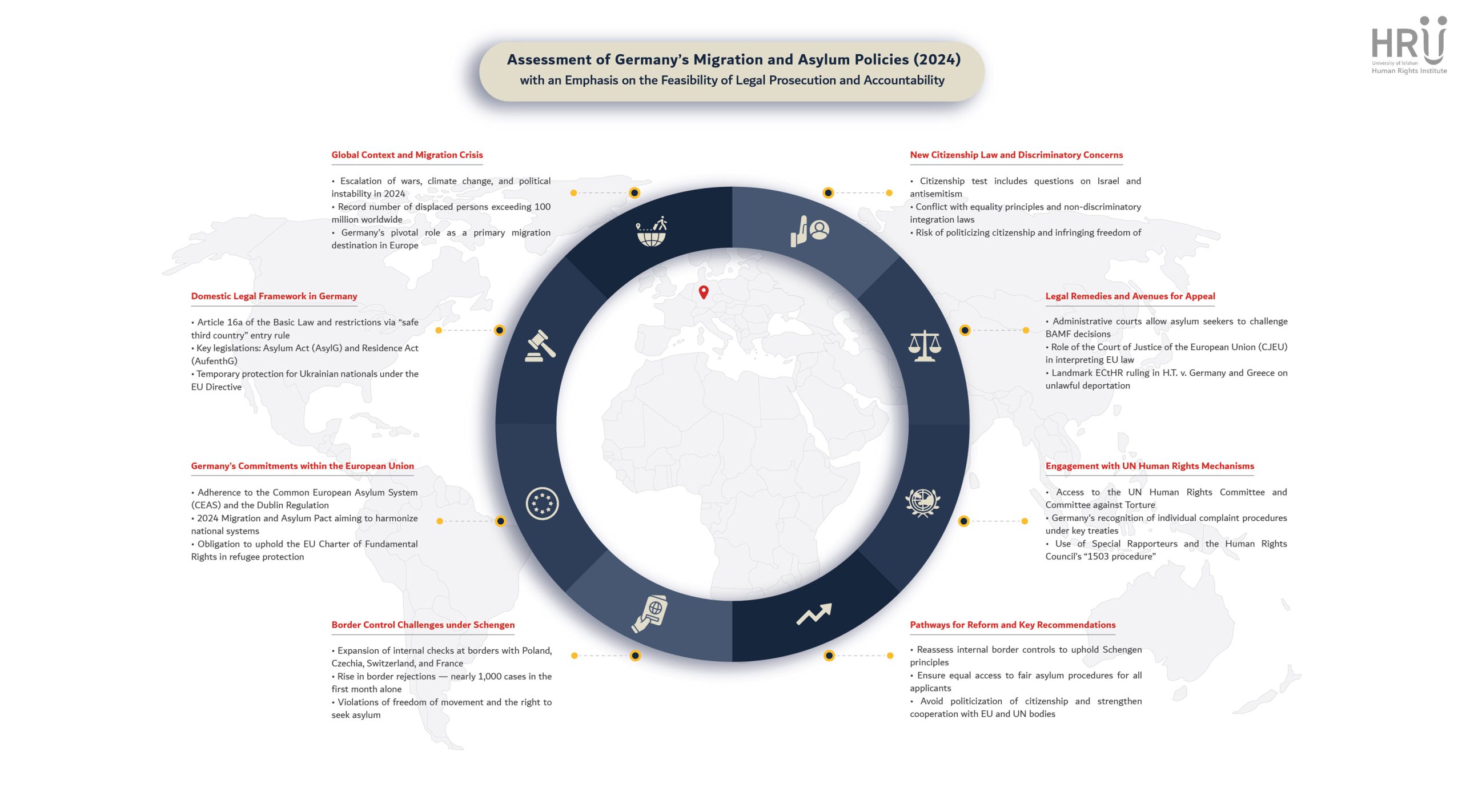
Germany’s migration and asylum policies in 2024 were shaped by a combination of profound domestic and international developments. The year was marked by intensifying humanitarian crises worldwide—ranging from wars and widespread climate change to political unrest—resulting in new waves of migration and displacement. According to reports by international bodies, the number of refugees and displaced persons globally reached more than 100 million by the end of 2024, an unprecedented figure that posed serious challenges to the international refugee protection system.
Within this context, Germany, as one of the principal destination countries in Europe, bore a pivotal responsibility. Its legal standing under the 1951 Geneva Convention and the 1967 Protocol, coupled with its membership in the European Union and its commitment to a set of common regulations, obliged the country to strengthen its national mechanisms for the reception and integration of asylum seekers while upholding its international obligations.
However, the intersection of these international commitments with domestic constraints—particularly in the economic, social, and security spheres—created a tense environment that gave rise to extensive political and social controversy. Consequently, Germany’s migration and asylum policies in 2024 faced widespread criticism from academic institutions, human rights organizations, and even certain European and international bodies, which questioned the compatibility of these policies with Germany’s constitutional guarantees and international human rights commitments.
The General Legal Framework of Asylum and Migration in Germany
Germany’s migration and asylum policies are founded on a combination of national laws, European Union regulations, and international obligations. The right to asylum is explicitly enshrined in the German Constitution (Grundgesetz). According to Article 16a of the Basic Law, individuals who are persecuted for political reasons have the right to asylum[1]. However, this same article also imposes a significant limitation: if an asylum seeker enters Germany through a “safe third country,” they cannot invoke this fundamental right to asylum[2].
In practice, since all of Germany’s neighboring states—including EU members as well as Norway and Switzerland—are recognized as “safe third countries,” most asylum seekers arriving in Germany do not fall under the constitutional asylum regime.
Germany’s principal domestic legal instruments governing asylum and migration are the Asylum Act (AsylG) and the Residence Act (AufenthG). Decision-making on asylum applications is primarily conducted under the former, while rules concerning entry, residence, employment, and integration fall under the latter. Moreover, Germany, through a number of secondary or complementary laws, has admitted individuals under temporary protection or humanitarian grounds, granting them temporary residence permits[3].
A notable example of this is the temporary admission of Ukrainian nationals under the EU Temporary Protection Directive, which legally ensured their right to reside in Germany temporarily, access asylum procedures, adequate housing, healthcare, and public education (for those under 18)[4]. Consequently, the number of Ukrainian arrivals in Germany in 2022 exceeded the combined total of Afghan, Iraqi, and Syrian entrants during the same period[5].
In addition to these domestic laws, Germany is bound by the Common European Asylum System (CEAS) as part of EU law. This framework includes key instruments such as the Dublin Regulation (which determines the Member State responsible for examining an asylum application), the Asylum Procedures Directive, and the Reception Conditions Directive, which establish common standards for the treatment of asylum seekers across the EU. Under the Dublin Regulation, every asylum application lodged within EU territory must be examined by one Member State[6].
In 2024, the European Union adopted the Migration and Asylum Pact, a comprehensive reform aimed at creating a more coherent and unified asylum system among its members. This legal framework seeks to ensure fair and humane treatment of individuals seeking international protection, harmonize asylum systems across the EU, reduce disparities among Member States through binding legislation, and strengthen practical cooperation among national asylum authorities as well as the external dimension of asylum policy[7].
Accordingly, Germany—within the interlocking frameworks of domestic law, European law, and international human rights law—bears serious responsibilities to uphold and protect the rights of migrants and asylum seekers entering its territory.
One of the most consequential actions taken by the German government in this regard was the expansion of internal Schengen border controls. Since the 2015 migration crisis, Germany had maintained temporary border checks at the Austrian frontier, even suspending train services[8]. In response to the surge in irregular crossings in late 2023, it extended these checks to the borders with Poland, the Czech Republic, and Switzerland.
In September 2024, the Federal Ministry of the Interior announced that all of Germany’s land borders—including those with France, Luxembourg, the Netherlands, Belgium, and Denmark—would be temporarily subjected to inspections, authorizing the Federal Police (Bundespolizei) to conduct a full range of fixed and mobile border enforcement operations across all land frontiers[9].
This decision sparked fierce criticism from civil society organizations and legal scholars, who argued that such widespread inspections violated the spirit of the Schengen Agreement (which guarantees freedom of movement) and infringed upon the rights of asylum seekers. Legally, internal border controls are permitted only under conditions of “serious threat” and as a “measure of last resort.” Critics therefore contended that the measure reflected a broader migration control strategy rather than a legally justified security response.
From a legal standpoint, if internal border checks are implemented in a manner that prevents asylum seekers from lodging their applications or results in their return to another country without an individual assessment, it constitutes a violation of the Common European Asylum System (CEAS).
Statistical evidence indicates that border rejections (refusals of entry) increased during 2023–2024; in the first month after the September 2024 expansion of controls alone, approximately 1,000 border rejections were recorded[10].
From a human rights perspective, these practices infringe upon the right to freedom of movement, the right to seek asylum, and the right to human dignity. Article 18 of the Charter of Fundamental Rights of the European Union and the 1951 Geneva Convention both guarantee the right to asylum. By restricting access to German territory and preventing individuals from filing asylum claims, these measures effectively undermine that right.
Furthermore, Article 1 of the EU Charter of Fundamental Rights[11] and Article 1 of the Universal Declaration of Human Rights both affirm the inviolability of human dignity. Widespread border controls, potentially degrading police practices, and the detention of individuals in unsuitable border facilities—particularly given Europe’s climatic conditions—are inconsistent with human dignity and therefore constitute violations of this principle.
Another major policy adopted by the German government, which many observers believe has led to serious human rights violations and raises grave legal concerns, was the passage of the new Citizenship Law (Einbürgerungsrecht) on 19 January 2024.
Under this reform, applicants must answer specific questions in the naturalization test related to anti-Semitism, the right of the State of Israel to exist, and Jewish life in Germany[12]. Traditionally, the test covered topics such as “living in a democracy,” “history and responsibility,” and “people and society,” but it now includes twelve new questions specifically related to anti-Semitism and Israel.
Given that the spirit of the Residence Act (AufenthG) is founded on the principle of non-discriminatory integration for migrants and asylum seekers, this new citizenship law appears to conflict directly with that principle by imposing selective criteria on specific communities—particularly Muslim migrants and those originating from the Middle East.
Moreover, Article 3 of the German Basic Law stipulates that no person shall be discriminated against or favored on grounds of sex, descent, race, language, homeland, faith, or political opinion[13]. However, by potentially favoring supporters of Israel and discriminating against critics of Israel or advocates for Palestine, the new law explicitly violates this constitutional guarantee.
From a human rights perspective, the law also infringes upon the right to freedom of expression and belief, as naturalization tests are typically designed to assess an applicant’s understanding of the host country’s legal, linguistic, and civic systems—not their alignment with any particular religious or political ideology. Furthermore, as this law disproportionately affects Muslim asylum seekers, it breaches the principle of non-discrimination.
Finally, by requiring implicit endorsement of a specific religious or ideological position—namely Judaism or Zionism—the law undermines the principles of freedom of religion and secularism embedded in German law and society, raising profound constitutional and ethical questions.
Feasibility of Legal Action
- Domestic Legal Frameworks in Germany
Governmental policies and actions concerning migration and asylum in Germany are constantly subject to legal oversight, and affected individuals can pursue several lawful avenues to defend their rights or challenge those policies.
At the national level, Germany’s legal system provides multiple mechanisms for addressing grievances and contesting administrative decisions affecting migrants and asylum seekers. The administrative courts constitute the primary avenue of appeal against decisions issued by the Federal Office for Migration and Refugees (BAMF). Such decisions can be challenged before the administrative judiciary, which holds the authority to overturn or amend government decisions and, in some cases, rule in favor of the asylum seeker.
On average, administrative proceedings take more than 16 months, yet many asylum seekers avail themselves of this right with the assistance of legal counsel.
Higher courts also play a crucial role in overseeing the legality of state actions. The Federal Administrative Court (Bundesverwaltungsgericht) and, at the apex, the Federal Constitutional Court (Bundesverfassungsgericht) are the ultimate authorities for adjudicating conflicts between laws or violations of fundamental rights.
Administrative courts examine both the factual circumstances of the case and the proper application of law by BAMF. In this process, asylum seekers may request an oral hearing, though cases may also proceed without one[14]. During an oral hearing, the reasons for the individual’s departure from their home country are re-evaluated. If the court upholds the BAMF’s initial decision, that decision remains binding. However, if the court determines that the applicant requires protection, the BAMF must issue a new decision granting asylum or other legal status[15].
- The Court of Justice of the European Union (CJEU)
Beyond Germany’s domestic legal system, significant legal avenues also exist at the European and international levels for migrants and asylum seekers seeking redress.
The Court of Justice of the European Union (CJEU) is one such forum, responsible for ensuring the uniform interpretation and application of EU law—including regulations related to asylum and migration. If German policies are deemed inconsistent with EU directives or regulations, the European Commission may initiate infringement proceedings against Germany before the Court, or German courts themselves may refer preliminary questions to the CJEU for interpretation.
In one case, following a CJEU ruling, Germany’s BAMF amended its internal administrative guidelines on asylum procedures. The revised directive explicitly states that “asylum applications are not subject to limitations in either time or number,” allowing applicants to file without any temporal restrictions—whereas previously, a three-month limit applied.
In another case, in February 2024, the Court ruled that Germany (and other Member States) must interpret exceptions to the re-examination of asylum claims broadly. The Court also held that new CJEU judgments themselves may constitute “new facts” justifying the reopening of an asylum case[16].
This ruling, issued in response to a reference from a German court, effectively prevented Germany from rejecting repeat asylum applications merely on the grounds of lacking new evidence.
- The European Court of Human Rights (ECHR)
The European Court of Human Rights, a key international judicial body, monitors state compliance with the European Convention on Human Rights (ECHR). Any individual who believes that their fundamental rights have been violated by the German state—and who has exhausted domestic remedies—may lodge a complaint with the ECHR.
In 2024, the Court delivered a landmark judgment against Germany in the case of H.T. v. Germany and Greece (2024). The case concerned a Syrian asylum seeker who, upon arrival at the German border[17], was summarily returned to Greece under a bilateral administrative arrangement between the two countries known as the Seehofer Agreement[18], without any individual assessment of his asylum claim.
The applicant had previously filed an asylum application on the Greek island of Leros, yet upon entering Germany, he was arrested at 5:15 a.m. on 4 September 2018 and deported back to Greece by 7:20 p.m. the same day—without being allowed to lodge an asylum claim in Germany or to access legal counsel before removal[19].
On 15 October 2024, the ECHR ruled that this transfer violated Article 5(1) of the Convention, classifying the detention as an unlawful deprivation of liberty. The Court emphasized that administrative arrangements between governments cannot replace or circumvent the legal procedures prescribed under EU and human rights law, and that Germany cannot expose individuals to risk by bypassing the Dublin Regulation or denying access to asylum procedures.
- UN Human Rights Mechanisms
The United Nations human rights mechanisms may also intervene in cases of serious violations of migrants’ rights. Bodies such as the Human Rights Committee (HRC) and the Committee against Torture (CAT) are competent to receive individual complaints and issue views on alleged violations of relevant treaties.
Although their findings are not legally binding in the same sense as judicial rulings, they hold substantial weight regarding states’ adherence to international obligations. However, nearly all UN treaty bodies—including the HRC and CAT—require the exhaustion of domestic remedies before accepting individual petitions. This means that an asylum seeker must first pursue all available legal avenues within Germany before an international complaint becomes admissible[20].
Furthermore, for an individual to file such a complaint, the state concerned must be a party to the relevant treaty and must have recognized the individual complaint procedure. Germany has ratified and accepted this procedure under instruments such as the International Convention on the Protection of the Rights of All Migrant Workers and Members of Their Families, the Convention against Torture, the International Covenant on Civil and Political Rights, and the International Convention on the Elimination of All Forms of Racial Discrimination[21]—all of which have direct relevance to migrants’ rights.
According to the UN Human Rights Committee, the complaint procedures are designed to be simple and accessible: the complainant does not need legal representation or technical expertise; they need only provide basic personal information—such as name, nationality, and date of birth—identify the state concerned, and submit a signed written statement[22].
In addition, several other avenues for individual complaints exist. Under the UN Human Rights Council, a complainant may submit a petition through the Communications Procedure (formerly known as the “1503 Procedure”) or to the Special Procedures—which include Special Rapporteurs and Working Groups—to address alleged violations of human rights by the German state[23].
Recommendations
- Revision of Internal Schengen Border Control Policy
The German government should employ internal Schengen border controls only as a last resort and strictly under circumstances involving a serious security threat. The continued and expanded application of such controls stands in direct conflict with the principles of the Schengen Agreement and the right to freedom of movement, and it may result in violations of fundamental human rights.
A return to proportional and temporary measures would reinforce confidence in the legal framework of the European Union. Strengthening a rights-based and proportionate approach—rather than adopting permanent exceptional mechanisms—would also help to reconcile the tension between national security requirements and the protection of individual fundamental rights.
- Ensuring Equal Access to Asylum Procedures
The Federal Republic of Germany must guarantee that no asylum seeker is deprived of the right to lodge an asylum claim due to border control measures or bilateral agreements with neighboring or non-neighboring states.
Equal and unimpeded access to fair and individualized asylum procedures is an obligation under both the 1951 Geneva Convention and the EU Charter of Fundamental Rights. Any denial of such access increases the risk of violating the principle of non-refoulement—the cornerstone of international refugee law.
This obligation also forms part of Germany’s international commitments under the Common European Asylum System (CEAS). Administrative procedures must be designed in a way that ensures the possibility of immediate and impartial registration of asylum applications, even in situations where border controls are in place.
- Avoiding the Politicization of Naturalization Procedures
The citizenship test should focus solely on an applicant’s knowledge of the legal, cultural, linguistic, and civic systems of Germany. It must not include requirements of ideological or political allegiance to a particular state or belief system.
Questions related to Israel or anti-Semitism, if used as selective or exclusionary criteria, are discriminatory and undermine Article 3 of the Basic Law, which enshrines equality before the law.
Such a politicized approach weakens the spirit of the Residence Act (AufenthG) and the constitutional principle of equality. It also risks deepening the sense of alienation among migrant and minority communities, thereby hindering their integration and trust in democratic institutions.
- Strengthening the Role of Administrative and Higher Courts
Germany’s administrative and higher courts should serve as effective mechanisms for the redress of rights violations experienced by asylum seekers and migrants. The excessive duration of proceedings—often exceeding 16 months—poses a significant challenge and adds further suffering to individuals who have already endured immense hardship in reaching safety.
Accelerating judicial proceedings, guaranteeing oral hearings, and ensuring independent case review would enhance confidence in the German judicial system and reaffirm its commitment to the rule of law and the protection of human dignity.
- Enhancing Cooperation with European and UN Mechanisms
Germany should pursue a constructive and cooperative relationship with the Court of Justice of the European Union (CJEU), the European Court of Human Rights (ECHR), and the United Nations treaty bodies.
Compliance with and implementation of their rulings is not only a legal obligation but also a reflection of Germany’s adherence to the values of human rights, fundamental freedoms, and the rule of law.
Active engagement with these bodies would strengthen Germany’s position as a global leader in the protection of fundamental rights, reinforce mutual trust within the EU framework, and serve as a model for other states in balancing sovereignty with international responsibility.
Conclusion
Germany’s migration and asylum policies in 2024 reveal that the country operates within a multi-layered legal framework, where the continuous interaction between domestic, European, and international levels is a source of both complexity and contention.
At the domestic level, Germany faces a fundamental duality: on one hand, its Constitution (Basic Law) and national legislation guarantee the right to asylum and the integration of migrants; on the other hand, recent reforms—such as the 2024 Citizenship Law—demonstrate a shift in practice, where political and ideological criteria increasingly replace traditional legal and social benchmarks of integration. This transformation risks turning the path to citizenship from a legal instrument of inclusion into a political tool of exclusion, thereby threatening the principle of equality enshrined in the Basic Law.
At the European level, examples such as the expansion of internal border controls demonstrate that Germany, rather than upholding the spirit of Schengen and the Common European Asylum System (CEAS), has tended toward selective migration management based on criteria external to legal principles. The rulings of the Court of Justice of the European Union (CJEU) have underscored the corrective role that the EU’s supranational legal order can play in constraining national interpretations driven by domestic political pressures. The Court’s insistence on a broad interpretation of exceptions to asylum re-examination and its recognition of new jurisprudence as “new facts” illustrate the EU’s ability to safeguard the uniform protection of refugees across Member States.
At the international level, Germany cannot circumvent its binding treaty obligations under the European Convention on Human Rights or the United Nations human rights instruments by relying on bilateral administrative agreements. The H.T. v. Germany and Greece (2024) judgment of the European Court of Human Rights reaffirmed that even bilateral executive arrangements must comply with the higher legal standards imposed by international conventions.
Similarly, the availability of individual complaint procedures before UN treaty bodies—though lacking direct judicial enforcement—serves as a significant political and moral accountability mechanism, exerting pressure on states to uphold their international obligations and maintain credibility within the global human rights system.
Ultimately, Germany’s 2024 migration and asylum policy landscape reflects a delicate balance between sovereignty and responsibility, national interest and humanitarian duty, legality and politics. The effectiveness of Germany’s response to future migration challenges will depend on its willingness to re-center its policy within the framework of international law, to reaffirm human dignity, non-discrimination, and the right to asylum as guiding principles, and to ensure that security concerns never override the foundations of human rights and the rule of law that define its constitutional and international identity.
References
[1] Federal Ministry of Justice and Consumer Protection. (2025, March 22). Basic Law for the Federal Republic of Germany in the revised version published in the Federal Law Gazette Part III. Federal Office of Justice. From: https://www.gesetze-im-internet.de/englisch_gg/englisch_gg.html
[2] Federal Office for Migration and Refugees. (2023, June 22). Entitlement to asylum. BAMF. From: https://www.bamf.de/EN/Themen/AsylFluechtlingsschutz/AblaufAsylverfahrens/Schutzformen/Asylberechtigung/asylberechtigung-node.html
[3] Federal Ministry of the Interior. (n.d). The Asylum Process in Germany. Federal Ministry of the Interior. From: https://www.bmi.bund.de/EN/topics/migration/asylum-refugee-protection/asylum-refugee-policy-germany/asylum-refugee-policy-node.html
[4] Migration and Home Affairs. (2025, April 2). Temporary Protection Directive. European Commission. From: https://home-affairs.ec.europa.eu/policies/migration-and-asylum/asylum-eu/temporary-protection_en
[5] Statistisches Bundesamt. (2023, February 16). Press release No. N010 of 16 February 2023. Destatis. From: https://www.destatis.de/EN/Press/2023/02/PE23_N010_12411.html?templateQueryString=GERMANY
[6] European Union. (2025, June). Statistics on countries responsible for asylum applications (Dublin Regulation). Eurostat. From: https://ec.europa.eu/eurostat/statistics-explained/index.php?title=Statistics_on_countries_responsible_for_asylum_applications_(Dublin_Regulation)
[7] European Union Agency for Asylum. (2022, January). 2.1 The Common European Asylum System and current issues. European Union Agency for Asylum. From: https://euaa.europa.eu/asylum-report-2020/21-common-european-asylum-system-and-current-issues
[8] Al Jazeera. (2015, September 14). Germany imposes border controls over refugee surge. Al Jazeera. From: https://www.aljazeera.com/news/2015/9/14/germany-imposes-border-controls-over-refugee-surge
[9] Bundesministerium des Innern. (2024, September 16). Internal border controls have been ordered at all German land borders. Bundesministerium des Innern. From: https://www.bmi.bund.de/SharedDocs/kurzmeldungen/DE/2024/09/binnengrenzkontrollen.html
[10] Riemer, L. & Rau, L. & Schalast, R. (2025, June 16). Overview of the main changes since the previous report update. AIDA. From: https://asylumineurope.org/reports/country/germany/overview-main-changes-previous-report-update/
[11] Official Journal of the European Union. (2012, October 26). Charter of Fundamental Rights of the European Union. Official Journal of the European Union. From: https://eur-lex.europa.eu/legal-content/EN/TXT/HTML/?uri=CELEX:12012P%2FTXT
[12] De Cabo, A. (2024, April 1). Germany will include questions about Israel and antisemitism in its new citizenship test. EL PAÍS. From: https://english.elpais.com/international/2024-04-01/germany-will-include-questions-about-israel-and-antisemitism-in-its-new-citizenship-test.html
[13] Federal Ministry of Justice. )1949, May 23). Basic Law for the Federal Republic of Germany. Federal Ministry of Justice. From: https://www.gesetze-im-internet.de/gg/BJNR000010949.html
[14] Riemer, L. & Rau, L. & Schalast, R. (2025, June 16). Country Report: Regular procedure, Germany. AIDA. From: https://asylumineurope.org/reports/country/germany/asylum-procedure/procedures/regular-procedure/
[15] UNHCR. (n.d). Asylum seeking process, Germany. UNHCR. From: https://help.unhcr.org/germany/asylum-in-germany/asylum-seeking-process/
[16] Riemer, L. & Rau, L. & Schalast, R. (2025, June 16). Subsequent applications, Germany. AIDA. From: https://asylumineurope.org/reports/country/germany/asylum-procedure/subsequent-applications/
[17] The European Court of Human Rights. (2024, October 15). Case of H.T. v. Germany and Greece. Council of Europe: European Court of Human Rights. From: https://www.refworld.org/jurisprudence/caselaw/echr/2024/en/148827
[18] European Center for Constitutional and Human Rights. (2024, October 15). “Automatic removal” at EU internal borders deemed unlawful Judgment: by the European Court of Human Rights in the case against Germany and Greece. European Center for Constitutional and Human Rights. From: https://www.ecchr.eu/en/press-release/automatic-removal-at-eu-internal-borders-deemed-unlawful/
[19] The European Court of Human Rights. (2025, January 15). Case of H.T. v. Germany and Greece. European Court of Human Rights. From: https://hudoc.echr.coe.int/eng#{%22itemid%22:[%22001-237290%22]}
[20] The Office of the High Commissioner for Human Rights. (n.d). Complaints procedures under the human rights treaties. OHCHR. From: https://www.ohchr.org/en/treaty-bodies/human-rights-bodies-complaints-procedures/complaints-procedures-under-human-rights-treaties
[21] UN Treaty Body Database. (n.d). View the ratification status by country or by treaty. UN Treaty Body Database. From: https://tbinternet.ohchr.org/_layouts/15/TreatyBodyExternal/Treaty.aspx?CountryID=66&Lang=EN
[22] A Conscientious Objector’s Guide to the International Human Rights System. (n.d). Human Rights Committee: Communication procedure. A Conscientious Objector’s Guide to the International Human Rights System. From: https://co-guide.info/mechanism/human-rights-committee-communication-procedure
[23] The Office of the High Commissioner for Human Rights. (n.d). Individual Communications
Human Rights Treaty Bodies. OHCHR. From: https://www.ohchr.org/en/treaty-bodies/individual-communications