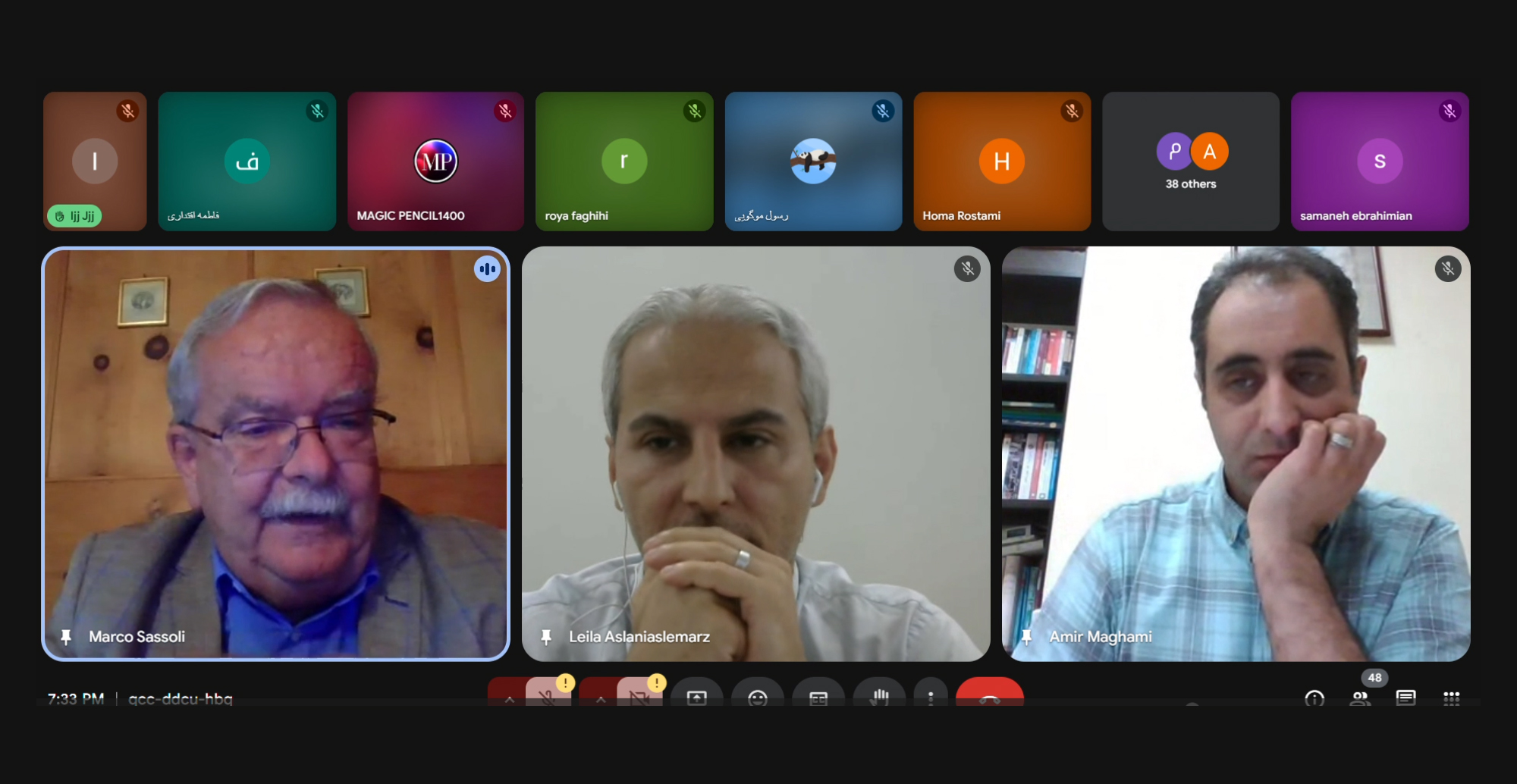
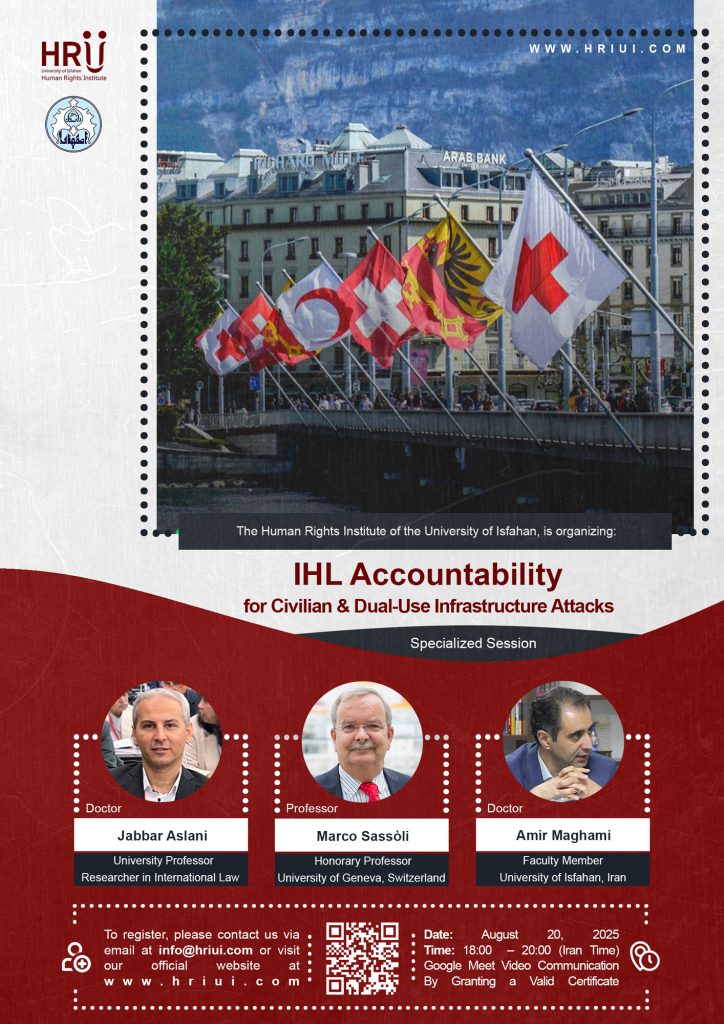
The international session on “IHL Accountability from Civilian & Dual-Use Infrastructure Attacks” was organized by the Human Rights Institute of the University of Isfahan (HRIUI) in August 2025. This dialogue, given the high significance of the responsibility of states and international actors with respect to attacks on civilian infrastructure and the imperative of ensuring accountability through global forums, provided a valuable opportunity to deeply examine this issue from the perspective of human rights foundations and international humanitarian law.
Session Information
- Moderator: Dr. Amir Maghami, Faculty Member, Department of Law, University of Isfahan, Iran
- Speakers:
- Prof. Marco Sassòli, Honorary Professor of International Law, University of Geneva, Switzerland
- Dr. Jabbar Aslani, University Professor and Researcher in International Law, Iran
- Main Themes:
- Fundamental Targeting Rules and Accountability Mechanisms under International Humanitarian Law
- Accountability in the Context of the Twelve-Day Conflict between Iran and Israel
- Date: Wednesday, August 20, 2025
- Time: 18:00–20:00
- Platform: Google Meet
Report of Presentations
Prof. Marco Sassòli structured his presentation around two key themes: first, clarifying the fundamental targeting rules in international humanitarian law, and second, explaining accountability mechanisms in this domain.
In the first part, he noted that targeting during armed conflicts is governed by non-derogable principles that ensure the preservation of human dignity and the limitation of the destructive effects of war. These three principles are:
- Principle of Distinction: the obligation to distinguish between combatants and civilians, as well as between military objectives and civilian objects.
- Principle of Proportionality: the prohibition of any attack in which incidental harm to civilians and civilian objects would be excessive in relation to the concrete and direct military advantage anticipated.
- Principle of Precaution: the duty of parties to an armed conflict to take all feasible measures to minimize harm to civilians.
He emphasized that members of armed forces and organized armed groups with continuous combat functions are legitimate targets, while civilians remain under protection. Specifically, he clarified that workers in military industries—such as arms factories—do not lose their civilian status, even if such facilities may constitute military objectives. Prof. Sassòli highlighted the special protection afforded to objects indispensable for survival, such as hospitals, food resources, and water facilities. He explained that the destruction of such infrastructure, even if constituting a lawful military target, can have broad secondary consequences. For example, destroying water systems could indirectly cause widespread disease and death among civilians. Therefore, proportionality assessments must consider not only the direct consequences of attacks but also their reverberating and indirect effects, as neglecting such considerations undermines the humanitarian foundations of international humanitarian law.
In the second part of his presentation, Prof. Sassòli turned to the fundamental challenge of accountability in IHL, identifying it in the lack of transparency by states and armed forces regarding targeting decisions. He explained that meaningful accountability requires the public and accessible disclosure of information encompassing three essential elements:
- The nature of the targeted objectives;
- Their military necessity and significance;
- The precautionary measures undertaken to protect civilians.
He stressed that without such disclosure, independent and impartial evaluation of the conduct of parties is impossible. While the establishment of a permanent international mechanism to ensure accountability would be ideal, he observed that the political will of states to establish such a body remains absent. He recalled that even institutions such as the International Humanitarian Fact-Finding Commission, created under the Geneva Conventions, have yet to be effectively employed. Likewise, ad hoc mechanisms such as those created for the Syrian crisis have faced structural and political limitations.
In conclusion, Prof. Sassòli underlined that despite the existence of a robust legal framework, the lack of enforcement mechanisms and political commitment undermines their effectiveness. Thus, there is an urgent need for innovation in designing and implementing accountability mechanisms that can overcome political barriers and provide more practical guarantees for compliance with the fundamental principles of international humanitarian law.
Dr. Jabbar Aslani addressed the theme of accountability in the context of the twelve-day conflict between Iran and Israel, analyzing its legal and humanitarian dimensions with reference to authoritative sources.
He began by documenting, based on reports from the United Nations and human rights organizations, the widespread civilian casualties, the destruction of hospitals, and the devastation of residential areas. He explained that such acts raise serious concerns under Article 51 of Additional Protocol I to the Geneva Conventions, which explicitly prohibits indiscriminate attacks. In particular, he emphasized the targeting of nuclear research facilities, which, according to the International Atomic Energy Agency (IAEA), were under the supervision of the Agency and did not constitute immediate military objectives. The destruction of such facilities, he argued, raises serious questions about Israel’s compliance with the 1949 Geneva Conventions.
In the second part, Dr. Aslani highlighted states’ legal obligations, reminding that all states are required to investigate and prosecute possible violations committed by their forces. He noted that accountability is not limited to domestic courts but, under the principle of universal jurisdiction, states may prosecute perpetrators of grave breaches of humanitarian law regardless of nationality. He further explained that violations facilitated through foreign support, such as arms transfers or financial assistance, constitute explicit breaches of international law and must be addressed through sanctions and multilateral mechanisms.
In conclusion, Dr. Aslani underscored the need to outline a way forward, recommending the strengthening of independent international commissions to ensure impartial and transparent investigations. He argued that accountability mechanisms should not be purely punitive but must also serve to restore the credibility of international law and rebuild trust in the fundamental principles of humanitarian law.
Conclusion
Overall, this international session reaffirmed that the fundamental principles of international humanitarian law remain of vital importance despite the passage of time and the changing nature of warfare. The remarks of Prof. Sassòli and Dr. Aslani underscored that the existing legal framework—including the Geneva Conventions and their Additional Protocols—is sufficiently strong and clear, yet the absence of effective enforcement mechanisms and the lack of political will remain the greatest obstacles to their practical implementation.
This gap leaves civilians and critical infrastructure vulnerable in conflict zones, weakening the application of principles such as distinction, proportionality, and precaution in practice. The session thus highlighted the pressing need to reinforce accountability mechanisms capable of ensuring that these principles are upheld in real-world conflicts, ultimately serving the purpose of protecting human dignity and mitigating the devastating effects of war.