Introduction
The right to access education is a fundamental human right recognized in international instruments and Iranian national law. Article 26 of the Universal Declaration of Human Rights states: “Everyone has the right to education. Education shall be free, at least in the elementary and fundamental stages… Higher education shall be equally accessible to all on the basis of merit.” Furthermore, Article 13 of the International Covenant on Economic, Social and Cultural Rights emphasizes the compulsory and free nature of primary education, as well as the progressive development of secondary and higher education for all.
Domestically, Article 30 of the Iranian Constitution obligates the government to provide free education for all citizens until the end of secondary school and to expand higher education free of charge to the extent that national self-sufficiency allows. Additionally, national educational frameworks such as the Fundamental Reform Document of Education underscore the need to ensure educational justice and equal access to learning opportunities across the country. Therefore, securing equitable access to quality education is not only a legal and human rights obligation for Iran, but also a fundamental condition for equitable societal progress and sustainable development. This report critically examines the state of the right to education in Iran through multiple dimensions.
Incidents
- Shortage of Educational Infrastructure
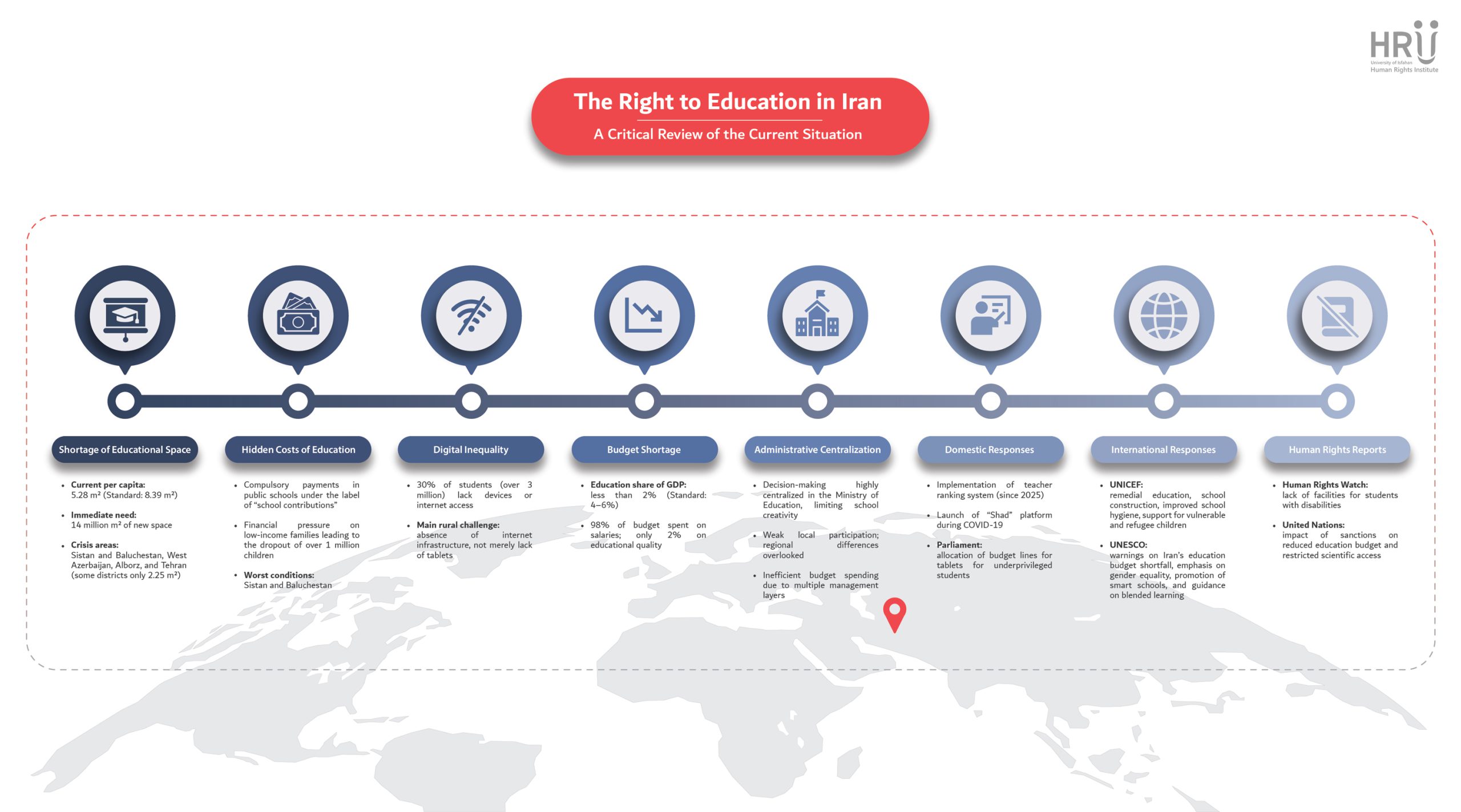
One major challenge facing Iran’s education system is the shortage of standard school buildings and classrooms. The average classroom space per student is approximately 5.28 square meters, while the Fundamental Reform Document of Education stipulates that this figure should be around 8.39 square meters. Even Iran’s Seventh Development Plan sets a medium-term target of only 6.1 square meters, which remains below the desirable standard. These figures highlight the overcrowded and under-resourced state of many Iranian schools. According to official reports, the education system requires around 14 million square meters of new educational space to meet minimum standards[1].
Certain provinces face more critical conditions—for example, Sistan and Baluchestan, West Azerbaijan, Alborz, and even Tehran are among the regions with the lowest per capita educational space and the highest school shortages. In Tehran province, the average educational space per student is around 5.16 square meters, and in areas such as Qods County, it drops to a crisis-level 2.25 square meters. The lack of adequate classrooms has led to an urgent need for the construction of approximately 13,000 new classes in Tehran alone[2]. In deprived provinces like Sistan and Baluchestan, many students have for years studied in non-standard facilities such as metal container classrooms, which, according to officials, are being gradually replaced[3]. Overall, these statistics indicate the inadequacy of physical infrastructure in parts of the country.
- Hidden Costs of Education
Despite the constitutional guarantee of free education, families are burdened with significant hidden costs. Public schools are legally prohibited from charging tuition fees, yet field reports indicate that many schools collect mandatory payments under titles such as “school donations.” In some cases, parents are required to pay fees to enroll their children, and there have been reports of schools withholding report cards until payments are made[4]. These hidden fees, in direct violation of Article 30 of the Constitution, put substantial pressure on low-income families and can lead to student dropouts[5].
According to joint reports by Iran’s Ministry of Education and UNICEF, more than one million children in Iran are currently out of school, with economic hardship cited as a key contributing factor. The highest dropout rates are found in underprivileged provinces such as Sistan and Baluchestan, Kurdistan, Hormozgan, South Khorasan, West Azerbaijan, and Khuzestan. Sistan and Baluchestan faces the country’s most acute dropout crisis[6]. Direct and indirect educational expenses—ranging from school supplies and uniforms to supplementary classes—exceed the financial capacity of many families, particularly those in the lower income brackets, thereby undermining the principle of equal access to education.
- Inequality in Digital Access
The third issue concerns the digital divide and unequal access to educational technology, a gap that became starkly evident during the shift to remote learning amid the COVID-19 pandemic. A significant portion of Iranian students lacked access to high-speed internet, smart devices (such as tablets or smartphones), and online educational content. According to the Ministry of Education, nearly 30% of students—equivalent to 3 to 3.5 million children—had no access to the tools needed to connect to the “SHAD” national online learning platform[7]. These students were primarily located in rural and underserved areas.
In many villages, the core issue was not only the absence of digital devices, but also the complete lack of mobile internet infrastructure, rendering online education impossible[8]. Even in connected areas, many impoverished families could not afford the necessary devices. Some rural students had to travel long distances or gather in limited coverage zones to find a signal—images of students climbing hills to connect to SHAD were widely circulated. As a result, a significant percentage of students fell behind in their education, exacerbating existing inequalities between well-resourced and marginalized regions[9].
Challenges and Responses
- Budget Shortfalls and Poor Prioritization
One of the fundamental obstacles in Iran’s education sector is the insufficient allocation of funds. Education’s share of GDP in Iran is less than 2%, whereas UNESCO recommends a standard of 4–6%. A member of the Iranian Parliament’s Education Committee noted in 2020 that the education sector’s share of the national budget was approximately 8.9%, compared to the global average of 14%. This share was about 18% in the early 2010s and has since declined to below 10%, indicating a policy shift toward the privatization of education.
Combined with severe economic sanctions, the decline in education funding has restricted government resources. UN human rights rapporteurs have confirmed that sanctions have reduced Iran’s public revenues and blocked international aid, thereby weakening its capacity to provide social services, including education[10]. Currently, around 98% of Iran’s education budget is used for salaries, leaving only 2% for quality improvements.
- Administrative Centralization and Structural Issues
Iran’s educational bureaucracy is highly centralized. Experts have observed that this excessive centralization fosters bureaucratic rigidity and stifles innovation, creativity, and school-level participation. Most key decisions and daily directives are issued by the Ministry of Education, creating an imbalance where the “large head” of the administrative system dominates the “thin body” of the school. This has curtailed the autonomy of school principals and teachers and weakened their motivation to initiate improvements.
The lack of decentralization and participatory governance means that local needs and disparities are not adequately reflected in planning and resource distribution. This structure also reduces public oversight and accountability and often results in resource mismanagement. Multiple managerial layers and the absence of an effective performance evaluation system have hindered efficient use of the already limited education budget[11].
- Domestic Reactions
A key initiative has been the implementation of the long-delayed teacher ranking system, which began in 2022. This reform, aimed at improving teacher compensation, slightly increased education’s share of GDP to 3.2%. Although this still falls short of global standards, the allocation of approximately 380 trillion rials (around $760 million) signaled an effort to address teacher livelihoods[12].
The Ministry of Education also attempted to manage online learning during the pandemic through the SHAD platform. The ministry compiled data on students lacking digital tools and collaborated with related agencies and charitable organizations. According to the Deputy Minister, over 3.255 million students were unable to access virtual learning solely due to the lack of devices. The ministry appealed to companies and philanthropists to fulfill their social responsibility by donating tablets[13]. Concurrently, it coordinated with the Ministry of Communications to provide free educational internet access for students and teachers[14].
In the legislative arena, Parliament held oversight sessions and passed budget-related laws to support education. The Education and Research Committee repeatedly highlighted the budget shortfall, bringing public attention to the issue. In the 2021 budget law, Parliament allocated a specific line item for providing tablets to low-income students, amounting to 5 trillion rials (around $10 million). For the 2022 budget, 10% of vehicle import revenues were earmarked for student tablet purchases[15]. Although these allocations are insufficient to meet multi-million student needs, they mark a step toward closing the digital divide.
- International Reactions
UNICEF has actively supported the right to education in Iran, partnering with the Ministry of Education on joint programs to promote equitable access. For instance, with funding from the European Union, thousands of Iranian and migrant children in disadvantaged provinces received preschool remedial education to better prepare for school[16]. UNICEF has also contributed to school construction and improvements in school water and sanitation infrastructure. It has funded development projects for underserved students, including building classrooms and water networks in vulnerable regions[17]. UNICEF has also consistently advocated in international forums for increased financial support for the education of Afghan refugee children in Iran, urging the international community to acknowledge Iran’s disproportionate burden in hosting these children[18].
UNESCO, as a global monitor of educational progress, has issued reports raising concerns and offering recommendations regarding Iran. Its annual Global Education Monitoring Reports evaluate Iran on indicators such as education budget share, gender parity, and adult literacy. UNESCO has specifically highlighted Iran’s underinvestment in education. One report notes that Iran still falls short of the minimum 4% GDP allocation for education. However, it has acknowledged certain achievements, such as gender parity in primary and secondary school enrollment. During the pandemic, UNESCO recognized Iran’s experience with SHAD and shared its hybrid learning initiatives with other countries. It has also encouraged Iran’s participation in the “Smart Schools” program, with several Iranian schools now part of the UNESCO Associated Schools Network.
Meanwhile, international human rights organizations have issued reports on education in Iran over the past five years. Human Rights Watch has cited inadequate physical accommodations (e.g., ramps, elevators) and the lack of inclusive education training for teachers as systemic problems. It urged Iran to abolish disability screening tests that contravene the Convention on the Rights of Persons with Disabilities and to promote inclusive education with adequate resources and policy reform[19].
The UN Office of the High Commissioner for Human Rights has addressed education in Iran from two perspectives: the effects of sanctions on socio-economic rights, and through its Universal Periodic Review process. In her 2022 visit to Iran, the Special Rapporteur on the negative impact of unilateral coercive measures (Alena Douhan) reported to the Human Rights Council that secondary U.S. sanctions and corporate self-sanctioning had restricted Iranians’ access to scientific exchanges and online education platforms. These restrictions, including IP blocks, impeded academic freedom and harmed the right to education. She also noted that government revenues had declined due to sanctions, placing pressure on education and other social sectors. The UN welcomed her recommendations and issued a statement calling for the immediate removal of sanctions that impede fundamental rights such as education.
Conclusion
Despite some progress, the right to access education in Iran remains hindered by multilayered obstacles that have rendered inclusive education difficult for many children. The shortage of physical infrastructure, such as standard classrooms, has led to overcrowding and reduced educational quality. Hidden educational costs have violated the principle of free public education and imposed financial hardship on low-income families. The digital divide, particularly in disadvantaged areas, has excluded millions from virtual learning and deepened educational inequality.
Addressing these issues requires a comprehensive and transformative approach, with government and Parliament prioritizing education in public budgets and GDP allocation. Educational equity must guide resource distribution and policymaking to ensure that underprivileged regions receive prioritized support. Strict oversight of Article 30’s implementation and the elimination of illegal tuition practices are essential. Increased transparency in indicators such as dropout rates, classroom space per student, and per-student expenditure can enable accountability and improve educational governance.
The experience of active partnerships with school-building philanthropists, grassroots organizations, and international bodies such as UNICEF and UNESCO has shown that substantial potential for positive transformation exists. Achieving free, high-quality, merit-based education for all Iranian children is not an idealistic dream—it is a strategic necessity that is entirely attainable with political will, targeted investment, and the leveraging of global expertise. A better future for Iran depends on inclusive quality education, and this investment is not only a response to present needs but also a guarantee of justice and development for the nation’s future.
References
[1] PANA. (2024, October 7). Iran’s Ministry of Education requires construction of approximately 14 million square meters of new educational space. PANA News Agency. From: https://www.pana.ir/news/1508056
[2] Tasnim News Agency. (2025, January 27). Motamedian: The biggest challenge facing Tehran Province is lack of educational infrastructure. Tasnim News. From: https://www.tasnimnews.com/fa/news/1403/11/07/3245687
[3] Poudineh, Sh. (2025, January 10). Minister of Education: Sistan and Baluchestan suffers from a severe shortage of school infrastructure. IRNA. From: https://www.irna.ir/news/85715137
[4] IMNA. (2025, January 10). Government school tuition fees: An illegal expense only on paper. IMNA News. From: https://www.imna.ir/news/790259
[5] ANA News Agency. (2024, September 7). Hidden tuition or school donation? Article 30 of the Constitution forgotten. ANA. From: https://ana.ir/fa/news/930373
[6] Asriran. (2024, December 25). Over one million children in Iran are out of school. Asriran News. From: https://www.asriran.com/fa/news/1024258
[7] Beiranvand, M. (2021, October 31). Head of Special Education: 30% of students lack access to smart devices or the internet. IRNA. From: https://www.irna.ir/news/84524632
[8] Hamshahri Online. (2020, September 28). One-third of rural students lack access to virtual learning infrastructure. Hamshahri Online. From: https://www.hamshahrionline.ir/news/552891
[9] Hashemi, H. (2020, April 14). Marginalized students absent from national Shad platform. Iran Newspaper. From: https://old.irannewspaper.ir/newspaper/item/540599
[10] United Nations. (2022). G2251188: Official document on human rights in Iran [PDF]. From: https://documents.un.org/doc/undoc/gen/g22/511/88/pdf/g2251188.pdf
[11] Hosseini, J. (2024, August 29). Challenges and departure points in Iran’s education system. Etemad Newspaper. From: https://www.etemadnewspaper.ir/fa/main/detail/221630
[12] Donya-e-Eqtesad. (2024, February 21). Increase in education sector’s share of GDP. Donya-e-Eqtesad. From: https://donya-e-eqtesad.com/fa/news/4047916
[13] ILNA. (2020, August 4). “Lack of access to tablets and phones” excluded 4.7 million students from Shad platform. ILNA News Agency. From: https://www.ilna.ir/fa/tiny/news-949241
[14] Iranian Parliament Research Center. (2020, December 19). Parliament plan to distribute one million student tablets. Majlis Research Center. From: https://rc.majlis.ir/fa/news/show/1633833
[15] Mohammadi, F. (2022, February 3). Parliament to fund purchase of student tablets through car import revenues. Zoomit. From: https://www.zoomit.ir/tech-iran/379131-student-tablet
[16] Sayyari, M. (2024, September 30). 1000 Iranian and refugee children and their families benefited from remedial and parenting classes. UNICEF Iran. From: https://www.unicef.org/iran/en/press-releases/1000-iranian-and-refugee-children-and-their-families-benefited-remedial-and
[17] Tehran Times. (2023, July 22). UNICEF supports projects for less-advantaged students in Iran. Tehran Times. From: https://www.tehrantimes.com/news/487108/UNICEF-supports-projects-for-less-advantaged-students-in-Iran
[18] UNESCO. (2024, September 19). Financing for equity – Iran (Islamic Republic of). Education Profiles. From: https://education-profiles.org/central-and-southern-asia/iran-islamic-republic-of/~financing-for-equity
[19] Human Rights Watch. (2019, October 2). Iran: Schools shut out children with disabilities. Human Rights Watch. From: https://www.hrw.org/news/2019/10/02/iran-schools-shut-out-children-disabilities