Introduction
In recent years, Hungary has at times faced challenges concerning democracy and political freedoms, a trend largely associated with the policies pursued by Viktor Orbán, the country’s former Prime Minister, and his party since 2010. According to numerous reports, the Orbán government, through the concentration of political power, changes to the electoral system, influence over the media, and restrictions on civil society organizations, weakened the country’s established democratic structures.
The European Commission and European Union monitoring bodies repeatedly warned of the erosion and weakening of the rule of law, judicial independence, and media freedom. International reports have likewise emphasized that, by introducing restrictive legislation targeting universities, research institutions, and human rights organizations, the government reduced these institutions’ ability to operate independently and exercised extensive control over the free flow of information.
Furthermore, the instrumental use of national security discourse to silence political opponents contributed to a deepening of social and political divisions within the country. Taken together, these developments led Hungary in recent years to shift from its position as an emerging democracy toward becoming an example of growing authoritarian tendencies in Europe. Consequently, the state of political freedoms, civic participation, and the rule of law in the country became a major source of concern for both domestic and European institutions.
Incidents
- Adoption of the Fourteenth Amendment to the Fundamental Law
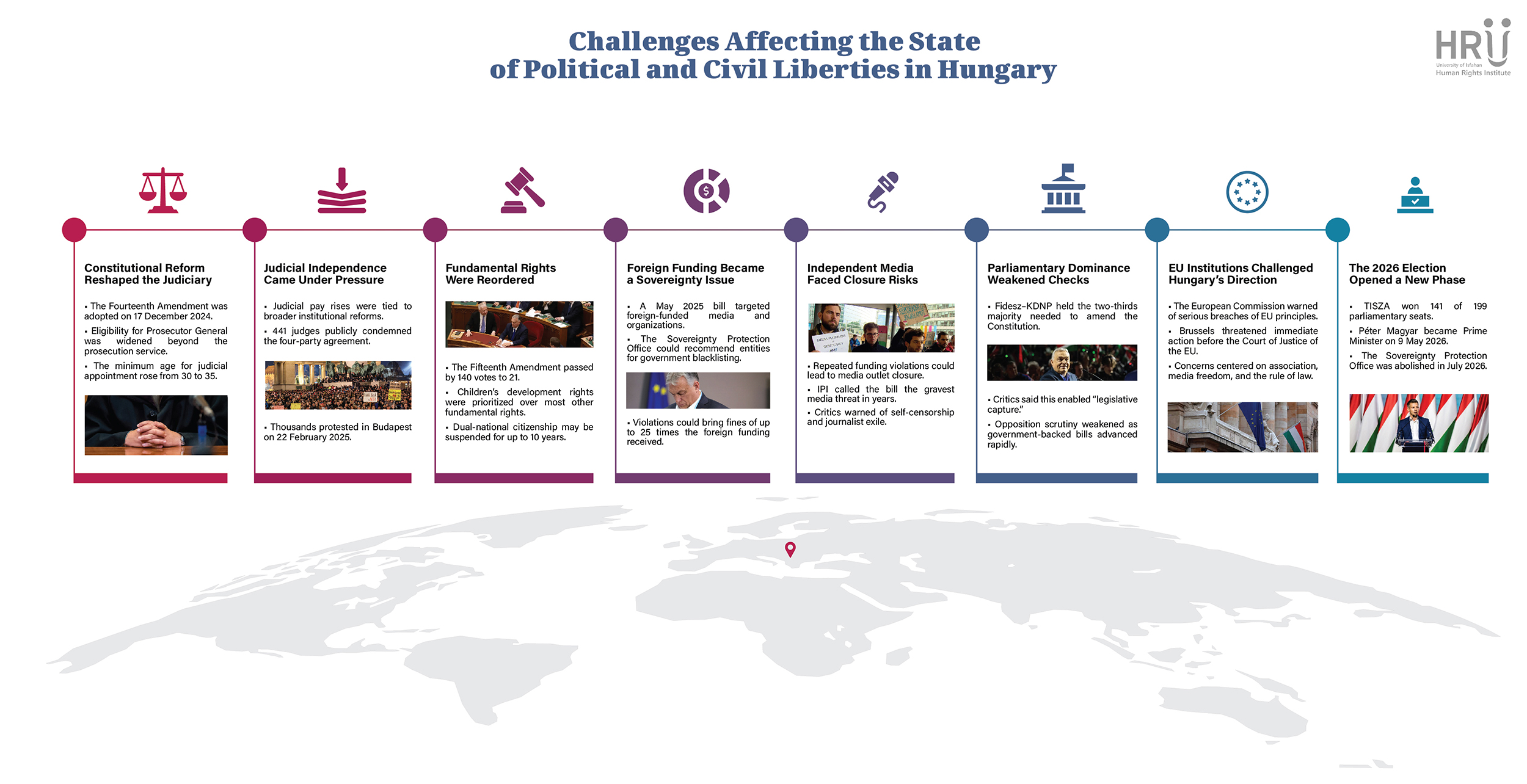
The Fourteenth Amendment to the Fundamental Law of Hungary, adopted on 17 December 2024, introduced a series of structural changes to the country’s judicial and prosecution systems. Its various provisions entered into force in stages, on 1 January 2025 and 1 March 2025, while the provisions allowing judges, in specified circumstances, to remain in office until the age of 70 took effect on 1 January 2026.
The amendment removed the previous requirement that the Prosecutor General be elected from among members of the prosecution service, thereby significantly broadening the pool of persons eligible for appointment to that office. It also redefined the age and professional requirements for the appointment of certain senior judicial officials and introduced substantial changes to the mechanisms governing the administration of the prosecution service and appointments to senior positions within the judiciary. Taken together, these reforms effectively reorganized the legal framework governing the selection and administration of the highest prosecutorial authority and parts of Hungary’s judicial system. The change substantially broadens the range of eligible candidates and, in practice, makes it possible for members of the government or political figures to head the prosecution service for a nine-year term.
Under the amendment, judges may, in cases specified by a cardinal Act, remain in office until the age of 70, whereas the previous general rule required their service to end upon reaching the general retirement age. The details of this process had yet to be fully specified, but critics argued that individualized assessments for extending judicial service could become a means of exerting pressure, enabling selective treatment, and politicizing the judiciary[1]. The amendment also raises the minimum age for appointment as a judge from 30 to 35[2].
The new requirements do not apply to individuals who had already entered judicial service before 1 January 2025 as court secretary (bírósági titkár), or who had served as trainee judge (bírósági fogalmazó) before that date. According to stakeholders, these changes favour candidates applying for judicial office from outside the judiciary[3]. More broadly, they may facilitate the appointment to judicial positions of individuals whose professional backgrounds lie outside the judicial system, including those with previous experience in the executive branch—an issue critics regard as a source of concern from the standpoint of judicial independence and impartiality.
- Salary Increases Tied to Judicial Reforms
The Hungarian government’s decision to make judicial salary increases conditional on acceptance of judicial reforms was formalized in a four-party agreement signed on 22 November 2024. The agreement linked pay rises for judges and court staff to the implementation of a broader package of reforms affecting the judicial system. Many judges and organizations defending judicial independence regarded this as an attempt to make salary increases contingent upon acceptance of the government’s reform agenda.
The four-party agreement was concluded between the government and the heads of the country’s three highest judicial bodies, without what critics described as the genuine participation or consent of the wider judiciary. Hundreds of judges and organizations representing their interests strongly objected to the agreement, characterizing it as “bargaining[4],” “political blackmail,” “bribery,” “a violation of judicial independence,” and “trading away judicial dignity.” The controversy led to public statements and large-scale demonstrations in Budapest and elsewhere.
Critics argued that the National Judicial Council, an independent body with statutory powers and budgetary autonomy, had been improperly pressured into signing the document hastily, in secrecy, and without adequate consultation with judges[5]. More broadly, although government officials maintained that the judiciary remained constitutionally independent, many judges believed that the developments posed serious threats to democratic norms[6].
Supporters of the Orbán government also publicly defended the government’s decision. Zsolt Bayer, a prominent pro-government writer and an ally of Viktor Orbán, went so far as to call for a list to be compiled of judges who had taken part in the demonstrations[7].
- Adoption of the Fifteenth Amendment to the Fundamental Law
The Fifteenth Amendment to the Fundamental Law of Hungary was adopted by the Hungarian Parliament on 14 April 2025, with 140 votes in favour and 21 against[8]. It was promulgated on the same day. Most of its provisions entered into force the following day, while Articles 7, 8, and 11 of the amendment took effect on 1 January 2026[9].
The amendment introduced a series of significant changes to the Fundamental Law, including giving priority to the rights and upbringing of children over other rights—with the exception of the right to life—guaranteeing the right to make payments in cash, and creating a legal basis for the suspension of citizenship in specified circumstances for dual nationals. The amendment provides that children’s right to the physical, mental, and moral development necessary for their proper growth, with the exception of the right to life, takes precedence over other fundamental rights, including the right of assembly[10].
With regard to the monetary and banking system, the text of the amendment states that “cash is legal tender which, in its physical form, operates independently of digital systems, banks, and third parties. Only the continued circulation of cash can ensure that the functioning of the economy does not become entirely dependent on electronic financial systems, which may be vulnerable for technical or market-related reasons[11].”
The amendment also made it possible, under conditions to be laid down in a cardinal Act, to temporarily suspend the citizenship of certain dual nationals. Subsequent implementing legislation provided for suspension for a period of up to ten years[12].
These reforms have been regarded as part of the government’s broader effort to reshape the country’s legal and social structures and strengthen the role of the state in key areas of governance. Critics argue that although these provisions are framed in terms such as family protection, children’s rights, constitutional identity, and Hungary’s Christian culture, they are, in substance, political and authoritarian in character[13].
Critics have also argued that the problem lies not only with this amendment as a discrete measure, but also with the Fundamental Law of Hungary itself, which provides the constitutional basis for such amendments. They contend that the Fundamental Law has long been criticized for having been adopted without meaningful participation by the political opposition, for promoting the conservative ideology of Fidesz, and for weakening independent institutions[14].
- Transparency in Public Life
On 13 May 2025, János Halász, a member of the governing Fidesz party, submitted to the Hungarian Parliament a draft law entitled “Transparency in Public Life.” The bill sought to establish a mechanism under which the Sovereignty Protection Office could recommend to the government that organizations, media outlets, and other legal entities receiving foreign funding be placed on a special list if they were deemed to pose a threat to Hungary’s sovereignty. The Sovereignty Protection Office was a body tasked with investigating organizations and media outlets suspected of being subject to foreign influence. Under the bill, the Office could recommend that an organization be included on the list of entities deemed to threaten sovereignty, while the final decision on listing remained with the government[15].
If a media outlet failed to comply with these provisions, the anti-money laundering authority could impose a fine equal to 25 times the amount of foreign funding received. Such a fine had to be paid within 15 days and could, in practice, financially destroy a small media outlet. If repeated violations involving the receipt of foreign funding were established, a media outlet placed on the list of entities deemed to threaten sovereignty could face closure, thereby creating a legal avenue that could effectively be used to shut down independent media outlets[16].
The draft law immediately prompted strong reactions from media freedom organizations, the European Union, and human rights organizations, which regarded it as an attempt to silence independent media. These concerns were further intensified by remarks made by Viktor Orbán in March 2025, when, using strongly worded rhetoric, he spoke of launching a kind of “spring cleaning” against political, media, and civil networks receiving foreign support[17].
Following these pressures, on 4 June 2025, the government postponed parliamentary consideration and voting on the bill, with further proceedings deferred until the autumn. These developments, taking place ahead of the 2026 parliamentary elections, heightened concerns about the possible impact of the proposed regulations on media outlets and civil society organizations[18]. Nevertheless, related structures such as the Sovereignty Protection Office remained operational, and concerns over threats to press freedom persisted.
It should be noted that following the change of government in 2026, the Hungarian Parliament approved the abolition of the Sovereignty Protection Office on 30 June 2026, and the institution ceased operations when the relevant legislation entered into force on 16 July 2026[19]. Earlier, in 2017, Budapest had adopted legislation targeting non-governmental organizations that generated considerable controversy. The government argued that the measure was intended to ensure transparency among groups receiving financial assistance. However, in 2020, the Court of Justice of the European Union ruled that the requirements imposed on civil society organizations receiving foreign funding constituted discriminatory and unjustified restrictions and were incompatible with European Union law[20].
Challenges and Responses
- Alignment Between the Government and Parliament
One of the challenges raised in relation to civil and political liberties in Hungary during the period of Fidesz rule was the extensive alignment between the government and the parliamentary majority. Viktor Orbán served as Prime Minister of Hungary from 2010 to 2026, while the Fidesz–KDNP coalition held a sufficiently strong majority for much of this period to advance the government’s legislative agenda on a broad scale.
As a result of changes introduced under Orbán to the structure of Hungary’s electoral system, the system enabled Fidesz to secure a particularly powerful parliamentary majority with a share of the popular vote lower than its proportion of parliamentary seats. Some scholars have described this process as a form of “legislative capture[21].”
Fidesz’s commanding parliamentary majority allowed the decision-making and legislative process to proceed without effective opposition, enabling the government to adopt controversial measures—including legislation concerning sovereignty protection, the regulation of civil society, and electoral-system reform—rapidly and with limited scrutiny. Critics regarded this alignment as a form of concentration of power and an erosion of the separation of powers, arguing that it created the conditions for the adoption of legislation restricting political and civil liberties.
Indeed, the two-thirds majority held by the Fidesz–KDNP coalition in Parliament made it possible to adopt constitutional amendments without requiring the support of opposition parties[22]. In critics’ view, this gradually reduced Parliament from an institution exercising oversight to one that largely endorsed government policy.
This alignment, which critics regarded as detrimental, also contributed to a less competitive electoral environment in Hungary, reduced diversity in the media sector, and exposed academic freedom to increasing restrictions and pressures[23].
This situation changed, however, following the 12 April 2026 parliamentary elections. The TISZA Party, led by Péter Magyar, won 141 of the 199 seats in the National Assembly, while the Fidesz–KDNP coalition was reduced to 52 seats, bringing Viktor Orbán’s tenure as Prime Minister to an end[24].
- Domestic Reactions
Hungarian judges responded to the decision to make salary increases conditional upon acceptance of reforms to the judicial system by issuing a public statement. A total of 441 judges and 530 other judicial employees decided to publicly condemn the four-party agreement signed on 22 November 2024 by the government and the highest-ranking officials of Hungary’s judiciary.
Katalin Surányi, a judge at the Budapest Regional Court, was among those who condemned the agreement. She stated:
“There is no place for such a thing in a country governed by the rule of law. Representatives of the different branches of power should cooperate solely on the basis of legal norms, not by relying on multilateral agreements.”
Tamás Csóti, President of the Budapest Regional Court, was another critic of the agreement. He stated:
“I watch with disbelief the inverted entanglement of the branches of government, the lack of transparency in the process leading to the agreement, the superficiality of the discussions, the acceptance of the powers of the Minister of Justice in budgetary matters, and the serious negligence of the National Judicial Council in advancing its support for forthcoming organizational legislation. If I encountered such an agreement in one of the cases before me, I would not believe that it had been concluded by parties who were equal and fully aware of their interests and the relevant legal issues. It is humiliating that the affairs of the Hungarian courts—our affairs—are being handled in this manner[25].”
Thousands of judges and judicial employees held a demonstration in Budapest on 22 February 2025 in defence of judicial independence. The protest was organized by the Hungarian Association of Judges (MABIE) and took place on the same day as the annual address of Viktor Orbán, then Prime Minister of Hungary.
Participants carried placards bearing slogans such as “Justice Is Not for Sale” and “Judicial Independence Guarantees Your Security.” Organizers stressed that the protest was entirely impartial and non-political, although one opposition party released a video report from the demonstration.
At the rally held in front of the Ministry of Justice, Katalin Boros, President of the Hungarian Association of Judges, said that judges believed measures adopted by the government had restricted judicial independence. According to her, reforms concerning the organizational structure and legal status of the judiciary had been adopted by the legislative and executive branches without any meaningful consultation with the judicial community.
She further stated that judicial employees had become increasingly vulnerable because adequate salary increases had not been provided.
Mikael Sjöberg, President of the European Association of Judges (EAJ), also said that the protest demonstrated that “the rule of law in Hungary is facing an ultimate challenge.” He announced that his association supported the demonstration. Sjöberg added that, at the end of the previous year, the association had sent a letter to the Hungarian Minister of Justice objecting to the government’s attempt to make salary increases conditional upon the implementation of judicial reforms—an approach which, in the association’s view, undermined judicial independence[26].
- International Reactions
In response to the “Transparency in Public Life” bill, the European Commission called on the Hungarian authorities to withdraw the proposal. The European Commission explicitly stated that, if adopted, Hungary’s draft law on transparency in public life would constitute “a serious breach of EU principles and rights”, and urged the government of Viktor Orbán to remove the bill from the legislative process immediately.
A European Commission spokesperson, speaking to Euronews, emphasized that the European Union had “deep concerns” about the draft, as it would allow the Hungarian government to place organizations and media outlets receiving foreign funding on a special list if they were deemed to threaten national sovereignty, thereby subjecting them to extensive financial and operational restrictions.
The Commission warned that, should the legislation be adopted, it would not hesitate to take legal action, including bringing the matter immediately before the Court of Justice of the European Union and requesting interim measures. Michael McGrath, the European Commissioner for Democracy, Justice, the Rule of Law and Consumer Protection, also described the draft as incompatible with fundamental standards concerning freedom of association and media freedom, noting that in 2024 the European Union had already referred Hungary to the Court of Justice of the European Union over legislation establishing the Sovereignty Protection Office[27].
The International Press Institute (IPI), together with a number of organizations supporting media freedom, also reacted to the 13 May 2025 bill. They stated that the Bill on the Transparency of Public Life, which would have allowed the government to place organizations, media outlets, and other covered legal entities on a special list and impose severe financial restrictions or even closure on media outlets and organizations receiving foreign funding, represented “the most serious threat to independent media in years.”
They further described the proposal as the latest stage in the more than decade-long campaign of Prime Minister Orbán’s government to weaken independent journalism and dismantle media pluralism. These organizations warned that the bill would effectively become the first law of its kind within the European Union and could open the way for a Russian-style model of media repression inside the Union. They also considered it a direct threat to the EU’s fundamental values, including media freedom, pluralism, and the free movement of capital under the Charter of Fundamental Rights of the European Union.
According to their assessment, the bill would grant extensive powers to the Sovereignty Protection Office, including the ability to place organizations on a blacklist, prohibit them from receiving foreign funding, impose fines amounting to 25 times the value of the funds received, confiscate resources, inspect newsrooms, require disclosure of managers’ assets, and deprive organizations of eligibility to receive voluntary one-percent personal income tax donations. These measures, they argued, could financially destroy many independent media outlets, increase self-censorship, and force journalists into exile.
The IPI and the other signatory organizations called for immediate action by the European Union, including a swift assessment of the bill’s incompatibility with EU law, urgent proceedings before the Court of Justice of the European Union, and the adoption of interim measures. They warned that inaction by the European Union could pave the way for similar measures to be replicated in countries such as Slovakia[28].
Conclusion
Developments in Hungary in recent years reflect a phase of legal and institutional restructuring that has simultaneously affected the judiciary, the constitutional order, and media regulation. Constitutional amendments, changes to recruitment and appointment criteria within the judiciary, and legislative initiatives concerning oversight of the financial resources of media outlets and civil society organizations have redefined the relationship between political power and the scope of authority exercised by political institutions. These developments have also raised questions regarding the degree of judicial independence, patterns of governance within the European Union, and the capacity of the political system to preserve an effective balance of powers domestically.
From the perspective of domestic and international institutions, this trajectory has had varying implications for political and civil liberties in Hungary. Parts of the judicial community expressed concern about the impact of these reforms on their professional and institutional independence, while a number of European organizations assessed their potential consequences for media freedom and the fundamental guarantees of the European Union. At the same time, the Orbán government justified these changes in terms of improving the efficiency of governance, protecting the public interest, safeguarding national sovereignty, and enhancing transparency.
The April 2026 parliamentary elections and the beginning of Péter Magyar’s premiership on 9 May 2026, following the victory of the TISZA Party, opened a new phase in this process. Measures taken by the new government and parliamentary majority to repeal or reconsider certain institutions and policies introduced during the Orbán era, including the abolition of the Sovereignty Protection Office, indicate that any assessment of the state of civil and political liberties in Hungary must now take into account not only the legal legacy of the previous period, but also the direction and practical consequences of the reforms pursued by the new government.
Taken together, these developments have created a distinctive situation in which the functioning of independent institutions, the scope of civil liberties, and the dynamics of the public sphere have once again become subjects requiring close examination. They also demonstrate that the path ahead will require a balance between public demands, the concerns of European institutions, and the preservation of democratic frameworks in Hungary.
References
[1] Farkas, E. (2025, April 29). Hungary’s 14th Constitutional Amendment: Cementing the Incremental Political Takeover of Judicial Power. ConstitutionNet. From: https://constitutionnet.org/news/voices/hungarys-14th-constitutional-amendment-cementing-incremental-political-takeover-judicial-power
[2] Daily News Hungary. (2024, December 18). Hungary’s parliament adopts constitutional amendment revising requirements for chief prosecutor and judges. ConstitutionNet. From: https://constitutionnet.org/news/hungarys-parliament-adopts-constitutional-amendment-revising-requirements-chief-prosecutor-and
[3] Europian Commission. (2025, July 8). 2025 Rule of Law Report, Country Chapter on the rule of law situation in Hungary. Europian Commission. From: https://commission.europa.eu/document/download/524bd8d4-33ba-4802-891f-d8959831ed5a_en?filename=2025+Rule+of+Law+Report+-+Country+Chapter+Hungary.pdf
[4] European Magistrates for Democracy and Freedoms. (2024, December 12). Solidarity with Hungarian Judges. MEDEL. From: https://medelnet.eu/solidarity-with-hungarian-judges/
[5] Komuves, A., & Fenyo, K. (2025, February 22). Hungarian judges, court staff rally for judicial independence. Reuters. From: https://www.reuters.com/world/europe/hungarian-judges-court-staff-rally-judicial-independence-2025-02-22/
[6] Lawyers and Democratic Decline. (2025, February 22). Hungary: Judges and Court Staff Rally to Defend Judicial Independence. University of Wisconsin. From: https://ladd.law.wisc.edu/2025/02/22/hungary-judges-and-court-staff-rally-to-defend-judicial-independence/
[7] Szaplonczai, L. (2025, March 24). Judges in Hungary fight for an independent judiciary. Yahoo News. From: https://uk.news.yahoo.com/judges-hungary-fight-independent-judiciary-144600298.html
[8] About Hungary. (2025, April 15). Hungary’s parliament adopts 15th amendment of Fundamental Law. About Hungary. From: https://abouthungary.hu/news-in-brief/hungary-s-parliament-adopts-15th-amendment-of-fundamental-law
[9] Uitz, R. (2025, May 2). The 15th Amendment of the Hungarian Fundamental Law: Advancing Illiberal Christian Democracy. ConstitutionNet. From: https://constitutionnet.org/news/voices/15th-amendment-hungarian-fundamental-law-advancing-illiberal-christian-democracy
[10] Gorondi, P. (2025, April 14). Hungary Passes Constitutional Amendment Recognizing Only Two Genders. Radio Free Europe. From: https://www.rferl.org/a/hungary-passes-bill-two-sexes/33385011.html
[11] Helsinki. (2025, April 14). The Fifteenth Amendment to the Fundamental Law of Hungary. Parliament of Hungary. From: https://helsinki.hu/en/wp-content/uploads/sites/2/2025/04/Bill_11152_adopted_EN_unofficial_translation.pdf
[12] Euronews., & AP. (2025, April 14). Hungary’s parliament passes constitutional amendment banning public LGBTQ+ events. Euronews. From: https://www.euronews.com/2025/04/14/hungarys-parliament-passes-constitutional-amendment-banning-public-lgbtq-events
[13] Mészáros, G. (2025. May 23). We the Bugs, Constitutionalizing “Enemies”. Verfassungsblog. From: https://verfassungsblog.de/we-the-bugs-hungary-orban-lgbtq/
[14] Eurochild. (2025, March 26). Hungarian NGOs Warn Against 15th Amendment’s Threat to Fundamental Rights. Eurochild. From: https://eurochild.org/news/hungarian-ngos-warn-against-15th-amendments-threat-to-fundamental-rights/
[15] Euronews. (2025, June 4). Hungary delays vote on ‘transparency law’ targeting foreign-funded NGOs and media until autumn. Euronews. From: https://www.euronews.com/2025/06/04/hungary-delays-vote-on-transparency-law-targeting-foreign-funded-ngos-and-media
[16] ARTICLE 19. (2025, June 4). Hungary: Foreign funding bill poses worst threat to independent media in years. ARTICLE 19. From: https://www.article19.org/resources/hungary-foreign-funding-bill-poses-worst-threat-to-independent-media-in-years/
[17] France 24. (2025, May 18). Hungarians protest ‘authoritarian’ bill against NGOs, media. France 24. From: https://www.france24.com/en/live-news/20250518-hungarians-protest-authoritarian-bill-against-ngos-media
[18] European Centre for Press and Media Freedom. (2025, November 7). Hungary: Media freedom remains in crisis mode ahead of 2026 elections. ECPMF. From: https://www.ecpmf.eu/hungary-media-freedom-remains-in-crisis-mode-ahead-of-2026-elections/
[19] National Legislation Database of Hungary. (2026, June 30). Act XXIV of 2026 on the Abolition of the Sovereignty Protection Office. National Legislation Database of Hungary. National Legislation Database of Hungary. From: https://njt.jog.gov.hu/jogszabaly/2026-24-00-00
[20] Court of Justice of the European Union. (2020, June 18). Judgment in Case C-78/18, Commission v Hungary (Transparency of associations). Court of Justice of the European Union. Court of Justice of the European Union. From: https://infocuria.curia.europa.eu/tabs/redirect/juris/liste.jsf?num=C-78%2F18
[21] Enyedi, Z., & Mikola, B. (2025). Legislative Capture in Hungary: Well-Managed Autocratization. The ANNALS of the American Academy of Political and Social Science. 712(1), 34-46. https://doi.org/10.1177/00027162241307778
[22] Scheppele, K. L. (2022). How Viktor Orbán Wins. Journal of Democracy. 33(3), 45-61. https://dx.doi.org/10.1353/jod.2022.0039.
[23] Smeltzer, M. (2024, July 18). Hungary Versus Brussels on the Diplomatic Stage. Freedom House. From: https://freedomhouse.org/article/hungary-versus-brussels-diplomatic-stage
[24] National Election Office of Hungary. (2026, May 7). Composition of the National Assembly – Parliamentary Elections 2026. National Election Office. National Election Office of Hungary. From: https://vtr.valasztas.hu/ogy2026/orszaggyules-osszetetele
[25] Hungarian Helsinki Committee. (2024, December 3). Judges’ salary is a public matter, and not an issue of personal finances. Helsinki. From: https://helsinki.hu/en/judges-salary-is-a-public-matter-and-not-an-issue-of-personal-finances/
[26] bne IntelliNews. (2025, February 24). Hungarian judges demonstrate for freedom of judiciary. bne IntelliNews. From: https://www.intellinews.com/hungarian-judges-demonstrate-for-freedom-of-judiciary-368607/
[27] Zsiros, S. (2025, May 24). Confrontation ahead: EU Commission demands that Hungary withdraws draft transparency law. Euronews. From: https://www.euronews.com/my-europe/2025/05/24/confrontation-ahead-eu-commission-demands-that-hungary-withdraws-draft-transparency-law
[28] International Press Institute. (2025, May 16). Hungary: Foreign funding bill poses most serious threat to independent media in years. IPI. From: https://ipi.media/hungary-foreign-funding-bill-poses-most-serious-threat-to-independent-media-in-years/