

Introduction
Since the beginning of 2026, the southern coast of Albania has become the focal point of a controversy whose implications extend far beyond a tourism development project or an environmental dispute. The launch of a large-scale tourism development in one of the country’s exceptional protected areas, backed by investment linked to the family of Donald Trump, President of the United States, gradually sparked a wave of local and nationwide protests. These demonstrations quickly evolved into a platform for voicing broader concerns over transparency in government decision-making, corruption, inequality, environmental protection, and respect for the rights of local communities. A project initially promoted on the promise of attracting foreign investment, boosting tourism, and creating employment opportunities has now confronted the government of Edi Rama with serious questions regarding the allocation of land, the extent of state intervention in protected areas, and the degree to which citizens and civil society organizations are afforded the right to participate in decisions that directly affect their living environment and economic future. The case has become particularly sensitive as Albania is simultaneously seeking to advance its accession to the European Union, a process in which the rule of law, the fight against corruption, institutional transparency, and compliance with environmental and human rights standards constitute fundamental requirements.
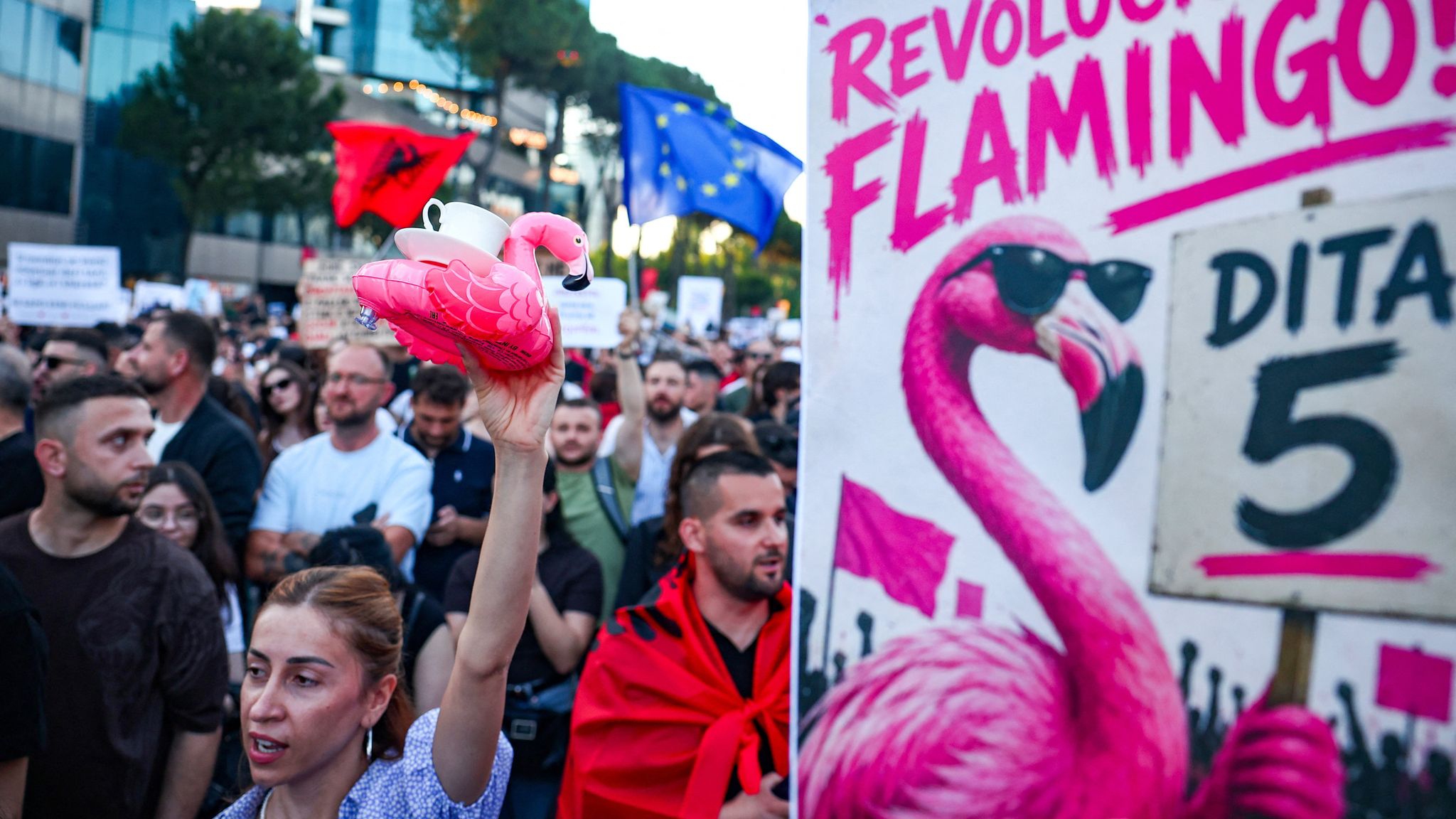
Against this backdrop, the pink flamingos inhabiting the region’s wetlands have been transformed from a feature of the natural landscape into a political and social symbol. Their prominent presence in images, demonstrations, and protest campaigns has led the movement to become known in parts of the media and public discourse as the “Flamingo Revolution”—a name that aptly captures the tension between a top-down model of economic development and citizens’ demands for the protection of natural resources and participation in determining the future of the environment in which they live. From a human rights perspective, the significance of this case is not confined to the fate of a single coastal area. The ongoing controversy can be seen as a test of the quality of governance, the rule of law, transparency, public accountability, and the extent to which citizens’ environmental and participatory rights are respected in Albania—a test whose outcome could affect not only the future of the region itself, but also the credibility of the country’s domestic reforms and its path toward European Union membership.
Incidents
The massive Sazan–Zvërnec tourism project, valued at $4.6 billion[1], has been launched along Albania’s southern coastline as one of the largest foreign investments in the country’s history. The project, spearheaded by Jared Kushner—the son-in-law of Donald Trump, President of the United States—through Affinity Partners[2] and a number of intermediary, or so-called “shell,” companies, including the Albanian company Zvërnec South Adriatic Development and the Dutch company Dutch Trust Management B.V.[3], is intended to transform the former military island of Sazan, a legacy of the communist era, together with the coastal area of Zvërnec, into a complex of luxury hotels, villas, and marinas. The project is expected to include as many as 10,000 hotel rooms and villas, with the stated objectives of expanding tourism, creating jobs, and attracting investment[4]. The project area is located in one of Albania’s most pristine coastal regions on the Adriatic Sea, characterized by a combination of sandy beaches and rocky shorelines.
Nevertheless, the commencement of construction work in the spring of 2026 triggered fierce opposition from local residents and environmental groups and rapidly developed into a political and human rights crisis in the country. The Spain-based newspaper EL PAÍS described the Albanian protests over the project as the country’s largest environmental demonstrations since the fall of the communist regime in 1991[5].
Large-scale protests emerged in several urban areas as well as in villages directly affected by the project. According to the Chinese newspaper China Daily, some of the demonstrations turned violent and a number of protesters were injured[6]. Police used tear gas and pepper spray against demonstrators who were throwing stones, eggs, and other objects at officers[7]. Public anger intensified further after a video circulated showing an activist being dragged along the ground by a private security guard during a demonstration at the project site[8].
At the same time, discontent over large-scale coastal tourism developments spread to other parts of Albania. In the northwestern village of Rrjoll, around 200 protesters tore down fencing surrounding a separate tourism development unrelated to the Kushner project, claiming that the land being used for the development had been wrongfully taken from local residents. Zeke Nikolle Shullani, 56, one of the protesting landowners, said: “The protests will not stop until the residents of the village of Rrjoll are compensated. We are 200 families whose land has been seized.” Nikolin Markpalaj, 60, another local landowner, similarly stated: “What is happening in this country is madness. We asked the investors to come and consult with the people, but they refused…” This separate protest, alongside the controversy surrounding the Zvërnec project, reflected growing public sensitivity over land ownership, the manner in which large tourism developments are implemented, and the rapid development of Albania’s coastline[9].
During demonstrations in Tirana, the capital of Albania, protesters carried cardboard cut-outs of pink flamingos, a symbol that helped give the protests the name “Flamingo Revolution.” The demonstrations initially had a predominantly environmental character, but quickly evolved into broader protests against corruption and the lack of accountability, placing the government of Edi Rama under intense scrutiny and raising questions about land ownership, the use of protected areas, and the manner in which government authorization had been granted for the development project[10].
This broader shift was clearly reflected in the slogans and interviews of demonstrators. Lindita Komani, a writer who joined the protests, said: “Albania is not for sale. Albania belongs to the Albanian people, and we decide what we want to do here. It is not for some corrupt politicians running Albania to decide what to do with our property, with Albania’s heritage, its natural heritage, and its cultural heritage[11].” Protesters also expressed anger over the rising cost of living, the healthcare system, pensions, and the limited opportunities available to young people, many of whom have left Albania in recent years[12]. The protests consequently extended beyond Albania, with diaspora communities in New York, London, and Brussels expressing support for these demands and calling for the resignation of Prime Minister Edi Rama[13].
Once the protests acquired an explicitly political dimension, demonstrators and critics pointed to the failure of a comparable project pursued by Jared Kushner and Ivanka Trump, the son-in-law and daughter of Donald Trump, in Serbia. In November 2025, the Serbian Parliament passed special legislation allowing the construction of a luxury complex in the capital, Belgrade, to be financed by an investment company associated with Kushner. The following month, Serbia’s Prosecutor’s Office for Organized Crime charged four individuals, including a government minister, with abuse of office and document forgery in connection with efforts to facilitate the development. Kushner subsequently withdrew from the planned multimillion-dollar investment, which was intended to replace a large former military complex that had been bombed[14].
Challenges and Responses
- Severe Environmental Damage and Degradation
The principal challenge associated with the project is the prospect of an unfolding environmental disaster in one of the Mediterranean’s most valuable wetland ecosystems. An area previously regarded as a safe haven for flamingos, sea turtles, and migratory birds is now being encroached upon by bulldozers and metal fencing. Protesters and environmental organizations maintain that the Vjosa–Narta area is a crucial migratory corridor for hundreds of bird species and one of the most important flamingo habitats in southeastern Europe. The area also provides habitat for the Mediterranean monk seal, sea turtles, and numerous endangered bird species. More than 40 environmental organizations from 28 countries have so far called on the Albanian authorities to suspend the project pending a comprehensive environmental assessment[15].
Besjana Shehu, an environmental activist and co-founder of the Albanian Ornithological Society, has spent more than a decade working to protect the wetlands, forests, and marshes of the Pishë Poro– Nartë area. In an interview with Deutsche Welle (DW), she stated: “What is at stake is the ecological integrity of more than 18,000 hectares of one of Albania’s most important natural corridors[16].”
Likewise, Aleksandër Trajçe, Executive Director of the Protection and Preservation of Natural Environment in Albania (PPNEA)—the country’s oldest and largest nature conservation organization—described the project as “land grabbing and ecosystem destruction[17].”
These concerns are rooted in a broader fear that the pressures generated by Albania’s rapidly expanding tourism sector have led the government to sideline nature conservation. In 2022, the authorities altered the boundaries of the protected area to allow construction of Vlora International Airport, which the government had hoped would receive its first commercial flight this month, although the airport is still awaiting an operating licence. In 2024, the country’s conservation legislation was relaxed to permit the construction of five-star hotels even within protected areas[18].
- Domestic Reactions
The Special Structure Against Corruption and Organized Crime (SPAK), Albania’s specialized anti-corruption and organized crime body, stated in a roughly 200-page investigative case file that there were “reasonable suspicions” that Artur Shehu, a key seller of land designated for the project, had acquired properties through the use of forged documents and through the laundering of proceeds derived from drug trafficking, allegedly in cooperation with a network involved in trafficking cocaine from South America to Europe.
SPAK subsequently issued an arrest warrant for Shehu and froze approximately €110 million in proceeds from the sale of the land. In connection with the same investigation, the authorities also issued arrest warrants for 20 other individuals on allegations of drug trafficking and money laundering. A spokesperson for the agency, however, declined to comment further on the details of the case, stressing that the investigation remains ongoing.
At present, no allegations of wrongdoing have been made in the case against Jared Kushner, the project’s investors, or the companies associated with them. A spokesperson for Sazan Real Estate Development has likewise stated that the company continues to believe that the underlying land acquisitions were conducted lawfully and in accordance with the applicable procedures[19].
Edi Rama, Prime Minister of Albania, has largely dismissed the protests and defended the Kushner project as a “respectable and law-abiding” investment, presenting it as part of his government’s broader vision of shifting the country away from mass tourism and toward a more upscale, higher-revenue tourism model. Rejecting accusations that his government was “selling Albania” to foreign interests, Rama argued that the protesters represented a small minority who were entitled to demonstrate but could not override the mandate of a government elected by an “overwhelming vote.”[20]
Local critics, by contrast—including residents of Vlorë, artists, and civil society activists—have portrayed the project as emblematic of a colonial approach to Albania’s natural resources. They have warned of the privatization of the coastline, violations of environmental legislation, and a lack of transparency regarding the benefits that such investment would actually deliver to ordinary citizens. Rama responded sharply and sarcastically to such concerns, dismissing them as “lessons from enemies.” He ultimately reinforced his uncompromising position by abruptly terminating his interview with Monocle[20].
- International Reactions
The response of European institutions to the project has been distinctly cautionary and can be understood at two levels. The European Commission issued an explicit warning to the Albanian government, urging it to act “without delay” and to refrain from taking any measures that could jeopardize fulfilment of the closing benchmarks under Chapter 27 of the EU accession negotiations, which covers environment and climate change. A European Commission spokesperson stated that Albania’s Minister of Environment had assured Brussels that construction activities had been suspended. At the same time, however, the Commission expressed serious concern over amendments to the Law on Strategic Investments, adopted in February 2025, which provided special exemptions for investments exceeding €50 million and raised concerns regarding transparency.[21]
The European Parliament, by contrast, adopted a more forceful position, calling for the complete repeal of the 2024 amendments to the Law on Protected Areas and for the immediate introduction of a moratorium on all development projects within protected areas. Members of the European Parliament expressed deep concern over developments in the Vjosa–Narta Protected Area, stressing that the rule of law and compliance with European Union environmental standards are non-negotiable conditions for accession, and regarding the project as emblematic of a broader threat to Albania’s path toward EU membership.
Ultimately, both institutions emphasized the necessity of conducting a comprehensive Environmental Impact Assessment (EIA) with meaningful public participation and warned that continuation along the present course could seriously jeopardize Albania’s accession progress[21].
The reaction of international environmental organizations was similarly emphatic. These organizations strongly welcomed the European Parliament resolution, describing it as a victory for both nature conservation and democracy in Albania. In a joint statement, they emphasized that by calling for the repeal of the 2024 amendments to the Law on Protected Areas and an immediate moratorium on all development projects in protected areas, the European Parliament had sent a clear message to the Albanian government: “you cannot join the EU while bulldozing protected wetlands and bypassing your own laws.”
Joni Vorpsi, Head of Policy and Advocacy at the Protection and Preservation of Natural Environment in Albania (PPNEA), described the Parliament’s call for an immediate moratorium as precisely what protesters needed in their efforts to protect the Vjosa–Narta Protected Area, and as an opportunity for the Albanian government to bring its policies into line with European environmental standards.
Likewise, Anouk Puymartin, Head of Policy at BirdLife Europe, referring to the presence of more than 100,000 protesters on the streets of Tirana, emphasized that the European Parliament had stood alongside the people of Albania, and that protecting nature and protecting democracy constituted a single struggle. These organizations further warned that other Western Balkan countries pursuing European Union accession were closely watching developments in Albania, and that the Parliament’s vote demonstrated that such an approach was incompatible with EU membership[22].
Conclusion
The Sazan–Zvërnec tourism project in Albania has become far more than an economic development initiative; it now represents a critical juncture in the country’s contemporary history, bringing into sharp relief the tensions among the interests of international investors, local political actors, and citizens’ rights. The project’s most outspoken critics argue that it reflects the political system shaped under Edi Rama, in which environmental regulations and citizens’ property rights are sacrificed in the pursuit of large-scale investment and power-laden relationships between the government and wealthy investors. Prime Minister Edi Rama’s determination to proceed with the project despite judicial investigations, widespread protests, and international warnings points to a profound divide between the government and civil society in Albania. It also raises a fundamental question: can the country’s path toward accession to the European Union continue without full respect for environmental standards and the rule of law?
At the same time, the firm response of European institutions and international environmental organizations has transformed the case into a major test for Albania. While the government has sought to advance the project by invoking a development-oriented narrative and dismissing public concerns, civil society, drawing on symbols such as the flamingo, has demonstrated that environmental protection and the defence of citizens’ rights are inseparable. The ultimate outcome of this confrontation will determine not only the future of the Vjosa–Narta wetland and its local communities, but may also provide a precedent for other countries in the Western Balkans as they confront the challenges posed by foreign investment and the obligations arising from the European Union accession process.
Ultimately, this crisis demonstrates that sustainable economic development without transparency, accountability, and respect for human rights and the environment is not merely unattainable, but potentially dangerous, as it can give rise to a deeper crisis affecting society as a whole.
References
[1] Doulgkeri, F., & AP., & AFP. (2026, June 14). Albania: mass protests against Trump son-in-law’s tourism investment enters 14th day. Euro News. From: https://www.euronews.com/my-europe/2026/06/14/albania-mass-protests-against-trump-son-in-laws-tourism-investment-enters-14th-day
[2] Cole, B. (2026, June 9). Kushner Island Resort Would ‘Wreak Lasting Havoc,’ Says Protest Group. Newsweek. From: https://www.newsweek.com/kushner-island-resort-wreak-havoc-environment-protest-group-albania-12048413
[3] Karaj, V. (2026, June). The Investors Behind the Trump Family’s Albanian Resort. Reporter.al. From: https://www.reporter.al/en/2026/05/29/the-investors-behind-the-trump-familys-albanian-resort/#respond
[4] Wetlands International. (2026, June 8). Wetland at risk: let’s not sacrifice the Vjosa-Narta in Albania for the sake of luxury tourism. Wetlands International. From: https://europe.wetlands.org/wetland-at-risk-lets-not-sacrifice-the-vjosa-narta-in-albania-for-the-sake-of-luxury-tourism/
[5] Camhaji, E. (2026, June 15). The Flamingo Revolution rises up against the Trump family’s megaprojects in Albania: ‘Our country is not for sale’. EL PAÍS. From: https://english.elpais.com/international/2026-06-15/the-flamingo-revolution-rises-up-against-the-trump-familys-megaprojects-in-albania-our-country-is-not-for-sale.html
[6] China Daily. (2026, June 5). Albanians protest against US-linked luxury resort. China Daily. From: https://ex.chinadaily.com.cn/exchange/partners/70/rss/channel/www/columns/y38633/stories/WS6a21dd4fa310d6866eb4c82c.html
[7] Agolli, H., & Cimili, Z. (2026, July 3). Albanian police use tear gas and pepper spray as Tirana protest turns violent. The Associated Press. From: https://apnews.com/article/albania-kushner-trump-development-protest-tourism-clashes-063288405ee82156e32e6bde500d0569
[8] Lenja, R. (2026, July 7). Making sense of the Flamingo Revolution in Albania. New Eastern Europe. From: https://neweasterneurope.eu/2026/07/07/making-sense-of-the-flamingo-revolution-in-albania/
[9] Reuters. (2026, June 14). Protesters tear down fences of Kushner project in Albania. DAWN. From: https://www.dawn.com/news/2007700/#comments
[10] Mugo, S. (2026, June 20). Thousands protest in Albania over Kushner-backed resort project. Investing. From: https://www.investing.com/news/economy-news/thousands-protest-in-albania-over-kushnerbacked-resort-project-4751637
[11] News 24. (2026, June 5). Albania protests erupt over Trump son-in-law’s $1.6 billion luxury Adriatic resort plan. News 24. From: https://www.news24.com/world/albania-protests-erupt-over-trump-son-in-laws-16-billion-luxury-adriatic-resort-plan-20260605-0665#google_vignette
[12] AFP. (2026, June 28). Albania protesters keep up pressure over Trump-linked project. Ahram Online. From: https://english.ahram.org.eg/UI/Front/Inner.aspx?NewsContentID=571802
[13] Danishevska, K. (2026, June 8). Trump family-linked resort project could threaten Albania’s EU ambitions. RBC Ukraine. From: https://newsukraine.rbc.ua/news/trump-family-linked-resort-project-could-1780916878.html
[14] Cimili, Z. (2026, June 3). Protests grow over Trump family-linked resort in Albania. Los Angeles Times. From: https://www.latimes.com/world-nation/story/2026-06-03/protests-grow-over-trump-family-linked-resort-in-albania
[15] BGNES. (2026, June 21). The Flamingo Revolution: Kushner-Linked Project Sends Thousands into the Streets of Tirana. BGNES. From: http://www.bgnes.com/politics/the-flamingo-revolution-kushner-linked-project-sends-thousands-into-the-streets-of-tirana
[16] Shehu, R. (2026, June 4). Kushner-backed Albania resort sparks protests, EU concerns. DW. From: https://www.dw.com/en/jared-kushner-trump-albania-luxury-resort-protests/a-77409540
[17] Canakci, B. (2026, June 11). ‘It’s not just flamingos’: Opposition grows in Albania over Trump-linked resort project. Anadolu Ajansi. From: https://aa.com.tr/en/world/-it-s-not-just-flamingos-opposition-grows-in-albania-over-trump-linked-resort-project/3964308
[18] Niranjan, A. (2026, June 12). ‘The birds will fly away’: can Albania’s flamingo revolution keep its wetlands free from Trumps and tourists. The Guardian. From: https://www.theguardian.com/world/2026/jun/12/albania-flamingos-wetlands-trump-tourists
[19] Wonderwall. (2026). Jared Kushner-backed resort project hits new speed bump as forged-deed claims emerge. MSN. From: https://www.msn.com/en-us/movies/celebrity/jared-kushner-backed-resort-project-hits-new-speed-bump-as-forged-deed-claims-emerge/ar-AA28dVQt?ocid=BingNewsVerp
[20] De Launey, G. (2026, July 30). Exclusive: Albania’s prime minister on the tourism backlash in the face of Trump resort plans. Monocle. From: https://monocle.com/affairs/edi-rama-albania-flamingo-revolution-debate-jared-kushner/
[21] Gwyn Jones, M. (2026, June 9). ‘Act without delay’: Brussels warns Albania over Trump-linked resort project. Euro News. From: https://www.euronews.com/my-europe/2026/06/09/act-without-delay-brussels-warns-albania-over-trump-linked-resort-project
[22] Si, N. (2026, June 17). Environmental Organizations Welcome European Parliament Vote on Protected Areas in Albania. Euro News Albania. From: https://euronews.al/en/environmental-organizations-welcome-european-parliament-vote-on-protected-areas-in-albania/#respond


