Introduction
In recent years, the Republic of Azerbaijan has witnessed a new wave of systematic repression targeting civil society actors, independent journalists, and government critics. In late 2023 and early 2024, dozens of political activists, human rights defenders, and journalists were arrested or sentenced to lengthy prison terms on charges such as “smuggling,” “fraud,” or financial crimes — accusations described by independent observers as baseless and fabricated. This broad crackdown escalated around the time of the snap presidential election in February 2024, which resulted in President Ilham Aliyev securing more than 92% of the vote — an election that Western observers deemed neither free nor fair[1]. This report reviews recent cases of repression against civil and media activists in Azerbaijan, highlighting key incidents, legal challenges, and both domestic and international responses.
Incidents
- Case of Tofig Yagublu
One of the most prominent political activists in recent years in the Republic of Azerbaijan is Tofig Yagublu. A well-known figure in the opposition to President Ilham Aliyev’s government, Yagublu has previously served as the deputy chairman of the Musavat Party and as a coordinating member of the National Council of Democratic Forces. His record of arrests due to political activity dates back to 2013. That year, he was arrested on charges of organizing unauthorized protests but was released under a general amnesty in 2017.
Later, on March 22, 2020, he was arrested again in the Nizami District of Baku, locally known as “8KM Topdan Bazar,” while sitting in a Toyota Corolla. According to reports, the arrest followed an incident where a car owned by a man named Ilkhan Jabrailov suddenly crashed into Yagublu’s parked vehicle. After an altercation between the individuals involved, police claimed that Yagublu had assaulted Jabrailov and his wife. However, Yagublu’s daughter, Nigar, rejected the accusation by publishing images of her father’s vehicle on social media. On September 3 of that year, the court sentenced Yagublu to four years and three months in prison on charges of hooliganism and use of violence. On September 18, however, the Baku Court of Appeal ordered his release and placed him under house arrest[2]. In July 2021, the prison sentence was converted to a suspended sentence.
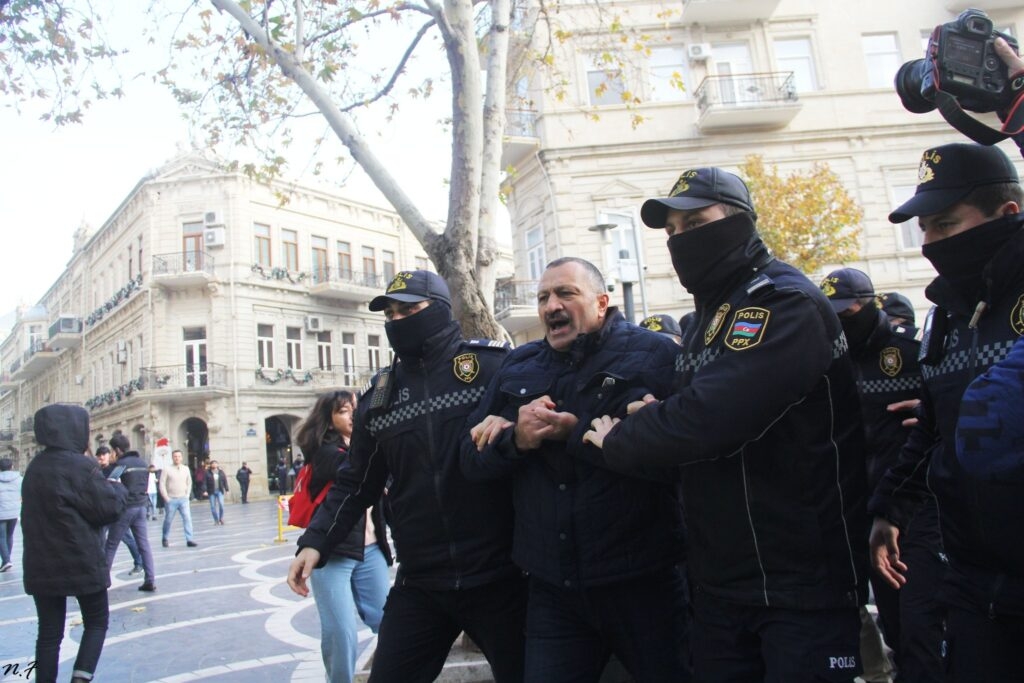
On December 1, 2021, Yagublu was arrested again during a rally in Fountain Square, Sabail District of Baku. Two days later, he was questioned for four and a half hours at the Sabail District Court. He claimed that he had been physically assaulted by security forces and demanded an investigation. In January 2022, his lawyer announced that the case regarding the alleged assault had been closed.
On December 14, 2023, Yagublu was once again arrested, and his trial process began in June 2024. Authorities claimed that during a search of his home, €25,000, 10,000 Azerbaijani manats, and some US dollars were discovered. Police alleged that the money belonged to a person named Elshan Huseynov and that Yagublu had received it from him on December 8 in the town of Zabrat, as part of a scheme to prepare forged documents for immigration to Germany. Yagublu denied all charges, stating that the money had not been present before the search and that the allegations were baseless. His wife, Maya, testified that the cash was retrieved from a hidden location in their home (under a mattress) by security officers, raising doubts about the legality of the search. Yagublu’s daughter further stated that during those days, her mother had to borrow a small amount of money for medical expenses, making the presence of such a large sum in the house seem illogical.
On December 15, 2023, the Narimanov District Court issued a four-month pretrial detention order based on the prosecution’s request. Human Rights Watch condemned this decision, stating that the court had failed to provide sufficient reasoning regarding flight risk or obstruction of justice — in violation of international standards, including the European Convention on Human Rights[3].
During the 2024 trial sessions, Yagublu’s legal team presented evidence, including mobile phone signal reports, indicating that he had not been present at the alleged location at the specified time. In court, Yagublu stated that he had faced similar fabricated charges in the past and that the current legal proceedings also suffered from significant procedural flaws[4].
On March 10, 2025, the Baku Serious Crimes Court sentenced Yagublu to nine years in prison under Articles 178.3.2 (large-scale fraud), 320, 320.1, and 320.2 of the Criminal Code of the Republic of Azerbaijan, related to forgery and the use of forged documents. Another individual, named Elnur Mammadov, accused as an accomplice in the same case, received an eight-year prison sentence. In response to the verdict, Yagublu rejected the charges and stated that this was yet another politically motivated case against him[5]. In a 135-page written statement following the sentencing, he declared his intention to continue his civil and social activism and urged citizens not to remain indifferent to the state of political freedoms in the country.
Since early April 2025, Yagublu has launched an indefinite hunger strike in protest of the ruling. According to his relatives, his physical condition has gradually deteriorated, and during some court sessions, he had to be supported by others to stand. However, in May 2025, the appellate court rejected the request to convert his detention to house arrest. Notably, during one of the recent hearings, reports emerged of physical altercations involving attendees — including Yagublu’s pregnant daughter.
- Case of Akif Qurbanov
Akif Qurbanov, a political figure and civic activist, is another vocal critic of President Ilham Aliyev’s administration currently held in detention. From 2006 to 2016, he served as a member of the Central Election Commission of Azerbaijan. He is also one of the founders of the “Third Republic Platform” and the “Institute of Democratic Initiative.” Qurbanov has been actively engaged in democracy promotion and electoral processes for many years, building a long track record of civic involvement. Government scrutiny of his activities intensified after he publicly stated that the 2015 parliamentary elections were not held in accordance with domestic and international obligations.
Accordingly, on March 6, 2024, several of Qurbanov’s colleagues, including Ruslan (Rauf) Izzatli and Alesker Mammadli (on criminal charges), along with six other members of the Toplum TV network (on precautionary grounds) and even a video editor, were arrested. Media and civil society offices associated with their work were searched and sealed. On the following day, March 7, Qurbanov was also detained under Article 206.3.2 of the Criminal Code (organized smuggling with collusion), and a criminal case was opened against him. International human rights organizations, including Human Rights Watch and Amnesty International, considered his arrest a violation of civil liberties and recognized him as a political prisoner[6].
According to information released during court proceedings, Qurbanov claimed that during the office search, police officers removed him and a colleague to a separate room and then proceeded to search the rest of the premises, later announcing the discovery of €30,000. He maintained that this money had not been present in the office beforehand and suggested it may have been planted by the officers. He also reported being treated violently at the time of his arrest. His defense attorney, Shahla Humbatova, stated that she heard her client protesting during the court session and added that he had been subjected to physical force by officers during his transfer to the courthouse. The lawyer also filed a formal complaint about the manner of the arrest and the conduct of the security forces.
On March 8, 2024, the court issued a four-month pretrial detention order for Qurbanov, as well as for Ramal Babayev and Ilkin Ibrahimov, all of whom were charged with organized smuggling under Article 206.3.2 of the Criminal Code. During searches of their homes and associated offices, security forces reported discovering additional amounts of cash — including approximately €2,700 and €3,100 — at the residences of some individuals. However, the accused and their families denied the allegations, stating that the money was not present at the time of the searches and may have been planted by officers. For example, the wife of one of the detainees — herself a presenter for Toplum TV — stated that she had been removed from the room during the house search, and the officers later claimed to have found cash in the home.
Qurbanov also stated during one of the court sessions that the actions taken against him and his family — including the stopping of his father’s car while taking his children to school, the confiscation of their mobile phones, and verbal threats — were completely unjustified and legally baseless. He further asserted, citing a public statement by the Third Republic Platform, that a senior government official visited him at Detention Center No. 1 in Baku and threatened him with torture and other punitive measures if he continued to express his critical views[7].
Challenges and Responses
1. Official Reactions
Officials from European countries have at times expressed concern over the human rights situation in Azerbaijan or have indirectly sought to support advocates of freedom within the country. In this context, Teresa Ribeiro, the OSCE Representative on Freedom of the Media, voiced serious concern over the arrest of Toplum TV staff, stating:
“The repeated imposition of harsh measures against media professionals in Azerbaijan is deeply troubling.”
More recently, the European Union called on the Azerbaijani government to review the case of Tofig Yagublu in accordance with its international obligations[8]. Peter Stano, spokesperson for the EU’s Foreign Affairs Service, responding to the March 2024 arrests, stated that the EU was “closely monitoring the situation” and called for the guarantee of freedom of expression, including the free operation of independent media in Azerbaijan[9].
Similarly, on March 8, 2024, the French Ministry of Foreign Affairs issued an official statement condemning the recent wave of arrests, stating that they targeted representatives of civil society and the independent press[10]. The German government also expressed concern separately: Robin Wagener, Germany’s Coordinator for Intersocietal Cooperation with the Southern Caucasus, posted a message on social media voicing worry over the arrests of Toplum TV journalists and other civil activists, emphasizing that “independent media and civil society must be protected[11].”
Notably, in August 2024, Akif Qurbanov was nominated for the Václav Havel Human Rights Prize of the Council of Europe — a gesture widely seen as an expression of support for Azerbaijani human rights defenders facing government repression[12].
The United States, meanwhile, has adopted a more explicit position. Following the detention of Tofig Yagublu, then-State Department Spokesperson Ned Price, on January 9, 2023, expressed concern over his arrest and that of another political prisoner, Bakhtiyar Hajiyev, and called for their immediate release[13]. The U.S. State Department also voiced deep concern over the detentions during the raid on Toplum TV. In addition, a group of U.S. senators and members of Congress sent letters to the State Department and the White House urging them to address the deteriorating human rights situation in Azerbaijan.
Ahead of the COP29 international climate summit scheduled to be held in Baku, a group of U.S. lawmakers published an open letter addressed to President Ilham Aliyev, criticizing the country’s human rights record and the presence of political prisoners. Later, in December 2024, the ambassadors of the United States, the European Union, and Switzerland publicly criticized the human rights situation and the arrest of journalists during a joint event in Baku. This action prompted a response from Azerbaijan’s Ministry of Foreign Affairs, which issued an official statement describing the criticism as “interference in the country’s independent judiciary” and declaring it unacceptable[14].
- Reactions from Institutions and Experts
Leila Alieva, a researcher and academic affiliated with the University of Oxford, argues that Tofig Yagublu’s case reflects the Azerbaijani government’s broader attempt to establish “total control” over the country’s public and political space. According to her, in a democratic society, the people govern the state, but in an authoritarian society, the state rules by controlling its people. She emphasized that the authorities in Azerbaijan are aware that as long as there are individuals who cannot be bought off or coerced, total control remains unattainable — and this unpredictability is a threat to authoritarian stability[15].
Domestically, leaders of the few remaining political parties have also condemned the rulings and called for the immediate release of all political prisoners. Ali Karimli, the leader of the Popular Front Party, stated in response to Yagublu’s sentence:
“The government, through shameful fabricated cases, does not discredit the opposition — it further undermines its own legitimacy[16].”
On the international stage, Amnesty International released a statement following Yagublu’s sentencing, asserting that officials rushed to issue the verdict while dismissing all defense arguments, including requests to examine CCTV footage. The organization called for Yagublu’s immediate and unconditional release, referring to the charges as unfounded[17].
Human Rights Watch also issued several statements, describing the recent arrests as part of a continuing pattern of suppressing dissenting voices in Azerbaijan. Giorgi Gogia, Associate Director for Europe and Central Asia at HRW, remarked:
“Azerbaijani authorities continue their assault on political opponents, journalists, and other critics. The arrest of Tofig Yagublu is yet another example of the government’s ongoing strategy to silence critical voices.”
In addition to these two organizations, other entities such as Freedom House, Reporters Without Borders (RSF), and the Committee to Protect Journalists (CPJ) also issued statements calling for the immediate release of all political prisoners and human rights defenders in Azerbaijan[18].
On the continental level, Azerbaijan’s human rights record has received significant attention. In January 2024, the Parliamentary Assembly of the Council of Europe (PACE) suspended the credentials of Azerbaijan’s parliamentary delegation due to serious human rights concerns[19]. Later, in September of the same year, more than forty international organizations signed a joint statement urging the Council of Europe to impose clear conditions for Azerbaijan’s full reinstatement in the Assembly. The statement noted that not only had the Azerbaijani government ignored previous warnings, but it had also intensified its repressive actions — a course that has led to the near-total dismantling of civil society in the country.
- The Challenge of Fabricated Criminal Cases
A close review of the cases involving media, political, and human rights activists in Azerbaijan — including the two outlined in this report — reveals a pattern whereby the government fabricates charges such as financial crimes, smuggling, conspiracy, or document forgery to target opposition figures. This approach allows the authorities to pursue convictions through formal legal channels under the guise of criminal wrongdoing, rather than openly prosecuting individuals for their political or media-related activities. As a result, opposition voices are sidelined, and those targeted are imprisoned not for their speech or activism, but for crimes they allegedly did not commit — a tactic that makes it easier for the Azerbaijani government to defend its actions in international forums on seemingly legal grounds[20].
From a legal standpoint, the judicial process in these cases is riddled with serious irregularities. Defense lawyers have repeatedly raised concerns that fair trial standards are not being observed: courts have issued months-long pretrial detention orders with little to no review of the evidence; in several instances, home and office searches were conducted without a lawyer present, followed by officials claiming to have discovered large sums of cash or documents. Defendants and their families strongly maintain that such “evidence” was planted and fabricated. Furthermore, reports have surfaced of physical coercion and threats being used to extract confessions or force cooperation from detainees.
Beyond the individual cases, the broader legal and regulatory environment in Azerbaijan has become a significant obstacle to civil society. Harsh laws passed in recent years have made it exceedingly difficult for independent NGOs and media outlets to operate. For instance, NGOs must obtain burdensome state approvals and disclose all funding sources — a requirement the government uses as a lever to block financial resources from reaching critical organizations. Independent media outlets, meanwhile, face the constant threat of license revocation or criminal prosecution of their staff.
In this regard, Human Rights Watch and ten other organizations published a joint statement in September 2024, asserting that the Azerbaijani government had, over the previous year, targeted the last remaining elements of civil society and independent media with baseless yet severe criminal charges. Dozens of activists and journalists were arrested, many of whom later reported torture and ill-treatment in detention centers. The statement warned that this ongoing crackdown, combined with a restrictive legal framework, poses a serious threat of erasing any remaining space for dissent or legitimate human rights activity in Azerbaijan[21].
Conclusion
The repression of civil society and media activists in Azerbaijan has become one of the most pressing human rights challenges in the South Caucasus region. Today, individuals who once represented some of the last remaining dissenting voices within the country are behind bars. The judicial proceedings, vague charges, and numerous reports of mistreatment of detainees all indicate that the Azerbaijani government is determined to silence any form of opposition. This is despite persistent official claims in state media that no one in the country is punished for their opinions or beliefs.
According to many analysts, Ilham Aliyev — who has held power as president since 2003 — has turned the Azerbaijani state into a rentier and unaccountable government, leveraging the nation’s oil wealth to entrench his authority and suppress all dissent. By expanding diplomatic and political engagements, the government has sought to minimize international pressure concerning its human rights violations.
Although the international community has voiced serious concerns and repeatedly called for the immediate release of political prisoners and an end to the crackdown, such verbal condemnations and resolutions will likely remain ineffective unless accompanied by concrete action and real leverage. Ultimately, the future of human rights in Azerbaijan depends largely on the balance between the government’s insistence on authoritarian policies and the internal and external pressures demanding reform. Critics argue that each day of delay in changing course carries a heavy cost — not only for the direct victims of repression, but also for the country’s credibility and its prospects for future development.
References
[1] Bagirova, N., & Papachristou, L. (2024, March 8). Azerbaijani court puts TV staff in pre-trial detention. Reuters. From: https://www.reuters.com/world/asia-pacific/azerbaijani-court-puts-tv-staff-pre-trial-detention-2024-03-08/
[2] Farhadova, A. (2025, May 6). Azerbaijani opposition politician Tofig Yagublu denied house arrest despite deteriorating health. OC Media. From: https://oc-media.org/azerbaijani-opposition-politician-tofiq-yagublu-denied-house-arrest-despite-deteriorating-health/
[3] Human Rights Watch. (2023, December 19). Azerbaijan: Prominent opposition figure arrested. Human Rights Watch. From: https://www.hrw.org/news/2023/12/19/azerbaijan-prominent-opposition-figure-arrested
[4] Bağırov, E. (2025, February 19). Prokuror Tofiq Yaqubluya 10 il həbs cəzası istəyib. Amerikanın Səsi. From: https://www.amerikaninsesi.org/a/7980636.html
[5] Azadlıq Radiosu. (2025, April 15). Tofiq Yaqublu: ‘Heç bir cəza məni Rəsulzadə ideyaları… uğrunda mübarizədən çəkindirə bilməz’. Azadlıq Radiosu. From: https://www.azadliq.org/a/tofiq-yaqublu-mehkum-edildi/33342834.html
[6] Azadlıq Radiosu. (2024, June 4). Akif Qurbanovun həbsdə təhdid olunduğu bildirilir. Azadlıq Radiosu. From: https://www.azadliq.org/a/akif-qurbanov/32976670.htmlMEYDAN.TV
[7] Meydan TV. (2024, March 13). Toplum TV işinə görə saxlanılanlarla bağlı həbs qərarı çıxarıldı. Meydan TV. From: https://www.meydan.tv/az/article/toplum-tv-isine-gore-saxlanilanlarla-bagli-hebs-qerari-cixarildi
[8] European External Action Service. (2020, September 4). Azerbaijan: Statement by the Spokesperson on the sentencing of Tofiq Yagublu. EEAS. From: https://www.eeas.europa.eu/eeas/azerbaijan-statement-spokesperson-sentencing-tofiq-yagublu_en
[9] AzerNews. (2024, May 30). Spokesperson Hajizade calls EU representative’s biased statement as far from reality. AzerNews. From: https://www.azernews.az/nation/226762.html
[10] Abzas Media. (2024, November 20). French Ministry of Foreign Affairs: “Azerbaijan’s hostile actions must come to an end”. Abzas Media. From: https://abzas.org/en/2024/11/fransa-xin-azrbaycann-dusmf8fb39e2-5/
[11] JAMnews. (2024, March 9). Toplum TV case in Azerbaijan: Arrests and detentions continue. JAMnews. From: https://jam-news.net/toplum-tv-in-azerbaijan-arrests-and-detentions
[12] Council of Europe. (2024, August 27). Three candidates shortlisted for the 2024 Václav Havel Prize. Council of Europe. From: https://www.coe.int/en/web/portal/-/trois-candidat%C2%B7e%C2%B7s-pr%C3%A9s%C3%A9lectionn%C3%A9%C2%B7e%C2%B7s-pour-le-prix-v%C3%A1clav-havel-2024-1
[13] 1Lurer.am. (2023, January 10). US deeply troubled by the arrest and detention of opposition figures: Ned Price. 1Lurer.am. From: https://www.1lurer.am/en/2023/01/10/US-deeply-troubled-by-the-arrest-and-detention-of-opposition-figures-Ned-Price/861865
[14] VOA News. (2024, December 5). Azerbaijan denounces diplomatic criticism of human rights. VOA News. From: https://www.voanews.com/a/azerbaijan-denounces-diplomatic-criticism-of-human-rights/7888014.html
[15] Süleymanov, E. (2020, September 5). Tofiq Yaqubluya daha bir həbs hökmü: İqtidar bu müxalifətçidən qorxurmu?. BBC Azeri. From: https://www.bbc.com/azeri/azerbaijan-54002686
[16] Karimli, A. [@AliKarimli]. (2025, March 11). PFPA Statement on the Sentencing of Tofiq Yaqublu. [Tweet]. X (formerly Twitter). From: https://x.com/AliKarimli/status/1899354528308191377
[17] Amnesty International. (2025, April 11). Azerbaijan: Authorities must immediately release Tofig Yagublu and urgently provide medical care as his health deteriorates. Amnesty International. From: https://www.amnesty.org/en/latest/news/2025/04/azerbaijan-authorities-must-immediately-release-tofig-yagublu-and-urgently-provide-medical-care-as-his-health-deteriorates/
[18] Committee to Protect Journalists. (n.d.). Azerbaijan. CPJ. From: https://cpj.org/europe/azerbaijan/
[19] Parliamentary Assembly of the Council of Europe. (2024, January 24). PACE resolves not to ratify the credentials of Azerbaijan’s parliamentary delegation, citing a failure to fulfil major commitments. PACE. From: https://pace.coe.int/en/news/9358/pace-resolves-not-to-ratify-the-credentials-of-azerbaijan-s-parliamentary-delegation-citing-a-failure-to-fulfil-major-commitments
[20] Grynszpan, E. (2024, October 11). Azerbaijan: Repression intensifies in the run-up to COP29 in Baku. Le Monde. From: https://www.lemonde.fr/en/international/article/2024/10/11/azerbaijan-repression-intensifies-in-the-run-up-to-cop29-in-baku_6729013_4.html
[21] Human Rights Watch. (2024, September 25). Council of Europe should address Azerbaijan rights crackdown. Human Rights Watch. From: https://www.hrw.org/news/2024/09/25/council-europe-should-address-azerbaijan-rights-crackdown