Introduction
In authoritarian political systems, the suppression of dissent does not necessarily take the form of explicit prohibitions, direct violence, or the overt elimination of political opponents. Instead, it is often pursued through mechanisms that appear formally legal, judicial, and criminal in nature. Under this model, governments seek to remove civil action, media activity, political protest, and human rights advocacy from the sphere of legitimate rights and redefine them as criminal offences, security threats, financial misconduct, or conduct contrary to public order.
The significance of this method lies in the fact that repression is no longer presented as an overt assault on freedom of expression or political participation. Rather, it is portrayed as the ordinary enforcement of the law and the routine adjudication of a criminal case. For this reason, the criminalization of dissent may be regarded as one of the most complex and, at the same time, most effective instruments of authoritarian governance: an instrument that operates through the language of law but may, in practice, undermine fundamental freedoms, erode civil society, and discredit critical voices and actors.
In recent years, the Republic of Azerbaijan has provided a particularly significant case through which this pattern may be examined, especially in relation to the treatment of civil society activists, independent journalists, and government critics. In this context, the central issue is not merely the arrest or prosecution of a limited number of individuals. Rather, attention must be directed toward a broader mechanism through which political and civic dissent is transferred from the public sphere—and from the domain of fundamental rights and freedoms—into the realm of criminal accusation, case-building, and prosecution.
Focusing on the concept of the criminalization of dissent, this report seeks to demonstrate how legal and criminal-justice mechanisms may be employed to control civic space, restrict independent media, and diminish citizens’ capacity to participate critically in public life.
The Concept of the Criminalization of Dissent
The criminalization of dissent refers to a process through which civil, journalistic, political, or critical activity is removed from the sphere of legitimate rights and redefined as a criminal offence, a threat, a violation, or unlawful conduct. According to an academic definition advanced by researchers affiliated with the University of Bologna in Italy, the criminalization of dissent involves the use of the legal system and law-enforcement mechanisms by the state to repress, silence, stigmatize, or render political opposition unlawful. This occurs when governments treat peaceful protests, boycotts, or critical expression as criminal conduct, frequently relying on vaguely worded legislation, counterterrorism laws, or public-order regulations to discredit and punish activists.
The concept of the criminalization of dissent may be observed in numerous historical examples. In the United States, the period of McCarthyism during the late 1940s and 1950s represented a prominent instance in which political and intellectual dissent was transformed into a perceived security threat. During this period, numerous intellectuals, artists, journalists, academics, and political activists were accused of sympathizing with the Soviet Union or the Communist Party, acting against the national interests of the United States, or threatening domestic security. Legal mechanisms, investigative committees, administrative pressure, and public campaigns were consequently employed to exclude them from professional and public life.
In China, the suppression of the well-known Tiananmen Square protests in 1989 similarly demonstrated how demands for democracy, freedom of expression, and political reform could be characterized by the state as threats to public order and political stability. In both cases, the authorities sought to portray dissent not as an exercise of the right to political participation, but as a danger to security and order. The principal difference lay in the methods employed. During McCarthyism, legal, administrative, and media mechanisms played a more prominent role, whereas in Tiananmen Square, direct, security-driven, and violent repression was considerably more visible. Nevertheless, the common feature of both cases was the transfer of dissent from the legitimate sphere of politics into the domain of criminality, threat, and disorder.
In general, states employ four principal instruments in the criminalization of dissent:
- Vague and Overbroad Legislation
Governments may adopt broadly formulated, ambiguous, and highly interpretable laws that enable extensive action against critics and opponents. Concepts such as “disruption of public order,” “threats to national security,” “propaganda against the state,” “unlawful cooperation,” “extremism,” or “terrorism” may be invoked against civil society and media actors without being defined with sufficient clarity.
Legal ambiguity obscures the boundary between legitimate political activity and criminal conduct. As a result, the law ceases to function primarily as a guarantee of citizens’ rights and instead becomes an instrument for controlling and restricting dissent.
A clear example may be found in Türkiye, where Amnesty International has documented the use of counterterrorism legislation and criminal-law provisions against journalists, political activists, human rights defenders, lawyers, academics, and protesters. Offences such as “making propaganda for a terrorist organization” have been applied to peaceful expression and legitimate civil society activity. Human Rights Watch has likewise documented how terrorism-related charges have been brought against journalists and media organizations for reporting, commentary, or association with critical publications. Article 7(2) of Türkiye’s Anti-Terror Law, which criminalizes “making propaganda for a terrorist organization,” has been particularly significant in such prosecutions. In some cases, the publication or reporting of critical viewpoints has been interpreted as support for terrorism.
- Powerful Police and Security Institutions
The criminalization of dissent is ordinarily difficult to sustain without the state’s reliance on powerful police, security, and intelligence institutions. Through summonses, arrests, searches, the dispersal of assemblies, surveillance, and physical or psychological pressure, these institutions can significantly restrict the space available for civil society activity.
In such circumstances, the extensive presence of security forces serves not merely to enforce the law, but also to generate fear and social deterrence. The implicit message is that critical participation may carry serious security and criminal consequences.
An example of this pattern may be observed in Belarus following the presidential election of August 2020. Human Rights Watch reported that Belarusian security forces arbitrarily detained thousands of protesters and systematically subjected hundreds of people to torture or other forms of ill-treatment. Documented injuries included broken bones, cracked teeth, skin wounds, electrical burns, and mild traumatic brain injuries. Amnesty International also reported the detention of more than one thousand people during a single day of peaceful demonstrations in November 2020.
- Targeting Key Actors
Under this model, governments generally do not impose a comprehensive legal prohibition on all forms of opposition. Instead, they selectively target influential individuals, organizers, journalists, civil society activists, protest leaders, and the networks through which they communicate.
Targeting key individuals weakens critical movements from within and reduces their ability to organize, disseminate information, mobilize public support, and maintain institutional continuity. This method also sends a warning to other actors. Even in the absence of mass repression, the public sphere may gradually become characterized by silence, caution, withdrawal, and self-censorship.
One illustrative case may be found in Hong Kong. Following the introduction of the National Security Law in 2020, prominent figures such as Jimmy Lai, founder of the now-closed critical newspaper Apple Daily, and democracy activist Joshua Wong were prosecuted on charges related to national security, collusion with foreign forces, or subversion.
On 9 February 2026, a Hong Kong court sentenced Jimmy Lai to 20 years’ imprisonment after convicting him of conspiracy to collude with foreign forces and conspiracy to publish seditious material. Several former Apple Daily employees and other co-defendants also received substantial prison sentences. The newspaper itself ceased publication in 2021 following arrests, the freezing of its assets, and sustained legal and security pressure.
Joshua Wong, who was already serving a prison sentence arising from an unofficial primary election held in 2020, was charged again in June 2025 with conspiracy to collude with a foreign country or external forces under the National Security Law. Critics and international human rights organizations characterized the new proceedings as further evidence of the continuing pressure on civil liberties and political opposition in Hong Kong.
- Digital Surveillance
In recent years, digital surveillance has become one of the most significant instruments used in the criminalization of dissent. Governments may employ the interception of online communications, monitoring of social-media platforms, surveillance of messaging applications, collection of personal data, and mapping of activists’ communication networks to exercise control over civil society.
Such surveillance may facilitate arrests, the construction of criminal cases, intimidation, or pressure against activists. Moreover, citizens’ awareness that they may be under surveillance can itself generate self-censorship and discourage participation in critical or oppositional activities.
A particularly clear example may be found in cases involving Pegasus spyware. According to Amnesty International and other organizations participating in the Pegasus Project, this technology has been used internationally to target journalists, activists, political figures, lawyers, and human rights defenders. Once successfully installed, the spyware may provide covert access to a mobile telephone’s messages, stored data, microphone, camera, and other sensitive information.
With regard to Azerbaijan, Access Now has reported that the Pegasus Project identified more than one thousand Azerbaijani telephone numbers on a list of individuals potentially selected for surveillance. Of these, investigators were able to associate hundreds of numbers with identifiable individuals, including journalists, political figures, and civil society actors. The presence of a number on the list does not, by itself, establish that the corresponding device was successfully infected; nevertheless, the scale and nature of the potential targeting have raised serious concerns.
The use of such technologies may threaten fundamental rights, including the rights to privacy, freedom of expression, access to information, peaceful assembly, and freedom of association. Amnesty International has also documented a sustained spear-phishing campaign directed against Azerbaijani human rights activists, journalists, and political dissidents through deceptive emails and Facebook messages. These operations appeared designed to obtain unauthorized access to private information and confidential communications.
Transferring Dissent from the Political Sphere to the Criminal Sphere
In the process of criminalizing dissent, governments do not ordinarily suppress political or civic action explicitly under the label of “dissent.” Instead, they redefine such conduct through the language of criminal law. In this context, activities such as protest, critical journalism, whistleblowing, civil society organizing, or engagement with independent institutions are no longer understood within the framework of freedom of expression and the right to political participation. Rather, they are subsumed under allegations such as disturbing public order, threatening national security, smuggling, forgery, money laundering, unlawfully receiving financial assistance, or collaborating with foreign actors.
The principal advantage of this shift for the state is that it transfers repression from the realm of overt political action into what appears to be an ordinary judicial proceeding. The government may consequently claim that it has not taken action against a “critic,” but has merely enforced the law against a criminal “suspect” or “defendant.” This method reduces the political and international costs of repression, obscures the true nature of the case in the eyes of the public, and facilitates the discrediting of the person concerned.
For example, when a critical journalist is prosecuted for an alleged financial offence rather than for investigative reporting or criticism of the authorities, the central issue is displaced from media freedom to purported personal misconduct. The political significance of the individual’s work is thereby obscured by a criminal-law narrative centred on fraud, illicit financing, tax violations, or smuggling.
The principal harm inflicted on the individual is that their status changes from that of a “public actor” or “rights-holder” to that of a “criminal defendant.” This is not merely a formal legal reclassification. It transforms the entire framework within which the person must defend themselves, the manner in which the public perceives the case, and their capacity to continue participating in social and public life.
Once a civil society activist or journalist is portrayed through the framework of a criminal charge, the primary question is no longer whether their freedom of expression, political participation, or public-interest role has been violated. Instead, public debate and even institutional scrutiny increasingly focus on whether the alleged offence was committed. Under such circumstances, an individual may face pretrial detention, restricted access to legal counsel, confiscation of personal devices and documents, suspension from professional activity, reputational damage, hostile media coverage, and social isolation long before any final conviction has been entered.
A clear illustration of this pattern may be found in the treatment of anti-war activists, journalists, and government critics in the Russian Federation following the full-scale invasion of Ukraine. On 4 March 2022, Russian authorities introduced legislation criminalizing the dissemination of what the state described as “knowingly false information” about the Russian armed forces and the “discrediting” of their activities. The laws provided for sentences of up to 15 years’ imprisonment and were subsequently used against independent reporting, public criticism of the war, peaceful protest, and calls for an end to military operations. Human Rights Watch has characterized these measures as part of a broader campaign to eliminate public dissent concerning the war.
Under this model, opposition to the war or the publication of accounts contradicting the official narrative is no longer treated primarily as political expression. Instead, it is reframed as the dissemination of “false information,” the “discrediting” of the armed forces, or conduct allegedly threatening public or national security. By changing the legal classification of the activity, the state substantially increases the cost of defending the individual and transfers them from the position of a citizen advancing a public demand into that of a defendant required to answer a criminal accusation.
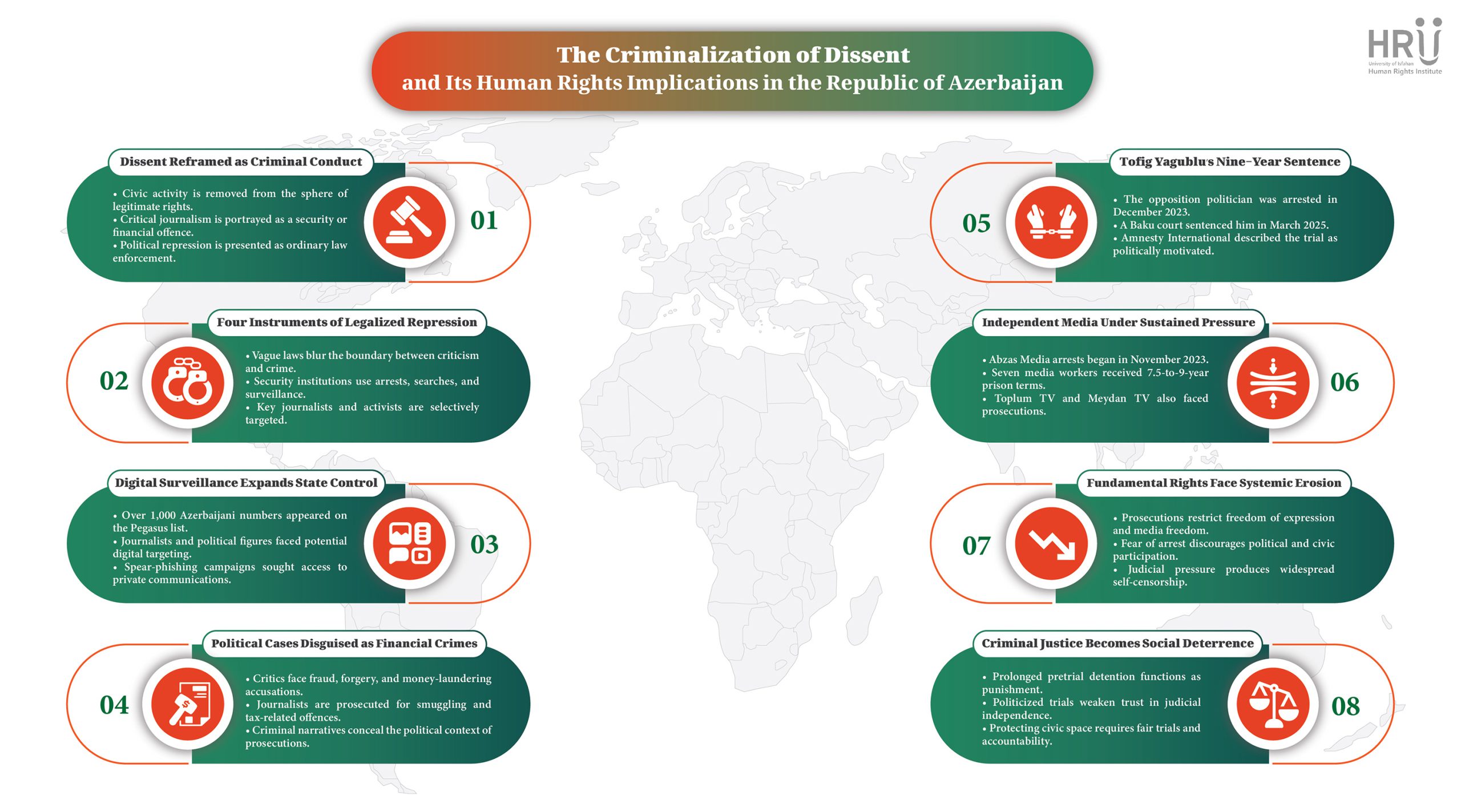
This logic is also visible in human rights cases in the Republic of Azerbaijan. According to reports by international human rights organizations and press-freedom groups, civil society activists, opposition figures, and independent media workers—including Tofig Yagublu and journalists associated with independent outlets—have faced charges involving fraud, forgery, currency smuggling, money laundering, tax evasion, and other financial offences. The accused, their lawyers, and human rights organizations have frequently described such charges as unfounded, fabricated, or politically motivated.
Tofig Yagublu, a veteran opposition politician and member of the Musavat Party and the National Council of Democratic Forces, was arrested in December 2023. On 10 March 2025, the Baku Serious Crimes Court sentenced him to nine years’ imprisonment on charges of “fraud resulting in substantial harm” under Article 178.3.2 of the Azerbaijani Criminal Code and document forgery under Articles 320.1 and 320.2. Yagublu denied the allegations and maintained that the case was politically motivated. Amnesty International described the proceedings as a sham trial and called for his immediate release.
A similar pattern can be observed in the proceedings against Abzas Media, an independent investigative outlet known for reporting on corruption. Beginning in November 2023, Azerbaijani authorities arrested the outlet’s director, editors, reporters, and other individuals allegedly connected to it. The initial cases centred on accusations that they had conspired to smuggle foreign currency into Azerbaijan. In August 2024, investigators added further economic charges, including money laundering, tax evasion, illegal entrepreneurship, and document-related offences. Human Rights Watch and the Committee to Protect Journalists have described these prosecutions as part of a broader crackdown on independent journalism and civil society.
The central issue, therefore, is no longer merely the arrest of several political activists, journalists, or human rights defenders. Rather, it is the conversion of civic and journalistic activity into a criminal-law matter. This process weakens and discredits the individual while simultaneously warning the wider civil society community about the potential costs of critical participation.
Another related example is the treatment of environmental activists in some countries through counterterrorism, public-order, or security legislation. Under this model, actions such as protesting environmentally harmful projects, symbolically obstructing roads or infrastructure, exposing industrial pollution, or organizing civil society campaigns are removed from the framework of the right to protest, freedom of expression, and public participation. They are instead redefined through concepts such as “disturbing public order,” “sabotage,” “interference with critical infrastructure,” or even “extremism.”
In recent years, some environmental and climate-justice groups in Europe and the United States have faced intensive police action, preventive arrests, restrictions on assemblies, injunctions, and criminal charges. The significance of these examples lies in demonstrating that the criminalization of dissent is not confined to party-political opponents or conventional opposition movements. It may extend to any form of effective civil action perceived as politically disruptive or economically costly by governments or powerful economic actors.
As a result, an environmental activist may be displaced from the position of a defender of the public interest and the rights of future generations into the position of an individual portrayed as disrupting order, damaging property, or threatening public security.
Human Rights Implications
The criminalization of dissent is not merely a method of subjecting government critics to judicial proceedings. Rather, it constitutes a broader pattern capable of undermining several fundamental human rights simultaneously.
The first major consequence is the restriction of freedom of expression and media freedom. When political criticism, independent journalism, or public-interest reporting carries the risk of criminal prosecution, citizens and journalists gradually refrain from expressing critical views. Under such conditions, censorship is not imposed solely from outside; it also becomes internalized in the form of self-censorship. Media organizations adopt increasingly cautious editorial policies, civil society actors avoid publishing sensitive reports, and the public sphere progressively loses its capacity for open and critical debate.
In the Republic of Azerbaijan, the prosecution of journalists and media workers associated with independent outlets such as Abzas Media, Toplum TV, and Meydan TV has been widely regarded by international human rights and press-freedom organizations as part of a broader campaign against independent journalism. Since late 2023, Azerbaijani authorities have detained journalists and media workers on allegations including currency smuggling, document forgery, illegal entrepreneurship, money laundering, and tax evasion. Human Rights Watch, Amnesty International, and the Committee to Protect Journalists have described many of these charges as spurious, fabricated, or politically motivated.
The proceedings against Abzas Media provide a particularly significant example. Beginning in November 2023, the authorities arrested the outlet’s director, editor-in-chief, journalists, and other individuals associated with its work. On 20 June 2025, the Baku Court of Grave Crimes sentenced seven media workers affiliated with the outlet—including director Ulvi Hasanli, editor-in-chief Sevinc Vagifgizi, journalists Hafiz Babaly, Nargiz Absalamova and Elnara Gasymova, translator Muhammad Kekalov, and economist and journalist Farid Mehralizade—to prison terms ranging from seven and a half to nine years. Amnesty International stated that the convictions formed part of an escalating crackdown on freedom of expression and followed unfair proceedings based on politically motivated charges.
When an independent journalist or media organization is accused of financial misconduct, smuggling, forgery, or unlawful cooperation, other media actors also receive a clear warning: reporting on politically sensitive issues, corruption, public accountability, or human rights may carry serious criminal consequences. The resulting chilling effect weakens one of the most important foundations of an open society—the ability of journalists and citizens to scrutinize the exercise of public power.
The second consequence is the decline of political and civic participation. When activists, journalists, political-party members, civil society organizations, and other social actors face the possibility of arrest, summons, restrictions on their activities, confiscation of equipment, travel bans, or criminal prosecution, the cost of public participation increases substantially.
Under such circumstances, citizens may refrain from signing public statements, attending assemblies, joining civil society organizations, cooperating with independent media, or supporting human rights campaigns, even when they have not personally been subjected to arrest or prosecution. Their withdrawal from public life does not necessarily arise from political indifference. Rather, it may result from a rational fear of judicial, professional, economic, or security-related repercussions.
The criminalization of dissent therefore erodes civil society from within. Communication networks weaken, trust among activists declines, cooperation becomes more difficult, and the possibility of collective organization is progressively diminished. Ultimately, the sphere of legitimate civic action contracts, while political power becomes increasingly insulated from public scrutiny and criticism.
United Nations experts have expressed concern about precisely this form of pressure in Azerbaijan. In May 2025, UN independent experts described the continued detention of prominent human rights defender Anar Mammadli as arbitrary and emphasized that defending human rights must never be treated as a crime. Earlier UN communications had also raised concerns regarding the alleged arbitrary detention and criminalization of Abzas Media journalists in connection with their anti-corruption reporting and legitimate exercise of freedom of expression.
From the perspective of the right to a fair trial, this pattern produces equally serious consequences. When the criminal justice system is used to manage political opposition and critical expression, public confidence in judicial independence, the impartiality of investigative bodies, and the presumption of innocence is severely damaged.
In such an environment, pretrial detention, prolonged investigations, vaguely formulated accusations, restrictions on access to legal counsel, and repeated extensions of detention may cease to function as exceptional procedural measures and instead become instruments of pressure. The criminal process is thereby diverted from its proper purpose—the impartial administration of justice—and transformed into a means of controlling or exhausting critics.
When pretrial detention becomes routine in political and civil society cases, courts may increasingly be perceived not as independent forums for determining individual criminal responsibility, but as components of a broader institutional process directed against dissent. Amnesty International has identified widespread violations of the right to a fair trial and the misuse of Azerbaijan’s criminal justice system for political purposes as longstanding concerns. Human Rights Watch has likewise reported the use of spurious financial and other criminal charges against journalists, political activists, human rights defenders, and academics.
The Abzas Media proceedings again illustrate this concern. The journalists were initially held in prolonged pretrial detention and prosecuted on currency-smuggling allegations, after which additional charges—including illegal entrepreneurship, money laundering, tax evasion, and document-related offences—were introduced. International human rights organizations maintained that these prosecutions were retaliatory and connected to the journalists’ investigative work, particularly their reporting on corruption.
In such cases, even when an individual is ultimately acquitted or released, the judicial process itself may operate as a form of punishment. Months or years of detention, repeated court appearances, legal expenses, professional disruption, reputational damage, uncertainty, and psychological distress may produce consequences comparable to those of a formal sentence. The harm caused by the criminalization of dissent therefore cannot be assessed solely by reference to the final judgment. It arises throughout the entire process of surveillance, investigation, arrest, pretrial detention, prosecution, and trial.
At the human and social levels, this pattern also places considerable psychological pressure on activists and their families. A person facing criminal proceedings because of journalistic, political, or civil society activity may live with a constant fear of arrest, social stigmatization, loss of income, professional exclusion, surveillance, or further prosecution. Their family may simultaneously experience emotional distress, economic instability, social pressure, and indirect forms of intimidation.
The effects of repression consequently extend beyond the individual defendant and reach their family, colleagues, professional community, and broader social environment. In this sense, the criminalization of dissent may generate forms of collective intimidation: the prosecution of one person is used to discourage a much wider group of people from engaging in similar activities.
When a civil society organization or independent media outlet is targeted, the consequences are not confined to its formal employees. Sources, contributors, interviewees, partner organizations, readers, supporters, and other connected actors may also become more cautious or withdraw from cooperation. The targeting of a single institution can therefore disrupt an entire network of information-sharing, advocacy, and public participation.
Concerns regarding prison conditions and access to healthcare may further aggravate these consequences. Amnesty International has reported that imprisoned journalists associated with Meydan TV and other outlets have faced alleged ill-treatment, inadequate medical care, and violations of their fair-trial rights. It has also raised concerns regarding the health and access to medical treatment of imprisoned Abzas Media journalist Nargiz Absalamova.
The criminalization of dissent should therefore be understood not merely as a violation of the rights of isolated individuals, but as a mechanism for producing collective fear and social deterrence. Its wider effect is to weaken civic space, diminish public trust in the justice system, restrict peaceful advocacy, and discourage citizens from exercising their rights to freedom of expression, association, assembly, and political participation.
Conclusion
The criminalization of dissent should be understood as one of the most complex forms of contemporary repression. Unlike overt coercion, it conceals itself behind the formal language and institutions of law, criminal accusation, judicial proceedings, and procedural legitimacy. Under this model, the state does not necessarily confront freedom of expression, the right to protest, or political participation directly. Instead, it transfers civil society actors, journalists, and government critics from the position of rights-holders and participants in public life to that of criminal suspects or defendants.
This reclassification obscures the political nature of the proceedings and makes public advocacy on behalf of the accused considerably more difficult. Once a case is framed as an ordinary criminal matter, questions concerning freedom of expression, media independence, political participation, or human rights advocacy may be displaced by allegations of fraud, forgery, smuggling, money laundering, tax evasion, unlawful entrepreneurship, or threats to national security. In this way, the legal characterization of the case may conceal the relationship between the prosecution and the individual’s journalistic, political, or civil society activities.
The effects of this process extend well beyond the person directly targeted. The arrest, prosecution, or conviction of a prominent journalist, activist, researcher, or political figure may communicate a warning to the wider community: critical participation in public life can carry serious personal, professional, financial, and criminal consequences. Criminal proceedings therefore operate not only as a means of restraining an individual, but also as a mechanism of broader social deterrence.
In the case of the Republic of Azerbaijan, the treatment of civil society actors and independent media workers should not be viewed solely as a collection of separate or exceptional cases. Rather, it must be examined within the context of a broader and increasingly consistent pattern involving the restriction of civic space, the weakening of independent journalism, the targeting of political opposition, and the erosion of public oversight.
International human rights organizations and United Nations experts have repeatedly raised concerns about the arrest, detention, and prosecution of Azerbaijani journalists, human rights defenders, political activists, academics, and researchers in connection with their legitimate professional or public-interest activities. These concerns include allegations of arbitrary detention, fabricated or politically motivated charges, prolonged pretrial detention, unfair trials, restrictions on legal representation, and the use of criminal proceedings to suppress freedom of expression and human rights work.
When an independent media outlet, civil society organization, or critical public figure is confronted with ostensibly non-political criminal charges, the consequences are not confined to the accused individual. The broader field of civic engagement becomes marked by caution, fear, withdrawal, and self-censorship. Journalists may avoid investigating corruption or human rights violations; activists may refrain from organizing campaigns or cooperating with international institutions; citizens may become reluctant to participate in peaceful assemblies, sign statements, or engage with independent organizations.
From this perspective, the criminalization of dissent is not merely a violation of individual rights. It is a structural process capable of gradually eroding freedom of expression, media pluralism, political participation, public trust in the administration of justice, and the institutional foundations of civil society.
It also undermines the rule of law. When criminal justice institutions are perceived as instruments for managing or silencing dissent, confidence in judicial independence, prosecutorial impartiality, due process, and the presumption of innocence is weakened. The judicial process may itself become punitive, irrespective of the final outcome, because prolonged detention, legal uncertainty, reputational damage, professional exclusion, and psychological pressure can impose severe and lasting harm.
The criminalization of dissent should therefore be assessed not only by examining final convictions or the formal legality of individual proceedings, but also by considering the broader context in which criminal law is applied. Relevant questions include whether charges are used selectively against government critics, whether similar patterns recur across independent media and civil society organizations, whether detention and prosecution are proportionate and supported by credible evidence, and whether defendants are afforded full guarantees of due process and a fair trial.
Ultimately, protecting civic space requires more than the formal recognition of freedom of expression, association, peaceful assembly, and political participation. It also requires ensuring that criminal law and judicial institutions are not used to stigmatize, exhaust, or silence those who exercise these rights peacefully.
In Azerbaijan, addressing the human rights consequences of this pattern requires safeguarding the independence of the judiciary, guaranteeing fair-trial rights, ending arbitrary and politically motivated detention, reviewing prosecutions based on allegedly fabricated or disproportionate charges, protecting independent journalism, and enabling civil society organizations and human rights defenders to operate without fear of criminal retaliation.
Without such safeguards, the use of formally legal and judicial mechanisms may continue to narrow the space available for peaceful criticism and public participation. The long-term consequence would not merely be the silencing of individual opponents, but the progressive weakening of civil society, public accountability, and citizens’ ability to participate meaningfully in the political and social life of their country.