Introduction
Since the withdrawal of United States and NATO military forces from Afghanistan in 2021, the country has once again come under the control of the Taliban. The return of the Taliban to power marked a fundamental transformation in the political, social, and legal structures of Afghanistan. The group, relying on its strict and restrictive interpretation of Islamic Sharia law, has implemented regulations that have severely limited civil liberties, women’s rights, and freedom of expression. The Taliban, in blatant disregard for fundamental human rights principles, have imposed extensive restrictions on women’s participation in education, employment, culture, and even their basic freedom of movement in society.
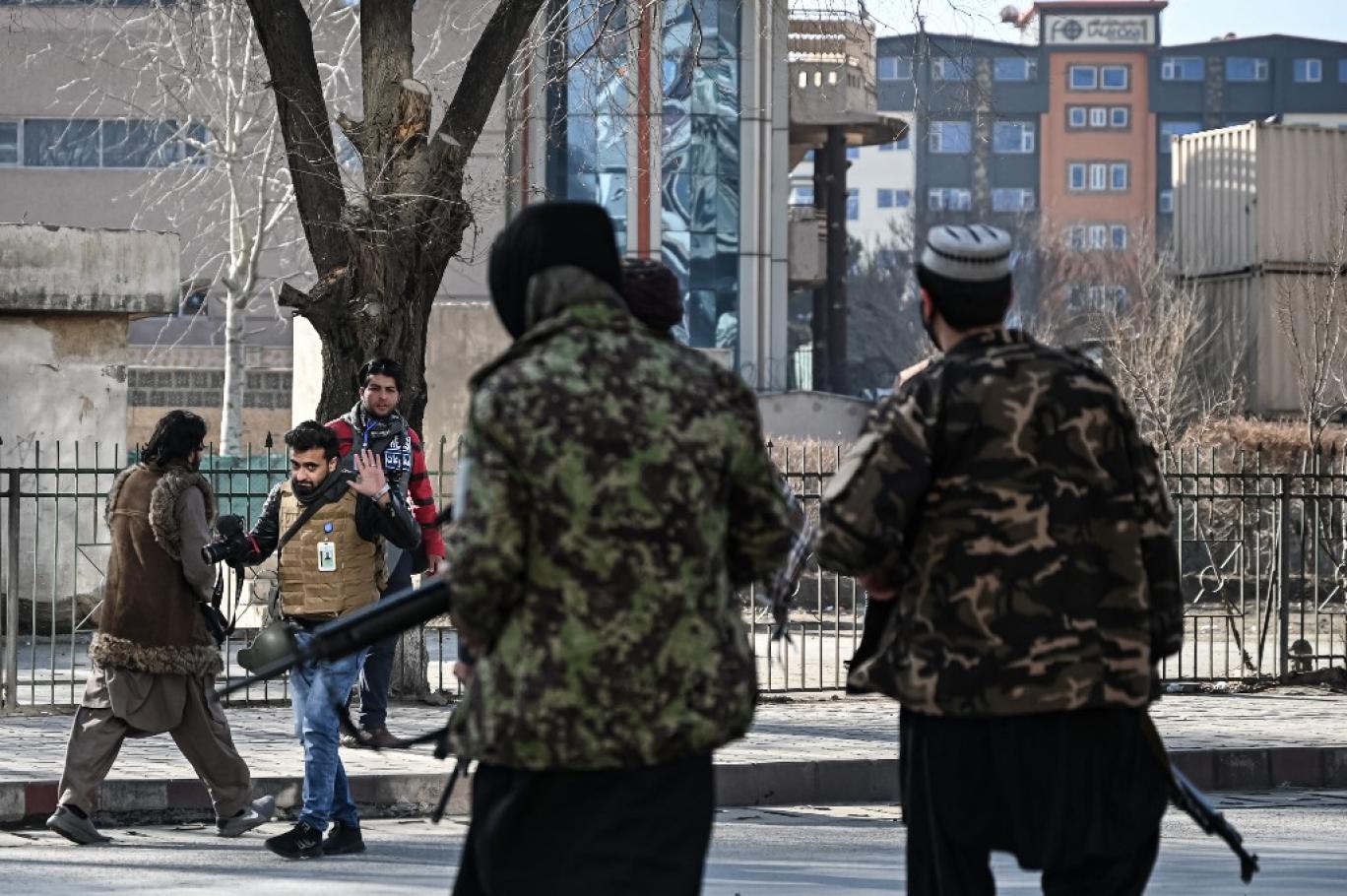
In addition to these restrictions, the media sector has been one of the primary targets of Taliban repression and control. Through the enforcement of restrictive content policies, the banning of critical reporting, and the cultivation of an atmosphere of fear and intimidation for journalists, the Taliban have drastically curtailed Afghanistan’s media landscape. Many media outlets have been forced to shut down or engage in self-censorship, and dozens of domestic and international journalists have been detained.
These developments have sparked strong and widespread condemnation from the international community, human rights organizations, and press freedom advocates. The United Nations, Special Rapporteurs on Human Rights, Amnesty International, Human Rights Watch, and other independent institutions have repeatedly warned about the human rights situation in Afghanistan, particularly the violations of women’s rights and the repression of media freedom. Nevertheless, the international community’s response has often been inadequate and, in some cases, limited to mere expressions of condemnation.
Incidents
- Arrest of Sayed Rahim Saeedi
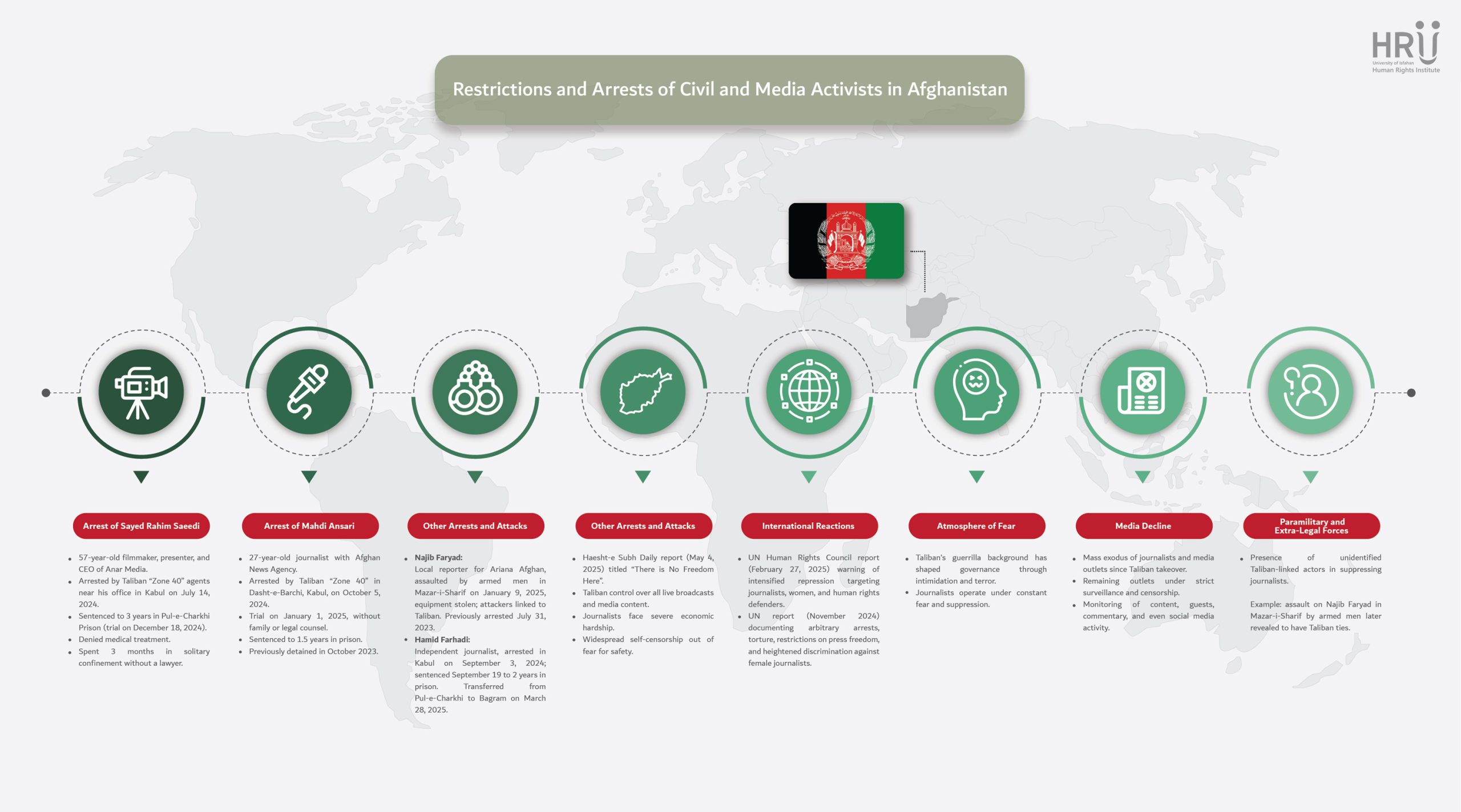
On July 14, 2024, Sayed Rahim Saeedi, a 57-year-old filmmaker, presenter, and CEO/producer of the independent YouTube-based media outlet Anar Media, was arrested near his office by Taliban agents known as “Zone 40.” Mr. Saeedi was sentenced to three years in prison and is currently serving his sentence in Pul-e-Charkhi Prison in Kabul. His initial trial took place on December 18, 2024, where the court accused him of “propaganda against the Taliban authorities.” The Afghanistan Journalists Center reported that Saeedi was arrested due to his creative works, including a script about a girl banned from education[1].
Mr. Saeedi suffers from medical conditions such as spinal disc issues and prostate problems. His health has deteriorated further due to beatings and torture while in custody. He has been denied access to adequate healthcare and essential medication and is being held in cold prison conditions[2]. The Taliban’s General Directorate of Intelligence (GDI) arrested him alongside his son, Seyed Waris Saeedi, and their cameraman, Habib. While the two others were released, Mr. Saeedi spent three months in solitary confinement before his first trial[3]. He ultimately accepted the verdict due to lack of legal representation and fear of extended imprisonment[4].
- Arrest of Mahdi Ansari
On October 5, 2024, Mahdi Ansari, a 27-year-old journalist working for Afghan News Agency, was arrested by “Zone 40” Taliban forces near his office in Dasht-e-Barchi, western Kabul. His family reported him missing after last seeing him leaving his office in Pul-e-Khoshk. Later that evening, the Taliban’s 13th police district informed the family of Mahdi’s detention, stating he was arrested for posting anti-Taliban videos on YouTube. One such video featured a Shia cleric, Ayatollah Waezzada Behsudi, criticizing the Taliban for recent laws and the destruction of a statue commemorating a Hazara leader—members of one of Afghanistan’s ethnic minorities[5].
At his initial trial on January 1, 2025, held in the absence of both his family and legal counsel, the court charged Ansari with propaganda against the Taliban based on his journalism and Facebook posts. During detention, he was subjected to mistreatment, including solitary confinement. His family was allowed only one five-minute visit one month after his arrest[6]. On January 8, he was sentenced to one and a half years in prison[7]. Notably, Ansari had previously been detained in October 2023 after posting on Facebook to mark the anniversary of a Taliban suicide attack on a Hazara education center on September 30, 2022[8].
- Other Arrests
On Thursday, January 9, 2025, Najib Faryad, a local reporter and journalist for Ariana Afghan, was assaulted by armed men in Mazar-i-Sharif, and his equipment was stolen. He had been preparing to cover the opening of an oil facility. Witnesses claimed the attackers were Taliban forces[9]. Previously, on July 31, 2023, Faryad was arrested along with journalists Hatif Arian and Sadegh Toran while reporting on a fire along the key highway connecting Balkh and Mazar, a report that apparently concerned Taliban authorities[10].
On September 3, 2024, Hamid Farhadi, an independent journalist and former employee of the Presidential Executive Office, was arrested along with his brother at their home in District 15 of Kabul[11] by Taliban intelligence forces. He was sentenced to two years in prison without legal representation on September 19. His charges were based on reporting related to the conditions of women and girls. On March 28, 2025, Farhadi was transferred without notice from Pul-e-Charkhi to the infamous Bagram Prison. His family is now only permitted to visit him for 30 minutes once a month[12].
Challenges and Responses
- Domestic Reactions
Nearly four years after the Taliban’s return to power, the local media outlet Haesht-e Subh Daily published a special report titled “There is No Freedom Here” on May 4, 2025—World Press Freedom Day. The report highlighted the ongoing restrictions journalists face. Although the Taliban maintain limited cooperation with media outlets, the report asserted that true media freedom does not exist. Even live broadcasts require Taliban approval, and many journalists work under severe economic hardship. Due to fears for their safety and that of their families, many media workers resort to self-censorship and are forced to avoid reporting on sensitive issues[13].
- International Reactions
In a report dated February 27, 2025, the UN Human Rights Council warned of the Taliban’s intensified repression. The report, which covered all segments of Afghan society, included specific references to media professionals. It stated that the Taliban seek to consolidate their power by instilling fear and targeting women, human rights defenders, and journalists[14]. Another UN report released in November 2024 focused specifically on the challenges faced by media actors in Afghanistan. Journalists face arbitrary arrests, torture, and severe restrictions on press freedom. Female journalists, in particular, endure heightened risks due to the gender-based discrimination enforced by Taliban rule[15].
- Atmosphere of Fear and Intimidation
One of the defining features of Afghanistan’s post-2021 media environment is the atmosphere of fear created by the Taliban. Unlike typical authoritarian states, Afghanistan is governed by a group that transitioned from a long-running insurgency into de facto rulers. The tools of control once used in warfare—intimidation, secrecy, and terror—are now being directed toward media professionals.
- Quantitative and Qualitative Limitations
Following the exodus of many media professionals and outlets after the Taliban takeover, the remaining media organizations operate under intense pressure and surveillance. The reduced number of media outlets has made it easier for the Taliban to enforce controls. Every aspect of programming—from guest selection and on-air commentary to the content of live broadcasts and online statements—is tightly monitored by Taliban censors.
- Presence of Paramilitary Actors
Another grave concern is the presence of extrajudicial or unofficial forces operating in Afghanistan. Journalists often encounter individuals whose affiliations with the Taliban are unclear, yet they actively obstruct news coverage. One example mentioned in this report is the assault on Najib Faryad by unknown individuals who were later revealed to be linked to Taliban authorities.
Conclusion
Since the Taliban’s return to power in 2021 after a twenty-year hiatus, a wave of repression has engulfed Afghanistan’s media and civil society. This includes restrictions on reporting, widespread censorship, harassment and physical assault of journalists, closure of media outlets, and arbitrary detentions. According to Reporters Without Borders, out of 12,000 Afghan journalists and media workers, nearly two-thirds—approximately 8,000—lost their jobs after the Taliban’s return. Additionally, 80% of female journalists left the profession. The organization also reports that 43% of media outlets have disappeared, and by the end of December 2021, only 4,360 of the 10,780 newsroom employees present before August remained[16].
The combination of repression by the Taliban and the flight of thousands of media professionals has resulted in the near-total monopolization of information by the ruling regime. Consequently, media coverage of events in Afghanistan is increasingly limited to state-sanctioned narratives, severely compromising journalistic independence and the right to information.
References
[1] Committee to Protect Journalists. (2025, January 31). Taliban sentences Afghan journalist Sayed Rahim Saeedi to 3 years in prison. CPJ. From: https://cpj.org/2025/01/taliban-sentences-afghan-journalist-sayed-rahim-saeedi-to-3-years-in-prison/
[2] Amnesty International. (2025, January 24). Afghanistan: Filmmaker arbitrarily detained: Sayed Rahim Saidi. Amnesty International. From: https://www.amnesty.org/en/documents/asa11/8970/2025/en/
[3] IDFA Institute. (2025, March 13). Release Sayed Rahim Saidi now. IDFA Institute. From: https://www.idfa.nl/en/news/release-sayed-rahim-saidi-now/
[4] Amnesty USA. (2025, April 24). FILMMAKER ARBITRARILY DETAINED [Afghanistan 7.25]. Amnesty USA. From: https://www.amnestyusa.org/urgent-actions/urgent-action-filmmaker-arbitrarily-detained-afghanistan-7-25/
[5] International Federation of Journalists. (2025, January 14). Afghanistan: Journalist sentenced on anti-regime charges. IFJ. From: https://www.ifj.org/media-centre/news/detail/article/afghanistan-journalist-sentenced-on-anti-regime-charges
[6] Amnesty International. (2025, February 4). Afghanistan: Release journalist convicted of propaganda: Mahdi Ansari. Amnesty International. From: https://www.amnesty.org/en/documents/asa11/8988/2025/en/
[7] Kabulnow. (2025, February 4). Rights Group Calls for Release of Journalist Mahdi Ansari from Taliban Custody. Kabulnow. From: https://kabulnow.com/2025/02/rights-group-calls-for-immediate-release-of-journalist-mahdi-ansari-from-taliban-custody/
[8] International Federation of Journalists. (2025, January 14). Afghanistan: Journalist sentenced on anti-regime charges. IFJ. From: https://www.ifj.org/media-centre/news/detail/article/afghanistan-journalist-sentenced-on-anti-regime-charges
[9] Rudabe. (2025, January 9). Taliban Assaults Journalist in Balkh Province. Rudabe. From: https://rudabe.org/archives/22168
[10] Moqim, M. (2023, July 31). Media Under Siege: Taliban Arrest Three Journalists While Covering Fire Incident in Balkh. 8am media. From: https://8am.media/eng/media-under-siege-taliban-arrest-three-journalists-while-covering-fire-incident-in-balkh/
[11] Radio Azadi. (2024, September 4). Relatives of Afghan journalist Hamid Farhadi: Taliban have arrested him. Radio Azadi. From: https://da.azadiradio.com/a/33105478.html
[12] Amnesty International. (2025, May 14). [First UA] AFGHANISTAN: JOURNALIST SENTENCED TO TWO YEARS FOR ‘PROPAGANDA’ : HAMID FARHADI. Amnesty International. From: https://www.amnesty.org/en/documents/asa11/9387/2025/en/
[13] Kawa, A. (2025, May 4). ‘There Is No Freedom Here’: Journalists in Afghanistan Speak Out on World Press Freedom Day. 8am media. From: https://8am.media/eng/there-is-no-freedom-here-journalists-in-afghanistan-speak-out-on-world-press-freedom-day/
[14] UN Human Rights Office. (2025, February 27). UN expert warns of intensifying human rights crisis as repression deepens in Afghanistan. Ohchr. From: https://www.ohchr.org/en/press-releases/2025/02/un-expert-warns-intensifying-human-rights-crisis-repression-deepens
[15] UN News. (2024, November 26). UN report reveals widespread restrictions on media freedom in Afghanistan. UN News. From: https://news.un.org/en/story/2024/11/1157511
[16] Fahim Dashty foundation. (2023, August 15). Freedom of speech and media in Afghanistan is in danger of complete collapse. Dashty foundation. From: https://dashtyfoundation.org/shahid-fahim-dashti-foundation-press-release-freedom-of-speech-and-media-in-afghanistan-is-in-danger-of-complete-collapse/