Introduction
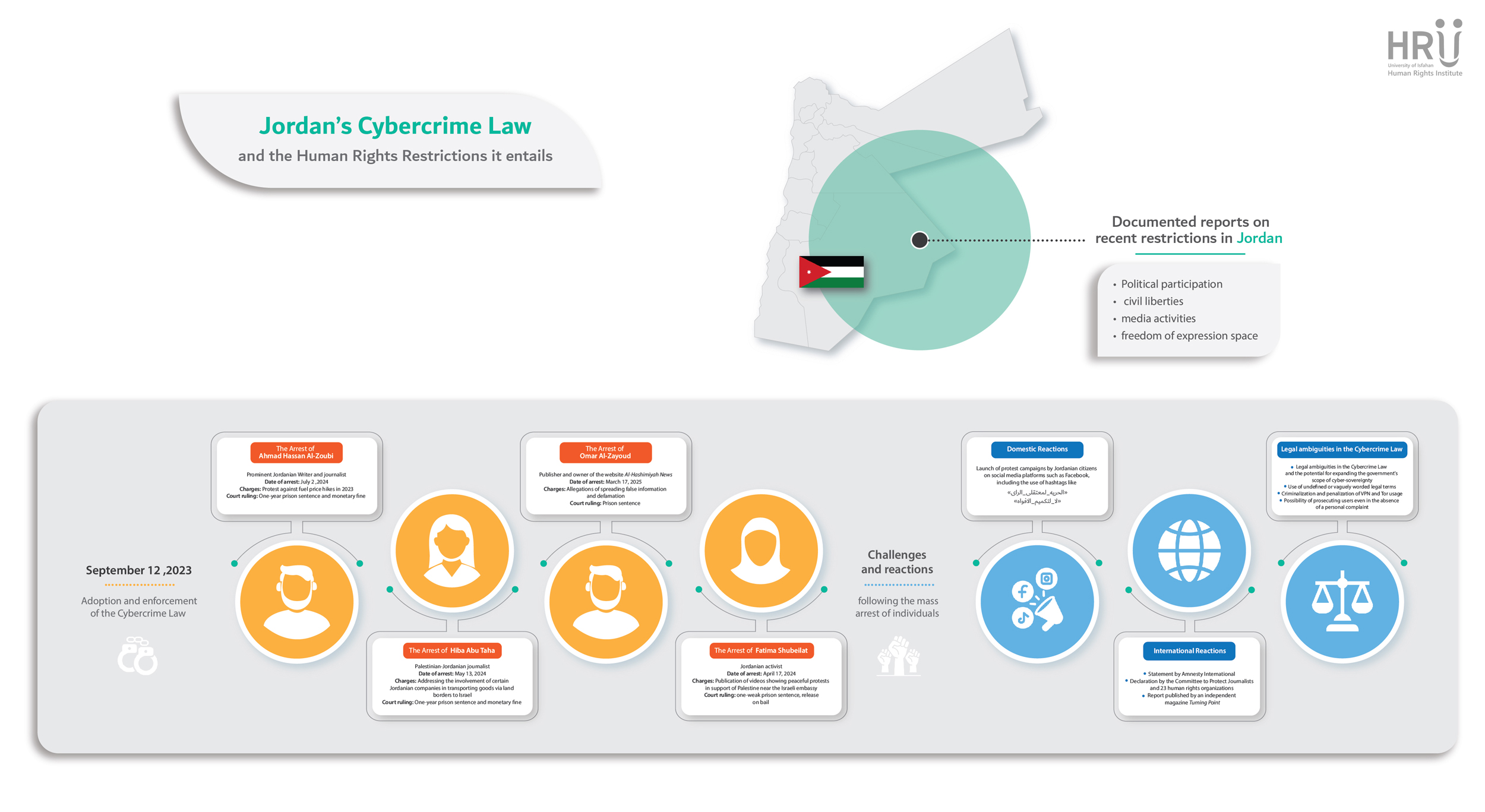
Jordan, a constitutional monarchy in the Middle East, has in recent years drawn increasing attention from international human rights bodies. Numerous documented reports by independent organizations have highlighted existing limitations on political participation, civil liberties, media activities, and the broader space for free expression in the country. The structure of governance in Jordan is characterized by limited mechanisms for broad and direct citizen participation in policymaking processes.
Within this context, the enactment and enforcement of the updated Cybercrime Law on September 12, 2023, triggered notable national and international reactions. This law, which significantly expands governmental oversight of online activity, has raised concerns particularly regarding its impact on fundamental rights of internet users, including journalists, civil society activists, and ordinary citizens. Several international human rights organizations have expressed concern over certain provisions of the law, citing vague definitions, the risk of overly broad interpretations, and its potential misuse to curtail freedom of expression.
In multiple instances, the law has been applied in cases involving the arrest, summons, or prosecution of digital activists. While the Jordanian government claims that the primary purpose of the law is to enhance cybersecurity and combat digital crimes, critics argue that its legal ambiguities and lack of safeguards for fundamental freedoms have enabled an erosion of public space and weakened the role of civil institutions within the country.
Incidents
- The Arrest of Ahmad Hassan Al-Zoubi
On July 2, 2024, prominent Jordanian writer and journalist Ahmad Hassan Al-Zoubi was arrested by security forces while traveling with his wife and children to his hometown of Al-Ramtha in northern Jordan. A lower court had previously sentenced him on June 22, 2023, to two months in prison and a fine of 50 Jordanian dinars (approximately 70 USD). However, on July 27, 2023, the public prosecutor overturned the initial verdict and ordered Al-Zoubi to serve a full year in prison[1]. On August 10, 2023, the Criminal Court of Appeals upheld the one-year sentence and increased the fine to 200 dinars (around 280 USD)[2].
Al-Zoubi was convicted under a provision of the 2015 Cybercrime Law, later superseded by a more expansive version of the law enacted in August 2023. His charges stemmed from social media posts in which he expressed support for truck drivers during the 2022 fuel price protests. Following the injury of Brigadier General Abdulrazzaq Al-Dalabeh, Deputy Police Chief of Ma’an Governorate, during the protests, Al-Zoubi posted a response to a government minister’s controversial statement, “If blood flows, fuel will not,” writing: “How much of our youth’s blood must be spilled to extinguish your fires? Mr. Minister, the blood has flowed—we are the firewood for your fireplaces[3].”
Al-Zoubi was detained in Marka prison from July 2, 2024. His health was reported to be at risk due to overcrowded conditions and his diabetes. Despite requests, authorities did not transfer him from Marka to Bab Al-Hawa prison[4]. Ultimately, on January 16, 2025, the court commuted his remaining sentence to community service, and he was released.
- The Arrest of Hiba Abu Taha
On May 13, 2024, Palestinian-Jordanian journalist Hiba Abu Taha was arrested in the town of Ain Al-Basha near Amman. She had authored a report titled “Partners in Genocide: Jordan’s Capital Complicit in the Gaza Genocide,” published in the Lebanese newspaper Annasher. The article alleged that certain Jordanian companies were facilitating the transfer of goods to Israel via land routes, a claim that was officially denied by Prime Minister Bisher Al-Khasawneh.
Under the Cybercrime Law, Abu Taha was charged with inciting discord and spreading false information[5]. The report allegedly included detailed data on exports to Israel through the Aqaba border, mentioning items such as construction materials, spare parts, and food supplies[6]. Some observers also believe her arrest was connected to another report she published in Anasher titled “Jordan’s Role in Defending the Enemy,” which criticized the interception of Iranian missiles over Jordanian airspace by Western forces[7].
She was sentenced to one year in prison and was later released upon completion of her term, after paying a fine of 5,000 Jordanian dinars. Her case marks the longest prison sentence documented by human rights organizations under the 2023 Cybercrime Law[8].
- The Arrest of Omar Al-Zayoud
On Monday, March 17, 2025, Omar Al-Zayoud, publisher and owner of the website Al-Hashimiyah News, was arrested by order of the Amman Public Prosecutor. He was accused of violating the Cybercrime Law—specifically publishing false information and defaming individuals—following a complaint by then-Prime Minister Bisher Al-Khasawneh[9].
Al-Zayoud had published a report alleging that the Prime Minister had received millions of dinars from high-ranking officials[10]. The prosecutor rejected his lawyer’s request for bail, arguing that the article, now removed from the website, directly harmed the complainant’s reputation and constituted a full cybercrime offense[11].
Al-Zayoud subsequently issued a formal apology addressed to the Prime Minister, his family, and his tribe, retracting his report as offensive, defamatory, misleading, and fabricated[12]. Observers suggest this apology was made under duress to facilitate his release and prevent further complications in the case. Nevertheless, as of March 23, 2025, reports indicated that he remained in detention, with no confirmed updates on his release.
- The Arrest of Fatima Shubeilat
On April 17, 2024, Fatima Shubeilat, widely known as “Umm Youssef,” a Jordanian activist, was arrested after posting a video on social media showing her participation in a peaceful demonstration in support of Palestine near the Al-Kalouti Mosque adjacent to the Israeli Embassy[13]. She was apprehended at a shopping center in the Marj Al-Hamam area of Amman and transferred first to the Amman Central Police Department, then to the Cybercrime Unit in the Abdali district, where she was interrogated without legal counsel. Her detention was formalized at the Al-Hussein Security Center[14].
According to her family, she was brought before the Public Prosecutor on Thursday, April 18, 2024, and charged with illegal assembly, resisting security forces, and insulting a government official. The prosecutor ordered her detention for one week. Although bail was later approved, her release was unexpectedly delayed on the grounds of a second pending case with the Cybercrime Unit.
She was returned to the prosecutor on Friday, April 19, 2024, and again remanded for one week at the Juwaida Correction and Rehabilitation Center. On Sunday, April 21, 2024, the prosecutor refused to release her on bail or apply alternative detention measures[15].
In the second case, the Cybercrime Unit accused her of violating Articles 13 and 15 of the Cybercrime Law[16], which pertain to the intentional dissemination of false news—especially concerning national security—and content that incites division, sedition, or racism. Shubeilat was eventually released on bail on April 30, 2024, but both of her cases remain open[17].
Challenges and Responses
- Domestic Reactions
Following the widespread arrests of journalists, media professionals, and activists in Jordan under the 2023 Cybercrime Law, Jordanian citizens launched online campaigns to express their discontent and to draw broader Arab public attention to the issue. These digital campaigns prominently featured hashtags such as #الحرية_لمعتقلي_الرأي (“freedom for prisoners of conscience”) and #لا_لتكميم_الافواه (“no to silencing voices”). The former hashtag was widely used in reference to detained individuals such as Hiba Abu Taha, Omar Al-Zayoud, Ahmad Al-Zoubi, and Fatima Shubeilat.
- International Reactions
Amnesty International published a report on September 13, 2024, marking the one-year anniversary of the enactment of Jordan’s Cybercrime Law, in which it issued strong objections to the legislation. The report stated:
“This law has become a tool for repression, silence, and the restriction of human rights in the digital space, including the rights to freedom of expression, access to information, and privacy. It has fueled self-censorship and fear, limiting one of the few remaining public spaces for Jordanians to engage in political discourse and critique of authorities.”
The organization, along with several other human rights bodies, urged the Jordanian government to repeal the law and adopt legislation on cybercrime that aligns with the country’s international human rights obligations[18].
On May 23, 2025, the Committee to Protect Journalists (CPJ), in collaboration with 23 other human rights organizations, issued a joint statement calling on the Jordanian government to reverse its decision to block twelve websites. The statement urged that the Cybercrime Law be subject to transparent and participatory review processes and demanded that the legal basis for the blocking orders be publicly disclosed. It also emphasized the necessity of ensuring access to effective legal remedies through an independent judiciary in accordance with constitutional standards and international law. The organizations reaffirmed that safeguarding press freedom and media pluralism is not incompatible with the rule of law, but rather a prerequisite for it[19].
The independent magazine Turning Point also published a report on May 9, 2025, titled “The Cybercrime Law and the Genocide in Palestine: A Perfect Storm to Shrink Freedom’s Space in Jordan”, addressing the widespread crackdown on pro-Palestine expression and the violations of free speech through the Cybercrime Law. The article stated that the Jordanian government, following the October 7 attacks, intensified restrictions in the digital space, particularly on content related to Palestine. The law’s vague language—using terms like “sedition,” “false news,” and “insulting”—has created a legal framework that facilitates repression.
As of the time of publication, approximately 2,000 individuals had been arrested under the law. The report also claimed that Jordanian authorities were using surveillance tools like Pegasus spyware to monitor online activities and that the media landscape was increasingly subjected to both censorship and self-censorship. According to the article, an unwritten rule exists: crossing red lines—such as criticism of the monarchy, the army, or relations with Israel—can lead to immediate summons or arrest[20].
- Legal Ambiguities and Broad Interpretations
The 2023 Jordanian Cybercrime Law is widely considered one of the region’s most restrictive pieces of digital legislation. However, the most significant criticism against the law is not merely its severity, but its vagueness, which grants the state expansive authority over digital expression. Terms like “incitement to sedition,” “spreading false news,” “insulting officials,” and “undermining national unity” are included in the law without clear or objective definitions.
This vagueness enables security forces and public prosecutors to criminalize virtually any form of online expression based on subjective interpretations. The use of protective tools such as VPNs or the TOR network is also criminalized under the law. Perhaps most concerning is the provision allowing prosecution even in the absence of a personal complaint, turning the law into a mechanism for the systematic repression of dissent and civil protest.
Conclusion
In recent years, Jordan has faced increasing challenges in safeguarding fundamental freedoms, largely due to its centralized political structure and the dominant role of ruling institutions, particularly the monarchy. One of the clearest manifestations of this dynamic is the adoption of the 2015 Cybercrime Law and its significant amendments in 2023. According to numerous reports from both international and domestic human rights organizations, these legal developments have had serious consequences for civil and digital liberties in the country.
Following its recent revision, the Cybercrime Law has served as a basis for extensive restrictions on freedom of expression, access to information, and digital and media activity. Under its provisions, public commentary on sensitive topics—such as the conduct and status of public officials, especially members of the royal family, foreign policy issues (notably Jordan’s relations with Israel), and matters of religion and belief—may result in prosecution or punitive actions.
Undoubtedly, the current legal framework has fueled heightened levels of self-censorship in society and has obstructed the emergence of an open, critical public sphere. Accordingly, the Jordanian government must urgently review and amend this highly ambiguous and politically exploitable legislation in a manner consistent with its obligations under international human rights law. Failure to do so risks enabling further repression of civil society and contributing to the systematic violation of human rights under a guise of legal legitimacy.
References
[1] Gulf Centre for Human Rights. (2024, August 14). Solidarity grows for detained Jordanian journalist Ahmed Hassan Al-Zoubi. Ifex. From: https://ifex.org/solidarity-grows-for-detained-jordanian-journalist-ahmed-hassan-al-zoubi/
[2] George, S. (2024, November 13). Jordan: Criminal Court of Appeal Sentences Journalist to One Year Imprisonment for Criticizing Authorities on Social Media. Library of Congress. From: https://www.loc.gov/item/global-legal-monitor/2024-11-13/jordan-criminal-court-of-appeal-sentences-journalist-to-one-year-imprisonment-for-criticizing-authorities-on-social-media/
[3] Alrakoba. (2024, July 5). He was arrested because of a Facebook post. UN calls on Jordan to release satirist. Alrakoba. From: https://www.alrakoba.net/31960039/%D8%A7%D8%B9%D8%AA%D9%82%D9%84-%D8%A8%D8%B3%D8%A8%D8%A8-%D9%85%D9%86%D8%B4%D9%88%D8%B1-%D8%B9%D9%84%D9%89-%D9%81%D9%8A%D8%B3%D8%A8%D9%88%D9%83-%D9%85%D9%86%D8%B8%D9%85%D8%A9-%D8%A3%D9%85%D9%85%D9%8A/
[4] The New Arab. (2024, September 9). Jordan journalist Ahmed Hassan Al-Zoubi’s health deteriorates in overcrowded prison. The New Arab. From: https://www.newarab.com/news/health-jailed-jordan-journalist-hassan-al-zoubi-deteriorates
[5] Middle East Eye. (2024, June 13). Jordan jails journalist over report on ‘land corridor’ with Israel. Middle East Eye. From: https://www.middleeasteye.net/news/jordan-sends-journalist-jail-over-report-exporting-goods-israel
[6] Sharika Wa Laken. (2024, May 21). Heba Abu Taha arrested for exposing normalization processes in Jordan. Sharika Wa Laken. From: https://www.sharikawalaken.media/2024/05/21/%D8%A7%D8%B9%D8%AA%D9%82%D8%A7%D9%84-%D9%87%D8%A8%D8%A9-%D8%A3%D8%A8%D9%88-%D8%B7%D9%87-%D9%84%D9%83%D8%B4%D9%81%D9%87%D8%A7-%D8%B9%D9%85%D9%84%D9%8A%D8%A7%D8%AA-%D8%A7%D9%84%D8%AA%D8%B7%D8%A8%D9%8A/
[7] Peoples Dispatch. (2024, October 30). Hiba Abu Taha: the imprisoned journalist who dared to expose Jordan’s complicity with Israel. Peoples Dispatch. From: https://peoplesdispatch.org/2024/10/30/hiba-abu-taha-the-imprisoned-journalist-who-dared-to-expose-jordans-complicity-with-israel/
[8] MENA Rights Group. (2025, January 21). Palestinian-Jordanian journalist jailed for expressing her support for Palestine. MENA Rights Group. From: https://menarights.org/en/case/hiba-abu-taha
[9] JO24.Net. (2025, March 17). Al-Hashemiya News Publisher Omar Al-Zeyoud Arrested Following a Complaint by a Former Prime Minister. JO24.Net. From: https://jo24.net/article/526968
[10] Balki News. (n.d.). Arrest of colleague Omar Al-Zeyoud, publisher of the “Hashemiya News” website, against the background of publishing a report on a former prime minister. Balki News. From: https://balkinews.com/article/443621
[11] Nabd. (2025, March 22). Urgent. Refusal to release the journalist Al-Zayoud on bail. Nabd. From: https://nabd.com/s/152542151-d01e5b/%D8%B9%D8%A7%D8%AC%D9%84..%D8%B1%D9%81%D8%B6-%D8%A7%D9%84%D8%A7%D9%81%D8%B1%D8%A7%D8%AC-%D8%A8%D9%83%D9%81%D8%A7%D9%84%D8%A9-%D8%B9%D9%86-%D8%A7%D9%84%D8%B5%D8%AD%D9%81%D9%8A-%D8%A7%D9%84%D8%B2%D9%8A%D9%88%D8%AF
[12] Al Balad News. (2025, March 26). “Hashemite News” and its publisher “Al-Zeyoud” apologize to the state of Bishr Al-Khasawneh. Will it be sponsored?. Al Balad News. From: https://albaladnews.net/article/422880
[13] Albosala. (2024, April 23). “Islamic Action Freedoms” condemns the arrest of the daughter of the late Laith Shubailat and demands the release of all detainees. Albosala. From: https://albosala.com/%D8%AD%D8%B1%D9%8A%D8%A7%D8%AA-%D8%A7%D9%84%D8%B9%D9%85%D9%84-%D8%A7%D9%84%D8%A5%D8%B3%D9%84%D8%A7%D9%85%D9%8A-%D8%AA%D8%B3%D8%AA%D9%86%D9%83%D8%B1-%D8%A7%D8%B9%D8%AA%D9%82%D8%A7%D9%84-%D8%A7-3/
[14] MENA Rights Groups. (2024, December 17). Jordanian peaceful protestor arrested for her support for Palestine. MENA Rights Groups. From: https://menarights.org/en/case/fatima-shubeilat
[15] Arab Organization for Human Rights in the UK. (2024, April 22). Jordanian authorities continue to detain Fatima al-Shubailat for her solidarity with Gaza. AOHR. From: https://aohr.org.uk/%D8%A7%D9%84%D8%B3%D9%84%D8%B7%D8%A7%D8%AA-%D8%A7%D9%84%D8%A3%D8%B1%D8%AF%D9%86%D9%8A%D8%A9-%D8%AA%D9%88%D8%A7%D8%B5%D9%84-%D8%A7%D8%B9%D8%AA%D9%82%D8%A7%D9%84-%D9%81%D8%A7%D8%B7%D9%85%D8%A9-%D8%A7/
[16] CIVICUS. (2024, October 31). Authorities continue clampdown against pro-Palestine protests and expression. CIVICUS. From: https://monitor.civicus.org/explore/authorities-continue-clampdown-against-pro-palestine-protests-and-expression/
[17] Amnesty International. (2024, August 13). Jordan: New Cybercrimes Law stifling freedom of expression one year on. Amnesty International. From: https://www.amnesty.org/en/latest/news/2024/08/jordan-new-cybercrimes-law-stifling-freedom-of-expression-one-year-on/
[18] Amnesty International. (2024, September 13). Jordan: Marking a year of oppression, fresh calls to scrap Cybercrime Law. Amnesty International. From: https://www.amnesty.org/en/documents/mde16/8523/2024/en/
[19] CPJ. (2025, May 23). CPJ, human rights organizations urge Jordanian authorities to reverse decision to block websites. CPJ. From: https://cpj.org/2025/05/cpj-human-rights-organizations-urge-jordanian-authorities-to-reverse-decision-to-block-websites/
[20] Shamandafar, M. (2025, May 9). The Cybercrime Law & the Genocide in Palestine: a Perfect “Storm” to Shrink Freedom’s Space in Jordan. Turning Point. From: https://turningpointmag.org/2025/05/09/the-cybercrime-law-the-genocide-in-palestine-a-perfect-storm-to-shrink-freedoms-space-in-jordan/