

Introduction
India has long been recognized as a multiethnic and multireligious country that encompasses a diverse array of traditions, languages, and beliefs. However, in recent decades, this diversity has, in many instances, become a locus of discrimination and repression rather than a foundation for peaceful coexistence. Ethnic and religious violence in Manipur, demolition of Muslim properties in Haryana, the hijab ban in Karnataka schools, the implementation of the Citizenship Amendment Act (CAA), and hardline policies in Kashmir are clear examples of violations of religious minorities’ rights and the erosion of democracy, freedom of expression, freedom of assembly, freedom of belief, and other fundamental freedoms in the country. Collectively, these developments have not only caused widespread suffering among religious and ethnic minorities, but have also seriously called into question India’s domestic and international human rights commitments.
Incidents
- Ethnic and Religious Violence in Manipur
Manipur—whose name means “the land of jewels”—consists of a valley surrounded by mountain ranges. The state is home to 39 ethnic communities adhering to different faiths, including Hinduism, Christianity, Islam, as well as indigenous religious traditions such as “Sanamahi.” Opposition to the terms of Manipur’s accession to India in 1949 laid the groundwork for nascent resistance and separatist movements and remains at the heart of tensions between New Delhi and many restive parts of the Northeast[1].
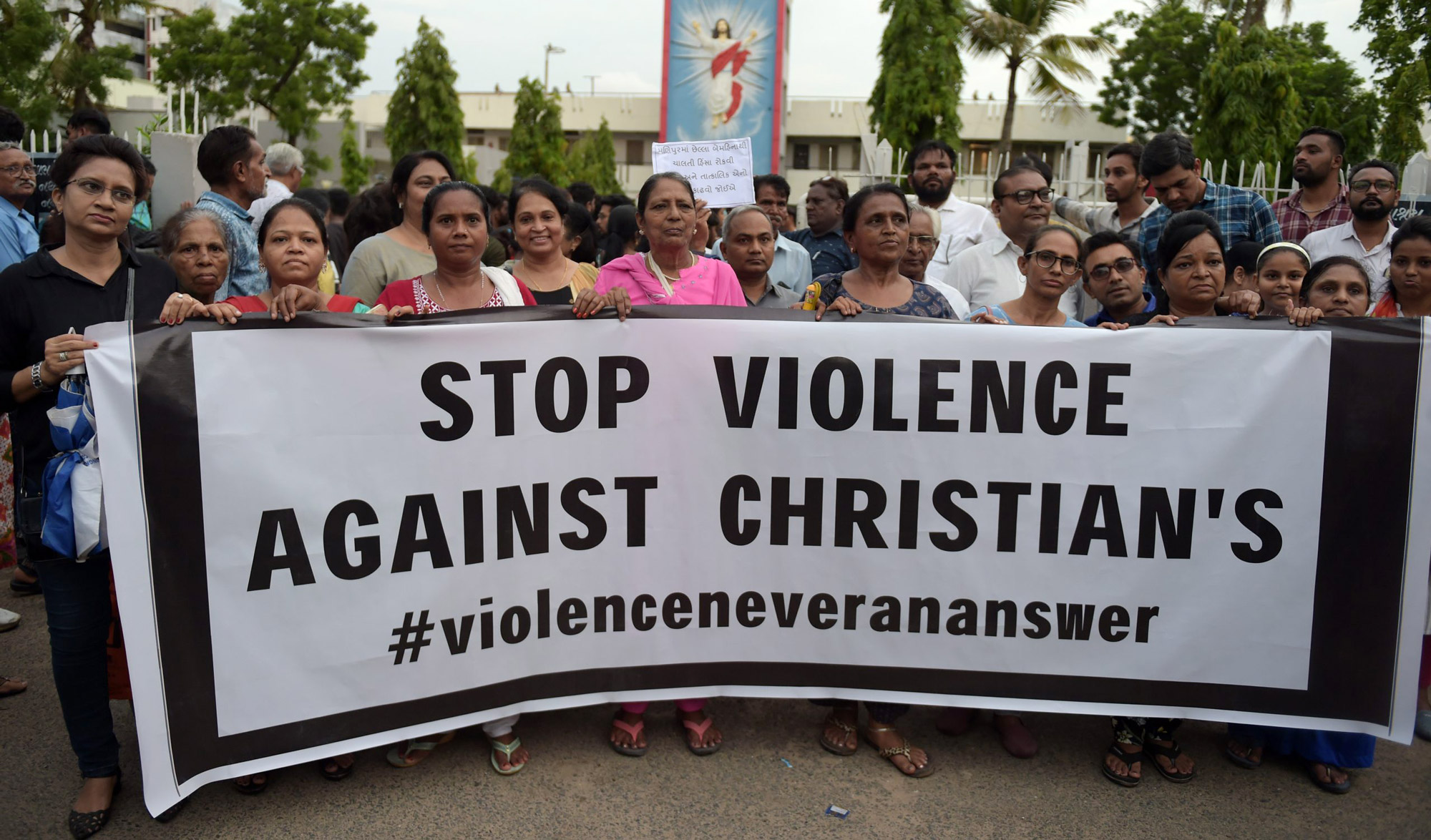
Since May 3, 2023, this northeastern state has witnessed intense clashes between the predominantly Hindu Meitei community (the demographic majority in the valley) and the Christian Kuki-Zo tribes (a demographic minority concentrated in the hills). The core dispute centered on a demand by the majority community for recognition as a “Scheduled Tribe,” which under Indian law confers benefits such as reservations in public employment, political representation, and land-related rights[2]. The minority community feared that such recognition would strengthen pressures imposed by the majority.
The violence has left over 200 people dead and displaced more than 60,000—most of them from the Christian minority. During the unrest, the state authorities and police took virtually no effective action and were largely bystanders to widespread violence, including arson, killings, beatings, and abductions. Self-styled vigilante groups such as “Arambai Tenggol” and “Meitei Leepun,” which support the majority Meitei community, became notorious as the authorities failed to end the violence and prosecute suspects; these groups reportedly recruited thousands of volunteers, often armed with military-grade weapons allegedly looted from state police armories[3].
Beyond inaction in the face of these activities, in July 2024 the local and state police filed a case against three women activists who were members of the fact-finding team of the “All India Democratic Women’s Association” (AIDWA). The charges included sedition-related offenses, criminal conspiracy, defamation, insult, inciting enmity, and disturbance of public order. The fact-finding mission had characterized the ethnic violence as “state-supported violence” and called for a Supreme Court-monitored investigation[4].
Authorities also imposed an extended internet shutdown in Manipur from May to December 2023, claiming it was necessary to curb the spread of misinformation. Following a court order in July 2023, the state government restored broadband services with certain safeguards; however, mobile internet remained shut until December, effectively cutting off the majority from the internet since 96 percent of people access it via mobile phones. The shutdown failed to deliver the peace anticipated by the state government, as law and order remained out of control—and, worse still, narratives began blaming those who had no voice in the conflict[5].
Despite certain steps taken—including the central government’s removal of the state’s Chief Minister after he made biased remarks favoring the majority and accusing the Christian minority of involvement in drug trafficking[6]—and a relative easing of the security situation, the potential for renewed unrest remains substantial.
- Demolition of Muslim Properties in Haryana
Following communal clashes in the Nuh area of Haryana on July 31, 2023, state authorities undertook large-scale demolitions of properties belonging to Muslims. More than 300 homes and makeshift structures were razed by bulldozers, many without prior notice or legal warrants[7]. According to official state figures, 283 Muslims and 71 Hindus were affected by the demolitions in the area[8]—numbers that contradict neutral reporting. One such set of figures, cited by Amnesty International, records 128 instances of Muslim property demolitions affecting 617 individuals[9].
The communal unrest began when, amid rumors that a well-known Hindu vigilante would attend a religious procession, Muslim and Hindu groups pelted stones at each other during a street gathering. The confrontation escalated into mob violence and assaults. Some Indian civil society groups contend that the demolitions constituted an organized act of retribution against Muslims by the Hindu-led state government.
A victim named Mohammad recounted that on August 4, while he was at work, one of his sons phoned to say that bulldozers and police had entered the village. By the time he arrived, his home—his only asset and the site of decades of labor and memories—was being destroyed. The family had received no prior notice from authorities, apart from a slip of paper pasted on the door minutes before the demolition began[10]. This is not the first instance of such actions by central and state authorities against Muslims; indeed, some officials have openly touted the unlawful demolition of Muslim properties as “bulldozer justice[11].”
- The Hijab Ban in Karnataka Schools
With the intensified enforcement of a “uniform dress code,” widespread protests erupted in Karnataka. Muslim students—particularly hijab-wearing girls—held rallies outside schools and universities, asserting their constitutional rights to freedom of dress and religious practice. In response, Hindu groups, especially supporters of Hindu nationalist organizations, staged counter-rallies, donning saffron shawls (a symbol associated with Hindu nationalists) and injecting the dispute into a broader political context. The confrontation deepened religious polarization and led to sporadic clashes.
The dispute began in January 2022, when a government school in Udupi district barred hijab-wearing girls from attending classes, prompting protests by Muslims who argued they were being denied basic rights to education and religious observance[12]. In February 2022, the state government issued an order prohibiting any clothing that “disturbs equality, integrity, and public law and order[13].”
Ultimately, the matter reached the Karnataka High Court. In March 2022, the court ruled that wearing the hijab is not an “essential religious practice” in Islam, thereby allowing schools to enforce a uniform dress code to preserve “educational unity and discipline,” and dismissed various petitions and appeals[14]. In practice, the ruling legalized the hijab ban in the state. While Muslims constitute 14 percent of India’s 1.4-billion population[15], Muslims in Karnataka not only lost the legal right to choose their dress but were also effectively barred from protesting the court’s decision due to orders restricting public gatherings. In a multireligious society like India—where each faith (e.g., Sikhs with turbans, or Hindus with a tilak on the forehead) has its own visible markers—Muslims argue that the hijab ban is indefensible[16].
- Implementation of the Citizenship Amendment Act (CAA) in India
Passed by India’s Parliament in December 2019, the CAA is among the most controversial laws enacted in recent decades. The stated purpose was to facilitate Indian citizenship for migrants from six ethno-religious groups—Hindus, Sikhs, Buddhists, Jains, Parsis, and Christians—from three neighboring countries (Pakistan, Afghanistan, and Bangladesh), provided they had entered India before December 31, 2014. Those arriving before that date—even without valid documents or with expired passports/visas—could apply for citizenship, and the residency requirement for naturalization was reduced from 11 to 5 years[17].
The chief and contentious feature of the law was its exclusion of Muslims, which triggered widespread domestic protests and international condemnation. Critics argue that the law is discriminatory, violates the secular character of the Indian Constitution, and contravenes the principle of equality under Article 14. India—whose majority is Hindu—has around 200 million Muslims, the third-largest Muslim population in the world. Human rights groups and opposition parties have criticized Prime Minister Modi’s government and his party for systematically targeting the minority community to advance the party’s core ideology of Hindu revivalism[18]. In addition to discriminating against Muslims, Amnesty International maintains that the government has used the CAA to pressure and suppress political opponents and activists[19].
Following passage, implementation was delayed for several years due to mass protests and then the COVID-19 pandemic. Finally, on March 11, 2024, the government released the implementing rules and put the law into effect. An online portal was launched for applications, and Home Minister Amit Shah described the move as the fulfillment of India’s historic promise to persecuted regional minorities. These statements were made even as Muslim minorities persecuted in neighboring countries—such as Rohingya Muslims and Hazara Shia—were deemed ineligible, and migrants fleeing non-Muslim states due to persecution—such as Tamil refugees from Sri Lanka and Tibetan Buddhists fleeing Chinese rule—were also excluded[20].
- Discrimination and Harassment of Muslims in Kashmir
Kashmir is a mountainous and strategic region in the northern subcontinent that has been a locus of dispute and conflict between India and Pakistan since independence in 1947. Since the two countries gained independence from Britain and partitioned the Muslim-majority region, many residents have demanded independence from India or accession to Pakistan[21]. The Indian-controlled part—Jammu and Kashmir—has a Muslim majority, a demographic feature that makes it a particularly sensitive arena for India’s domestic and foreign policy.
In August 2019, the Indian government, led by the Bharatiya Janata Party (BJP), abrogated Article 370 of the Constitution and revoked the region’s special autonomous status—a move that sparked widespread local protests and international condemnation. Since then, the security and political environment has been highly restrictive, marked by extensive repression, censorship, and prolonged internet shutdowns. As a senior editor of a prominent newspaper told Amnesty International: “When the National Investigation Agency raids a journalist’s home or the Enforcement Directorate threatens an editor with fabricated cases, it affects not only that journalist or editor but the entire community. They fear they will be next; independent journalism has become impossible[22].”
Public assemblies have been banned, and at times even access to television signals has faced serious restrictions. During protests, Indian forces have used tear gas, pepper bombs, and pellet guns to disperse demonstrators[23].
Challenges and Responses
- Ascendancy of Hindu Nationalists
Hindus, India’s largest demographic group, occupy a decisive presence across all levels of governance, social institutions, and economic structures. Their demographic weight has enabled Hindu-aligned candidates to secure power in many national and state-level elections. The result is a concentration of political power in the hands of representatives emerging from the Hindu majority—actors who, naturally, prioritize the majority’s preferences in policymaking.
This concentration of power and policy orientation systematically strengthens resistance to fulfilling the demands and rights of religious minorities, institutionalizing structural bias toward the majority. Consequently, there is both suspicion and evidence of organized discrimination against minorities at the level of public policy and administration. This state of affairs not only undermines social equilibrium and multicultural coexistence in India but also represents one of the gravest legal and human-rights obstacles to achieving equal rights for religious minorities.
- Domestic Reactions
In August 2023, after days of demolitions of homes, shops, and shanties—largely belonging to Muslims—in Nuh, Haryana, the Punjab and Haryana High Court intervened. The court asked whether these demolitions amounted to an exercise in ethnic cleansing, noting: “It also emerges that buildings belonging to a particular community may have been demolished under the guise of maintaining law and order, and that, in fact, a form of ethnic cleansing by the State may be underway.” The High Court ordered an immediate four-day stay on bulldozer operations and underscored that state authorities had carried out the demolitions without following due legal process.
Justices G. S. Sandhawalia and Harpreet Kaur Jeewan observed that no prior notices had been served to property owners, which constitutes a clear violation of legal principles. Legal commentators described the High Court’s stance as a rare instance of India’s judiciary posing a question that had previously been raised primarily by human rights organizations and experts at the national and international levels: that demolitions of Muslim properties, ostensibly to restore law and order, may in fact be targeted actions against a specific community[24].
- International Reactions
On January 22, 2020—at a time when the CAA had been passed but not yet implemented—the European Parliament adopted a resolution deeming the law incompatible with secularism and human rights. The resolution stressed that, for the first time, religion would become a criterion for citizenship in India, threatening the constitutional principle of equality. Members noted that the CAA violates India’s international obligations, including the International Covenant on Civil and Political Rights and the Universal Declaration of Human Rights, and that the UN High Commissioner for Human Rights had characterized the law as inherently discriminatory.
The Parliament urged the Indian government to demonstrate its commitment to protecting refugees and migrants regardless of religion and to engage in constructive dialogue with protesters. It called for repeal of the CAA, an end to the criminalization of protests, cessation of disproportionate restrictions on freedom of expression and assembly, and independent investigations into torture and ill-treatment. It also urged the EU and its member states to raise human rights concerns in all negotiations with India and to make any trade agreement conditional on a binding human rights clause. In another section, Members addressed Kashmir, condemning the revocation of its autonomy, political detentions, and communication blackouts. They called on the EU and member states to push for implementation of UN Security Council resolutions on Kashmir and to encourage India and Pakistan to seek a peaceful resolution[25].
Time magazine also published a report titled “How India’s Bulldozers Became a Vehicle of Injustice,” highlighting discrimination against Muslims through property demolitions in Haryana. It reported that the impoverished town of Nuh was reduced to heaps of rubble after authorities bulldozed hundreds of homes and shops—mostly belonging to Muslims, who make up 77 percent of the district’s population. The demolitions followed the July 31 clashes that left at least six people dead and dozens injured. While state officials claimed the structures were illegal, residents rejected these assertions. Civil society activists argue that bulldozers have become an extralegal tool of the ruling party to target Muslim properties and places, with the bulldozer emerging as a symbol not only of “instant justice” but also of power in election campaigns, nationalist anthems, and public celebrations. The practice traces back to the 1992 demolition of the Babri Mosque, which paved the way for the ascent of ruling party leaders, including Prime Minister Narendra Modi. In recent years, demolitions have intensified, including during protests against the 2019 citizenship law and even targeting mosques despite court orders. According to legal networks, from March 2020 to July 2021, more than 43,000 houses were demolished in India, rendering around 21 people homeless every hour. Legal experts contend these actions often contravene the Constitution by denying residents due notice and a chance to appeal[26].
On July 31, 2024, Human Rights Watch released a report on the situation in Kashmir five years after the revocation of its autonomy by the Indian government. The report concludes that, even five years on, freedoms of expression and association have not been restored. Indian security forces continue to implement repressive policies, including arbitrary detentions, extrajudicial killings, and other serious human rights violations. Authorities have sought to justify these abuses by claiming that political violence has significantly decreased over the past five years and that civilian and security-force casualties have declined.
In March 2024, protesters in Ladakh (now a separate union territory) demanded greater participation in the governance of their region. Since 2019, religious minorities and migrant workers have been targeted in attacks, and hundreds of Kashmiris—including journalists and human rights defenders—have remained in detention under stringent preventive and counterterrorism laws. At least 35 journalists in Kashmir have faced police interrogations, raids, threats, assaults, movement restrictions, or fabricated criminal cases for their reporting. A new media policy introduced in June 2020 facilitated censorship, and in June 2024, authorities adopted measures purportedly to protect government employees against allegedly false complaints, including penalties against media outlets deemed to spread misinformation—steps that raise concerns about accountability and further threaten press freedom. The report concludes that Indian authorities should reassess their approach to Jammu and Kashmir and prioritize justice for victims of abuses[27].
Conclusion
The review of multiple instances of discrimination and violence against religious and ethnic minorities in India indicates a sustained pattern of majoritarian policy preferences and repressive practices—from the structural marginalization of Muslims and Christians to the restriction of fundamental freedoms in Kashmir. Domestic judicial responses—such as the intervention by the Punjab and Haryana High Court—and international reactions by bodies including the European Parliament, the United Nations, and human rights organizations demonstrate broad concern over these trends and the curtailment of fundamental freedoms and human rights in the country. India’s image as the world’s largest democracy has been increasingly tarnished, heightening the risk of deepening social and ethnic cleavages. Meaningful change, however, requires a fundamental shift in the government’s approach to minorities and a genuine embrace of equality and cultural pluralism.
References
[1] Nepram, B. & Schuchert, B. (2023, June 2). Understanding India’s Manipur Conflict and Its Geopolitical Implications. United States Institute of Peace. From: https://www.usip.org/publications/2023/06/understanding-indias-manipur-conflict-and-its-geopolitical-implications
[2] Open Doors. (2023, May 26). India: Violence in Manipur – ethnic and religious background. Open Doors. From: https://www.opendoors.org/en-US/research-reports/articles/stories/India-violence-in-Manipur-ethnic-and-religious-background/
[3] Amnesty International. (2024, July 16). India: Authorities ‘missing-in-action’ amid ongoing violence and impunity in Manipur state – New testimonies. Amnesty International. From: https://www.amnesty.org/en/latest/news/2024/07/india-authorities-missing-in-action-amid-ongoing-violence-and-impunity-in-manipur-state-new-testimonies/
[4] Human Rights Watch. (2023, July 24). Activists protesting ethnic violence in northeastern Manipur state shout slogans in Mumbai. Human Rights Watch. From: https://www.hrw.org/world-report/2024/country-chapters/india
[5] Human Rights Watch. (2025, March 27). India: Ethnic Clashes Restart in Manipur. Human Rights Watch. From: https://www.hrw.org/news/2025/03/27/india-ethnic-clashes-restart-manipur
[6] Lekhi, R. (2024, December 23). Tens of thousands displaced by ethnic violence in northeast India suffer squalid conditions in camps. The Associated Press. From: https://apnews.com/article/india-manipur-ethnic-violence-displacement-9153549db3852e7f34a3ef70b7bdb349
[7] Kumar, A. (2023, August 08). “Ethnic Cleansing” By State? High Court’s Big Question On Nuh Demolitions. NDTV. From: https://www.ndtv.com/india-news/nuh-violence-case-latest-news-haryana-nuh-bulldozer-action-in-court-order-halting-bulldozer-action-an-ethnic-cleansing-reference-4278589
[8] The Tribune. (2023, August 19). No structure demolished against law: Haryana. The Tribune. From: https://www.tribuneindia.com/news/haryana/no-structure-demolished-against-law-haryana-536075/
[9] Dasgupta, S. (2024, May 30). Bulldozers in the Modi Decade: A Symbol of Quick ‘Justice’ and Collective Punishment. The Wire. From: https://thewire.in/politics/bulldozers-in-the-modi-decade-a-symbol-of-quick-justice-and-collective-punishment
[10] The Polis Project. (2025, June 12). In a village not far from India’s capital, how a Muslim home was razed by state bulldozers. The Polis Project. From: https://thepolisproject.com/research/india-muslim-home-demolition-nuh-bulldozers/
[11] Amnesty International. (2024, February 07). India: Authorities must immediately stop unjust targeted demolition of Muslim properties. Amnesty International. From: https://www.amnesty.org/en/latest/news/2024/02/india-authorities-must-immediately-stop-unjust-targeted-demolition-of-muslim-properties/
[12] Arabic RT. (2022, March 15). India.. Judiciary upholds hijab ban in Karnataka schools and universities. Arabic RT. From: https://ar.rt.com/sln1
[13] The Times of India. (2023, April 30). Explained: What was Hijab ban row? Is it a major issue in Karnataka elections?. The Times of India. From: https://timesofindia.indiatimes.com/elections/assembly-elections/karnataka/news/explained-what-was-hijab-ban-row-is-it-a-major-issue-in-karnataka-elections/articleshow/99886128.cms
[14] Aljazeera. (2022, March 15). India.. Court upholds ban on hijab in Karnataka school premises. Aljazeera. From: https://www.aljazeera.net/news/2022/3/15/%D9%85%D8%AD%D9%83%D9%85%D8%A9-%D9%87%D9%86%D8%AF%D9%8A%D8%A9-%D8%AA%D8%A4%D9%8A%D8%AF-%D8%AD%D8%B8%D8%B1-%D8%A7%D9%84%D8%AD%D8%AC%D8%A7%D8%A8-%D9%81%D9%8A-%D8%A3%D9%85%D8%A7%D9%83%D9%86
[15] Anadolu Agency. (2022, March 15). India.. Karnataka court upholds hijab ban in schools. Anadolu Agency. From: https://www.aa.com.tr/ar/%D8%AF%D9%88%D9%84%D9%8A/%D8%A7%D9%84%D9%87%D9%86%D8%AF-%D9%85%D8%AD%D9%83%D9%85%D8%A9-%D9%88%D9%84%D8%A7%D9%8A%D8%A9-%D9%83%D8%A7%D8%B1%D9%86%D8%A7%D8%AA%D8%A7%D9%83%D8%A7-%D8%AA%D8%A4%D9%8A%D8%AF-%D8%AD%D8%B8%D8%B1-%D8%A7%D9%84%D8%AD%D8%AC%D8%A7%D8%A8-%D9%81%D9%8A-%D8%A7%D9%84%D9%85%D8%AF%D8%A7%D8%B1%D8%B3/2535406
[16] Dhillon, A. (2022, March 15). India court in Karnataka upholds ban on hijabs in colleges. The Guardian. From: https://www.theguardian.com/world/2022/mar/15/india-court-in-karnataka-upholds-ban-on-hijabs-in-colleges
[17] Pandey, A. (2025, September 3). Big decision by the government on CAA: From 2024, minorities from Pakistan, Bangladesh, and Afghanistan who came to India before this year will now be allowed to stay. The Time of India. From: https://navbharattimes.indiatimes.com/india/citizenship-amendment-act-registration-deadline-extended-to-2024-major-decision-by-indian-government/articleshow/123675666.cms
[18] Dayal, S. (2024, May 15). India grants citizenship to first batch of 14 refugees under controversial law. Reuters. From: https://www.reuters.com/world/india/india-grants-citizenship-first-batch-14-refugees-under-controversial-law-2024-05-15/
[19] Amnesty International. (2024, March 14). India: Citizenship Amendment Act is a blow to Indian constitutional values and international standards. Amnesty International. From: https://www.amnesty.org/en/latest/news/2024/03/india-citizenship-amendment-act-is-a-blow-to-indian-constitutional-values-and-international-standards/
[20] Ellis-Petersen, H. (2024, March 12). India enacts citizenship law criticised as ‘discriminatory’ to Muslims. The Guardian. From: https://www.theguardian.com/world/2024/mar/11/india-enacts-citizenship-law-criticised-as-discriminatory-to-muslims
[21] Anadolu Ajansi. (2019, September 9). The UN Commissioner calls on India to respect human rights in Kashmir. Anadolu Ajansi. From: https://www.aa.com.tr/ar/%D8%A7%D9%84%D8%B3%D9%8A%D8%A7%D8%B3%D8%A9/%D8%A7%D9%84%D9%85%D9%81%D9%88%D8%B6%D8%A9-%D8%A7%D9%84%D8%A3%D9%85%D9%85%D9%8A%D8%A9-%D8%AA%D8%AF%D8%B9%D9%88-%D8%A7%D9%84%D9%87%D9%86%D8%AF-%D9%84%D8%A7%D8%AD%D8%AA%D8%B1%D8%A7%D9%85-%D8%AD%D9%82%D9%88%D9%82-%D8%A7%D9%84%D8%A5%D9%86%D8%B3%D8%A7%D9%86-%D9%81%D9%8A-%D9%83%D8%B4%D9%85%D9%8A%D8%B1/1576952
[22] Amnesty International. (2022, September 2). India: The Government must end the repression of rights in Jammu and Kashmir. Amnesty International. From: https://www.amnesty.org/en/latest/news/2022/09/india-the-government-must-end-the-repression-of-rights-in-jammu-and-kashmir/
[23] Al Arabiya. (2020, May 20). India reimposes restrictions on Kashmir’s largest city after clashes. Al Arabiya. From: https://www.alarabiya.net/arab-and-world/2019/08/18/%D8%A7%D9%84%D9%87%D9%86%D8%AF-%D8%AA%D8%B9%D8%A7%D9%88%D8%AF-%D9%81%D8%B1%D8%B6-%D9%82%D9%8A%D9%88%D8%AF-%D8%B9%D9%84%D9%89-%D8%A3%D9%83%D8%A8%D8%B1-%D9%85%D8%AF%D9%86-%D9%83%D8%B4%D9%85%D9%8A%D8%B1-%D8%A8%D8%B9%D8%AF-%D8%A7%D8%B4%D8%AA%D8%A8%D8%A7%D9%83%D8%A7%D8%AA
[24] Al Jazeera. (2023, August 8). India court asks if Nuh demolitions were ‘an exercise of ethnic cleansing’. Al Jazeera. From: https://www.aljazeera.com/news/2023/8/8/india-court-asks-if-nuh-demolitions-were-an-exercise-of-ethnic-cleansing
[25] European Parliament. (2020, January 22). MOTION FOR A RESOLUTION on India’s Citizenship (Amendment) Act, 2019. European Parliament. From: https://www.europarl.europa.eu/doceo/document/B-9-2020-0079_EN.html
[26] Rajvanshi, A. (2023, August 11). How India’s Bulldozers Became a Vehicle of Injustice. TIME. From: https://time.com/6303571/how-bulldozers-became-a-symbol-of-anti-muslim-sentiment-in-india/
[27] Human Rights Watch. (2024, July 31). India: Repression Persists in Jammu and Kashmir. HRW. From: https://www.hrw.org/news/2024/07/31/india-repression-persists-jammu-and-kashmir


