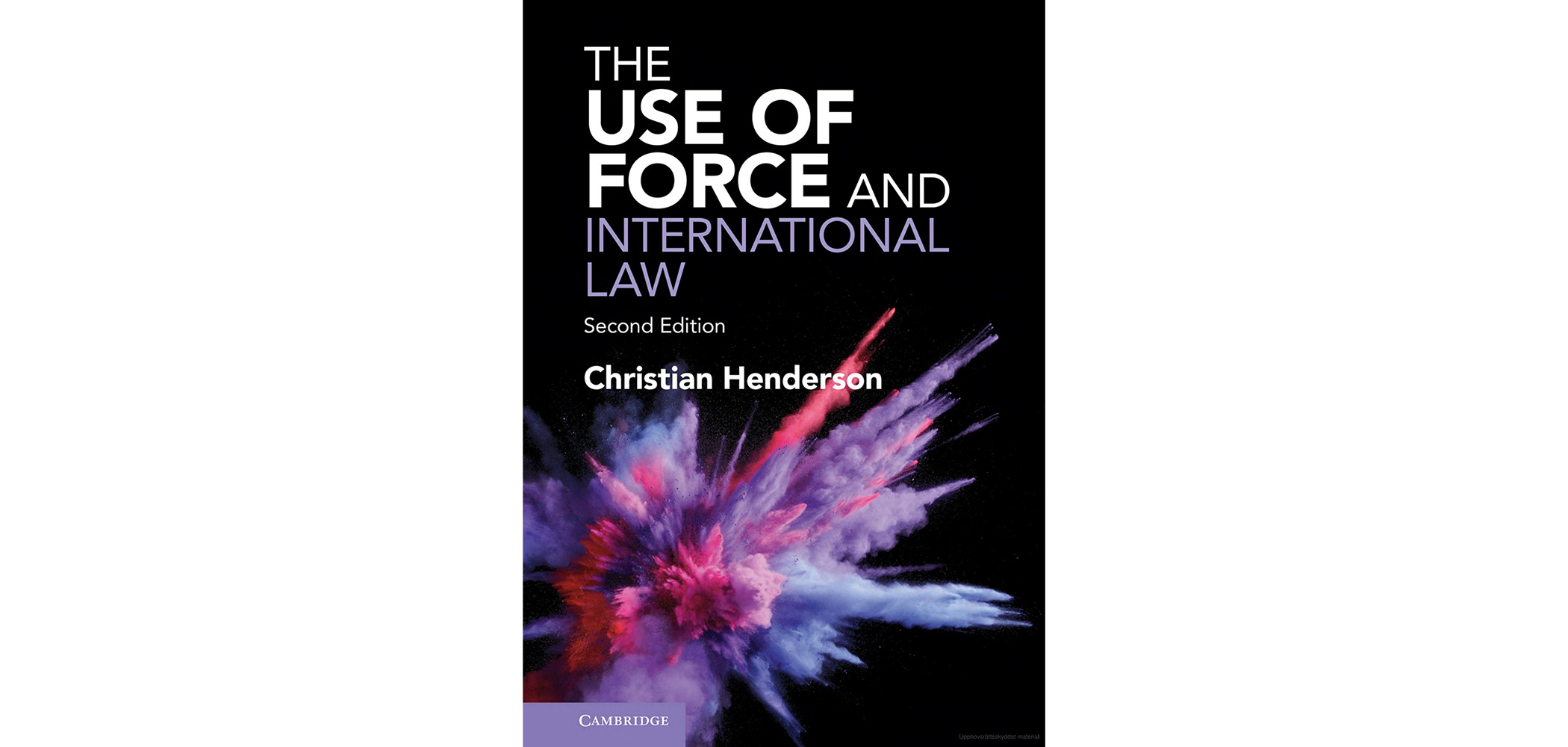
Book Title: The Use of Force and International Law
Author: Christian Henderson
Publisher: Cambridge University Press
Publication Year: 2023
The second edition of The Use of Force and International Law, authored by Christian Henderson and published by Cambridge University Press in November 2023, offers a comprehensive, rigorous, and thoroughly updated examination of the legal frameworks governing the use of force in international relations. Spanning ten core chapters and approximately 560 pages, the book provides an in-depth analysis of both the theoretical foundations and the practical state practice shaping the contemporary jus ad bellum regime. The significance of this new edition lies in its timely incorporation of recent global developments—most notably, the legal and strategic implications of the 2022 Russia–Ukraine war. Henderson also addresses emerging challenges such as cyber warfare, gray-zone operations, and the expanding role of non-state actors—including terrorist groups—in reshaping doctrinal debates in international law.
Structure and Chapters Content
- Chapter 1: The General Breadth and Scope of the Prohibition on the Threat or Use of Force
The opening chapter examines the contemporary scope of the prohibition on the threat or use of force, situating it within its historical evolution. It analyzes the legal sources underpinning the rule, its recognition as a jus cogens norm, and the implications of this status for its future development. Henderson further distinguishes the concept of “threat of force” from actual use of force and highlights the persistent ambiguities surrounding responsibility and accountability in an international legal system characterized by decentralization. The human dimension of the prohibition, as well as its long-term effectiveness and normative resilience, is also critically assessed.
- Chapter 2: The Meaning of “Force”
This chapter clarifies the legal definition of “force,” demonstrating that the concept extends beyond traditional, kinetic military attacks. Henderson argues that coercive actions falling “below the threshold of war,” including disruptive cyber operations capable of disabling a state’s critical infrastructure, may fall within the legal meaning of the “use of force.” This expanded conception reflects the changing nature of contemporary hostilities.
- Chapter 3: The Use of Force under the Auspices of the United Nations
This chapter provides a detailed examination of how the UN system regulates the use of force, with particular emphasis on the central role of the Security Council. It begins by analyzing the relevant Charter provisions and the distribution of authority among the UN organs—including the Security Council, the General Assembly, and the Secretariat—to clarify the original legal design of the post-1945 order. Henderson then evaluates how these powers have been exercised during the Cold War and in the post-Cold War era, focusing on the evolution of the Council’s practice in authorizing the use of force by states, coalitions, or regional organizations. The chapter concludes with an analysis of the relationship between the UN and regional or collective defense bodies in the regulation of force.
- Chapter 4: Issues in Relating to Authorization by the United Nations Security Council
Following the discussion in Chapter 3, this chapter explores the legal and political challenges associated with Security Council authorization. It analyzes the Council’s attempts to balance multilateralism and unilateral state action when issuing resolutions that permit states to take “all necessary measures.” Henderson examines the interpretive authority over Security Council resolutions—including debates on the “revival” or “revalidation” of past authorizations, as in Iraq between 1991 and 2003—and the scope of implicit or explicit mandates. The chapter also discusses instances in which the Council has retroactively endorsed uses of force (ex post facto). Finally, it evaluates the Security Council’s role in coercive implementation of the Responsibility to Protect (R2P) doctrine.
- Chapter 5: United Nations Peacekeeping and the Use of Force
This chapter addresses the legal foundations of peacekeeping operations—despite their absence from the UN Charter—and traces their doctrinal evolution. Special attention is given to “peace enforcement” operations in which UN forces may use force beyond self-defense. Henderson also examines the growing involvement of regional organizations, such as NATO and the African Union, in peacekeeping and enforcement activities.
- Chapter 6: General Aspects of the Right of Self-Defence
Here, Henderson begins his analysis of the most significant exception to the prohibition on force: the inherent right of self-defence under Article 51 of the UN Charter. The chapter outlines the requirement of an “armed attack” as the legal trigger and examines the customary limitations of necessity and proportionality that govern the exercise of this right.
- Chapter 7: Preventative Self-Defence
This chapter assesses the various forms of anticipatory self-defence and asks whether the right can be invoked before an armed attack occurs—or before clear evidence of an imminent attack emerges. Given that no formal amendments to Article 51 have been undertaken, Henderson explores whether anticipatory, interceptive, and pre-emptive self-defence claims can be reconciled with the Charter’s strict textual requirement of an armed attack. These doctrines are evaluated in light of contemporary security threats.
- Chapter 8: The Use of Force against Non-state Actors
Chapter 8 explores the complexities surrounding self-defence against non-state actors. After identifying general conceptual issues, Henderson differentiates between operations aimed exclusively at non-state actors and those targeting both the non-state actor and the territorial state that harbors or is unwilling to constrain them—such as the U.S. response to the September 11, 2001 terrorist attacks. The chapter distinguishes between defensive actions that encompass both the attacker and the host state, and actions directed solely at non-state entities.
- Chapter 9: Consent to Intervention and Intervention in Civil Wars
Focusing on the legal notion of “valid consent,” this chapter analyzes who holds the authority to grant consent to the use of force. Although this authority traditionally lies with governments, Henderson shows that practical ambiguities concerning effective control, international recognition, and self-determination often complicate the issue. The chapter then explores consent in the context of civil wars, including whether prior interventions create a right of “counter-intervention.” Various forms of consent—its limits, explicitness, and implied dimensions—are evaluated in detail.
- Chapter 10: The Doctrine of Humanitarian Intervention
The final chapter addresses the contentious doctrine of humanitarian intervention. Henderson first examines its compatibility (or incompatibility) with the UN Charter system, then evaluates state practice during the Cold War and post-Cold War periods. The chapter analyzes NATO’s 1999 intervention in Kosovo as a pivotal moment shaping modern debates on humanitarian intervention. It also assesses the impact of the war in Ukraine, including questions about whether genocide triggers a duty or obligation to intervene. The Syrian civil war receives significant attention as a tragic contemporary context in which debates over humanitarian intervention and Responsibility to Protect continue to unfold. The chapter concludes with an assessment of the evolving influence of R2P on the doctrine.
Conclusion
Christian Henderson’s The Use of Force and International Law provides a meticulously structured and fully updated account of the modern jus ad bellum regime. Through its engagement with recent conflicts, technological transformations, cyber operations, and the evolving role of non-state actors, the book offers a comprehensive and authoritative analysis of the legal parameters governing war and peace in the twenty-first century. With its blend of doctrinal depth, state practice, and critical evaluation of emerging challenges, this volume stands as an essential resource for scholars, practitioners, and students seeking to understand the contemporary architecture of international law on the use of force.