

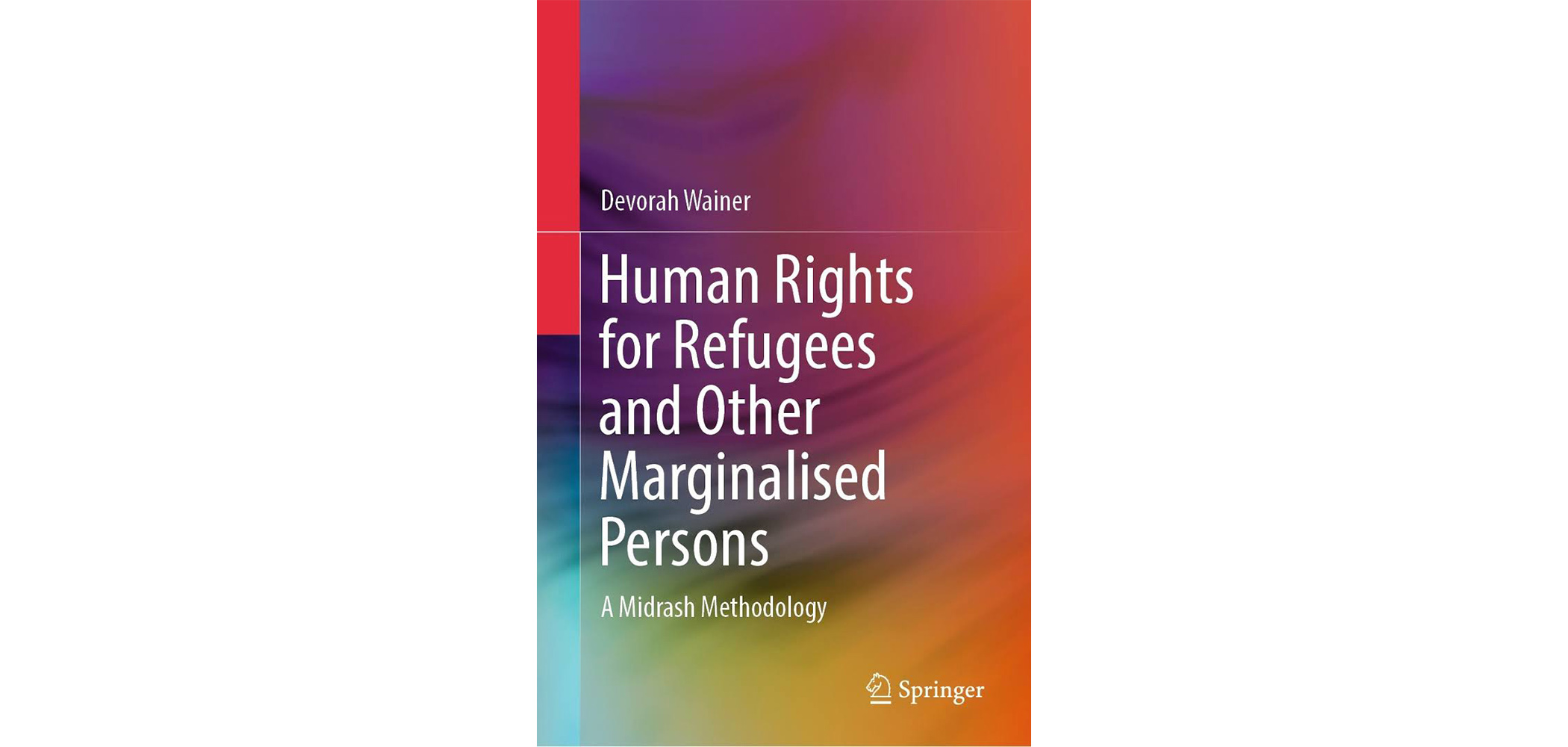
Book Title: Human Rights for Refugees and Other Marginalised Persons
Author: Devorah Wainer
Publisher: Springer
Publication Year: 2023
This book, Human Rights for Refugees and Other Marginalised Persons, written by Devorah Wainer, is composed of fourteen chapters spanning 247 pages. It introduces an innovative framework for conducting qualitative research on refugees and asylum seekers through the ethical lens of Emmanuel Levinas’s philosophy of “face-to-face encounter.” This methodology is rooted in the concept of Midrash—a narrative form of revelation and interpretation—which redefines the interaction between asylum seekers and those who study their experiences. By transcending the tendency toward “othering” and the silencing of voices that often characterize refugee research, Wainer’s approach enables the creation of a multidimensional, rich text filled with heterogeneous voices, experiences, and subjects. The Midrashic methodology stands as an honest and transparent research practice designed to rekindle the passion and moral engagement of academics and scholars.
Structure and Chapters Content
- Chapter 1: Introduction – Interweaving Research, Refugees, and Rights
This opening chapter introduces the Midrashic methodology, which extends beyond the boundaries of traditional qualitative research and offers new pathways for knowledge creation grounded in the inherent dignity and sacred worth of every human being. The author advocates for a philosophy that begins with recognizing the intrinsic value of others before interpreting them through frameworks of alienation, devaluation, or danger. Inspired by Levinas’s ethics, the chapter encourages scholars and policymakers to attune themselves to the lived experiences of marginalised persons and detained refugees.
- Chapter 2: The Marginalised Other
This chapter argues that artificial social contracts are sustained by complicity and collective agreement, showing how misinformation and manipulative narratives were produced by successive governments long before the term “fake news” became popularized. Political discourse and media have constructed categories such as “boat people,” “queue jumpers,” and “asylum seekers,” often equating them with illegality or terrorism. Drawing upon the reflections of Nelson Mandela, Bishop Desmond Tutu, and Martin Buber, Wainer situates these fabrications within broader moral and political frameworks concerning refugees.
- Chapter 3: History of the Methodology
Here, the author addresses recurring questions such as: “How can one bear witness to the experiences of current and former detainees without generalizing or distorting their realities?” The chapter advocates for a research model that is both ethically grounded and academically rigorous. The original Midrashic framework is presented as a distinctive narrative mode, allowing scholars, researchers, and students to be simultaneously creative and disciplined within and beyond disciplinary boundaries.
- Chapter 4: New Knowledge
This chapter asks how a researcher becomes aware of the ontological complicity between their being, research intent, and writing practice. Arguing that new knowledge requires new thinking—and that such thinking is impossible without new research methods—Wainer rejects the rigid linguistic and semiotic confines of traditional disciplines. Instead, Midrash becomes a vehicle for articulating both the research field and the felt reality of the researcher’s engagement.
- Chapter 5: Contextualising the Need for a Levinasian Approach
Drawing on Hannah Arendt and Seyla Benhabib, this chapter connects philosophy and methodology. It asserts that researchers must explicitly or implicitly align themselves with Levinas’s notion of individual responsibility toward the Other and the stranger. Levinas’s concept of responsibility defines ethics as a non-normative relation. After elucidating this moral philosophy, the author explores its implications for a researcher’s ethical relationship with marginalised people within the framework of Midrashic inquiry.
- Chapter 6: The Ethical Interruption
For researchers to truly embrace human rights in relation to marginalised individuals, Wainer invites them to compose their own Midrashim. Rather than adhering to a prescriptive, step-by-step model, she situates the discussion within Levinas’s lived experience and his intellectual position among continental philosophers before and after World War II. Precisely because Levinas’s biography and philosophy are inseparable, his thought offers a philosophical, political, and practical response to the vulnerability of asylum seekers and other disenfranchised communities.
- Chapter 7: Knowledge
This brief yet dense chapter contrasts two academic epistemologies identified by Levinas: “Athens” (Greek) and “Jerusalem” (Hebrew). The Athenian model—rooted in hypothesis, thesis, argumentation, rhetoric, and analytical communication—dominates Western academia. The Jerusalem model, by contrast, represents a different search for meaning and understanding through dialogical, interpretive engagement. Both traditions, emerging from antiquity, illuminate the tension between reason and revelation in the pursuit of knowledge.
- Chapter 8: Who is Speaking and Why?
This chapter incorporates examples of Midrash, poetry, and court transcripts to emphasize relational communication. Dialogue here becomes a generative process through which data, findings, understanding, and ultimately knowledge emerge. Wainer argues that true openness to the Other requires direct engagement with lived experience rather than abstract theorization or universal generalizations.
- Chapter 9: Midrash
Opening with a brief etymological analysis of the Hebrew term Midrash, the chapter examines lived experiences “behind the wires” in detention centers and island prisons. Notably, not all the detainees discussed are asylum seekers. To illustrate the pervasiveness of systemic mistreatment, Wainer recounts the cases of two Australian citizens who were unlawfully detained, revealing how disgust and dehumanization operate beyond refugee categories.
- Chapter 10: Principles
Here, Midrash is presented as a counter to static myths about human existence, politics, religion, and economy. To deepen theoretical, social, and cultural understanding, Wainer draws parallels between Midrashic interpretation in Judaism and analogous traditions in Islam. Historically, Sufi interpreters did not confine themselves to literal meanings of the Qur’an but sought its symbolic and metaphysical possibilities. Like Rumi’s poetry and Ibn Arabi’s commentaries, Midrash transcends narration—it enlightens, interprets, and opens hearts.
- Chapter 11: Putting It All Together
Integrating philosophy, research methods, and Midrash, this chapter demonstrates how the complete research methodology operates through iterative processes of writing, meaning-making, secondary data use, and analysis. The recurring questions—“What does this mean?” and “How can I understand it?”—become metaphors for the research journey itself. A Midrashic narrative placed mid-chapter exemplifies the temporal and emotional perspectives of the author-researcher as a living model of the method.
- Chapter 12: Sense-Making
Designed to complement the previous chapter, this section includes additional Midrashim and poetry. It reflects on questions such as, “Why are you doing this work?” and offers interpretive space for readers to engage emotionally and intellectually with both the author’s reflections and their own theoretical responses.
- Chapter 13: Boundaries, Spaces, and Lacuna
Here, the Midrashic methodology once again pushes the boundaries of traditional qualitative research by incorporating “disordered” or non-linear texts as legitimate sources of meaning and understanding. This approach celebrates the complexity and fluidity inherent in human experience.
- Chapter 14: Epilogue
The final chapter narrates the author’s personal memory of finding a translator: on her second day on an island, she unexpectedly encounters the person who would become her translator. Through vivid descriptions of Ottoman-modern décor, the nervous receptionist, and the improvisational communication through gestures and expressions, Wainer captures the subtle humanity that characterizes the fieldwork encounters underpinning her research.
Conclusion
Through the narrative-based Midrashic method, Wainer constructs a legal and political analysis of migrant and refugee rights grounded in lived experience. Using rare field data—such as interviews with detainees in Australian centers—she substantiates her argument that the book responds to two simultaneous crises:
- The global migration crisis and the rise in asylum seekers driven by war and climate change;
- The crisis of meaning within human rights discourse, reflected in its diminished capacity to impact refugees’ real lives.
By interweaving theology, philosophy, and social science, Wainer transcends rigid legalistic frameworks and proposes a practical model for transforming “human feeling” into “political action.” The author concludes that the protection of migrants’ rights will not emerge from new laws alone but through a return to fundamental human ethics—a moral awakening that reclaims the spirit of justice and empathy at the heart of human rights.


