Introduction
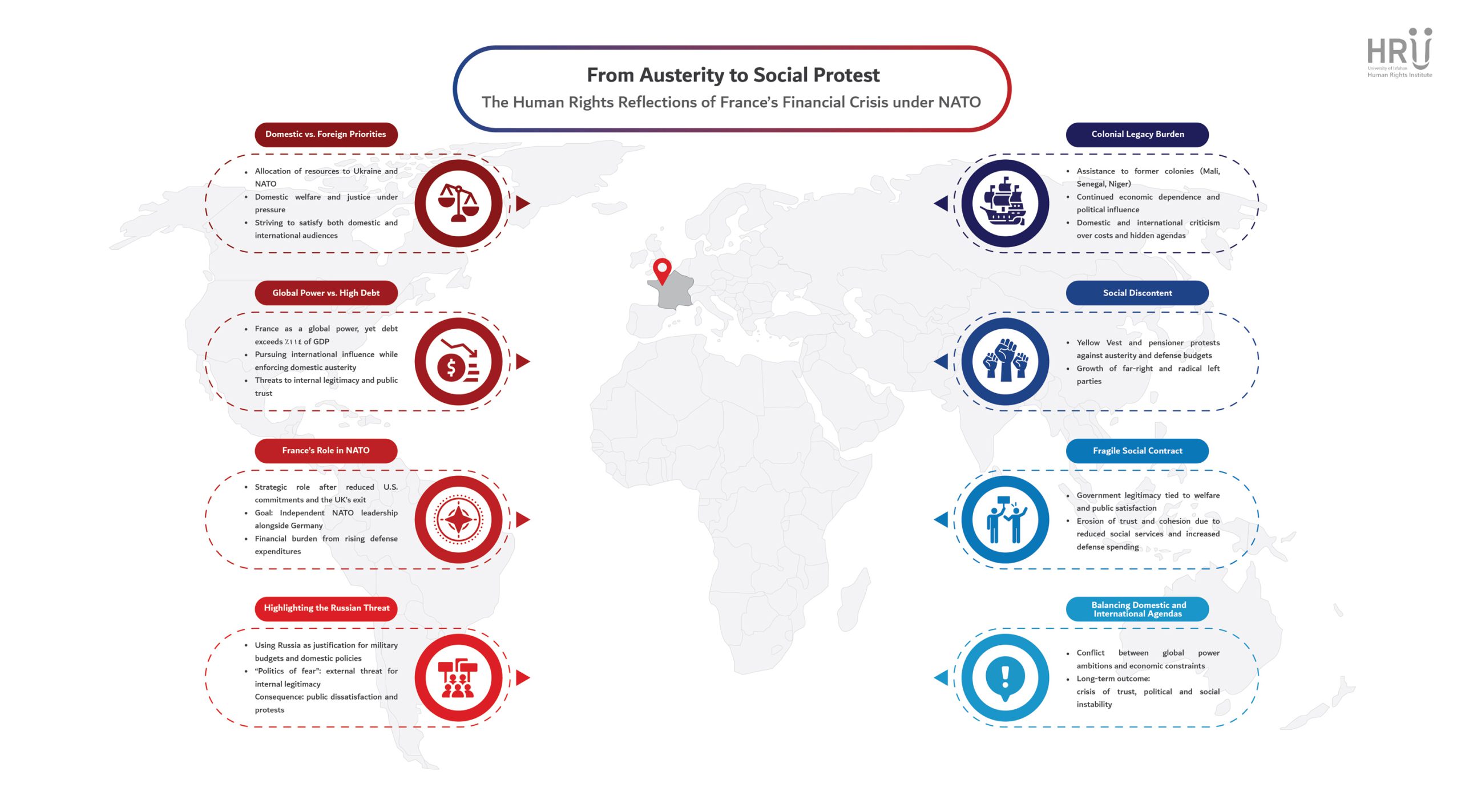
France, as a founding member of the European Union and a permanent seat holder on the United Nations Security Council, has always played a key role in global developments. Nevertheless, in 2025, the country’s economy faces structural and complex challenges. According to official data, France’s public debt surpassed €7 trillion at the beginning of this year, ranking it among the most indebted economies of the Eurozone. This figure—equivalent to approximately 114% of its GDP—rings serious alarm bells for its economic stability. Alongside this high level of debt, the persistence of budget deficits, rooted in poor fiscal management, global crises of recent decades, and successive periods of recession, has eroded the government’s capacity to deliver public services and has deepened social divides. This situation has manifested itself in widespread farmers’ protests, the “Yellow Vest” movement, discontent among pensioners, and opposition to pension system reforms.
Despite these internal crises, the French government continues to allocate portions of its financial resources to external commitments, including development aid, historical obligations to former colonies, and contributions to NATO’s military budget. With NATO’s defense expenditures rising due to the ongoing war in Ukraine and the decreasing financial role of the United States, France’s share in this framework has grown substantially, placing additional strain on its domestic resources.
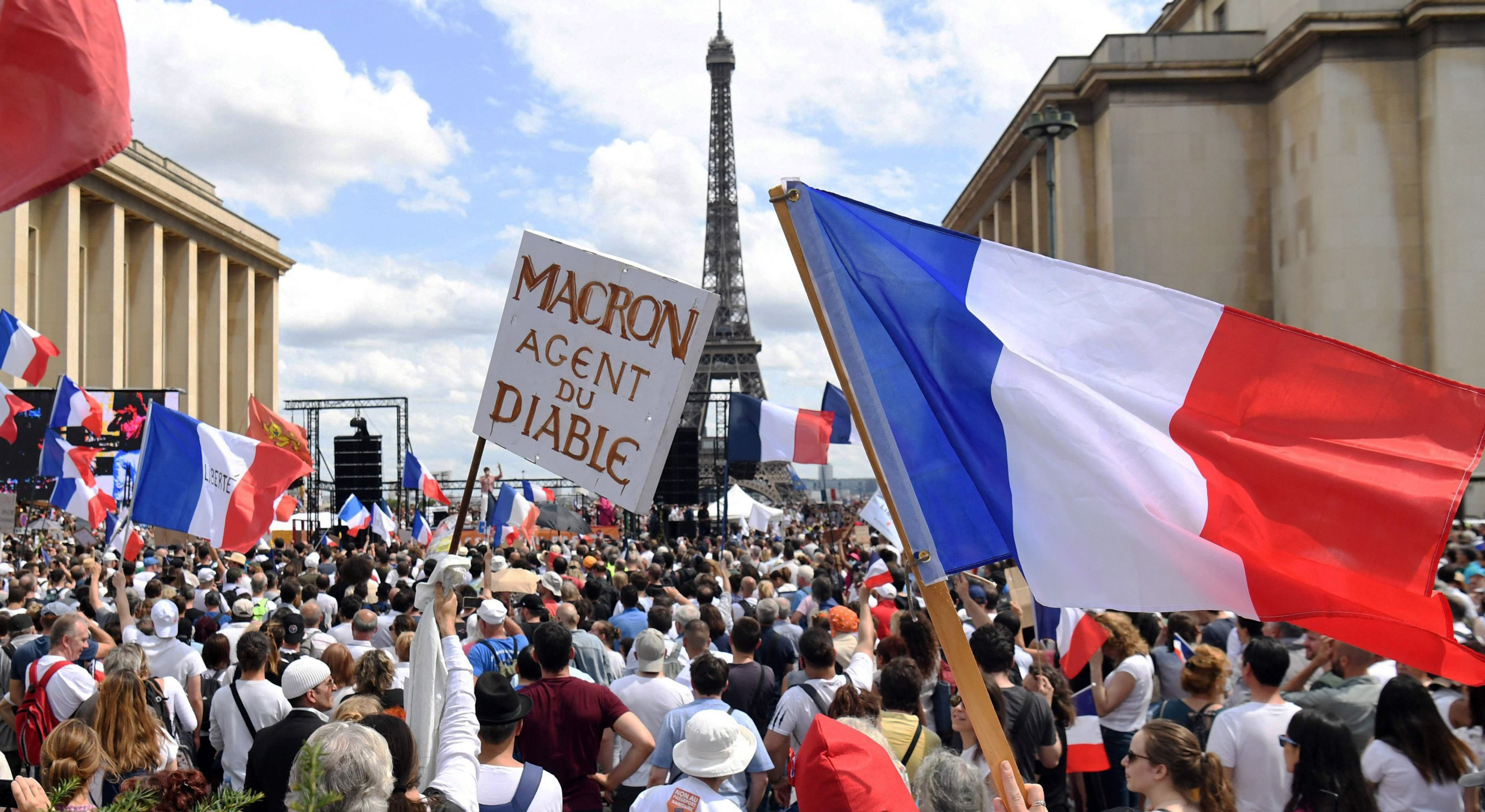
In this context, public opinion and civil society organizations have raised questions regarding the prioritization of national resources: Is it logical for a country facing social and economic crises at home to persist in upholding international commitments? This contradiction between domestic imperatives and external obligations has now become one of the most intricate dilemmas of policymaking and governance in France. This tension was vividly illustrated in September 2025, when Prime Minister Bayrou failed to win a vote of confidence in parliament, with 364 votes against him, and mass street protests erupted in Paris, Marseille, and Lyon.
The Clash of Domestic and External Priorities
One of the core challenges facing the French government this year—and indeed in recent years—is the clear conflict between domestic priorities such as controlling inflation, strengthening the pension system, and investing in education and healthcare, and the demands of foreign policy. The country’s economic situation necessitates focusing on social welfare and reducing class disparities; yet in practice, a significant share of national resources is directed toward international obligations, military assistance to Ukraine, and NATO’s defense budget.
This duality has set public opinion against French policymakers and exacerbated feelings of injustice, particularly among vulnerable groups and pensioners. Robert Putnam’s “two-level game” theory offers a useful lens for analyzing this situation: political leaders simultaneously negotiate at both domestic and international levels, and to maintain their positions, they must satisfy both arenas. From this perspective, France’s decision-making can be understood as an attempt to balance internal pressures for greater social welfare with international obligations to maintain geopolitical standing. The real problem emerges when the government fails to maintain this balance: failure at one level threatens legitimacy at the other. This imbalance is clearly visible in France today—while financial resources are channeled toward foreign policy, citizens are protesting in the streets for social and economic needs.
The Contradiction between Power and Debt
France perceives itself as a global power: it is a permanent member of the UN Security Council, a nuclear state, and—alongside Germany and the UK—one of Europe’s main political, economic, and cultural actors. However, the economic reality of recent years tells another story: persistent budget deficits, financial fragility, and mounting debt that has sparked widespread social protests over the past decade. Its debt-to-GDP ratio, now above 114%, underscores the medium- and long-term instability of its financial and economic standing.
This gap between France’s international status and its poor fiscal performance creates a stark policy contradiction. The government seeks to preserve global influence by maintaining military spending, foreign aid, and active engagement in addressing international crises, including climate change and global warming. Yet these actions coincide with domestic austerity measures. Consequently, many in society view France’s “external show of strength” as a mere cover for internal crises. International credibility without domestic stability—especially political and economic stability—cannot last, and social protests only aggravate this fragility.
Here, the “performance legitimacy” framework provides an accurate lens: political legitimacy is derived not merely from ideology or democratic institutions but from the state’s effectiveness in delivering tangible results such as economic welfare, financial stability, and social responsiveness. When France, despite domestic crises and mounting debt, directs resources toward foreign policy goals, it effectively jeopardizes its reservoir of performance legitimacy.
Nonetheless, France’s governing structures continue active international engagement—including military missions, participation in global environmental programs, and involvement in transregional crises. The result of this divergence is a widening gap between domestic and foreign policies: domestically, austerity and reduced social support coupled with widespread protests; internationally, sustained political and strategic ambitions. Over time, this inconsistency risks undermining domestic legitimacy and eroding political cohesion. Governments in such contexts often seek to maintain international prestige or symbolic standing by adopting policies misaligned with their actual economic capacities. In the long run, this mismatch between external power projection and internal fiscal realities may hinder the achievement of both domestic and international objectives, while fueling crises of trust and effectiveness at home. This dynamic was illustrated when Bayrou’s government collapsed after failing to win parliament’s confidence, and leftist parties such as La France Insoumise even called for the president’s resignation. These events show that once performance legitimacy in delivering welfare and stability falters, neither institutional tools nor international standing can compensate for the erosion of public trust.
France’s Role in NATO
Within NATO, France plays a role that goes beyond that of an ordinary member. Particularly following the UK’s gradual retreat from military influence in Europe and the United States’ reduced commitments to NATO after Donald Trump’s presidency, France’s role as a strategic member has become more prominent. The Macron government has leveraged this role to bolster its international standing and, together with Germany, has sought to sketch a vision of NATO leadership less dependent on the United States—casting France and Germany as the alliance’s future leaders.
However, the rising costs of participation in coalition operations and NATO’s financial obligations are placing and will continue to place heavy burdens on France’s public budget. From 2025, France committed to raising defense expenditure to 3.5% of GDP under new NATO agreements, with plans to reach 5% by 2035. France had initially pledged to double its defense budget relative to 2017 levels by 2030 but decided to reach this target three years earlier. This decision was made even as many other states reconsider their defense models.
Domestic critics argue that this approach represents political dependence on NATO for French security and a departure from France’s long-standing principle of strategic autonomy. On the other hand, government supporters portray it as necessary to deter threats from Eastern Europe, namely Russia and Belarus. This divergence has become a source of political conflict.
Here, the concept of “strategic autonomy” in European defense policy provides a relevant framework. It holds that states and unions must build the capacity to pursue defense and security policies independently of great powers, particularly the United States. France’s insistence on raising its NATO defense budget while simultaneously advocating for independent leadership of the alliance exemplifies the duality at the heart of this concept: the contradiction between institutional dependence on a supranational structure and the aspiration for national autonomy. From this perspective, France’s active NATO role can be seen both as evidence of international strength and as a factor eroding its strategic autonomy—a paradox that fuels domestic political disputes and challenges the legitimacy of defense decisions in the eyes of the public.
Amplifying the Russian Threat and Justifying Costs
The French government has consistently emphasized the Russian threat as justification for increased military spending and NATO involvement. Since the outbreak of the Ukraine war in February 2022, the framing of Russia as a grave danger to Europe and the “free world” has been vigorously advanced, prompting European governments to raise military expenditures under the banners of defending democratic values, protecting Europe’s borders, and preserving the free world against Eastern threats. France, in particular, has attempted to consolidate its strategic position by demonstrating acute sensitivity to Eastern European security and sending arms.
Yet analysts warn that deliberate exaggeration of the Russian threat may serve less as a genuine warning and more as a tool for legitimizing austerity measures and domestic restrictions—precisely the argument advanced by opponents of Macron and Bayrou. In effect, external threats can become pretexts for silencing domestic demands for social justice and welfare. This is precisely what Frank Furedi’s “politics of fear” theory captures: governments and elites can exploit real or constructed external threats to mobilize public opinion, strengthen political control, and justify costly or restrictive policies.
Military spending is defensible only when the threat is real, tangible, and proportionate to national capacity—conditions that many now dispute. In fact, much of the evidence suggests that Russia’s aggression materialized after Ukraine pursued NATO membership, and many international relations scholars contend that the true provocation originated with Europe’s proposal to bring Ukraine into NATO. From the perspective of the politics of fear, this dynamic illustrates how external threats such as Russia are deployed not only in terms of national security but also as instruments to legitimate economic, political, and security decisions—including increased military budgets and austerity measures.
Thus, justifying military expenditures is credible only when the threat is concrete. Presently, that is not the case, and France faces growing social protests and public discontent. The real danger, as Furedi warns, arises when fear substitutes for rational analysis and decisions are based on exaggerated perceptions of danger rather than actual needs. In France, political exploitation of the Russian threat may be symptomatic of such a mechanism, which, in the long run, risks undermining public trust and social cohesion—and, arguably, is already manifesting itself through mass protests.
The Historical Burden of Colonies
As a former colonial power, France continues to assume multiple historical responsibilities toward its former colonies. Indeed, among the top ten recipients of French financial and development aid globally, six are former colonies, including Mali, Senegal, and Niger. These responsibilities often manifest as development aid, support for governance structures, and political-military backing in Africa. Yet maintaining these policies amid a domestic fiscal crisis has faced mounting criticism. Protesters and critics question France’s paternalistic role toward its former colonies, arguing that such a posture is obsolete in today’s world.
Supporters and French political elites justify these policies on two grounds: first, that populations in these states often live in poor socio-economic conditions, making assistance a moral and human rights obligation; and second, that abandoning these commitments would undermine France’s credibility in international forums.
Critics counter that these expenditures neither help the recipient societies nor strengthen France, but instead perpetuate dependency while dragging France into regional conflicts, coups, and political crises across Africa. Moreover, many intellectuals in the Global South view such aid not as solidarity but as a new form of colonialism—an interpretation aligned with Kwame Nkrumah’s “neo-colonialism” framework. This theory explains that while formal colonial rule may have ended, domination persists through economic dependency, political influence, and military presence. From this perspective, development aid, support for dependent governments, and military deployments in former colonies are less about moral responsibility than about preserving informal structures of dominance and securing geopolitical interests.
Such patterns raise suspicions when France, for example, supports governments in Africa against protest movements or political collapses, or when its presence in Chad, Côte d’Ivoire, and Niger appears to serve strategic objectives. France’s stance toward Lebanon—a former colonial territory—has also consistently favored pro-Western and Christian groups while sidelining the Muslim majority, reinforcing suspicions of ideological and political agendas.
The colonial and historical burden must therefore be re-examined within a framework prioritizing domestic development, historical justice, and equal cooperation. Neo-colonialism theory underscores this imperative: ostensibly humanitarian or development-oriented measures often serve as vehicles for reproducing historical inequalities and structural dependency. In this light, criticisms of France’s roles in Africa and Lebanon echo this concern—highlighting the need to transcend power-based relations in favor of international relations grounded in equality, mutual respect, and historical justice.
Consequences of Social Discontent
France’s austerity policies, combined with increased defense spending for NATO, have led to unprecedented social discontent. From the Yellow Vest protests to opposition to pension reforms and livelihood grievances, clear signs of social fracture and public distrust toward the government have emerged. In recent years, falling purchasing power, restrictions in public services, and contractionary fiscal policies have sparked protests among farmers, teachers, and pensioners. Against this backdrop, allocating billions of euros for defense and external commitments has not only failed to generate solidarity but has fueled perceptions of inequality.
According to official government planning, France will spend more than €413 billion on weapons modernization and advanced military technologies by 2030. For socially and economically vulnerable regions, this decision is interpreted as evidence of government indifference to citizens’ welfare and its preference for geopolitical interests over popular demands. These grievances have reverberated politically. In recent local and regional elections, far-right parties such as the Rassemblement National and radical left movements such as La France Insoumise have significantly expanded their voter base. Unless the government manages to reconcile international security with domestic welfare, the risks of political extremism, rising far-right mobilization, greater social instability, widespread civil unrest, populism, and electoral crises will only intensify.
The concept of the “fragile social contract” aptly illuminates this situation. In political economy and political sociology, it posits that when governments fail to provide basic needs such as economic justice, public services, and social equality, the unwritten bond that underpins governmental legitimacy through citizen consent becomes weak and fragile. From this perspective, declining purchasing power, reduced public services, contractionary fiscal policies, and simultaneously allocating billions to defense are all concrete instances of social contract erosion.
In contemporary France, every euro spent on weapons modernization while cutting education, healthcare, or social support is not merely an economic decision but a blow to social cohesion and public trust. Accordingly, the Yellow Vest protests, opposition to pension reforms, and farmers’ and teachers’ discontent cannot be reduced solely to livelihood difficulties—they are visible manifestations of the weakening of the social contract between state and society. When a large segment of society perceives that the government prioritizes geopolitical commitments over domestic welfare, the legitimacy bond underpinning political stability unravels, and citizens resort to street protests as their only means of leverage. The fragile social contract framework explains this cycle—one now starkly observable in France.
Conclusion
In recent years, France has faced complex economic and social challenges. With public debt surpassing €7 trillion, serious concerns have arisen about the country’s economic stability. The debt crisis, persistent budget deficits, and declining public services have fueled social protests—from the Yellow Vest movement and farmers’ demonstrations to opposition to pension reforms. Meanwhile, the French government continues to allocate substantial resources to external obligations such as development aid to former colonies and significantly increased NATO defense spending.
This contradiction between domestic priorities and external commitments has undermined the government’s performance legitimacy and contributed to its downfall. In its quest to maintain global standing, France has boosted military spending and justified defense costs by amplifying the Russian threat—even though these policies contradict the country’s fiscal realities and lack the economic capacity to sustain them. Domestic austerity policies, juxtaposed with active international engagement, have triggered deep social discontent, mass street protests, and a parliamentary vote of no confidence in Macron’s government, leading to the rise of radical right- and left-wing parties.
Furthermore, the continuation of financial aid to former colonies under the guise of historical and moral responsibility has faced serious criticism, with many interpreting it as a form of neo-colonialism. Ultimately, France’s financial crisis and its human rights implications reveal the profound tension between domestic welfare and external obligations—tension that, if unresolved, threatens both the country’s internal stability and its international credibility.