Introduction
France’s overseas territories are regarded as an inseparable component of the country’s power structure and global presence. Although France defines these territories within the legal framework of the Republic—and at times as part of its administrative-territorial organization—the reality is that the historical legacy of colonialism, experiences of cultural assimilation, and stark disparities in development and social welfare between metropolitan France and the overseas territories have contributed to the formation of a particular social divide. Within this divide, certain Indigenous and local communities perceive themselves as being exposed to structural marginalization and constraints on the realization of collective and individual rights.
These territories, despite being geographically far removed from Europe and metropolitan France, play a significant role for France in political, economic, and geopolitical terms. Through these territories, France has been able to maintain its influence across oceans and strategic regions. This role is not solely a product of geography; rather, it has been shaped by the transformation of these territories into instruments for producing power, extending influence, and preserving—as well as enhancing—France’s international standing.
Nevertheless, the continuation of French sovereignty over these territories has never been free of contestation. It has consistently been accompanied by human-rights and normative questions, including those concerning legitimacy, decolonization, cultural assimilation, and the right to self-determination. Accordingly, the present text seeks to address various human-rights dimensions of France’s overseas territories, to analyze their role in securing France’s strategic interests, and, in doing so, to place primary emphasis on the geopolitical, economic, and cultural functions of these territories.
France’s Overseas Territories
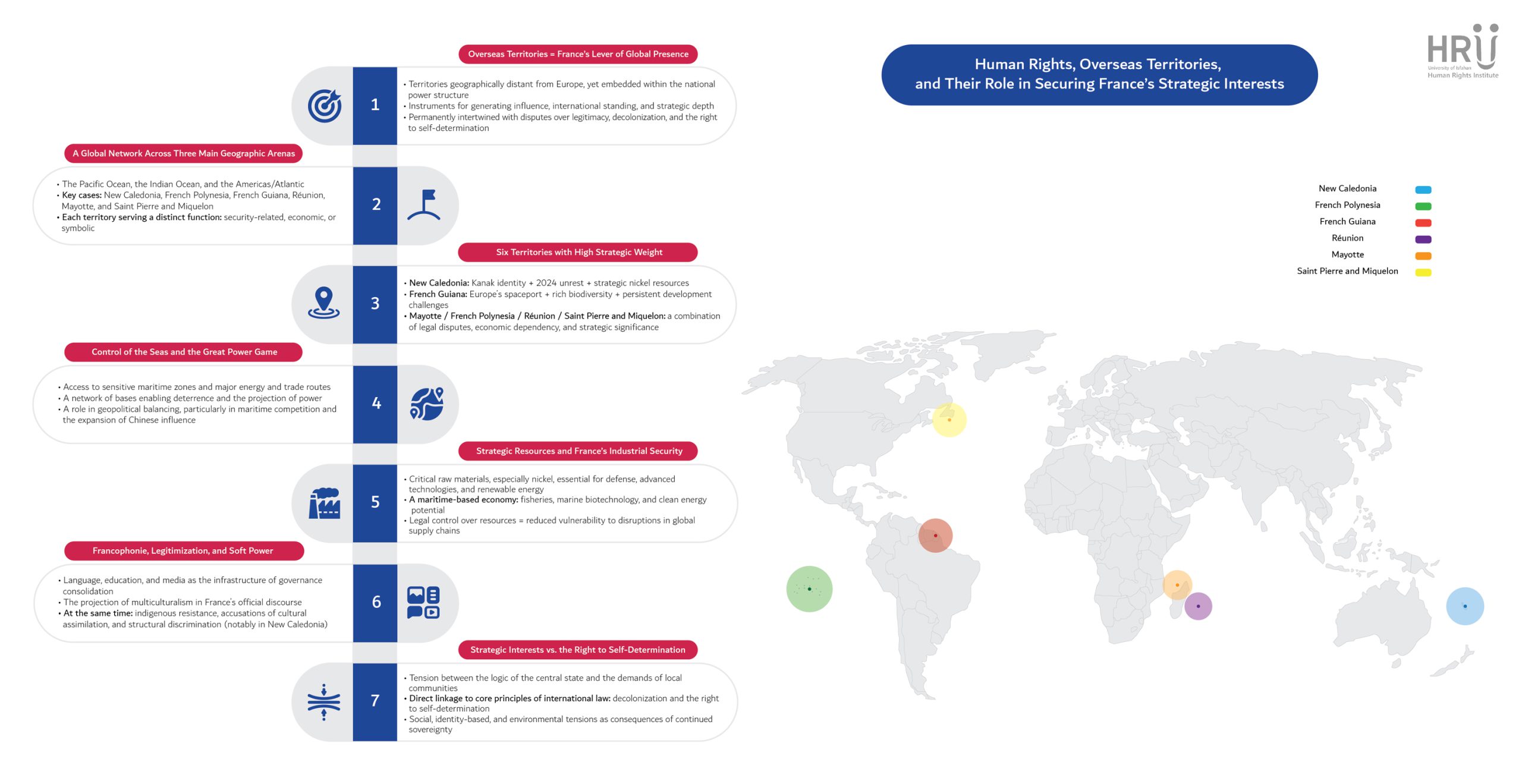
France possesses a wide range of overseas territories across three principal geographical areas: the Pacific Ocean, the Indian Ocean, and the wider Caribbean/Central American region. These include territories such as New Caledonia, French Polynesia, Réunion, Mayotte, French Guiana, Guadeloupe, Martinique, Saint Martin, Saint Barthélemy, Saint Pierre and Miquelon, Wallis and Futuna, the French Southern and Antarctic Lands, and uninhabited islands such as Clipperton.
Each of these territories—depending on its geographical and geopolitical position, as well as its unique characteristics—plays a different role in serving France’s economic, security, maritime, and symbolic interests. However, given the large number of these territories, providing a detailed discussion of all of them falls beyond the scope of this text. Accordingly, the analysis focuses on several key territories that carry the greatest strategic weight for France, thereby enabling a more precise understanding of the logic underpinning French policy toward its overseas territories.
Within this framework, these territories are selected not on the basis of their apparent or superficial importance, but rather according to the extent of their influence on France’s geopolitical, economic, and security equations. This focus also allows for a more concrete examination of the link between France’s strategic interests and the legal, identity-related, and political challenges arising from the continued exercise of sovereignty over overseas territories. On this basis, studying these cases can present a clearer picture of France’s overarching rationale for maintaining and consolidating its extra-regional presence. These territories are as follows:
- New Caledonia
New Caledonia is an archipelago in the southwestern Pacific Ocean, with a population of around 300,000, and has been under French sovereignty since the nineteenth century (1853). The original inhabitants of this territory are the Melanesian peoples, who historically possessed strong seafaring skills and are understood to have migrated there approximately 1,500 years ago.
The territory has a diverse population, including both French residents and Indigenous communities. Among the Indigenous population, the pro-independence Kanak constitute a significant segment. Culturally, however, French cultural norms are dominant, as the population largely speaks French and—like the population of metropolitan France—primarily follows Christianity.
Politically, New Caledonia has a distinct and special status compared to other French overseas territories, with its own local institutions, a territorial government, and a dedicated Congress. Indigenous identity, historical relations with France, and decolonization processes are among the central themes shaping developments in this territory. In recent decades, referendums on its political future have been held in accordance with United Nations-related arrangements and decisions.
The territory continues to face social and political challenges linked to French sovereignty and the rights and participation of Indigenous communities. In the most serious recent developments, in mid-2024 a series of protests took place in response to existing grievances and, in particular, France’s perceived lack of genuine willingness to grant independence. These protests escalated into very high levels of violence. One major reason for France’s reluctance is that New Caledonia is rich in nickel resources, with around 8 percent of the world’s total nickel reserves located in this territory.
- French Guiana
French Guiana is a territory with a population of approximately 300,000—predominantly Catholic Christian—located on the northern coast of South America, bordering Brazil and Suriname. Unlike many overseas territories, this territory forms part of a continental landmass and is legally recognized as an overseas department of France. In other words, French Guiana—unlike most overseas territories—is located on the South American continent and is not an island.
Legally, French Guiana is treated as equivalent to departments within metropolitan France, and French laws and administrative structures are applied directly. Its population consists of a mixture of Indigenous peoples, regional migrants, and French citizens. Geographically, the territory contains dense forests and very high biodiversity. It also hosts Europe’s largest spaceport, which accounts for around 25 percent of its gross domestic product. Fishing and forestry are other important sources of income.
Despite its formal status as part of France, French Guiana faces challenges such as underdevelopment, social inequality, healthcare constraints, and irregular migration. It should also be noted that its administrative structure is subject to French and European Union rules, and French is the primary language spoken.
- Réunion
Réunion is a volcanic island in the Indian Ocean, east of Madagascar, with a population close to 850,000 and a Christian majority. This territory is also administered as an overseas department of France and, legally, is considered part of France and the European Union. Réunion’s population consists of diverse African, Asian, and European origins, creating a notable cultural pluralism.
The local economy is largely based on agriculture, services, and tourism. The island faces social issues such as unemployment and economic inequality. At the same time, relative political stability is maintained.
As a special region of France, Réunion is integrated into France’s political and governance system and is subject to the oversight and control of French military and security forces. Consequently, the people of Réunion elect members of the French National Assembly, and they also select their representatives to that Assembly. Although Réunion has generated significant income through tourism—particularly in recent years—issues related to economic development, infrastructure, the environment, and education remain major crises in the territory.
- Saint Pierre and Miquelon
Saint Pierre and Miquelon is a small archipelago in the North Atlantic, near the eastern coast of Canada, and is regarded as the last remaining remnant of France’s territorial presence in North America. With a population of around 6,000, this territory is legally a French overseas collectivity with limited autonomy, while defense, security, and foreign policy are administered directly by the French central government.
Although Saint Pierre and Miquelon does not carry significant economic or military weight, its importance is considerable in symbolic, historical, and legal terms as an expression of France’s extra-regional presence. Historically, the territory played an important role—particularly in fisheries—yet with the decline of fish stocks, its economy has become heavily dependent on subsidies and financial support from the French state.
Saint Pierre and Miquelon has also been the subject of maritime disputes between France and Canada in past decades, and its role in defining France’s Exclusive Economic Zone (EEZ) has gained importance. Overall, this territory is less an economic or security asset than it is a symbol of France’s continued historical and geopolitical presence beyond Europe, and an instrument for maintaining France’s extra-regional standing in the international order.
- Mayotte
Mayotte is a small archipelago in the northern Mozambique Channel, near the Comoros archipelago, with a population of approximately 200,000 and a predominantly Muslim population. In recent years, it has been formally recognized as an overseas department of France. Mayotte has a young demographic profile and a high population growth rate.
The territory faces extensive challenges such as poverty, irregular migration, and severe shortages in social infrastructure. Cultural and social differences between Mayotte and metropolitan France are significant. According to assessments, around 80 percent of its population lives below the poverty line, making it the poorest territory under French sovereignty. Issues related to identity, citizenship, and access to public services constitute major concerns. In this regard, statistics indicate that around one-third of the population lacks access to safe and sanitary water.
The Muslim-majority Union of the Comoros, located near Mayotte, claims the territory as part of its own domain and argues that France has unlawfully appropriated it. It should be noted that, despite a United Nations position calling for the completion of the independence process and separation from France, Mayotte remains part of France. Like New Caledonia, the territory has witnessed several rounds of votes related to the determination of the population’s political future. While these votes have favored remaining under the French flag, the United Nations, the African Union, and the Comoros—claiming sovereignty over the territory—have, for various reasons, not recognized the results.
- French Polynesia
French Polynesia is a group of more than 118 islands and coral atolls in the South Pacific, with a population of approximately 280,000, predominantly Christian. Its center is the city of Papeete on the island of Tahiti. Legally, the territory is a French overseas collectivity with a degree of internal autonomy; however, its foreign policy, defense, and security remain under the authority of the French central government.
The population of French Polynesia is largely Indigenous, and Christianity is the predominant religion. The economy relies on tourism, pearl farming, fishing, and services, and it is significantly dependent on French financial assistance. French Polynesia is strategically important for France’s maritime and geopolitical presence in the Pacific and plays a major role in French policy in the region.
The territory also has a history of hosting French nuclear tests, which generated extensive environmental and social consequences. In recent years, pro-independence demands and opposition to continued French sovereignty have intensified, and the right to self-determination has become one of the central axes of domestic political contestation.
Geopolitical Significance
France’s overseas territories hold distinctive geopolitical importance and enable France to maintain a presence in the international system beyond the European Union or similar frameworks. Located across the Indian, Pacific, and Atlantic oceans, these territories ensure France’s access to geopolitically sensitive areas within maritime and oceanic spaces.
Within this context, the overseas territories function as key instruments for France to exercise control, conduct surveillance, and sustain continuous presence at sea—one of the principal arenas of geopolitical competition in the contemporary international order. Through these territories, France is able, as a permanent member of the UN Security Council with veto power, to play a more active role in competition among major powers and to secure a standing comparable to powers such as the United Kingdom and the United States in terms of sustained presence across strategically sensitive maritime zones.
France’s military and naval presence in these territories increases its deterrent capacity and security influence, and enables effective monitoring and control over strategic routes for the transfer of energy, goods, and international shipping. This deterrence is not merely regional; it constitutes part of France’s extra-regional deterrence posture vis-à-vis both state and non-state actors.
These territories also allow France to play a role in managing, intervening in, and participating within regional arrangements, initiatives, and even crises, and to justify its presence through narratives of security responsibility and stabilization. From this perspective, overseas territories form part of France’s strategic depth. Moreover, France’s military and naval presence in these territories is not purely defensive; it is part of a broader strategy of deterrence, power projection, and geopolitical balancing against rivals and emerging threats—particularly in response to the expanding influence of China in maritime domains. Above all, this reflects intensifying competition over maritime spaces and global sea lanes. Relying on a network of military bases, France is thereby able to consolidate its role as an extra-regional power in the global security order.
Economy and Mineral Resources
Many of France’s overseas territories possess valuable natural and mineral resources of major importance for France’s economy and industry. These resources are framed within France’s economic and industrial security and serve purposes that go beyond purely commercial interests. Access to resources such as nickel, fisheries, and broader marine and biological capacities plays an important role in securing France’s economic interests.
Nickel in particular—given its strategic value in defense industries, renewable energy technologies, and advanced manufacturing—holds a prominent place within France’s industrial strategy. For example, with respect to the relatively rare metal nickel, France has consistently utilized New Caledonia’s mining capacity. According to available statistics, in 2024 France imported a significant amount of nickel from New Caledonia with an approximate value of $59 million.
In the fisheries sector, fresh seafood products generate approximately $7.37 billion in turnover in France, and the share contributed by overseas territories is significant. Of France’s roughly 6,200 fishing vessels, nearly one-third operate in overseas territories.
In this context, legal and sovereign control over these resources is as important as their economic exploitation. Sectors such as mineral extraction and processing, production and processing of fisheries products, research and development in marine biotechnology, and renewable-energy exploitation tailored to the climatic conditions of these territories represent major economic domains through which France’s interests in overseas territories are secured.
The economies of some of these territories are heavily dependent on the extraction and exploitation of natural resources, making them key components of France’s economic strategy. Sovereign control enables France, amid global market instability and disruptions in supply chains, to reduce dependency on external resources and maintain a degree of economic and industrial self-reliance.
Furthermore, the significance of these resources is not limited to direct economic gains; rather, within the framework of global competition over strategic raw materials and the development of a blue economy, they play a decisive role in shaping France’s industrial and technological future. The importance of these resources has become even more pronounced amid intensifying global competition over strategic raw materials and temporary supply-chain disruptions. By way of example, through New Caledonia France alone has access to nearly 7 to 8 percent of the world’s total nickel reserves.
In this sense, overseas territories have become economic and environmental “laboratories” for France, supporting the development of new marine technologies, renewable energies, and novel models of exploitation and sustainable development—one of the most prominent examples being Europe’s largest spaceport in French Guiana, known as “Europe’s Spaceport.”
At the same time, the emphasis on extraction and resource exploitation in some of these territories has produced social and environmental consequences and has intensified economic inequalities—dynamics that can themselves become sources of local tensions and governance challenges. Despite these challenges, economic and industrial interests remain among France’s principal motivations for preserving and consolidating these territories. Accordingly, the economy of the overseas territories constitutes part of France’s broader strategy for reducing economic vulnerability and safeguarding industrial autonomy within the global system.
Cultural Interests
France’s overseas territories play a major role in expanding French cultural and linguistic influence. Through these territories, the French language and French cultural and value patterns are preserved and reproduced across various regions of the world, thereby strengthening France’s soft power and reinforcing the diffusion of Francophone culture and values.
A strategic principle underpinning this approach is the “principle of the indivisibility of the Republic” (L’unité et la diversité dans la République), which emphasizes France’s unitary sovereignty, a single French nation, a unified legal order, and the centrality of the French language. Within this framework, culture and language are not merely tools of soft influence; they function as infrastructure for producing and consolidating France’s political legitimacy.
The cultural diversity present in these territories also allows France to present itself as multicultural, inclusive, and global—an image that, in official discourse, is portrayed as evidence of cultural tolerance and coexistence with Indigenous peoples.
At the same time, France’s cultural policies in these territories are often accompanied by identity-based challenges, historical demands, and Indigenous resistance. In territories such as New Caledonia, structural cultural discrimination against Indigenous communities and efforts toward cultural assimilation have resulted in widespread protests and persistent tensions between Indigenous populations and the French central government. In New Caledonia, for instance, as early as 1971 demands emerged that Indigenous languages should be granted a status equal to French in administrative, educational, and official systems. This demand was not accepted and subsequently became one of the most important claims advanced by Indigenous communities within later independence movements.
In French Polynesia, among six local languages spoken across the islands, only Tahitian managed to gain a position alongside French, while other languages were marginalized. Accordingly, France’s educational, media, and linguistic systems in these territories play a key role in reproducing the political and cultural order preferred by the central government. These tensions demonstrate that France’s cultural project has not been met with equal social acceptance across all territories and has often encountered local resistance.
Despite these challenges, France seeks to use cultural and linguistic ties as instruments for consolidating political dominance and structural influence. In this process, local culture is typically unable to prevail over French language and culture—or is systematically excluded. For example, in France’s Caribbean overseas territories, local dance and music known as “Gwo ka” have often been rejected by dominant French culture and mocked using labels such as “savage music.”
Cultural dominance in these territories is not merely a byproduct of French presence; it operates as a foundational infrastructure and prerequisite for continuing sovereignty and legitimizing that sovereignty. Acceptance of French rule—pursued not only through military power but also through education, language, media, and cultural policy—is among the central prerequisites for securing France’s material and symbolic interests in its overseas territories. In this way, cultural acceptance of sovereignty facilitates economic exploitation and the consolidation of France’s geopolitical presence.
On the other hand, overseas territories also serve as target markets for French cultural products. The export of French cultural, media, and educational products to these territories not only generates significant economic revenues for France’s cultural industries but also serves France’s broader cultural objectives by consolidating presence, reproducing influence, and shaping frameworks aligned with French interests. In this way, France’s cultural interests in overseas territories are directly linked to its geopolitical and economic interests and play a decisive role in sustaining the prevailing order in these territories.
Overseas Territories, Neocolonialism, and Advanced Structural Neocolonialism
The concept of “neocolonialism” in relation to France’s overseas territories addresses a fundamental question: can the continuation of France’s political and administrative sovereignty over these territories be explained solely through modern legal arrangements and democratic mechanisms, or can it also be analyzed within frameworks of new forms of dependency and structural domination?
In this view, neocolonialism does not refer to classic military occupation; rather, it denotes more complex forms of economic dependency, administrative integration, cultural assimilation, and control over strategic resources—forms that are reproduced within formal legal orders.
For instance, in New Caledonia, although institutions such as a local Congress and a territorial government exist, defense policy, currency matters, foreign policy, and key economic sectors remain under Paris’s control. In addition, the 2024 reform of electoral rules—which altered the scope of eligible voters—was perceived by a significant segment of the Indigenous Kanak as an action intended to consolidate France’s structural presence, and it triggered widespread protests.
In French Guiana, although the territory is legally a full department of the French Republic, the development gap between it and metropolitan France is striking. High unemployment, weak health and educational infrastructure, and the large-scale protests of 2017—organized under the slogan “La Guyane souffre” (“French Guiana is suffering”)—reflect a sense of structural marginalization.
In Mayotte as well, despite becoming an official department in 2011, indicators of poverty, lack of access to safe water, and pressure generated by regional migration have turned the territory into one of the poorest areas under French sovereignty. Under such conditions, the territories’ heavy financial dependence on the central government’s budget may create short-term stability, but it raises questions about the capacity for self-reliant economic formation and the realization of the right to sustainable development.
Extending this discussion, the concept of “advanced structural neocolonialism” describes a more complex stage of reproducing domination: a stage in which power operates not through overt coercion or even direct economic dependency, but through a network of institutional, educational, epistemic, and discursive mechanisms.
In French Polynesia, for example, while a degree of internal autonomy exists, defense and security policy and much of the developmental framework are defined in connection with decisions of the metropole (the French central government). The formal educational system—largely grounded in French language and national curricula—shapes the epistemic and identity horizons of new generations within a framework where connection to the Republic is represented as a natural and self-evident condition. Under such circumstances, even local elites may participate in reproducing the same structural logic without recognizing it as a form of institutionalized domination.
From this perspective, trans-neocolonialism shifts attention from territorial ownership alone to deeper layers of governance, legitimacy production, and the possibility of genuinely free and informed exercise of the right to self-determination under contemporary international law—where the core issue is not merely the holding of referendums, but the structural conditions necessary to enable a truly free, equal, and non-coercive choice.
Conclusion
France’s overseas territories cannot be understood merely as historical remnants of a past colonial order. Rather, they play active, significant, multi-layered, and strategic roles in France’s contemporary power structure. These roles indicate that the overseas territories constitute part of France’s structural power logic in the contemporary international system.
An examination of the geopolitical, economic, and cultural dimensions of these territories demonstrates that France’s presence in them forms part of a broader strategy to preserve its extra-regional standing, expand strategic depth, and enhance its diplomatic and security weight in the international order. Within this framework, France’s geopolitical, economic, and cultural interests in these territories do not operate separately; instead, they are intertwined in ways that reinforce one another.
These territories provide access to sensitive maritime spaces, strategic resources, and economic and cultural markets, while simultaneously offering instruments for deterrence, geopolitical balancing, and the exercise of soft power.
At the same time, the continuation of French sovereignty over these territories has been accompanied by serious legal, identity-related, social, and environmental challenges, manifested in independence movements, Indigenous resistance, and political tensions. From this perspective, the overseas territories constitute a site of tension between the strategic-interest logic of the central government and the self-determination claims of local communities—a tension directly connected to principles of international law, including the right to self-determination and processes of decolonization. Accordingly, France’s overseas territories have become one of the principal arenas in which France’s central-state interests intersect with international law—particularly the right to self-determination.