
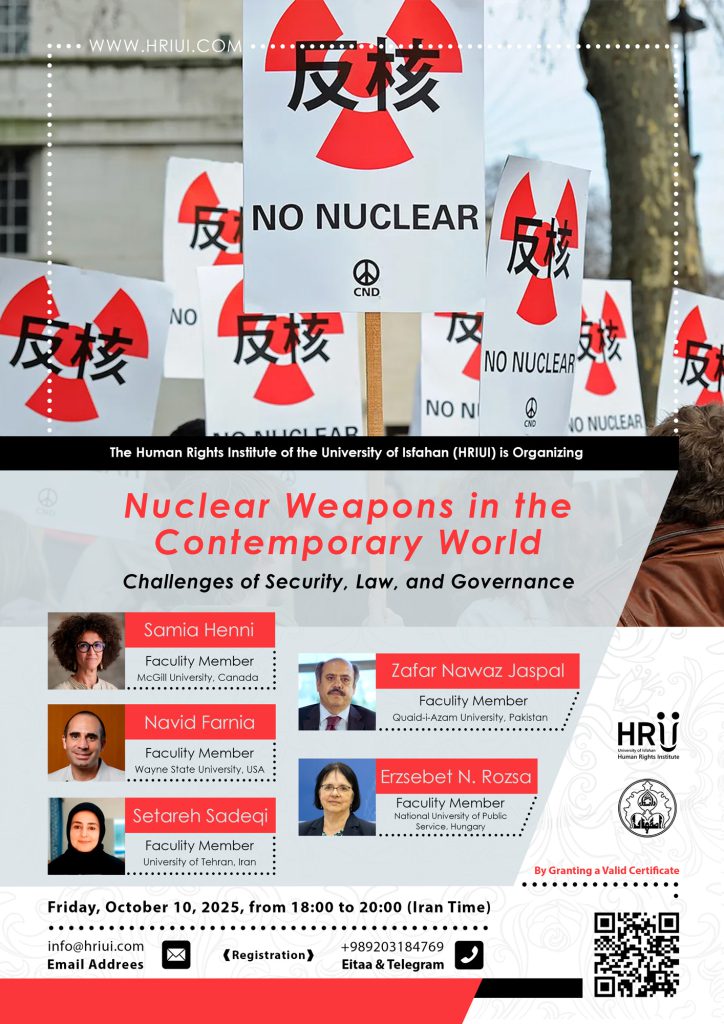
The international session “Nuclear Weapons in the Contemporary World: Challenges of Security, Law, and Governance” was convened by the Human Rights Institute of the University of Isfahan (HRIUI) on 10 October 2025. Bringing together scholars from diverse academic and geographical backgrounds, the conference sought to provide an in-depth analytical platform to examine one of the most contentious and complex issues of the contemporary global order.
Focusing on the intricate interconnections between international security, international legal norms, and global governance mechanisms in the field of nuclear weapons, the conference addressed the enduring centrality of nuclear arms in the security doctrines of major powers, the continuation of nuclear testing and its long-term humanitarian and environmental consequences, as well as the persistent legal challenges surrounding non-proliferation, disarmament, and state responsibility. Against this backdrop, the event aimed to explore the multi-layered dimensions of nuclear weapons from complementary and critical perspectives, highlighting their implications far beyond traditional military considerations.
Session Information
- Moderator: Prof. Setareh Sadeqi, Faculty Member, University of Tehran, Iran
- Speakers:
- Prof. Samia Henni, Faculty Member, McGill University, Canada
- Prof. Zafar Nawaz Jaspal, Faculty Member, Quaid-i-Azam University, Pakistan
- Prof. Navid Farnia, Faculty Member, Wayne State University, USA
- Prof. Erzsébet N. Rózsa, Faculty Member, National University of Public Service, Hungary
- Main Themes:
- French Nuclear Tests and Their Consequences in Algeria
- Domestic and International Responsibilities of States in Preventing the Production and Use of Strategic or Tactical Nuclear Weapons
- Iran’s Nuclear Program and U.S. Policy: Security, Law, and Global Implications
- Nuclear Deterrence in National Security Doctrines
- Date: Friday, 10 October 2025
- Time: 18:00–20:00
- Format: Online (Google Meet)
Summary of Presentations
French Nuclear Tests and Their Consequences in Algeria (Prof. Samia Henni)
Opening the conference, Prof. Henni addressed a comparatively under-examined chapter in the global history of nuclear weapons: France’s nuclear tests in Algeria and their enduring humanitarian, environmental, and legal consequences. Drawing on historical documentation and field-based reports, she explained that these tests inflicted extensive and long-lasting harm on local populations and ecosystems, while simultaneously revealing a clear manifestation of structural inequality within the international system—whereby the security costs of colonial powers were imposed upon subordinated societies.
By raising the fundamental question of states’ legal responsibility for the long-term effects of nuclear testing, Prof. Henni highlighted profound gaps in existing mechanisms for reparations, victim recognition, and historical accountability. In her analysis, the Algerian case demonstrates that nuclear weapons are not merely a latent threat to future generations, but a present and ongoing source of harm whose consequences persist across generations and remain largely outside effective frameworks of international justice.
Domestic and International Responsibilities of States in Preventing the Production and Use of Strategic or Tactical Nuclear Weapons (Prof. Erzsébet N. Rózsa)
In the subsequent presentation, Prof. Rózsa focused on the legal and governance dimensions of nuclear weapons, examining state responsibility not only at the international level but also within domestic legal systems. Referring to the distinction between strategic and tactical nuclear weapons, she argued that the lowering of the threshold for the use of tactical nuclear weapons poses new and serious challenges to international humanitarian law and international human rights law.
She emphasized that states cannot confine their obligations solely to treaty commitments. Rather, they bear a duty to prevent the unlawful production, deployment, and use of nuclear weapons through robust domestic legislation, democratic oversight, and institutional transparency. Prof. Rózsa concluded that the absence of effective governance in this field risks normalizing nuclear weapons and eroding long-standing international deterrence norms, thereby undermining the fragile architecture of global nuclear restraint.
Iran’s Nuclear Program and U.S. Policy: Security, Law, and Global Implications (Prof. Navid Farnia)
In the final presentation, Prof. Farnia analyzed the relationship between Iran’s nuclear program and United States policy, demonstrating that this issue cannot be adequately understood as a purely bilateral confrontation. Instead, it carries far-reaching implications for the global non-proliferation regime, regional stability, and the international legal order.
Reviewing the evolution of U.S. policy—from conditional diplomacy to strategies of maximum pressure—he argued that the securitization of Iran’s nuclear program has often been driven less by legal reasoning than by geopolitical calculations and power rivalries. Referring to Iran’s obligations under the Treaty on the Non-Proliferation of Nuclear Weapons (NPT) and the supervisory role of the International Atomic Energy Agency, Prof. Farnia stressed that the weakening of multilateral mechanisms and the marginalization of legal pathways have not only diminished mutual trust but have also exposed the global non-proliferation regime to gradual erosion.
He concluded that the continuation of this approach could generate consequences extending well beyond the Middle East, potentially establishing a dangerous precedent for addressing other nuclear cases worldwide.
Conclusion
Overall, the conference clearly demonstrated that nuclear weapons remain at the core of one of the most complex and multi-dimensional challenges of the contemporary world—a challenge in which security considerations, legal obligations, and global governance mechanisms are so deeply intertwined that separating them is neither feasible nor effective. The discussions underscored that nuclear weapons are not merely instruments of deterrence within national security doctrines, but phenomena with profound human rights, environmental, historical, and intergenerational consequences whose impacts transcend national borders and directly shape the international order.
The presentations collectively emphasized that despite the existence of a relatively extensive network of international rules, treaties, and norms governing non-proliferation, disarmament, and state responsibility, a significant gap persists between formal commitments and actual state practice. This gap not only undermines the legitimacy of international law but also facilitates the reproduction of power-centric approaches to nuclear issues, marginalizing human-centered and rights-based considerations.
Ultimately, the analytical outcome of the conference suggested that without genuine reinforcement of state accountability, enhanced transparency and responsibility at both domestic and international levels, critical re-examination of deterrence-based doctrines, and renewed confidence in multilateral mechanisms, the risks posed by nuclear weapons will not be effectively contained. On the contrary, they may re-emerge in more fragmented and unpredictable forms. From this perspective, the conference stressed that the future of international security increasingly depends on moving beyond narrowly militarized and power-driven approaches toward frameworks that define security in close and meaningful connection with human rights, responsible governance, and the shared interests of humanity.