

Introduction
Since 7 October 2023, and the outbreak of military hostilities between Hamas and Israel, the response of the German government to these developments has been marked by heightened sensitivity. Germany, due to its historical past and its active role in the Holocaust, considers itself morally and politically committed to ensuring the security of Jewish people and the very existence of Israel. From the very outset, Germany positioned itself firmly alongside Israel, emphasizing that “terrorism must not be celebrated” and asserting that no tolerance would be shown toward antisemitism.
However, following Israel’s large-scale attacks against civilians in the Gaza Strip, and after Benjamin Netanyahu and his Minister of War were identified as war criminals by the International Criminal Court (ICC), a wave of protests against Israel and Netanyahu emerged across Europe, including Germany.
In this context, the German government, by invoking counterterrorism legislation and stigmatizing individuals through accusations of supporting “terrorist organizations,” sought to suppress such protests. In particular, laws commonly referred to as “support for terrorism” and “banning terrorist organizations” have served as the principal legal instruments in this regard, criminalizing any form of material or propagandistic support for groups designated as terrorist.
Shortly after the 7 October attacks, the German government formally declared any activity or promotion in favor of Hamas illegal, and subsequently implemented stringent security policies against expressions of support for Hamas—and even for Palestine itself. This approach has sparked serious legal and political debates within German society regarding the tension between maintaining public security and the violation of fundamental freedoms, including freedom of expression, freedom of belief, and freedom of assembly.
Incidents
With the outbreak of the Gaza war in the autumn of 2023, Germany’s security and political climate rapidly became tense. One of the largest Palestinian migrant communities in Europe resides in Berlin, with an estimated population of approximately 300,000 people[1]. Just a few hours after the Hamas attack, limited gatherings by Palestinian supporters took place in the city, provoking strong reactions from German authorities.
For instance, in the Neukölln district of Berlin, around 50 individuals took to the streets. Reports indicated that the gathering had been organized by the Palestinian group Samidoun—a group that describes itself as a solidarity network for Palestinian prisoners, but which, according to Israel, is considered a terrorist organization affiliated with the Popular Front for the Liberation of Palestine (PFLP). Berlin police dispersed the gathering and detained several participants.
At the political level, German Chancellor Olaf Scholz and other senior politicians explicitly condemned these demonstrations and called for decisive action against what they described as “supporters of Hamas terror on German soil.” For example, Nancy Faeser, then Federal Minister of the Interior, stated after consultations with officials from the Federal Criminal Police Office (Bundeskriminalamt): “If we can deport Hamas supporters, we must do so[2].” She subsequently announced, on Thursday, 2 November 2023, that the formal ban on Hamas activities or support for the group—already designated as a terrorist organization in Germany—had been fully enforced[3].
In the days and weeks that followed, a series of security and judicial measures were implemented against any gathering or slogan interpreted as being in favor of Palestine. German authorities emphasized that these restrictions were not aimed at expressions of humanitarian solidarity with Gaza’s civilians, but rather at preventing “terrorist propaganda” and antisemitism. Nevertheless, in practice, many legitimate pro-Palestinian demonstrations were also subjected to bans.
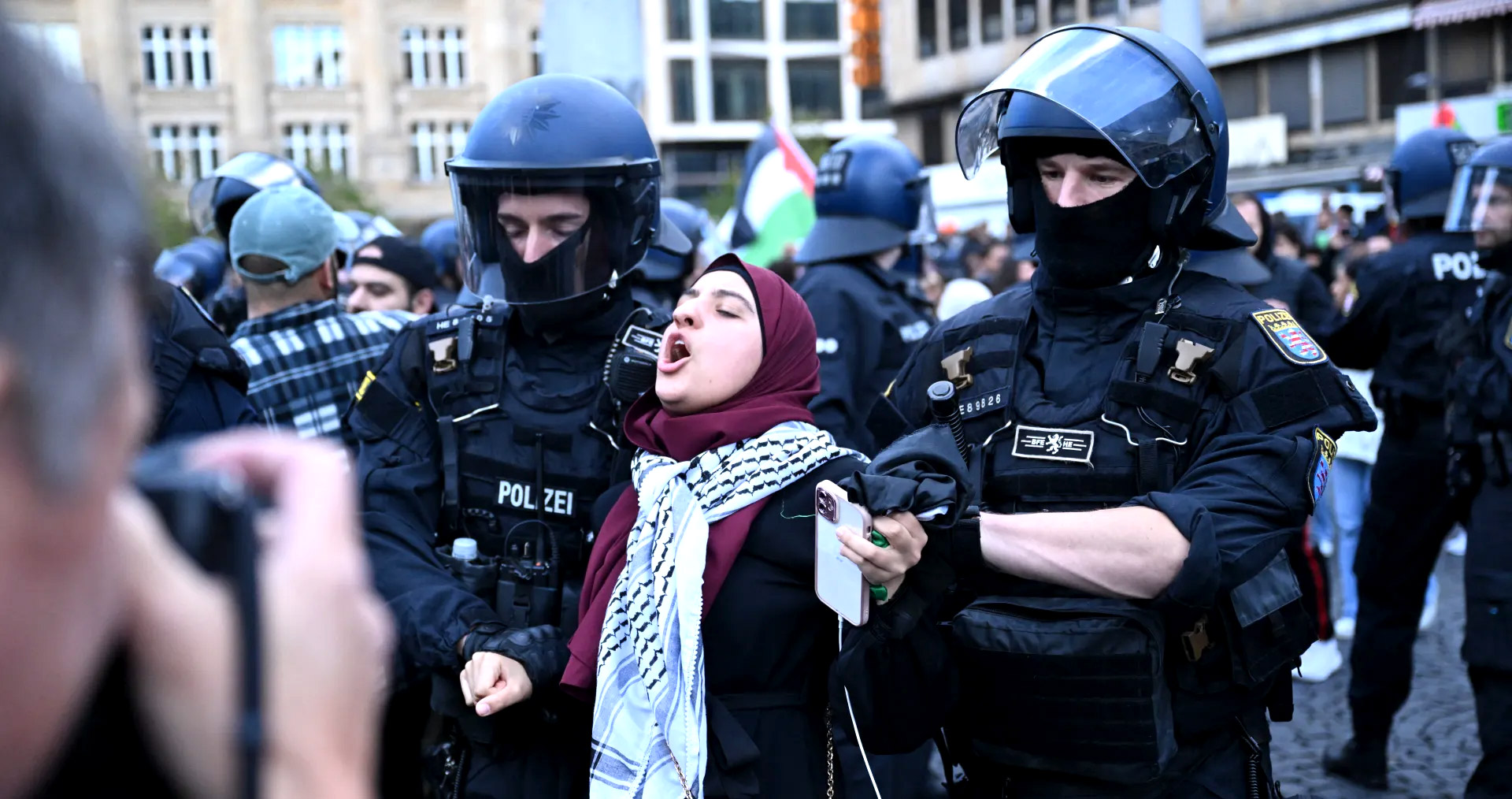
During the first weeks of the war, nearly all requests for demonstrations supporting Palestinians were rejected in major cities such as Berlin and Frankfurt. Berlin police announced that between 7 October and 19 October, only two small marches, classified as “silent gatherings,” had been approved, while dozens of others were prevented. As previously noted, Berlin hosts one of the largest Palestinian migrant communities; yet, during an unauthorized demonstration in the early days of the conflict and the killing of civilians in Gaza, Palestinians who spoke to Reuters reported feeling anxious about expressing their opinions. They feared being labeled as supporters of Hamas—a group designated as terrorist by Germany—in a country where support for Israel is considered sacrosanct[4].
Police actions in Germany escalated to the point where some individuals were detained merely for wearing the well-known Palestinian keffiyeh, and schools were authorized to prohibit students from possessing or displaying such symbols. These measures were justified under bans on the use of terrorist symbols or symbols allegedly associated with support for terrorism. Andreas Frank, Chief Public Prosecutor of Munich and Antisemitism Commissioner of the Bavarian judiciary, had previously announced his intention to pursue charges based on such slogans, as well as banned Nazi symbols and slogans[5].
In the judicial sphere, unprecedented measures were also adopted. German prosecutors and judges, under pressure from public opinion and the government, adopted expansive interpretations of anti-terrorism and hate-speech laws in order to criminalize and restrict pro-Palestinian slogans and actions. In its official notice banning Hamas activities—known as the Betätigungsverbot—the German Federal Ministry of the Interior explicitly stated that the phrase “From the river to the sea” was prohibited, whether expressed in German or in any other language.
This phrase was first banned in August 2024 by a Berlin judge, on the grounds that it allegedly constituted support for terrorism[6]. The State of Bavaria subsequently classified the phrase as a “symbol of terrorism[7].” According to the Interior Ministry’s ruling, published in an official government bulletin, chanting this slogan is considered equivalent to using the symbols and rhetoric of a banned terrorist organization, and may carry a penalty of up to three years’ imprisonment under Section 86a of the German Criminal Code (Strafgesetzbuch), which prohibits propaganda for unconstitutional or illegal organizations[8].
For example, in January 2023, following the cancellation of Nakba Day demonstrations by German authorities, one individual who participated in an unauthorized gathering held a sign bearing the slogan “From the river to the sea.” He was charged under the aforementioned provision before the Mannheim District Court, and was acquitted only because it could not be proven that he was aware of the slogan’s association with Hamas or the Popular Front for the Liberation of Palestine (PFLP). The court relied on a Federal Office for the Protection of the Constitution report on antisemitism, which stated that Hamas and Hezbollah had used the slogan, and therefore classified it as a symbol of a terrorist organization[9].
This demonstrates that such measures against critics of Israel and supporters of Palestine are not limited to events following 7 October. In another case, Ava Moayeri, a 22-year-old Iranian–German woman, was immediately arrested by two police officers on charges of hate speech after spontaneously chanting the slogan during a rally held in support of a student who had been assaulted by a teacher. Although she stated in court that her chant was intended solely as a symbol of peace and justice, she was fined €600 by Judge Birgit Balzer[10] and subsequently released. Two months later, Ava discovered that her apartment had been searched by police on allegations of supporting terrorism, and that her computer and other electronic devices had been confiscated[11].
In the months that followed, the repression continued. Whenever police became aware of a gathering where “anti-Israeli” slogans or placards might be displayed, such events were either immediately banned or subjected to strict conditions. Germany’s domestic intelligence agency, the Federal Office for the Protection of the Constitution (Verfassungsschutz), announced that it had placed dozens of individuals under surveillance as “Hamas-supporting extremists,” and was monitoring videos and social media platforms to identify alleged supporters of violence.
In several cases, enforcement measures were particularly severe, including the dismantling of protest camps. One high-profile example was the forced evacuation of a pro-Palestinian sit-in camp in Berlin in October 2024, which police dismantled as soon as they learned of the possible presence of figures such as Greta Thunberg—the internationally known climate activist, who had publicly expressed support for Gaza.
Taken together, these events demonstrate that any expression of solidarity with Palestine in Germany following the Gaza war may be labeled as support for terrorism, carrying potential criminal or administrative consequences. Even individuals merely participating in peaceful demonstrations faced risks such as visa revocation or deportation. In this context, lawyer Alexander Gorski stated in a media interview that he had reviewed multiple cases in which German law had been applied against individuals of Arab or Palestinian background, often based on nothing more than a social media post, comment, or even a “like.”
In April 2025, the media outlet that published the interview reported that four individuals were on the verge of deportation from Germany solely on the basis of alleged pro-Hamas slogans, without any formal criminal conviction having been registered against them. Kasia Wlaszczyk, a Berlin-based cultural activist, stated in an interview that in January 2025, she and several other activists in Berlin received letters from the immigration authorities informing them that their freedom of movement within Germany had been revoked, and that they were required to leave the country by 21 April, failing which they would be forcibly deported. The allegations against them included participation in protests against the genocide in Gaza and affiliation with designated “terrorist organizations” such as Hamas and associated entities.
It should be noted that the use of immigration law against Palestinian activists intensified after 7 October 2023, and has even included the unlawful suspension of asylum procedures for Gaza refugees[12]. Zaid Abdulnasser, a Syrian–Palestinian refugee who had lived in Germany for nearly a decade, stated that in 2023 the German Ministry of the Interior revoked his refugee status due to his alleged cooperation with Samidoun, which was later accused of “glorifying various terrorist organizations” and subsequently banned.
The German government later introduced new legal and regulatory dimensions to this policy[13]. On Wednesday, 26 June 2024, the cabinet of Chancellor Olaf Scholz approved a draft law aimed at making it easier to deport individuals who, in the government’s view, “praise terrorist crimes,” without requiring a prior relevant criminal conviction[14].
In another case, on Thursday, 16 May 2024, the Duisburg Police Department in the state of North Rhine–Westphalia conducted searches of four residences—one near the city’s university and three in the northern part of the city—following the ban on the group “Solidarity with Palestine Duisburg.” Individuals were arrested on charges of supporting terrorism, and their personal property, including mobile phones, laptops, organizational documents, and cash, was confiscated.
Herbert Reul, Minister of the Interior of North Rhine–Westphalia, who had ordered the ban on the group, stated that such prohibitions were “not a cure-all for extremism,” but rather tools that democracy must use against those who poison social coexistence and support terrorism.” He further added: “I would also like relatively larger organizations that operate nationwide—and which I have repeatedly mentioned elsewhere—to be banned soon as well[15].” According to Reul, any organization attempting to replace a dissolved group would likewise be prohibited, and the use of its symbols would be banned.
Taken together, these decisions are widely perceived as a deliberate effort to intimidate and silence the pro-Palestinian movement in Germany.
Challenges and Responses
- Domestic Reactions
The Heinrich Böll Foundation, a cultural–political foundation, responded to the repression of pro-Palestinian supporters in Germany through a report published on its official website entitled “I No Longer Recognize My Country.” Following the 7 October 2023 attacks and Israel’s military response in Gaza, German politics and mainstream media declared their unconditional solidarity with Israel. While this position was initially justified by reference to the Holocaust, it quickly generated a sense of alienation and estrangement among many citizens—particularly Muslims and migrants. To such an extent, the phrase “I no longer recognize my country” became emblematic of this condition.
The response of the German government to the siege and bombardment of Gaza—which international institutions described as a clear violation of international law and even a possible act of genocide—was marked by silence and omission. Many German officials and media outlets refused to acknowledge the suffering of Palestinian civilians, and in some cases even stated that they did not wish to view images of the victims.
This approach sparked shock and anger on social media and within public opinion, particularly among migrant communities. Domestically, state governments such as Berlin and Hamburg imposed far-reaching restrictions on demonstrations and Palestinian symbols. Schools were authorized to ban the use of Palestinian flags and symbols, and numerous demonstrations were cancelled. Widespread images of police violence against protesters further intensified public mistrust and a sense of systematic repression.
At the same time, senior officials such as Robert Habeck and Frank-Walter Steinmeier, through statements emphasizing the “need for Muslims to clearly distance themselves from antisemitism,” reinforced perceptions among Muslim communities that they were being subjected to collective suspicion and placed at risk of losing their civil rights. These developments contributed to the spread of alienation, fear, and even intentions to leave Germany among many Muslims and migrants. Some families left the country, while many others began seriously considering emigration.
Experts warn that this trend, beyond accelerating the departure of skilled professionals, also creates fertile ground for radicalization and the exploitation of grievances by extremist movements. The sharp decline in Muslim voter support for governing parties in the 2024 European elections is cited as a clear indicator of this deepening societal rift[16].
- International Reactions
The well-known media outlet The Guardian, in a report published on 3 April 2025 by Hanno Hauenstein, a Berlin-based journalist, addressed the issue of deportations of pro-Palestinian migrants in Germany on allegations related to terrorism and antisemitism. The author characterizes the German government’s treatment of pro-Palestinian supporters as a form of political repression of dissent, arguing that such practices are closely aligned with the migration policies of the German government. According to the report, individuals face the risk of deportation based on allegations such as using antisemitic symbols, chanting pro-Palestinian slogans, or participating in peaceful or non-peaceful demonstrations.
The author further argues that far-right actors in Germany have instrumentalized the concept of “Staatsräson”—defined as “Israel’s security as part of Germany’s national interest”—as a justification for the expulsion of migrants. Germany, the article concludes, stands at a critical crossroads: it can either uphold the freedoms and democratic principles it claims to defend, or continue down a path of authoritarian governance. At present, the direction appears unambiguously clear[17].
The U.S.-based nonprofit organization “Unicorn Riot” has also addressed the repression of pro-Palestinian supporters in Germany in a report entitled “Germany’s Repression of Solidarity with Palestinians.” The report demonstrates that the repression of Palestinians and their supporters, particularly in Berlin, constitutes a systematic and deeply rooted pattern that began years before the events of 7 October 2023 and intensified significantly thereafter.
According to the “Index of Repression” database, more than 766 incidents of repression were recorded between 2019 and April 2025, encompassing a wide range of measures including arrests, censorship, bans on demonstrations, job dismissals, academic and cultural pressures, and even house raids triggered by social media activity.
The ideology of “Staatsräson”, which frames Israel’s security as a fundamental national interest of Germany, serves as the cornerstone of these policies. This principle was formally articulated by Angela Merkel in 2008, and later reinforced by Olaf Scholz and Friedrich Merz. Under this framework, criticism of Zionism is frequently equated with antisemitism, while solidarity with Palestine is framed as a security threat.
As a result, pro-Palestinian demonstrations, particularly after 7 October, were met with bans and violent suppression, and hundreds of individuals—including children—were arrested for carrying Palestinian flags or chanting the slogan “From the river to the sea.” The Palestine Congress in April 2024 was shut down following a large-scale police operation, and many organizers—including anti-Zionist Jewish participants—were dismissed from their jobs or labeled as “antisemitic.”
Within the education sector, universities violently dispersed student protests, while schools banned Palestinian symbols such as the keffiyeh or the Palestinian flag. In the cultural sphere, institutions and artists were defunded or shut down due to expressions of support for Palestine.
In the military domain, Germany has emerged as the second-largest arms exporter to Israel, with exports increasing tenfold between 2022 and 2023, despite warnings from international courts and United Nations experts that such actions may fall within the framework of genocide-related violations.
Press freedom has also been severely affected. More than 80 documented cases of pressure and censorship against journalists have been recorded. The case of Hüseyin Dogru, a German journalist, has become emblematic of this repression; he was sanctioned by the European Union for his coverage of Israeli crimes.
Despite these conditions, the Palestinian solidarity movement in Germany remains active. In June 2025, approximately 60,000 people took to the streets of Berlin in what became the largest pro-Palestinian demonstration in the country’s history, demonstrating that solidarity with the Palestinian people has not been extinguished, despite widespread repression and restrictions[18].
- Misuse of the Concept of Staatsräson
The concept of Staatsräson, which in the German political tradition refers to the prioritization of the state and its fundamental interests over other considerations, represents a central challenge to support for Palestine and opposition to Israeli policies in Germany. This principle, which has its intellectual roots in the Middle Ages, was explicitly articulated in 2008 by Angela Merkel during her address to the Knesset, where she declared that Israel’s security constitutes part of Germany’s national interest[19].
Rather than being interpreted as a general responsibility toward universal human rights, this principle has been narrowly reduced to unconditional support for Israel. Critics argue that such an interpretation effectively channels Germany’s historical memory of the Holocaust in a highly selective manner: instead of fostering a universal commitment to “never again” for all peoples, it has been transformed into a tool for legitimizing Israeli state policies.
As a result, opposition to Zionism or criticism of Israel’s actions is frequently and swiftly labeled as “antisemitism” or “support for terrorism.” Opponents warn that this policy has produced a form of “reversal of responsibility”: rather than confronting genuine antisemitism, which predominantly emanates from far-right extremist movements, the focus has shifted toward Arab and Muslim migrants and Palestinian solidarity movements.
This approach not only presents a distorted picture of reality, but also contributes to the institutionalization of structural racism and Islamophobia within German society.
Conclusion
Despite Germany’s longstanding self-identification as a state committed to universal human rights principles and fundamental freedoms, it has consistently faced a profound dilemma when these principles intersect with its support for Israel. Under the framework of Staatsräson, Germany considers itself obligated to safeguard the security of Israel and Jewish communities in Europe, and has therefore systematically suppressed protests and criticism directed at Israel’s treatment of Palestinians and civilians.
The German government has criminalized support for Palestine and opposition to Israeli policies through labels such as “antisemitism,” “support for terrorism,” and “use of terrorist symbols.” Consequently, expressions of solidarity with Palestine have frequently resulted in state-led stigmatization, criminal investigations, and administrative sanctions.
These policies have provoked serious criticism from independent institutions and human rights organizations, both within Germany and internationally. Critics argue that by branding pro-Palestinian supporters and critics of Israel as “terrorists” and embedding this logic within legal and administrative frameworks, the German state has effectively restricted fundamental freedoms, including freedom of expression and freedom of assembly. Moreover, they contend that this approach has not succeeded in combating antisemitism, but has instead added Islamophobia to the spectrum of discrimination, creating a range of social, legal, and political challenges within German society.
References
[1] Sharma, G. (2023, October 26). ‘Complete censorship’: Germany’s Palestinian diaspora fights crackdown. Aljazeera. From: https://www.aljazeera.com/features/2023/10/26/complete-censorship-germanys-palestinian-diaspora-fights-crackdown
[2] Reuters. (2023, October 20). German interior minister supports deportation of Hamas supporters. Reuters. From: https://www.reuters.com/world/europe/german-interior-minister-calls-deportation-hamas-supporters-2023-10-20/
[3] Aljazeera. (2023, November 2). Germany announces complete ban of Hamas activities. Aljazeera. From: https://www.aljazeera.com/news/2023/11/2/germany-announces-complete-ban-of-hamas-activities
[4] Alkousaa, R, & Escritt, T, & Foroudi, L. (2023, October 19). In France and Germany, Palestinian supporters say they struggle to be heard. Reuters. From: https://www.reuters.com/world/europe/france-germany-palestinian-supporters-say-they-struggle-be-heard-2023-10-19/
[5] Leicht, J. (2023, November 19). Germany to prosecute slogan calling for freedom for Palestine as a crime. World Socialist Web Site. From: https://www.wsws.org/en/articles/2023/11/20/zvsr-n20.html
[6] Jamal, H. (2025, July 15). The Berlin police lied and the lie is now used to justify repression. Aljazeera. From: https://www.aljazeera.com/opinions/2025/7/15/the-berlin-police-lied-and-the-lie-is-now-used-to-justify-repression
[7] Jegic, D. (2024, January 7). Why is Germany so viciously anti-Palestinian?. Aljazeera. From: https://www.aljazeera.com/opinions/2024/1/7/why-is-germany-so-viciously-anti-palestinian
[8] Bogner, M, & Fenker, I. (2023, November 11). What the ban on the slogan “From the river to the sea” means. Zeit. From: https://www.zeit.de/politik/2023-11/deutschland-staatsanwaltschaft-palaestina-verbot-antisemitismus
[9] Steinbeis, M. (2023, June 02). Signs and Symbols. Verfassungsblog. From: https://verfassungsblog.de/signs-and-symbols/
[10] Cole, D. (2024, August 06). German court convicts activist for leading ‘from the river to the sea’ chant. The Guardian. From: https://www.theguardian.com/world/article/2024/aug/06/german-court-due-to-rule-on-from-the-river-to-the-sea-case-in-test-of-free-speech
[11] Bateman, J. (2024, October 04). Legal ordeal just strengthened my resolve to speak out, says German pro-Palestine activist. Hyphen. From: https://hyphenonline.com/2024/10/04/ava-moayeri-germany-pro-palestine-protest-free-speech-police-arrest-violence/
[12] Wlaszczyk, K. (2025, April 9). On 21 April, Germany will deport me – an EU citizen convicted of no crime – for standing with Palestine. The Guardian. From: https://www.theguardian.com/commentisfree/2025/apr/09/germany-deport-me-eu-citizen-no-crime-standing-palestine
[13] Omar, S. (2024, August 14). Germany’s new citizenship law: A crackdown on pro-Palestine support?. The Newarab. From: https://www.newarab.com/analysis/germanys-citizenship-law-crackdown-pro-palestine-support
[14] Reuters. (2024, June 26). German cabinet agrees tighter deportation rules for praising terrorism. Reuters. From: https://www.reuters.com/world/europe/german-cabinet-agrees-tighter-deportation-rules-praising-terrorism-2024-06-26/
[15] Welt. (2024, May 16). Raid on Hamas supporters – “Red line was crossed,” says Reul. Welt. From: https://www.welt.de/politik/deutschland/article251542500/Duisburg-Razzia-gegen-Hamas-Unterstuetzergruppe-vier-Haeuser-durchsucht.html
[16] Moller, P. (2024, September 26). “I don’t recognize my country!”. Heinrich Boll Stiftung. From: https://heimatkunde.boell.de/de/2024/09/26/ich-erkenne-mein-land-nicht-wieder
[17] Hauenstein, H. (2025, April 3). Germany is now deporting pro-Palestine EU citizens. This is a chilling new step. The Guardian. From: https://www.theguardian.com/commentisfree/2025/apr/03/germany-deporting-pro-palestine-eu-citizens-chilling-new-step
[18] Halva, Y. (2025, August 06). Germany’s Crackdown on Palestinian Solidarity. Unicorn Riot. From: https://unicornriot.ninja/2025/germanys-crackdown-on-palestinian-solidarity/
[19] Knesset. (2008, March 18). Speech by Federal Chancellor Angela Merkel to the Knesset in Jerusalem. Knesset. From: https://m.knesset.gov.il/EN/activity/Documents/SpeechPdf/merkel.pdf


