Introduction
In recent years, climatic conditions in Iran have turned into a serious challenge. This issue has affected various dimensions of citizens’ daily lives and placed them under strain. The impacts of climate change, including sudden floods and prolonged periods of drought, along with mismanagement of resources and the financial as well as administrative inability to rehabilitate and modernize energy infrastructures, have led to imbalances in the energy sector. These imbalances are manifested in the form of scheduled interruptions of water, electricity, and gas supplies during different seasons of the year.
In the cold months of the year, some regions experience gas pressure drops or complete cuts of gas and electricity, while in the warm seasons, high consumption demand leads to restrictions in the supply of water and electricity. This situation has caused serious disruption in the ordinary flow of occupational, educational, and family activities of Iranian citizens and has further intensified social discontent. Moreover, the issue of energy imbalance has more severe consequences for vulnerable groups such as the elderly, patients, and children.
Providing care for the elderly without access to electricity and the failure of electric medical devices is practically impossible; likewise, maintaining the health of patients either at home or in medical centers without access to energy can result in irreparable harm. From a human rights perspective, the continuation of such conditions may jeopardize the realization of some fundamental rights such as access to safe water, sustainable energy, health, and welfare, and in certain cases, may even lead to the deprivation of rights as essential as the right to life.
Incidents
- Household Power Outages
Based on the experience of previous years, following the early presidential elections in Iran and the beginning of Masoud Pezeshkian’s term as the new president in the summer of 2024, speculations were raised concerning the crisis of fuel and energy shortages in Iran. After the onset of the cold season, the Iranian government imposed restrictions on electricity consumption and called on citizens to save energy in order to prevent gas pressure drops in peripheral areas and to ensure stable gas supply.
Gas pressure drops were not noticeable in densely populated urban regions, but blackouts implemented to control electricity consumption due to the use of heating equipment caused discontent among citizens in different areas. It should be noted that a significant portion of the electricity outages during winter were due to insufficient fuel supply to power plants.
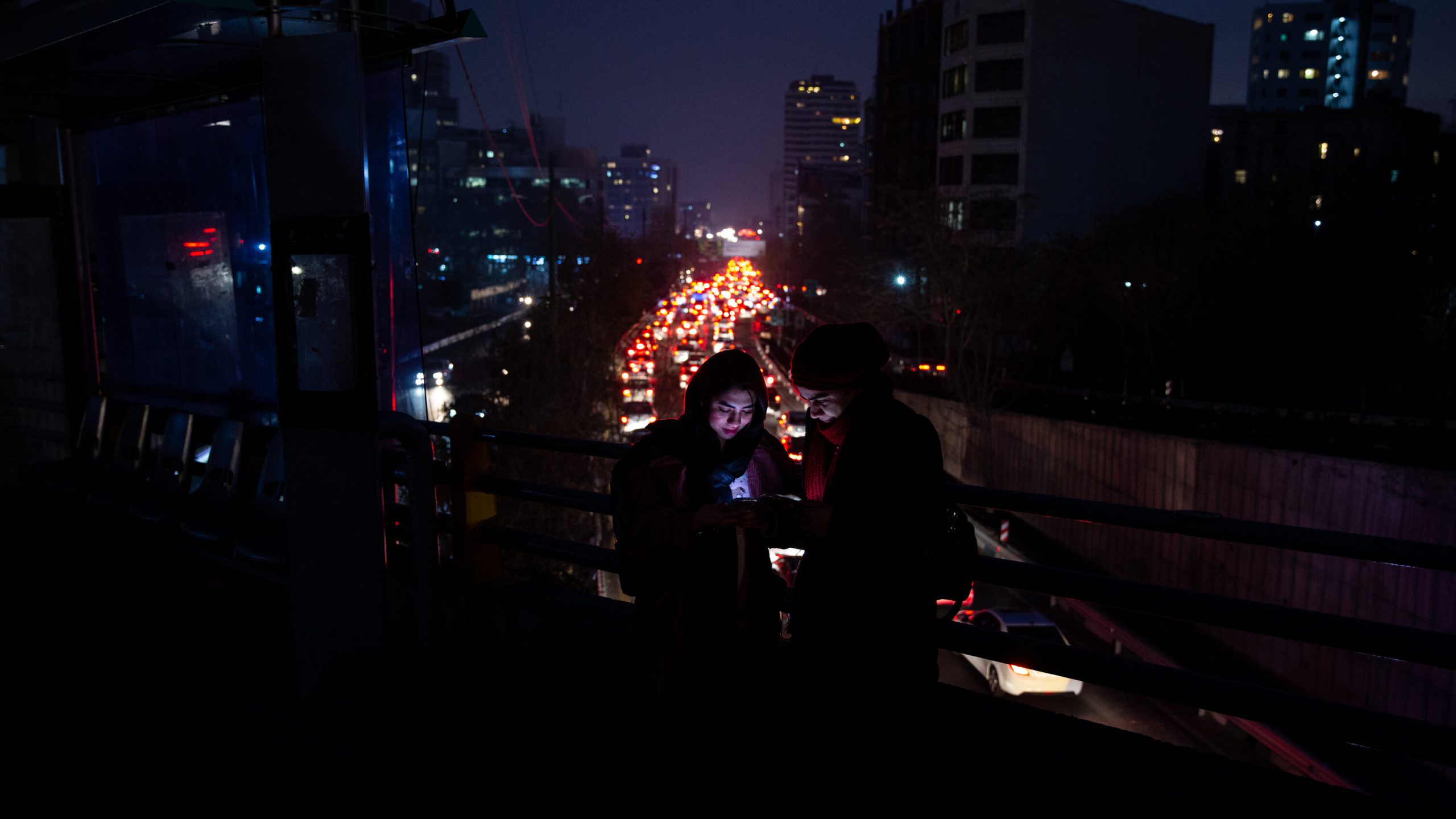
The shortage of electricity in winter was so severe that, in addition to planned and unplanned blackouts for household consumption, the government was compelled to shut down administrative centers, schools, and universities. This, in addition to creating disruption in citizens’ daily lives, strengthened the notion that, since electricity consumption in Iran rises in summer due to cooling appliances, widespread blackouts would be inevitable.
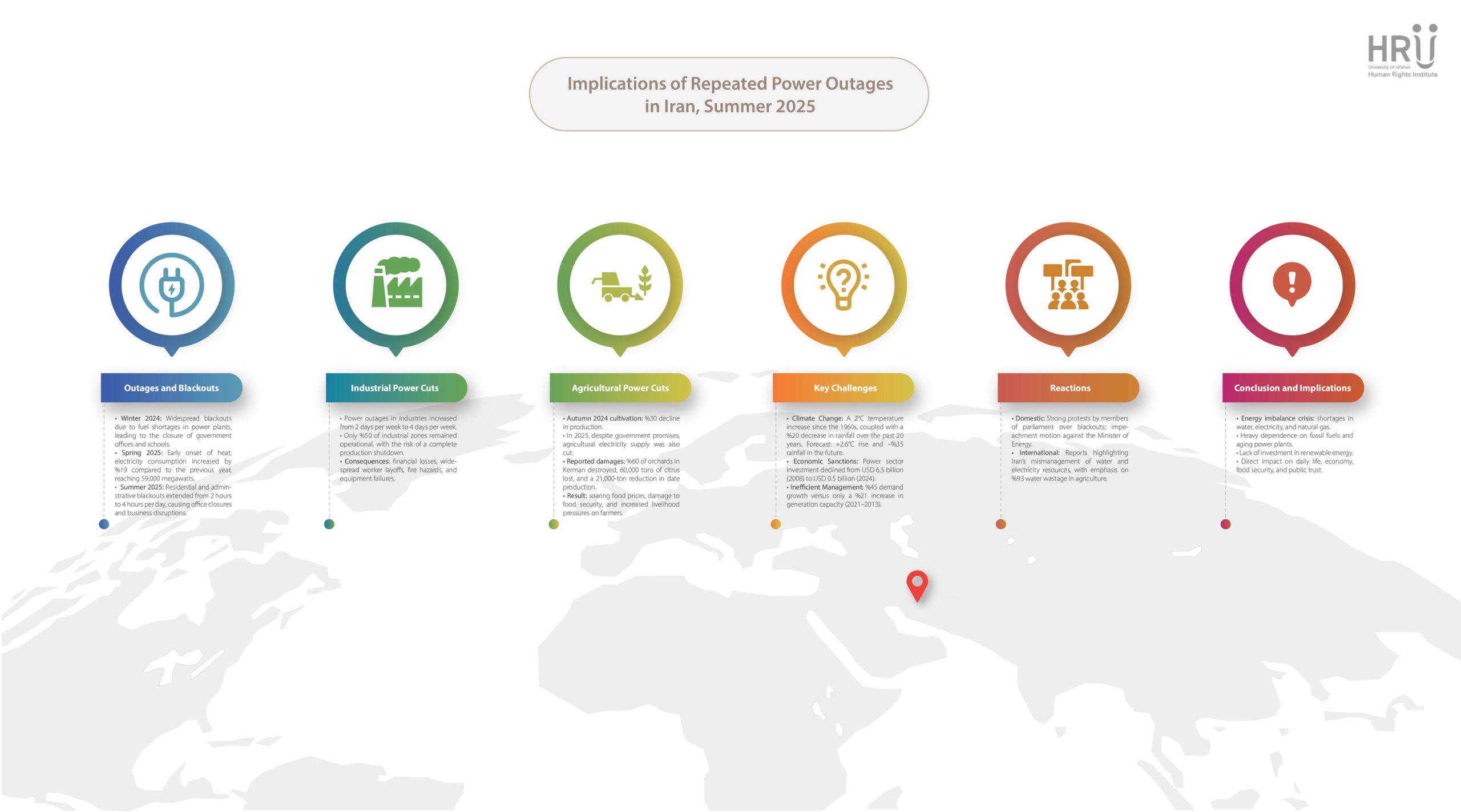
Following the early onset of heat in Iran coinciding with May 2025, speculations about electricity outages began. These blackouts, which had already existed sporadically in April, were imposed and intensified in the residential sector without prior notification starting in May. The reason was that, due to the early arrival of hot weather, electricity consumption suddenly surged. Normally, electricity consumption at this time of year is lower than in summer, but due to the unusual rise in temperatures, national electricity consumption increased to unprecedented levels.
Statistics showed that consumption had risen by 19 percent compared to the same period in the previous year, reaching more than 59,000 megawatts. For this reason, the Ministry of Energy issued a warning statement that, unless widespread savings were adopted by the population, the imbalance between production and consumption would reach 30,000 megawatts. This level of shortage represents the largest energy gap in Iran in decades[1].
The blackouts first started in Tehran with a quota of two hours of daily power outage and then spread to other regions of the country, to the extent that even the southern provinces, enduring extreme heat, faced daily blackouts similar to other regions.
From early summer, with rising temperatures, the scheduled blackouts for administrative and residential sectors increased from two hours per day to four. For example, in one case, the Alborz Province Power Distribution Company announced that, due to a sharp increase in electricity consumption following the extreme heat, the blackout schedule would be implemented in two shifts of two hours each, between 9 a.m. and 11 p.m. This measure was taken in order to manage grid load and prevent larger-scale outages[2].
In another case, the CEO of the West Azerbaijan Province Power Distribution Company, referring to the increase of blackouts from two hours to four, stated: “We are compelled to make this decision[3].” Nevertheless, these measures neither solved the problem of nearly 20,000 megawatts of electricity shortage nor stopped the continuation of blackouts in household and commercial sectors. Moreover, the government’s decision to impose intermittent closures of administrative offices, banks, and state centers also persisted.
This situation, in addition to reducing the productivity of commercial and administrative units, led to delays in processing public requests in offices and banks and created livelihood problems for commercial units. Since two to four hours of blackout effectively shut down business activity, in units supplying foodstuffs it also resulted in spoilage due to heat and failure of cooling devices, including refrigerators used for perishable goods.
- Industrial Power Outages
Industrial power cuts are far more complex than household and commercial blackouts. The electricity outages in industrial parks, which initially amounted to two days per week, increased to four days per week by mid-July. This situation has led to the reality that only 50 percent of industrial parks in Iran are currently active[4].
For example, in Kamard Industrial Area on the outskirts of Tehran, out of 5,000 existing industrial units, 2,000—mainly small workshops—are struggling to operate at a minimal level, while 3,000 units have been completely shut down[5].
The distinction here is that household blackouts do not entirely halt daily life and some activities continue, albeit in a limited form. However, industrial power cuts result in the complete shutdown of a factory until electricity supply is restored.
Industrial electricity is primarily used to feed and transfer energy to machinery and equipment, and can be applied to fulfill different needs such as production, pumping, lighting, heating and cooling, process control, and other industrial operations[6]. Therefore, a power outage effectively means halting all of the aforementioned activities.
In addition to production stoppages, blackouts followed by reconnection pose risks such as fire hazards, spoilage of raw production materials, breakdown of production machinery, and other complications. Alongside these technical challenges, industrial power outages reduce factory revenues, ultimately leading to shutdowns. This, in turn, creates livelihood problems for thousands of workers and their families, directly impacting poverty levels and purchasing power.
- Agricultural Power Outages
Despite the experience of severe damages caused by agricultural power cuts during the autumn cultivation season of 2024—which led to a 30 percent reduction in agricultural production[7]—the situation in the agricultural sector has mirrored that of other areas.
Although in April 2025 it had been officially announced that agricultural electricity supply would not be cut[8], this promise was not upheld, and daily outages were imposed on the sector. This occurred despite the fact that, according to the “Law on Facilitating the Electrification of Agricultural Wells,” the Ministry of Energy is legally obligated to provide 24-hour electricity to agricultural wells[9].
For example, in Kerman Province, blackouts damaged 60 percent of the province’s orchards and affected 127,000 farmers. Additionally, 60,000 tons of citrus fruits were harmed due to irrigation delays, while date production dropped by 21,000 tons[10].
Beyond reduced output, disruptions in the operation of wells caused serious damage to pumping equipment and local electricity networks. Pump motors, due to surges or prolonged outages, suffered burnouts or accelerated wear, with repair or replacement costs adding further economic pressure on farmers[11].
In addition to technical challenges, electricity outages have not only jeopardized the livelihood of farmers but have also, through reduced or disrupted production and distribution of agricultural goods, caused an increase in consumer prices. It can be stated unequivocally that these power cuts have had a direct impact on the livelihoods of Iranian society as a whole and on food security within the country.
Challenges and Responses
- Climate Change
One of the major challenges related to blackouts and energy imbalance in Iran is climate change. Typically, climate change manifests differently across regions of the globe, reflecting each area’s prevailing weather patterns. In the Middle East and the Iranian Plateau—already characterized by dry, low-rainfall conditions—this phenomenon is expressed through reduced precipitation, severe drought, extreme heat, dust storms, and other environmental stressors.
Iran is considered one of the countries most severely affected by the negative consequences of climate change, according to experts[12]. Its geographical location in the mid-latitude belt has exposed the country to significant environmental transformations and serious challenges. More than 82 percent of Iran is classified as arid or semi-arid, and its annual rainfall is less than one-third of the global average[13].
Mohammad Rahimi, a climatology professor at Semnan University in Iran and co-author of a related study, told the Associated Press: “Global climate change caused by human activity has made life considerably more difficult for tens of millions of people in West Asia. With each degree of temperature rise, Syria, Iraq, and Iran will become increasingly challenging places to live.”
The study’s authors further calculated that climate change has increased the likelihood of drought by 25 times in Syria and Iraq and by 16 times in Iran[14]. Moreover, climate change annually reduces about one billion cubic meters of Iran’s renewable water resources[15].
According to UNICEF, the country’s average temperature has risen by 2°C since the 1960s, while rainfall has declined by 20 percent over the past 20 years, alongside shifts in precipitation patterns. Forecasts suggest that, in the coming decades, Iran will experience a 2.6°C increase in average temperature and a 35 percent decrease in precipitation[16]. This trajectory will exacerbate water shortages and overexploitation of water resources.
This trend means that electricity generation from water sources has already sharply declined and will continue to decrease. Meanwhile, electricity consumption will increase, and the costs borne by the government to secure drinking water—already dependent on electricity—will rise significantly.
- Economic Sanctions
Beyond the effects of climate change in recent decades, Iran has also faced severe economic sanctions, which have hampered its access to effective equipment necessary for the development and modernization of energy-related industries.
GlobalData reported that U.S.-imposed sanctions have left Iran struggling to pay for or finance renewable energy projects. In early 2022, Iran’s Ministry of Energy announced plans to add 10 gigawatts of renewable energy capacity by the end of 2026. This figure aligns with the ministry’s 2030 target of achieving a cumulative capacity of 30 gigawatts.
However, this goal has fallen far short of ensuring the potential development of renewable energy in the country, with the main challenge being the lack of foreign investment in the renewable energy sector due to sanctions[17]. According to a member of parliament, investment in Iran’s electricity industry has declined dramatically. While in 2008 approximately $5.6 billion was invested in the sector, by 2024 the figure had plummeted to just $500 million[18]—a severe drop to one-seventh of its previous level.
- Declining Hopes for Change
The continuation of sanctions, the intensifying effects of climate change, and the absence of reforms in macro-level management of water and energy have collectively eroded public hopes for improvement.
For instance, while energy demand rose by 45 percent between 2013 and 2021, infrastructure capacity increased by only 21 percent[19]. According to Reza Riahi, CEO of Mahtaab Power Generation Company, addressing the current 25,000-megawatt electricity deficit requires approximately $15 billion in investment and a three-to-five-year timeline, solely for the power plant sector[20].
Years of failure to alter national approaches to energy have made short-term change seem virtually impossible, fueling widespread social despair.
- Domestic Reactions
Following the intensification of blackouts and increased daily outage durations, members of Iran’s parliament reacted strongly. Protests began when, after the New Year holidays in 2025, blackouts commenced earlier than expected and without public announcements.
As noted earlier in this report, outages in 2025 began far earlier than anticipated, sparking parliamentary protests. Moreover, lawmakers objected to what they perceived as discriminatory treatment of peripheral towns and smaller counties compared to major metropolitan centers during blackouts.
Eventually, on July 29, 2025, the Minister of Energy was summoned to parliament and formally admonished by MPs. Mehrdad Lahoti, MP for Langarud, stated: “It is now rice harvest season. With this situation of power cuts, three million tons of rice produced by farmers, along with all their efforts, will be wasted.”
Similarly, Ahmad Moradi, MP for Bandar Abbas, remarked: “Power outages in provinces like Hormozgan, with temperatures above 50°C, are an outrageous injustice against the people[21].”
In the end, with 100 parliamentary signatures collected, the impeachment process for the Minister of Energy was initiated.
The Tehran Times also published a report titled “Iran’s Energy Imbalance: Challenges and Solutions”, addressing the issue of energy imbalance in Iran. It cited four primary causes: excessive reliance on natural gas, aging power plants, sanctions, and inefficient consumption. The report also outlined several remedies, including expanding renewable energy capacity, upgrading power plants and infrastructures, diversifying energy sources, improving energy efficiency, and encouraging private-sector participation in the energy sector[22].
- International Reactions
The Stimson Center, in a report titled “No Easy Solutions for Iran’s Water Shortages and Power Outages”, addressed Iran’s challenges regarding water scarcity and energy imbalance. The report emphasized that Iranians face a combination of complex human and natural factors in water and energy sectors, making conditions more difficult.
For example, Iran’s water crisis is not merely the result of climate change and global warming as natural factors, but also stems from mismanagement, population growth, urbanization, uncontrolled extraction of groundwater resources, and several other human-driven issues.
This very water shortage directly impacts energy supply, since dams also produce electricity; hence, mismanagement of water resources means disruption in power generation as well.
The report also addressed unregulated, inefficient agricultural practices, noting that although only 12 percent of Iran’s land is under cultivation, agriculture consumes 93 percent of its water resources.
Ultimately, the report concluded that addressing water challenges requires sustainable management, conservation, diverse resource development such as desalination, and efforts to mitigate climate change[23].
Conclusion
The issue of energy imbalance—which manifests as water and electricity shortages in the warm seasons and gas and electricity shortages in the cold seasons—has turned into a serious dilemma in Iran. This problem, in addition to disrupting daily life and causing public frustration, has inflicted widespread financial losses on citizens.
Considering the existence of extensive economic sanctions, severe droughts, climate change, and, above all, the lack of a strategic vision at the level of policymakers, the problem has intensified every year, imposing greater hardship on Iranian citizens.
Over recent decades, economic sanctions, coupled with the accelerating impacts of climate change and chronic mismanagement, have prevented Iran from expanding its energy industries in proportion to its growing population and industrial demands, or from rehabilitating and modernizing its existing infrastructures.
This situation has increased reliance on fossil fuel resources and exacerbated pressure on existing infrastructures—facilities that, in many parts of the country, cannot withstand the additional seasonal loads. At the same time, insufficient policies in the area of demand management, including inefficient consumption patterns across household, industrial, and agricultural sectors, have added to the crisis.
The lack of comprehensive planning for alternative resources such as renewable energy has left Iran’s significant potential in this area largely untapped. Furthermore, the geographic concentration of power generation facilities in certain parts of the country has hindered the equitable distribution of energy, making shortages or frequent power and gas outages common in some regions.
The informational gap regarding accurate statistics on consumption and production is another factor that has disrupted precise, data-driven policymaking. Collectively, all these elements have created a situation in which the management of energy resources in Iran has become one of the country’s most pressing challenges.
References
[1] Economics Gate. (2025, May 12). Iran’s power outages and concerns over energy imbalance ahead of the heat. Economics Gate. From: https://economicsgate.com/iran-electricity-blackouts-energy-crisis/
[2] Sedaye Iran. (2025, August 3). Scorching summer ahead with scheduled twice-daily blackouts; authorities urge public to prepare. Khabar Farsi. From: https://khabarfarsi.com/u/221753902
[3] Khabar Online. (2025, July 21). Power outage duration in West Azerbaijan rises to 4 hours a day / Solar energy seen as a medium-term solution to the electricity crisis. Khabar Online. From: https://www.khabaronline.ir/news/2092597/%D8%A7%D9%81%D8%B2%D8%A7%DB%8C%D8%B4-%D8%B3%D8%A7%D8%B9%D8%A7%D8%AA-%D8%AE%D8%A7%D9%85%D9%88%D8%B4%DB%8C-%D8%AF%D8%B1-%D8%A2%D8%B0%D8%B1%D8%A8%D8%A7%DB%8C%D8%AC%D8%A7%D9%86-%D8%BA%D8%B1%D8%A8%DB%8C-%D8%A8%D9%87-%DB%B4-%D8%B3%D8%A7%D8%B9%D8%AA-%D8%AF%D8%B1-%D8%B1%D9%88%D8%B2-%D8%A7%D9%86%D8%B1%DA%98%DB%8C
[4] Asriran. (2025, May 18). 50% of industrial zones shut down due to power outages. Asriran. From: https://www.asriran.com/fa/news/1060924/%D8%AA%D8%B9%D8%B7%DB%8C%D9%84%DB%8C-%DB%B5%DB%B0-%D8%AF%D8%B1%D8%B5%D8%AF-%D8%B4%D9%87%D8%B1%DA%A9-%D9%87%D8%A7%DB%8C-%D8%B5%D9%86%D8%B9%D8%AA%DB%8C-%D8%A8%D8%A7-%D9%82%D8%B7%D8%B9-%D8%A8%D8%B1%D9%82
[5] Ayoubi, A. (2025, July 20). Industrial zones turning into ghost towns / With power outages reaching 4 days a week, 3,000 workshops shut down in just one industrial park near the capital. Hammihan Online. From: https://hammihanonline.ir/fa/tiny/news-43601
[6] Khosroshahi, N. & Mohammadnezhad, F. (2025, May 19). Power Cuts Hit Industries, Trigger Mass Layoffs in Factories. ISNA. From: https://www.isna.ir/news/1404022920905/%D8%AA%D8%A7%D8%AB%DB%8C%D8%B1-%D9%82%D8%B7%D8%B9%DB%8C-%D8%A8%D8%B1%D9%82-%D8%A8%D8%B1-%D8%B5%D9%86%D8%A7%DB%8C%D8%B9-%D9%88-%D8%A7%D8%AE%D8%B1%D8%A7%D8%AC-%DA%A9%D8%A7%D8%B1%DA%AF%D8%B1%D8%A7%D9%86-%DA%A9%D8%A7%D8%B1%D8%AE%D8%A7%D9%86%D9%87-%D9%87%D8%A7
[7] Avizhgan, Z. & Hosseinipour, F. (2025, May 3). Agricultural Chamber criticizes power cuts to irrigation wells / Calls for water extraction to be managed based on crop water needs. ISNA. From: https://www.isna.ir/news/1404021308522/%D8%A7%D9%86%D8%AA%D9%82%D8%A7%D8%AF-%D8%A7%D8%AA%D8%A7%D9%82-%D8%A7%D8%B5%D9%86%D8%A7%D9%81-%DA%A9%D8%B4%D8%A7%D9%88%D8%B1%D8%B2%DB%8C-%D8%A7%D8%B2-%D9%82%D8%B7%D8%B9%DB%8C-%D8%A8%D8%B1%D9%82-%DA%86%D8%A7%D9%87-%D9%87%D8%A7%DB%8C-%DA%A9%D8%B4%D8%A7%D9%88%D8%B1%D8%B2%DB%8C-%D8%A8%D8%B1%D8%AF%D8%A7%D8%B4%D8%AA
[8] Tasnim News. (2025, April 9). No power cuts for agricultural wells this year. Tasnim News. From: https://tn.ai/3288282
[9] Foodna. (2024, July 6). What is the latest status on the resolution of electricity cuts to agricultural wells?. Foodna. From: https://www.foodna.com/fa/newsagency/122006/%D8%AA%D8%B9%DB%8C%DB%8C%D9%86-%D8%AA%DA%A9%D9%84%DB%8C%D9%81-%D9%82%D8%B7%D8%B9%DB%8C-%D8%A8%D8%B1%D9%82-%DA%86%D8%A7%D9%87-%D9%87%D8%A7%DB%8C-%DA%A9%D8%B4%D8%A7%D9%88%D8%B1%D8%B2%DB%8C-%D8%A8%D9%87-%DA%A9%D8%AC%D8%A7-%D8%B1%D8%B3%DB%8C%D8%AF
[10] Mohades, E. (2025, February 6). Extensive Damage to Farmers Due to Power Outages in Iran. Iran Focus. From: https://iranfocus.com/iran/53323-extensive-damage-to-farmers-due-to-power-outages-in-iran/
[11] Eghtesade Moaser. (2025, June 13). How do power outages undermine food security?. Eghtesade Moaser. From: https://eghtesademoaser.ir/fa/news/25678/%D8%AE%D8%A7%D9%85%D9%88%D8%B4%DB%8C-%D8%A8%D8%B1%D9%82-%DA%86%DA%AF%D9%88%D9%86%D9%87-%D8%A8%D9%87-%D8%A7%D9%85%D9%86%DB%8C%D8%AA-%D8%BA%D8%B0%D8%A7%DB%8C%DB%8C-%D8%B6%D8%B1%D8%A8%D9%87-%D9%85%DB%8C%E2%80%8C%D8%B2%D9%86%D8%AF
[12] Dolat. (2023, October 24). The necessity of national action to address the negative impacts of climate change in the country. Dolat. From: https://dolat.ir/detail/425159
[13] Rezaei, M. & Hosseini, R. (2025, March 23). Climate Change in Iran: A Wake-Up Call for the Country’s Water and Environmental Security. ISNA. From: https://www.isna.ir/news/1404010200805/%D8%AA%D8%BA%DB%8C%DB%8C%D8%B1%D8%A7%D8%AA-%D8%A7%D9%82%D9%84%DB%8C%D9%85%DB%8C-%D8%AF%D8%B1-%D8%A7%DB%8C%D8%B1%D8%A7%D9%86-%D8%B2%D9%86%DA%AF-%D8%AE%D8%B7%D8%B1-%D8%A8%D8%B1%D8%A7%DB%8C-%D8%A7%D9%85%D9%86%DB%8C%D8%AA-%D8%A2%D8%A8%DB%8C-%D9%88-%D8%B2%DB%8C%D8%B3%D8%AA-%D9%85%D8%AD%DB%8C%D8%B7%DB%8C
[14] Borenstein, S. (2023, November 8). Nasty drought in Syria, Iraq and Iran wouldn’t have happened without climate change, study finds. The Associated Press. From: https://apnews.com/article/climate-change-drought-syria-iraq-iran-bd1c8458da5fbd2be766b25ecd86e958
[15] Mellatema. (2023, November 15). The Thirteenth Administration’s Special Focus on Climate Change. Mellatema. From: https://www.mellatema.com/fa/news/25284/%D9%86%DA%AF%D8%A7%D9%87-%D9%88%DB%8C%DA%98%D9%87-%D8%AF%D9%88%D9%84%D8%AA-%D8%B3%DB%8C%D8%B2%D8%AF%D9%87%D9%85-%D8%A8%D9%87-%D9%85%D8%B3%D8%A7%D9%84%D9%87-%D8%AA%D8%BA%DB%8C%DB%8C%D8%B1%D8%A7%D8%AA-%D8%A7%D9%82%D9%84%DB%8C%D9%85%DB%8C
[16] Unicef Iran. (n.d.). Climate Change. Unicef Iran. From: https://www.unicef.org/iran/en/climate-change
[17] Asian Power. (2023). US sanctions hit Iran’s clean energy sector: report. Asian Power. From: https://asian-power.com/lending-credit/news/us-sanctions-hit-irans-clean-energy-sector-report
[18] Tasnim News. (2024, November 26). Samsami: Investment in the power industry has significantly declined. Tasnim News. From: https://tn.ai/3207693
[19] Ahmadi, M. (2025, January 26). An Analysis of the Challenges Facing the Power Industry. Daghigheh. From: https://d-mag.ir/p18637/
[20] Riyahi, R. (2025, May 14). Why has investor interest in the power industry declined?. Mahtaab. From: https://www.mah-taab.com/p/24324?lang=fa
[21] Eco Iran. (2025, July 29). Parliament protests power outages; energy minister receives a warning. Eco Iran. From: https://www.shahrekhabar.com/news/175376928027670
[22] Fallahi, E. (2024, December 18). Iran’s Energy Imbalance: challenges and solutions. Tehran Times. From: https://www.tehrantimes.com/news/507636/Iran-s-Energy-Imbalance-challenges-and-solutions
[23] Anonymous. (2025, March 26). No Easy Solutions For Iran’s Water Shortages and Power Outages. Stimson. From: https://www.stimson.org/2025/no-easy-solutions-for-irans-water-shortages-and-power-outages/