Introduction
In recent months, Argentina has faced a deepening and multifaceted human rights crisis rooted in the actions of the new administration led by President Javier Milei. Ascending to power with radical economic promises and pledges to dismantle the “traditional political class,” Milei’s government has implemented stringent austerity measures and centralized authority, igniting widespread public discontent. In response, the administration has resorted to suppressing social protests and employing force against demonstrators, drawing sharp criticism from both domestic and international human rights organizations. Concurrently, President Milei’s decisions—deemed by legal institutions and experts as attempts to undermine democratic institutions and judicial independence—have eroded public trust in the nation’s judiciary. This dual crisis, characterized by street-level repression and the concentration of power within judicial bodies, has placed Argentina at a critical juncture concerning the rule of law, civil liberties, and foundational democratic principles.
Incidents
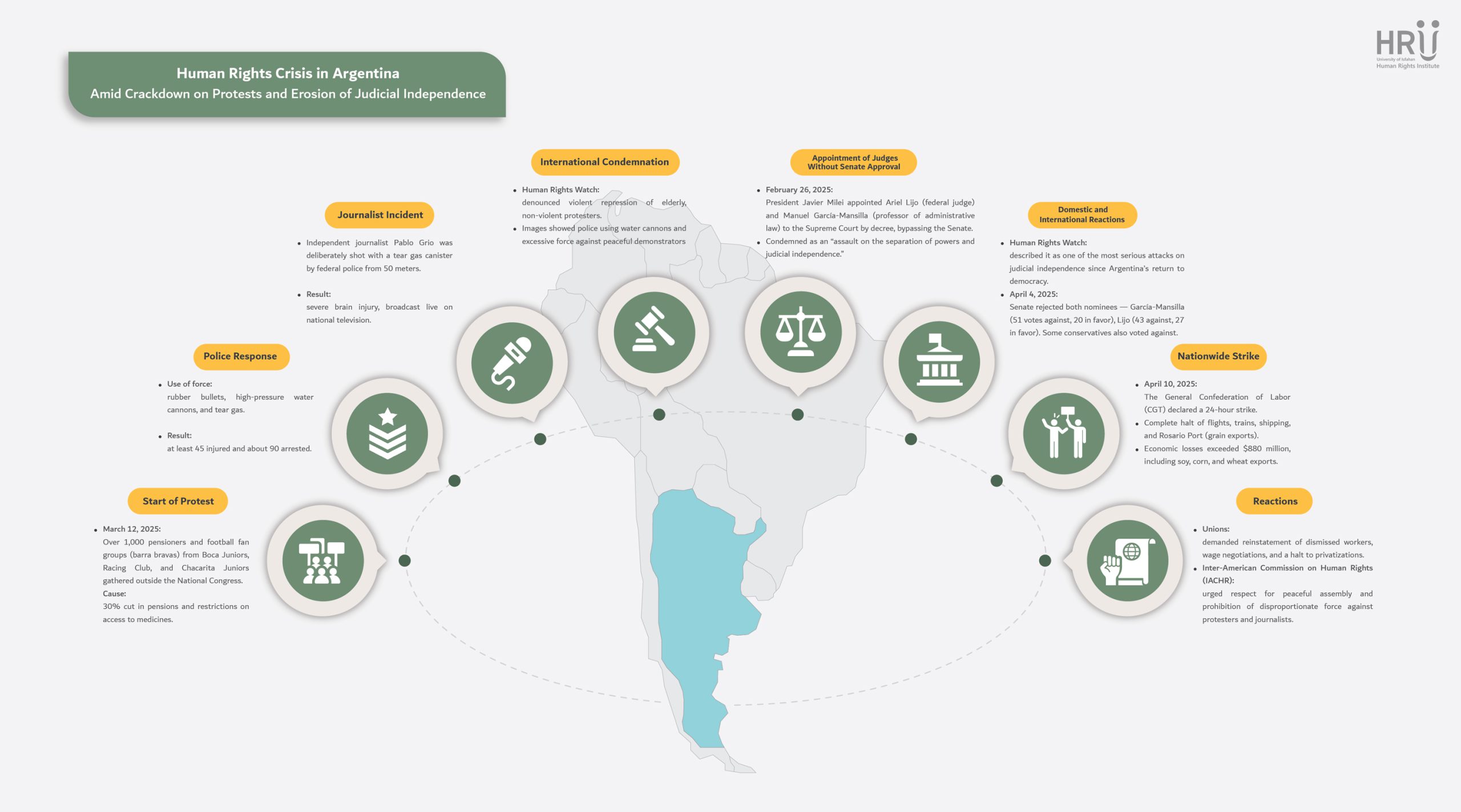
- March 12, 2025: Over 1,000 pensioners and members of football fan groups, known as “barra bravas” from clubs like Boca Juniors, Racing Club, and Chacarita Juniors, gathered peacefully outside the National Congress to protest a 30% reduction in pensions and restricted access to medications. The demonstration was met with excessive police force, including rubber bullets, high-pressure water cannons, and tear gas, resulting in at least 45 injuries and approximately 90 arrests. Notably, a federal police officer deliberately fired a tear gas canister directly at independent journalist Pablo Grio from about 50 meters away, causing severe brain injury. This incident, broadcast live on national television, was analyzed by Human Rights Watch, which identified it as a blatant violation of international standards governing crowd-control equipment. Additional footage depicted violent actions by security forces, such as deploying high-pressure water cannons against predominantly elderly, non-violent protesters. According to the Buenos Aires city government’s official report, at least 25 individuals were injured during these confrontations.
- February 26, 2025: President Milei issued two executive decrees appointing federal judge Ariel Lijo and administrative law professor Manuel García-Mansilla to the Supreme Court without Senate approval. This move was condemned by international bodies as an “assault on the separation of powers and judicial independence.” The appointments bypassed the standard legal procedures and Senate confirmation, prompting legal analysts and human rights organizations to express serious concerns about the erosion of checks and balances. Human Rights Watch described this action as “one of the most serious attacks against the independence of the Supreme Court in Argentina since the return of democracy.” Although these appointments were temporary and required Senate confirmation by November 30, 2025, both nominees were rejected during the April 4, 2025, vote: García-Mansilla received 51 votes against and 20 in favor, while Lijo garnered 43 against and 27 in favor. Significantly, some conservative senators joined the opposition in rejecting the appointments, emphasizing the necessity of adhering to legal protocols and transparency in selecting high-ranking judicial officials.
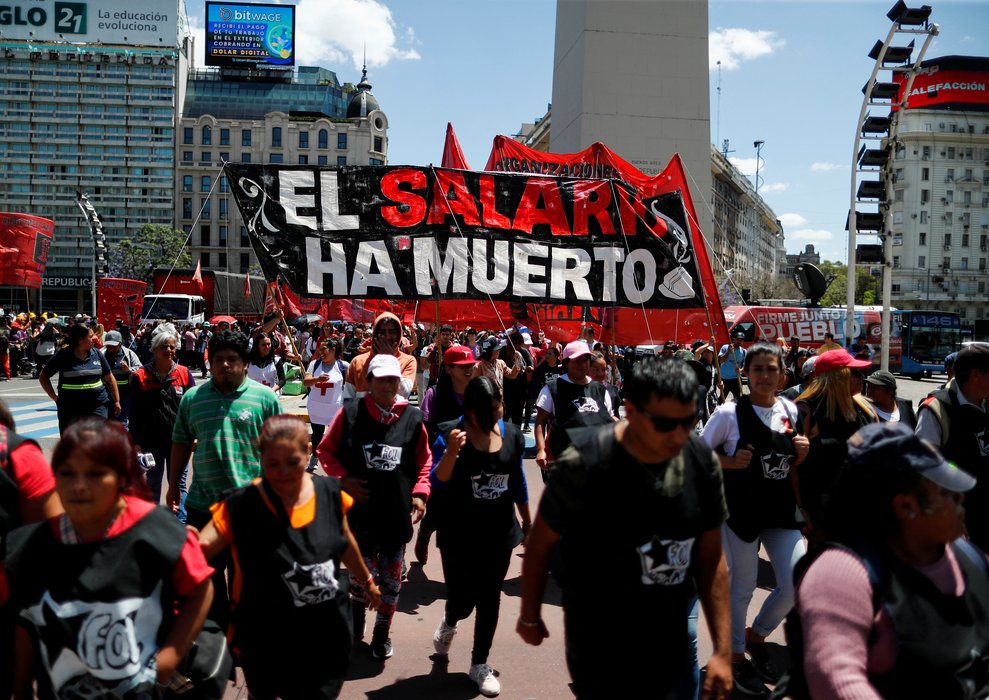
- April 10, 2025: The General Confederation of Labor (CGT) announced a 24-hour nationwide strike, effectively halting all rail, air, and port services, including the crucial grain export hub in Rosario. Supported by over ten major unions—such as those representing railway workers, aviation staff, and port employees—the strike led to the cancellation of hundreds of flights, a complete shutdown of train services, and the suspension of maritime operations. In the capital, city buses operated at minimal capacity, banks and schools closed, and hospitals provided only essential services. At the Rosario port, Guillermo Wade, director of the CAPyM union, confirmed that no ships were permitted to dock or depart, effectively pausing the export of soybeans, corn, and wheat for 24 hours. Economic analyses estimated that this significant disruption to the grain supply chain and transportation services inflicted direct losses exceeding $880 million on the national economy, encompassing declines in railway, port, and public service revenues. Unions issued statements demanding the reinstatement of dismissed workers, the resumption of wage negotiations, and the cessation of privatization plans for state-owned enterprises, including Aerolíneas Argentinas. Héctor Daer, CGT’s Secretary-General, stated, “We cannot stand by as ongoing dismissals occur,” while ATE Secretary-General Rodolfo Aguiar likened the relentless public spending cuts to a “buzzsaw” that must be halted. Public reactions varied: some viewed the strike as a necessary defense of workers’ rights, while others criticized the disruption of emergency services. Internationally, the Inter-American Commission on Human Rights (IACHR) urged the Argentine government to respect the right to peaceful assembly and to refrain from disproportionate use of force against protesters and journalists.
Conclusion
The recent developments in Argentina, particularly actions taken by President Javier Milei’s administration—such as the violent suppression of social protests, the unconstitutional appointment of Supreme Court judges, and the dismissal of labor unions’ demands—highlight an escalating trend of undermining democratic institutions, consolidating power, and egregiously violating fundamental rights. The disproportionate use of force against protesters, including pensioners and journalists, coupled with the disregard for legal procedures in appointing high-ranking judges, effectively challenges the principles of the rule of law and judicial independence. In this context, the Argentine government must immediately cease police violence, ensure adherence to international standards in managing public demonstrations, restore legal and transparent processes within judicial structures, and establish effective dialogue channels with civil institutions and unions. Simultaneously, international human rights organizations are obligated to deploy fact-finding missions and apply diplomatic pressure to compel the government to honor its international commitments and to actively participate in rebuilding the capacity of domestic oversight institutions. Civil society must also play a pivotal role by meticulously documenting violations and strengthening international collaborations to safeguard citizens’ rights and the nation’s democratic frameworks.