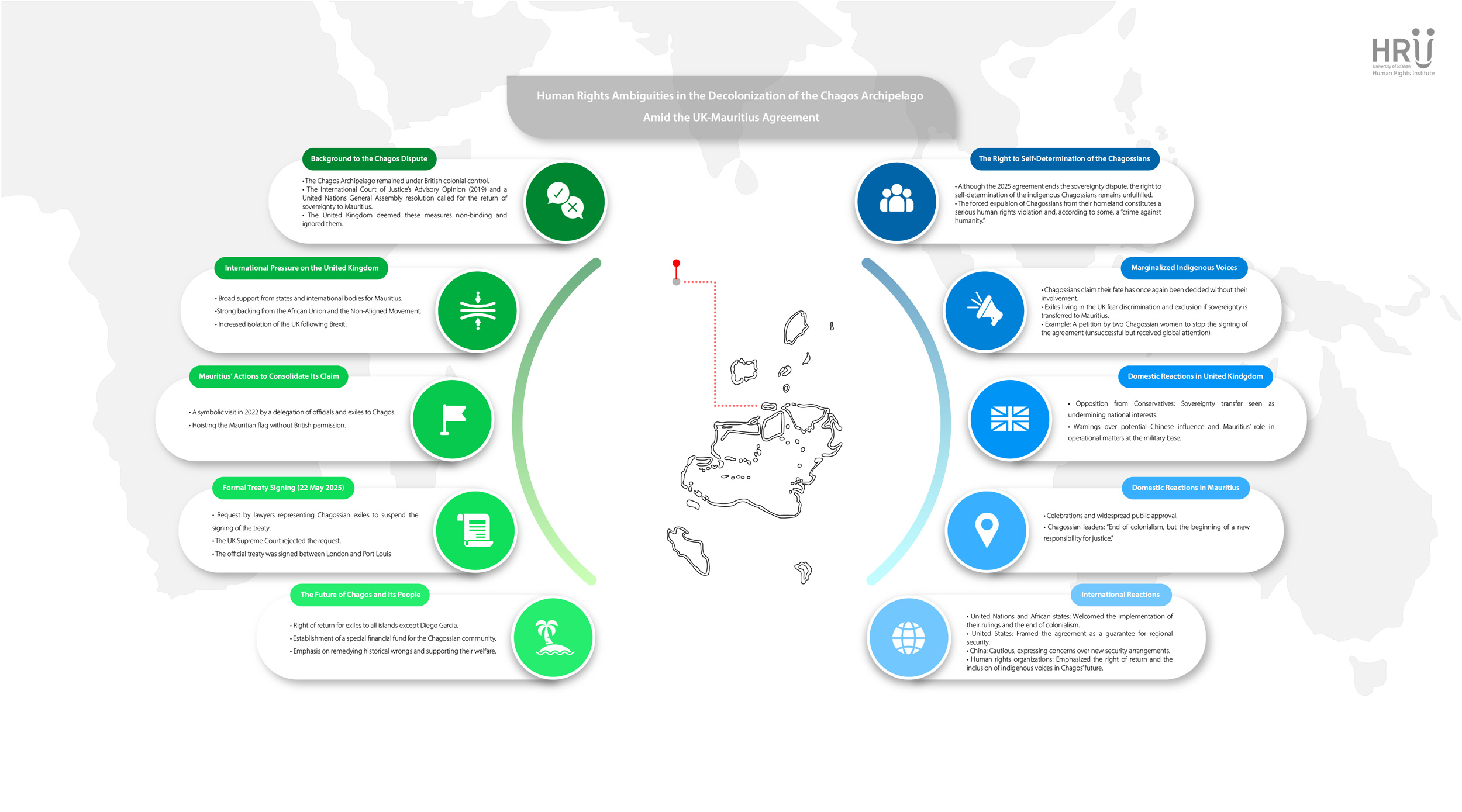
Introduction
The Chagos Archipelago, located in the middle of the Indian Ocean approximately 1,600 kilometers off the eastern coast of Africa, has in recent decades become a focal point of one of the most prominent cases of colonial and human rights disputes. These islands were annexed by Britain in the early 19th century and remained part of colonial Mauritius until 1965. That year, three years prior to Mauritius’ independence, the British government unilaterally detached the Chagos Islands from Mauritius and placed them under direct British control as part of the British Indian Ocean Territory (BIOT). Shortly thereafter, the UK entered into a secret agreement with the United States, granting the U.S. access to Diego Garcia—the largest island of the archipelago—for the construction of a military base.
To pave the way for this installation, from the late 1960s to the early 1970s, the entire indigenous population of the Chagos Islands—known as the Chagossians—was forcibly removed from their homeland. They were deported to Mauritius, the Seychelles, and some were relocated to the UK under promises of citizenship[1]. This forced displacement, affecting between 1,500 and 2,000 individuals, shattered the social fabric of the Chagossian community, severed their ancestral ties to the land, and initiated decades of legal and political struggle for repatriation and restitution.
Since gaining independence in 1968, Mauritius has consistently asserted its sovereignty over the Chagos Islands, denouncing their separation during the colonial period as illegal. On the international stage, the Chagos case has come to be seen as a textbook example of the violation of the right to self-determination. United Nations General Assembly Resolution 1514 (adopted in 1960) explicitly prohibits the dismemberment of colonial territories and affirms the right of peoples to determine their own destiny.
In line with this principle, in 2017 the UN General Assembly requested an advisory opinion from the International Court of Justice (ICJ) regarding the legality of the Chagos-Mauritius separation. The Court’s advisory opinion, issued in February 2019, followed by a General Assembly resolution on May 22, 2019, unambiguously concluded that the decolonization of Mauritius was incomplete due to the non-consensual detachment of Chagos. It further declared that continued British control over the archipelago constitutes a breach of international law[2]. Both documents called on the UK to unconditionally and expeditiously terminate its colonial administration over the Chagos Islands, thus enabling the full realization of the Chagossians’ right to self-determination.
Nevertheless, despite these strong international and legal foundations, the Chagos dispute remained unresolved until recently, and the fate of the Chagossian people continued to be shrouded in uncertainty.
Incidents
In recent years, significant developments unfolded regarding the Chagos dispute, ultimately culminating in a historic agreement between the United Kingdom and Mauritius. Following the ICJ’s advisory opinion and the 2019 UN General Assembly resolution mandating British withdrawal, the UK dismissed both as non-binding and refused to comply. However, London faced increasing diplomatic isolation, particularly after it and the United States lost the General Assembly vote and witnessed overwhelming support for Mauritius from states and international bodies.
The African Union and the Non-Aligned Movement invoked the imperative to end colonialism and strongly endorsed Mauritius’ claims. Simultaneously, many of the UK’s European allies, especially in the post-Brexit context, were reluctant to openly support continued British colonial authority[3].
Amid this shifting landscape, the government of Mauritius took unprecedented steps to assert its sovereignty. Notably, in early 2022, a delegation of Mauritian officials and exiled Chagossians made a symbolic visit to the archipelago (without British authorization) and raised the Mauritian flag on its soil.
Ultimately, in November 2022, the then-Conservative government of the UK, under mounting international pressure, announced the start of formal negotiations with Mauritius concerning the future of Chagos[4]. These talks lasted nearly two years and were accompanied by significant political changes. In Mauritius, national elections brought a new government to power led by Prime Minister Navin Ramgoolam, who called for a reassessment of key terms in the emerging agreement[5]. Meanwhile, in the UK, power shifted to the Labour Party in late 2024, and Keir Starmer became the new Prime Minister. Starmer prioritized continuing negotiations with Mauritius.
In October 2024, Starmer and Ramgoolam issued a joint statement announcing that a “principled agreement” had been reached, in which the UK declared its readiness to transfer sovereignty over the Chagos Islands to Mauritius. The joint statement described the agreement as “a historic moment in the relationship between the two nations and a testament to their commitment to the peaceful resolution of disputes and the rule of law.”
The leaders further emphasized that alongside the transfer of sovereignty, “the long-term, secure, and effective operation of the existing base on Diego Garcia—which plays a vital role in regional and global security—must be guaranteed[6].” Thus, the primary condition for this agreement was the continued presence of U.S. and UK military forces on Diego Garcia.
To this end, both London and Port Louis agreed to maintain the joint base in Chagos, with Mauritius consenting to a long-term lease of Diego Garcia to the UK and the United States. In early 2025, coordination with the new U.S. administration was completed. Then-President Donald Trump publicly supported the deal, calling it vital for Western security interests.
Finally, on May 22, 2025, the UK and Mauritius held the official signing ceremony for the treaty in London. This historic moment came after a last-minute legal challenge: in the early hours of the signing day, lawyers representing two exiled Chagossians petitioned the British High Court to suspend the treaty’s signing. A temporary injunction was granted. However, just hours later, Justice Martin Chamberlain overturned the injunction, arguing that further delays could significantly harm British interests[7].
With the legal obstacle removed, officials from London and Port Louis signed and exchanged the treaty. The new treaty contains key provisions that formally end the five-decade territorial dispute over Chagos. Under the agreement, the UK relinquishes full sovereignty over the archipelago to Mauritius. In return, the Mauritian government agrees to lease Diego Garcia to the UK and U.S. for 99 years, ensuring uninterrupted operation of the strategic military base.
According to the UK government, London will pay Mauritius approximately £101 million annually for the long-term lease—amounting to a cumulative sum of nearly £3.4 billion over the 99-year period. Prime Minister Starmer described this payment as a necessary cost to preserve a vital base in the global fight against terrorism and monitoring threats in sensitive regions.
On the other side, Prime Minister Ramgoolam hailed the treaty as a “great victory for the Mauritian nation,” declaring that the country had achieved full decolonization with the recovery of Chagos. He emphasized that one guiding principle of the negotiations was that “Chagossians must once again be able to live in their islands[8].”
The agreement text specifies that Mauritius is free to implement a resettlement program for exiled Chagossians across all islands of the archipelago—except Diego Garcia. Furthermore, both parties committed to measures aimed at redressing past wrongs and supporting Chagossian well-being, including the creation of a special financial fund dedicated to the Chagossian community[9].
Challenges and Responses
- The Right to Self-Determination of the Chagossians
Although the recent agreement marks a diplomatic breakthrough and an apparent resolution to the sovereignty dispute, it still raises serious human rights concerns. At the core of these concerns lies the issue of the Chagossians’ rights—particularly their right to self-determination—which, according to critics, was not fully realized during the UK-Mauritius negotiations.
Historically, the Chagossian people have suffered grave violations of human rights: their forced mass expulsion from their ancestral homeland and the lifelong denial of their return not only constituted blatant breaches of fundamental rights (including the right to reside in one’s homeland), but have also been described by some international bodies as amounting to crimes against humanity[10].
In a detailed 2023 report marking the 50th anniversary of the Chagossians’ exile, Human Rights Watch denounced the conduct of both the British and U.S. governments as “ongoing colonial crimes,” from the forced displacement to the persistent obstruction of return. The organization called for full reparations and recognition of the Chagossians’ right of return. The report also warned that ongoing UK-Mauritius talks were progressing without meaningful participation of the Chagossian people and urged that their rights to return and redress be explicitly guaranteed in any final settlement[11].
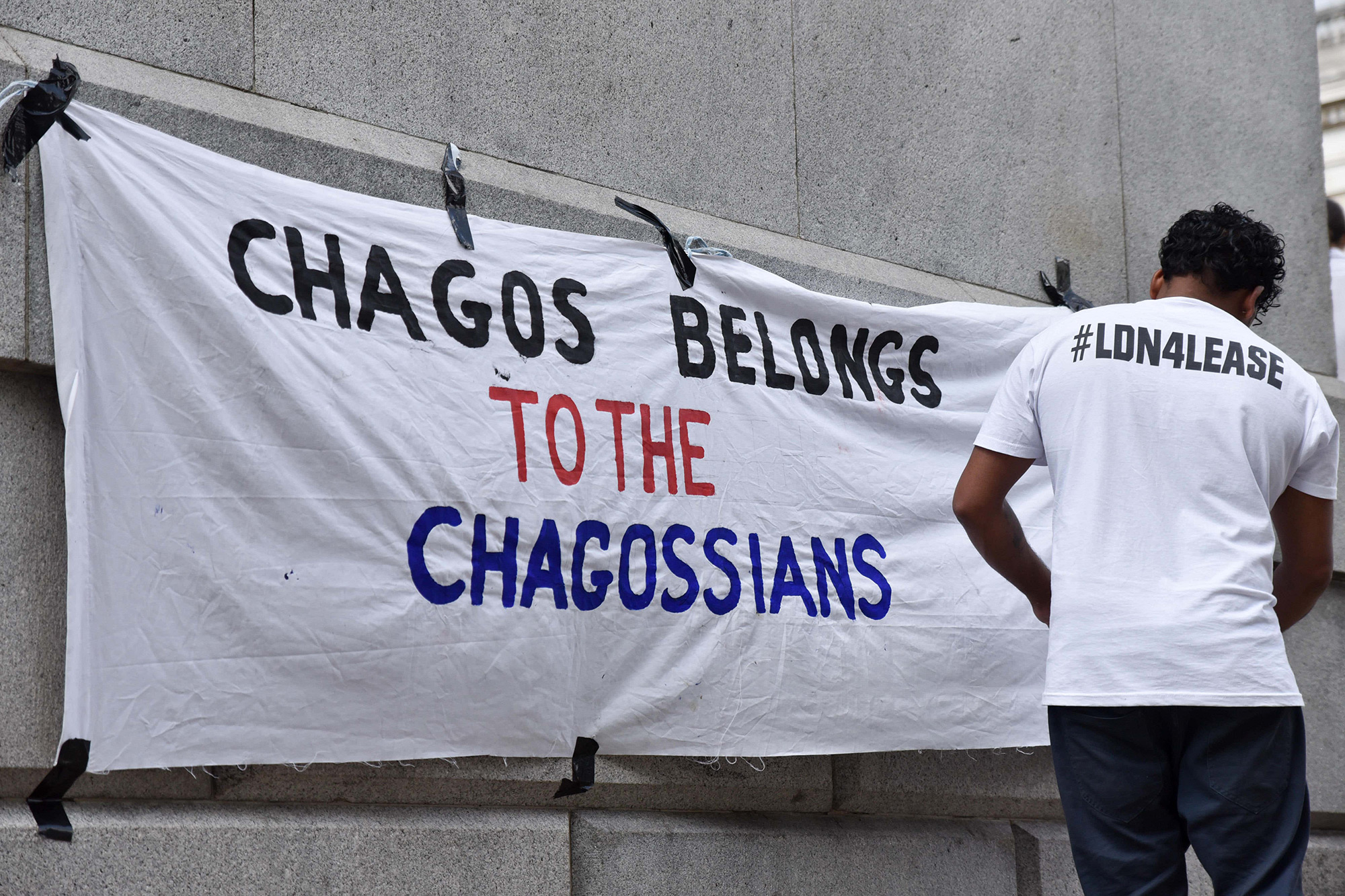
These criticisms reflect a deep-rooted concern long voiced by many Chagossians themselves: that once again, the future of their ancestral homeland is being decided without their presence or consent. In their view, just as their right to self-determination was denied in the 1960s through their forced separation from Mauritius and displacement from their homes, the 2025 treaty similarly excludes them from meaningful participation.
Two Chagossian women—Bernadette Dugasse and Beatrice Pompey—who sought a court injunction to stop the treaty, stated in their petition to the UK High Court that “the Chagossian people, despite being the indigenous population of the territory, have been unlawfully denied a voice in its future.” They also raised concerns about the Mauritian government’s potential treatment of Chagossians, noting that many UK-based Chagossians are not Mauritian citizens and might face discrimination or serious barriers to return once sovereignty is transferred.
Although their legal challenge was ultimately unsuccessful and the High Court cleared the path for the treaty’s signing, their protest resonated widely. Following the ruling, one of the women stated, “Today is a very, very sad day,” while vowing, “We will not give up.” She added, “We don’t want to surrender our rights and hand them over to Mauritius—we are not Mauritian[12].”
Her statement reflects a distinct Chagossian identity. Many within the community regard themselves as a separate people and some have even openly rejected Mauritian sovereignty, seeking independent status to exercise self-determination as an indigenous nation.
Nevertheless, for decades, the demands and perspectives of the Chagossian people have been consistently sidelined by the powers deciding their fate—and there are growing concerns that their voices will continue to be marginalized in the future.
- Domestic Reactions
In the United Kingdom, the signing of the treaty provoked sharp criticism from opposition politicians. The Conservative Party, in opposition at the time, condemned the agreement as detrimental to national interests, arguing that Prime Minister Starmer’s government had agreed to pay for relinquishing British-controlled territory. Some Conservative critics warned that ending British sovereignty over Chagos could expose the UK to Chinese influence, given Mauritius’ close ties with Beijing.
Security figures, including former Security Minister Tom Tugendhat, voiced concern that under the treaty, the UK is obliged to inform Mauritius of any operations conducted from the Diego Garcia base. This, they argued, effectively gives Mauritius an operational stake in the base’s affairs—something they regarded as a worrying shift with serious implications for Britain’s military capabilities in the region[13].
By contrast, reaction in Mauritius was overwhelmingly positive and celebratory. Local media and officials hailed the treaty as the end of a colonial chapter and celebrated the restoration of national territorial integrity after decades of diplomatic struggle[14]. Even before the official signing, upon news of the agreement reaching Mauritius, groups of Chagossians living near Port Louis gathered to mark the occasion with symbolic celebrations.
Olivier Bancoult, leader of the Chagos Refugee Group and himself a descendant of the first generation of exiles, described the signing day as “a historic day.” He remarked: “This agreement marks the end of colonial occupation, but it must not be the beginning of a new silence. Alongside Mauritian sovereignty, there must now be clear guarantees for the rights of the Chagossians— for memory, for justice, and above all, for the future[15].” His words reflect that a segment of the Chagossian community—particularly those living in Mauritius—welcomed the end of British rule and looked forward, albeit painfully, to the possibility of returning to their homeland.
- International Reactions
On the international stage, the UK-Mauritius agreement was largely welcomed with cautious optimism, although it also prompted some concerns. The United Nations and African states that had long supported Mauritius viewed the deal as a step toward implementing past resolutions and a victory for multilateralism. As Mauritius’ ambassador to the UN stated, the outcome showed that global resolve—despite the pressures of powerful states—had succeeded in dismantling colonial remnants in Africa.
The United States, as the primary beneficiary of the Diego Garcia military base, expressed satisfaction with the stabilization of the situation. U.S. Secretary of State Marco Rubio praised the agreement, noting that it “guarantees the long-term, stable, and effective operation of the joint U.S.-UK military facilities on Diego Garcia.” The White House also revealed that President Trump had previously expressed his strong support for the agreement during a meeting with Prime Minister Starmer[16].
China, which has long championed the Chagos decolonization issue in international forums, adopted a cautious stance. While welcoming the end of British colonial rule, Beijing expressed concern over any new security arrangements in the Indian Ocean and signaled its wariness about the military implications of the agreement[17].
International human rights organizations focused their reactions on the human dimension of the issue. Both Amnesty International and the United Nations Human Rights Council stressed the importance of ensuring the Chagossians’ right of return and reparations during the agreement’s implementation. UN Special Rapporteurs also emphasized the necessity of involving the Chagossians themselves in future decisions affecting their homeland.
Overall, while there was broad global support for ending colonial rule in Chagos, all parties appeared to be closely watching how the treaty would be executed—especially to determine whether it would bring about historical justice for the Chagossians. The UN General Assembly had previously stated that, because Mauritius’ decolonization process in the 1960s had not been conducted in accordance with the right to self-determination, Britain’s continued presence in Chagos constituted a wrongful act. It had urged London to cooperate with Mauritius to facilitate the resettlement of Mauritian citizens of Chagossian descent on the islands[18].
Now that the UK has finally agreed to cooperate, the faithful implementation of the Chagossians’ rights will be the decisive metric by which the international community will judge this agreement.
Conclusion
The 2025 treaty between the United Kingdom and Mauritius can be regarded as a turning point in the turbulent history of the Chagos Islands—a treaty that, on one hand, ends decades of colonial conflict and diplomatic discord, and on the other, raises complex questions from the perspective of human rights and international law.
From an optimistic standpoint, the agreement marks a triumph for the principles of decolonization and self-determination within the international system. The global community succeeded in extricating one of Africa’s last remaining colonial territories from the grip of an imperial power and restoring territorial sovereignty to its rightful state. Moreover, the treaty’s inclusion of mechanisms for the resettlement and benefit of Chagossians—albeit belated—signals overdue recognition of the suffering endured by this displaced indigenous community.
However, the ultimate fate of the Chagossian people still hinges on future actions. The agreement will only be deemed a truly just and comprehensive solution if it results in the full realization of their rights: including the right to freely return to their homeland, obtain reparations, and enjoy equal citizenship rights on their native soil. The implementation of a resettlement program on the islands not occupied by the military base will serve as a litmus test for the Mauritian government’s sincerity—demonstrating whether it views Chagossian return not as a concession but as a right.
In this process, the agency and advocacy of the Chagossians themselves—dispersed across the UK, Mauritius, Seychelles, and beyond—remains a key factor. After decades of silence and marginalization, they insist that their voices must now be heard and that they must be allowed to participate in shaping the future of their ancestral homeland.
From a geopolitical perspective, the continued presence of a foreign military base on Chagossian soil for the next century is a stark reminder that the strategic interests of great powers still cast a long shadow over the destiny of these islands. While sovereignty has formally changed hands, the enduring military reality underscores that the Chagos are not yet fully free of the legacy of the Cold War and global rivalries.
Altogether, the Chagos case carries important lessons for international law and anti-colonial movements. The determined resistance of a small nation—supported by multilateral institutions—eventually prevailed over a longstanding imperial power, reaffirming the weight of self-determination and territorial integrity in the balance of international norms.
Yet true justice can only be said to prevail if the rights of those who have been exiled from their land for decades are fully restored. For now, the world’s attention turns to the implementation phase of the treaty: will the states involved fulfill their pledges and begin to heal the wounds of the past?
As one Chagossian representative in the UK poignantly stated, “A treaty that is concluded without the voice of the indigenous people runs the risk of perpetuating the injustices of the past for generations to come.” Thus, the story of Chagos remains an unfinished chapter—one that international observers will continue to follow closely to ensure that the long-denied right to self-determination of the Chagossians is finally realized.
References
[1] Bowcott, O. (2019, February 25). UN court rejects UK’s claim of sovereignty over Chagos Islands. The Guardian. From: https://www.theguardian.com/world/2019/feb/25/un-court-rejects-uk-claim-to-sovereignty-over-chagos-islands
[2] International Court of Justice. (2019, February 25). Legal consequences of the separation of the Chagos Archipelago from Mauritius in 1965. ICJ. From: https://www.icj-cij.org/case/169
[3] Bowcott, O., & Borger, J. (2019, May 22). UK suffers crushing defeat in UN vote on Chagos Islands. The Guardian. From: https://www.theguardian.com/world/2019/may/22/uk-suffers-crushing-defeat-un-vote-chagos-islands
[4] Rathore, R. (2025, May 23). Where are the Chagos Islands, what is the deal between UK and Mauritius, and why it is a positive move for India: Explained. OpIndia. From: https://www.opindia.com/2025/05/where-are-chagos-islands-what-is-the-deal-between-uk-and-mauritius-and-why-india-supports-it
[5] Muvija, M., & Holden, M. (2025, May 22). UK signs Chagos deal with Mauritius to seal future of US-UK air base. Reuters. From: https://www.reuters.com/world/uk/uk-set-sign-deal-ceding-sovereignty-chagos-islands-mauritius-2025-05-22
[6] Harding, A. (2024, October 3). UK will give sovereignty of Chagos Islands to Mauritius. BBC News. From: https://www.bbc.com/news/articles/c98ynejg4l5o
[7] Radio Farda. (2025, May 22). The United Kingdom signed an agreement to transfer sovereignty of the Chagos Islands to Mauritius; Diego Garcia remains under a 99-year lease. Radio Farda. From: https://www.radiofarda.com/a/uk-signs-chagos-deal-with-mauritius-to-seal-future-of-us-uk-air-base/33421589.html
[8] Francis, S., & Whannel, K. (2025, May 22). UK signs £101m-a-year deal to hand over Chagos Islands. BBC News. From: https://www.bbc.com/news/articles/c9914ndy82po
[9] Demony, C., & Makori, B. (2024, December 10). Chagossians want say as UK-Mauritius deal faces fresh scrutiny. Reuters. From: https://www.reuters.com/world/chagossians-want-say-uk-mauritius-deal-faces-fresh-scrutiny-2024-12-10
[10] Brown, D. L. (2023, February 15). Human Rights Watch demands reparations from Britain, U.S. for exiling Chagos islanders. The Washington Post. From: https://www.washingtonpost.com/nation/2023/02/15/human-rights-watch-report-reparation-chagos-diego-garcia/
[11] Human Rights Watch. (2023, February 15). That’s when the nightmare started: UK and US forced displacement of Chagossians and ongoing colonial crimes. Human Rights Watch. From: https://www.hrw.org/report/2023/02/15/thats-when-nightmare-started/uk-and-us-forced-displacement-chagossians-and
[12] Hui, S. (2023, May 3). Displaced Chagos islanders fear they will never go home after a UK-Mauritius deal. AP News. From: https://apnews.com/article/chagos-britain-mauritius-chagossians-97e1acb6d1accbb0fb65d08357595e08
[13] The Guardian Politics Live Blog. (2024, October 3). UK politics: Tom Tugendhat suggests Chagos Islands deal could lead to China establishing base there – as it happened. The Guardian. From: https://www.theguardian.com/politics/blog/live/2024/oct/03/keir-starmer-angela-rayner-donations-labour-conservatives-uk-politics-news-live
[14] Financial Times. (2025, May 22). UK to pay £101mn a year under deal to hand over Chagos Islands to Mauritius. Financial Times. From: https://www.ft.com/content/2402978e-cf62-4a1e-8a0c-8bb85af85d8c
[15] Trapnell, O. (2025, May 25). Chagossians flee to Britain en masse after Keir Starmer hands over their homeland to Mauritius. GB News. From: https://www.gbnews.com/news/chagos-deal-chagossians-flee-britain-keir-starmer-mauritius
[16] Al-Kassab, F. (2025, May 22). The U.K. hands Chagos Islands over to Mauritius but says it will secure a U.S. base. NPR. From: https://www.npr.org/2025/05/22/g-s1-68461/uk-chagos-islands-mauritius-diego-garcia-us-military-base
[17] Diver, T. (2025, May 16). Chagos security fears as China cosies up to Mauritius. The Telegraph. From: https://www.telegraph.co.uk/politics/2025/05/16/chagos-security-fears-as-china-cosies-up-to-mauritius
[18] UN Press. (2019, May 22). General Assembly welcomes International Court of Justice opinion on Chagos Archipelago. United Nations. From: https://press.un.org/en/2019/ga12146.doc.htm