

Introduction
Germany, as a prominent European actor that claims commitment to democratic values and human rights, has long played an active role in shaping and promoting international norms. However, its conduct regarding the Israeli-Palestinian conflict—particularly in light of the systematic violations of human rights in the occupied territories—raises serious and fundamental questions about the sincerity, consistency, and depth of Germany’s human rights commitments. This report explores various dimensions of Germany’s support for Israel and its implications for fundamental rights, including freedom of expression, freedom of assembly, and the principle of non-discrimination.
Incidents
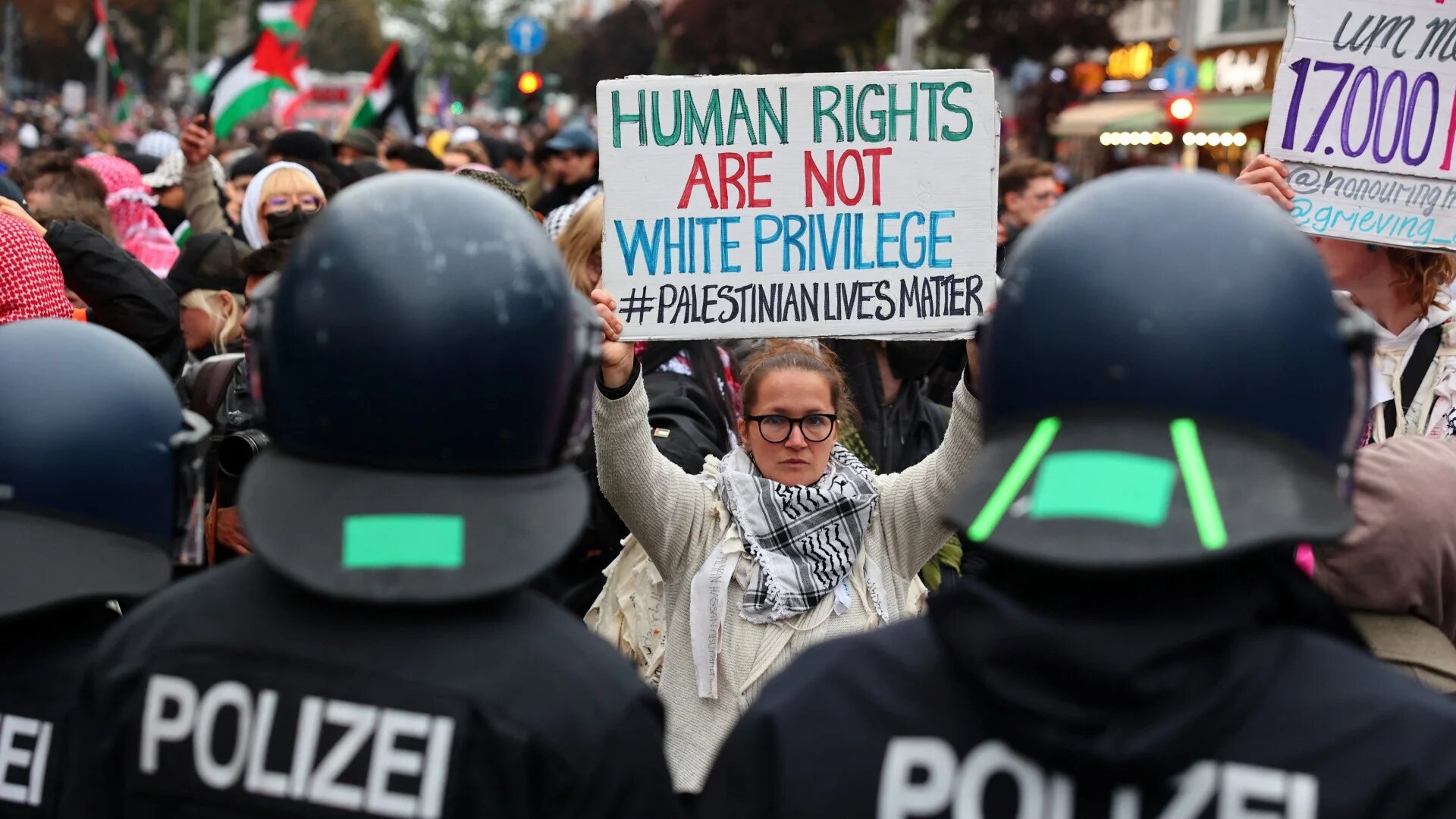
- Symbolic Restrictions and Suppression of Fundamental Freedoms: One of the most visible instances of Germany’s human rights violations is the imposition of symbolic yet deeply consequential restrictions in the public sphere. Since October 2023, the majority of pro-Palestinian demonstrations have been officially banned in major German cities, and the Palestinian flag has been prohibited in many protest settings. According to Middle East Monitor, in numerous instances, demonstrations have been canceled with less than an hour’s notice, and the police have cited “threats to public order” to prevent gatherings. These measures contravene Article 19 of the International Covenant on Civil and Political Rights (ICCPR), which unequivocally guarantees the right to freedom of expression—even regarding political and controversial issues. Curtailing peaceful protests and imposing security or judicial mechanisms against activists effectively results in the suppression of legitimate dissent.
- Ideological Labeling and Character Assassination of Critics: In recent years, German political and media institutions have adopted an aggressive posture against academics, journalists, and activists who have highlighted Israel’s human rights violations. Many of these individuals have been labeled as “antisemitic.” For instance, in Spring 2024, Ghassan Hage, a prominent international scholar at the Max Planck Institute, was dismissed from his position over allegations of antisemitism—despite the fact that his critique was grounded in official reports by the International Criminal Court and the United Nations Human Rights Council. As reported by outlets such as Al Jazeera, any sharp criticism of Israeli policies is swiftly equated with antisemitism. This trend, referred to as a strategy of discursive delegitimization, effectively deters universities and media from engaging with human rights documentation. Such labeling constitutes a blatant misuse of anti-discrimination discourse to silence critics and restrict academic freedom.
- Selective Approach and Double Standards: While Germany openly condemns press restrictions and minority rights violations in countries like Turkey and Iran, it refrains from issuing firm criticism of Israel’s expansion of settlements and military aggression in the West Bank and Gaza—even in the face of well-documented evidence of war crimes or acts that may constitute genocide, as defined under Article 6 of the Rome Statute. This contradictory conduct undermines the fundamental principles of the UN Charter and customary international law, thereby damaging Germany’s global reputation as a principled defender of human rights.
- Systematic Support for Israel Despite Global Concerns: Germany remains one of the main suppliers of advanced weaponry to Israel, playing a critical role in sustaining the regime’s military capabilities. According to SIPRI data, Germany accounted for nearly 30% of Israel’s major arms imports between 2019 and 2023—most notably including Sa’ar 6-class corvettes and armored vehicle engines used in operations in Gaza. Furthermore, Reuters reports that in 2023 alone, the German government authorized arms exports to Israel valued at €326.5 million. This occurred despite repeated warnings by organizations such as Human Rights Watch and Amnesty International, which have accused Israel of apartheid, systemic discrimination, and crimes against humanity. Germany’s disregard for these warnings reflects a prioritization of geopolitical and security interests over humanitarian principles and arguably constitutes a violation of the Responsibility to Protect (R2P) doctrine.
- Coordinated Media Silence and Public Opinion Management: A significant portion of Germany’s mainstream media engages in either self-censorship or organized censorship when reporting on developments in Palestine. This silence deprives the public of accurate and unbiased information, weakens public discourse, obstructs global empathy, and shields Israel from international pressure. According to a 2023 study by the Al Jazeera Institute, most coverage of the conflict by German mainstream media either reflects self-censorship or strictly adheres to official Israeli narratives. Furthermore, analyses by Journalistik.online confirm that this pattern has been repeatedly observed during major events such as the October 2023 war, effectively erasing Palestinian voices from top-tier media priorities.
Germany’s stance toward the Palestinian crisis illustrates a clear “human rights blind spot” in its foreign policy—one in which strategic interests and historical obligations have supplanted universal human rights principles. This silence—or at times complicity—in the face of widespread human rights abuses in Palestine undermines Germany’s credibility as a defender of human dignity and contributes to the erosion of trust in the international legal order. Ultimately, it is imperative that civil society, human rights organizations, and the academic community expose these contradictions and hold the German government accountable, demanding transparency, responsibility, and unconditional adherence to international human rights standards.


