

Introduction
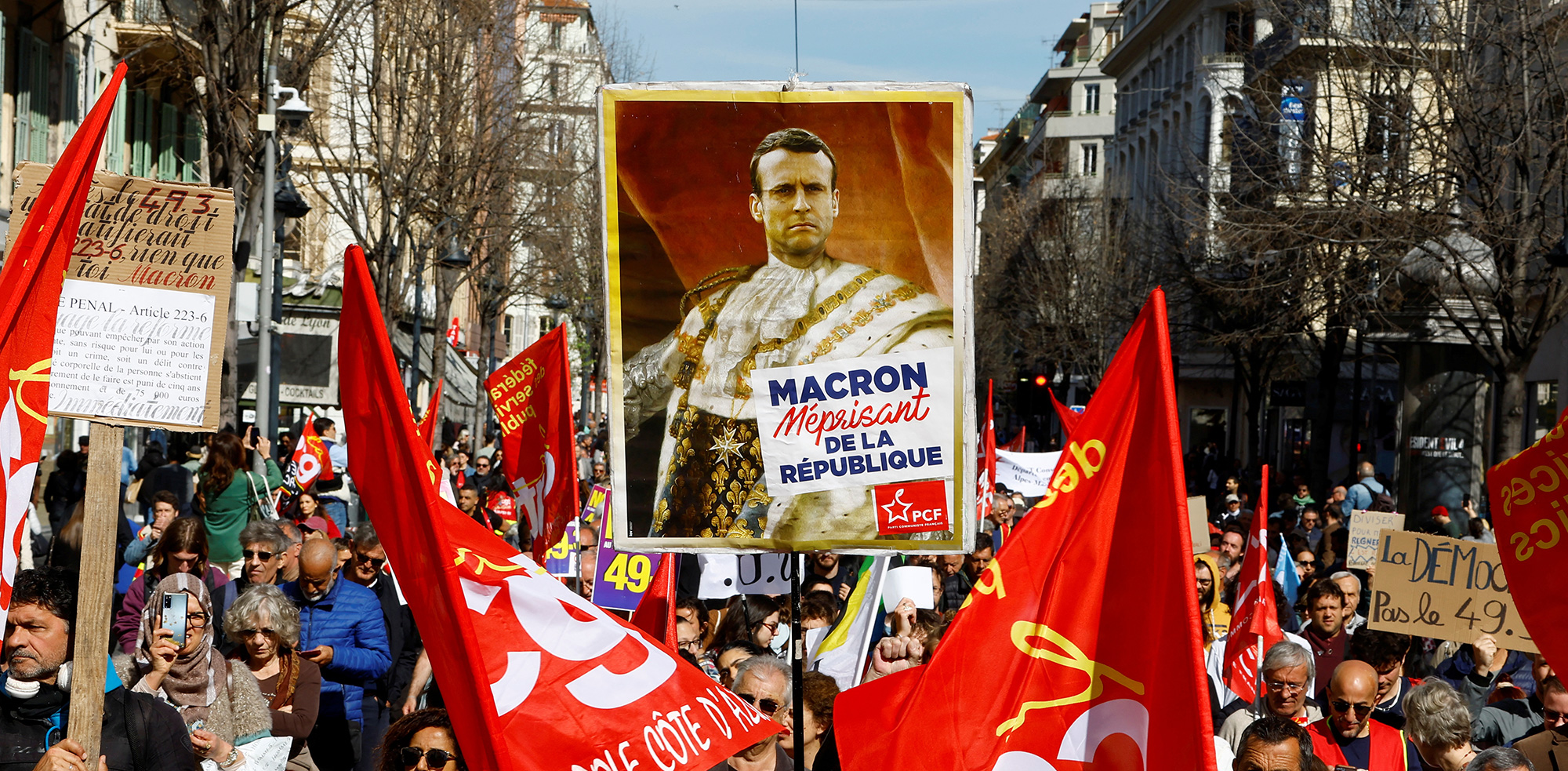
While France maintains a prominent position in the international order as a founding member of the European Union and a permanent member of the United Nations Security Council, its economic situation has become increasingly precarious. According to official reports, the total public debt of France has reached approximately €7 trillion from the beginning of 2025 to the time of writing, placing it among the most indebted countries in the European Union. This amount represents around 114% of the country’s GDP. Alongside this, a chronic budget deficit—stemming from years of fiscal mismanagement, global crises, and economic stagnation—has resulted in cuts to public services, mounting social dissatisfaction, and widespread protests.
This economic crisis has manifested in various aspects of social life: massive demonstrations by farmers and the “Yellow Vests” movement, the government’s inability to sufficiently support retirees, stagnant wages failing to keep pace with inflation, and the controversial decision to raise the retirement age, all contributing to a surge in public discontent. Meanwhile, the French government continues to allocate significant funds beyond its borders, prompting severe criticism from political and civil sectors alike. These expenditures include development aid to impoverished nations, historical reparations to former colonies, and France’s share of NATO’s budget. However, with NATO’s rising military expenditures due to the ongoing Russia-Ukraine war and a decline in U.S. financial participation, France now bears a heavier financial burden. According to some reports, France’s contribution to NATO’s defense budget in 2025 has increased significantly compared to previous years, placing additional strain on the national budget. As a result, many citizens and civil society organizations have begun to question the government’s resource prioritization policies. Critics ask why a country grappling with profound domestic crises should continue to fund international projects while unresolved issues persist at home. This dichotomy between international commitments and internal needs has become one of the central challenges of French economic policymaking in 2025.
Incidents
- Austerity Measures
In recent years, the French government has faced significant financial and budgetary challenges, with an annual budget deficit exceeding 5%, the highest in the Eurozone. Efforts have been underway to gradually reduce this deficit to meet the EU’s threshold of 3% of GDP. One major strategy involves cutting public expenditures to achieve budgetary balance. Accordingly, in July 2025, Prime Minister François Bayrou proposed a plan to reduce the deficit to €43 billion by 2026, with the following measures:
- Elimination of 3,000 civil service jobs by 2027 without replacement;
- Abolishment or consolidation of 1,000 to 1,500 governmental positions;
- Capping government healthcare spending at €5 billion;
- Reforms to unemployment insurance and pension schemes;
- Elimination of two national holidays (Victory Day and Easter Monday) to increase productivity;
- Reductions in regional and local expenditures, excluding defense spending[1].
These and similar initiatives aimed at saving the French economy from insolvency are placing significant pressure on wide segments of society, particularly workers and pensioners, as many essential government-funded services are being “frozen” or suspended. As a result, despair is mounting among day laborers, many of whom view these measures not as reforms but as a form of attrition[2]. Beyond their socioeconomic impact, the austerity plans may also jeopardize French democracy: if the Prime Minister fails to secure parliamentary approval for the budget, he may resort to invoking constitutional provisions that override parliamentary debate[3]. France thus finds itself at a crossroads between upholding its stated values of democracy and human rights, and averting bankruptcy and financial collapse. The Cour des Comptes (Court of Audit) has warned that France must realign its finances in 2025 or face severe future market backlash[4].
- Increase in Defense Budget
Despite the aforementioned financial crisis, on July 14, 2025, President Emmanuel Macron announced—during a speech to French soldiers at the Bastille Day celebrations—that France’s military budget will reach €64 billion by 2027, three years ahead of schedule. Specifically, €3.5 billion will be added in 2026, and another €3 billion in 2027[5]. This development stems from the NATO summit held in The Hague in June 2025, during which all member states pledged to increase their defense contributions to 5% of GDP by 2035 (3.5% for military expenses and 1.5% for infrastructure). As a key NATO member perceiving the Russian threat as acute, France has committed to meeting this target[6].
- Foreign Aid Expenditures
France ranks as the fifth-largest global donor of official development assistance (ODA)[7], allocating substantial annual funds for bilateral and multilateral aid. These grants, mostly non-repayable, support sectors such as healthcare, education, and environmental protection. While often justified as part of France’s human rights commitments, such aid faces mounting scrutiny at home.
Firstly, critics argue that in times of internal fiscal constraints, every euro should be prioritized for domestic welfare[8]. Secondly, a significant portion of this aid is directed toward former colonies—some of which are notorious for human rights abuses—raising ethical concerns, particularly when France also provides military support to sustain these regimes. Thirdly, questions arise about the geographic concentration of aid in countries such as Niger, Senegal, Burkina Faso, Mali, Lebanon, and Côte d’Ivoire, casting doubt on the aid’s neutrality. Finally, while the aid is framed as humanitarian, many proponents see it as a tool for asserting France’s global leadership[9].
It is worth noting that France has, in fact, reduced its development aid. The 2025 budget shows a 39% cut—amounting to €2.3 billion. Thus, while the government faces domestic backlash for external spending, it is also criticized internationally for failing to meet its commitments. In June 2023, during a global development summit, France pledged to support COVID-19-affected and climate-vulnerable countries but has since failed to fulfill these promises[10]. Many believe France is caught between isolationist nationalism and preserving its international prestige.
Challenges and Responses
- Exaggeration of Threats
One of the most contentious issues surrounding France’s foreign expenditures is the perceived exaggeration of threats. Despite its strained financial conditions, the French government has chosen to cut social spending while increasing NATO’s military budget—justifying this shift by amplifying the threat posed by Russia. In early 2025, France accused Russia of a decade-long campaign of cyberattacks, ranging from the 2015 hijacking of a French TV signal by “ISIS” to the 2017 leak of President Macron’s emails[11]. The government has labeled both Russia and China as systematic cybersecurity threats[12]. Such portrayals serve to rationalize increased military spending despite France’s economic woes.
- Domestic Reactions
The austerity measures and simultaneous military spending increases under President Macron and Prime Minister Bayrou have faced criticism from across the political spectrum. The far-right National Rally party has declared any tax hikes on pensioners as a red line. Even left-leaning parliamentarians aligned with the Prime Minister have expressed concerns, arguing that the budget cuts unfairly target low-income families[13].
The French Communist Party issued a harsh statement via its General Secretary’s official website, denouncing the government’s plans. The statement questioned why corporate profits and the wealth of major capitalists were not being used to address economic challenges and fund defense initiatives, instead of burdening the poor. It cited the scandal of a €211 billion subsidy to multinational corporations and an additional €6.7 billion for arms manufacturers in 2026, questioning how long France would continue to pursue neoliberal policies aligned with the Trump-era agenda in Europe[14].
- International Reactions
In a commentary titled “Europe Does Not Have to Choose Between Guns and Butter—There Is Another Way,” The Guardian criticized the reduction of government social obligations in France and other European countries in pursuit of NATO’s financial and military goals. The article advocated taxing corporations and the wealthy instead of slashing social spending, warning that sacrificing the welfare state for military power would lead to repeating historical mistakes. The authors argued that the success of “Keynesian militarism” in Europe’s past stemmed not from choosing between guns or butter, but by securing both simultaneously—ensuring military preparedness along with public support during conflict[15].
Greek economist Yanis Varoufakis, in an analytical piece titled “The Economics of Europe’s Descent into Warmongering,” examined NATO’s rising defense budgets. He argued that the EU is no longer a peace project but rather a fully militarized one, orchestrated under U.S. influence. According to him, the 2008 financial crisis was a missed opportunity to reform the economic structure. Instead, moderate governments like France pursued money-printing for the rich and austerity for the poor, thereby undermining EU legitimacy. He contended that France’s compulsory purchase of tanks and other military gear only enriched arms manufacturers without enhancing European security—labeling the €2.7 trillion already spent as wasteful madness[16].
Conclusion
France has grappled with serious economic troubles in recent years, particularly since the 2008 global financial crisis. Various administrations have attempted to address structural crises through measures such as reducing public expenditure, raising taxes, and shifting fiscal burdens onto vulnerable groups. While these policies aim to preserve financial stability, they have consistently sparked public backlash, union protests, and sharp criticism from economists.
One of the most contested aspects of government spending is the allocation of funds to foreign assistance: from NATO defense contributions to international development programs and historical reparations to former colonies. French public opinion increasingly views these expenditures with skepticism—especially when coupled with domestic social service cuts.
Despite France’s human rights rhetoric, the government has not only reduced its aid but has also used the post-Ukraine war narrative to justify ramping up its defense budget and aligning with NATO’s strategic objectives. This dual-track policy raises serious questions about the government’s true priorities and its international obligations.
References
[1] Reuters. (2025, July 15). France’s belt-tightening plan to avoid being ‘crushed’ by mounting debt. Reuters. From: https://www.reuters.com/world/europe/frances-belt-tightening-plan-avoid-being-crushed-by-mounting-debt-2025-07-15/
[2] The Times of India. (2025, July 18). Working more for less: France’s austerity push sparks outrage. The Times of India. From: https://timesofindia.indiatimes.com/education/news/working-more-for-less-frances-austerity-push-sparks-outrage/articleshow/122768309.cms
[3] Abboud, L. (2025, July 15). French PM proposes scrapping national holidays and freezing spending to cut deficit. Financial Times. From: https://www.ft.com/content/4cc1b5e6-e506-4878-9c7b-dcabb2338c31
[4] Reuters. (2025, July 2). France must squeeze spending or risk market backlash, says auditor. Reuters. From: https://www.reuters.com/en/france-must-squeeze-spending-or-risk-market-backlash-says-auditor-2025-07-02/
[5] Ruitenberg, R. (2025, July 14). France to quicken defense-spending boost in bid to be ‘feared’. Defense News. From: https://www.defensenews.com/global/europe/2025/07/14/france-to-quicken-defense-spending-boost-in-bid-to-be-feared/
[6] Corder, M. & Corbet, S. & Quell, M. & Cook, L. (2025, June 25). NATO leaders agree to hike military spending and restate ‘ironclad commitment’ to collective defense. The Associated Press. From: https://apnews.com/article/nato-defense-spending-trump-spain-db0912cbfdaedc4c6b57809c9e11d6bd
[7] Donor Tracker. (2025, April 25). ODA Outlook, France. Donor Tracker. From: https://donortracker.org/donor_profiles/france
[8] MacKinnon, V. (2025, May 9). French Aid is Under the Guillotine. Here’s What You Can Do About It. Global Citizen. From: https://www.globalcitizen.org/en/content/french-aid-is-under-the-guillotine-heres-what-you/
[9] Keaten, J. & Mednick, S. & Anna, C. (2023, September 3). France’s waning influence in coup-hit Africa appears clear while few remember their former colonizer. The Associated Press. From: https://apnews.com/article/france-africa-coups-gabon-41076df319704032aa729ad3fd137bc9
[10] Focus 2030. (2025, July 23). France reneges on its Official Development Assistance commitments. Focus 2030. From: https://focus2030.org/France-reneges-on-its-Official-Development-Assistance-commitments
[11] Nguyen, T. (2025, April 29). France accuses Russia of a decade’s worth of high-profile cyberattacks. The Verge. From: https://www.theverge.com/politics/658222/france-russia-cyberattacks-fancy-bear-apt28-macron-leaks
[12] Asokan, A. (2025, July 15). France Says Russia Is Top Threat, Warns of ‘Open Warfare’. ISMG. From: https://www.bankinfosecurity.com/france-says-russia-top-threat-warns-open-warfare-a-28976
[13] Lilley, Z. (2025, July 17). Threats of censure, ‘social war’, ‘too hard on middle-class’: reaction to France’s austerity budget. The Connexion. From: https://www.connexionfrance.com/news/threats-of-censure-social-war-too-hard-on-middle-class-reaction-to-frances-austerity-budget/736285
[14] Roussel, F. (2025, July 15). Budget d’austérité : face à ce braquage inédit de nos richesses, j’appelle le pays à résister et à se mobiliser. PCF. From: https://www.pcf.fr/reaction_annonces_bayrou_budget2026
[15] Vallee, S. & De Weck, J. (2025, July 7). Europe does not have to choose between guns and butter. There is another way. The Guardian. From: https://www.theguardian.com/commentisfree/2025/jul/07/europe-guns-butter-defence-spending-welfare-state
[16] Varoufakis, Y. (2025, June 13). The Economics of Europe’s Descent into Warmongering – and our duty now. Yanis Varoufakis. From: https://www.yanisvaroufakis.eu/2025/06/13/the-economics-of-europes-descent-into-warmongering-and-our-duty-now/


