Introduction
The events of 7 October 2023, which reignited escalated tensions between Palestinians and Israel, marked a historic turning point in the political and security dynamics of the Middle East. This incident, which began with Hamas’s surprise attack on the areas surrounding the Gaza Strip, rapidly evolved into one of the most violent and complex conflicts of the past decade in the region. In response to the attack, Israel launched an intense and wide-ranging military campaign, initiating relentless aerial and ground assaults on the Gaza Strip. These operations resulted in extensive destruction of civilian infrastructure—including hospitals, schools and religious sites—as well as the displacement of hundreds of thousands of Gaza’s residents.
Meanwhile, the international community witnessed a deep divide among global powers. Some countries offered unconditional support to Israel, while others called for an immediate ceasefire, an end to genocide and respect for the rights of civilians. Diplomatic efforts led by the United Nations, Qatar, Egypt and other mediators to restore calm faced repeated failures or temporary pauses, until eventually a fragile ceasefire was established—one whose durability remains highly uncertain.
Beyond the immense human and material losses suffered by the Palestinian population, the war also left profound impacts on Israeli society. On one hand, the failure of Israeli security institutions to anticipate or counter the initial attack triggered a political legitimacy crisis for the government. On the other hand, the economic, psychological and social consequences of the conflict deepened internal fractures and tensions within Israeli society.
Incidents
- Economy
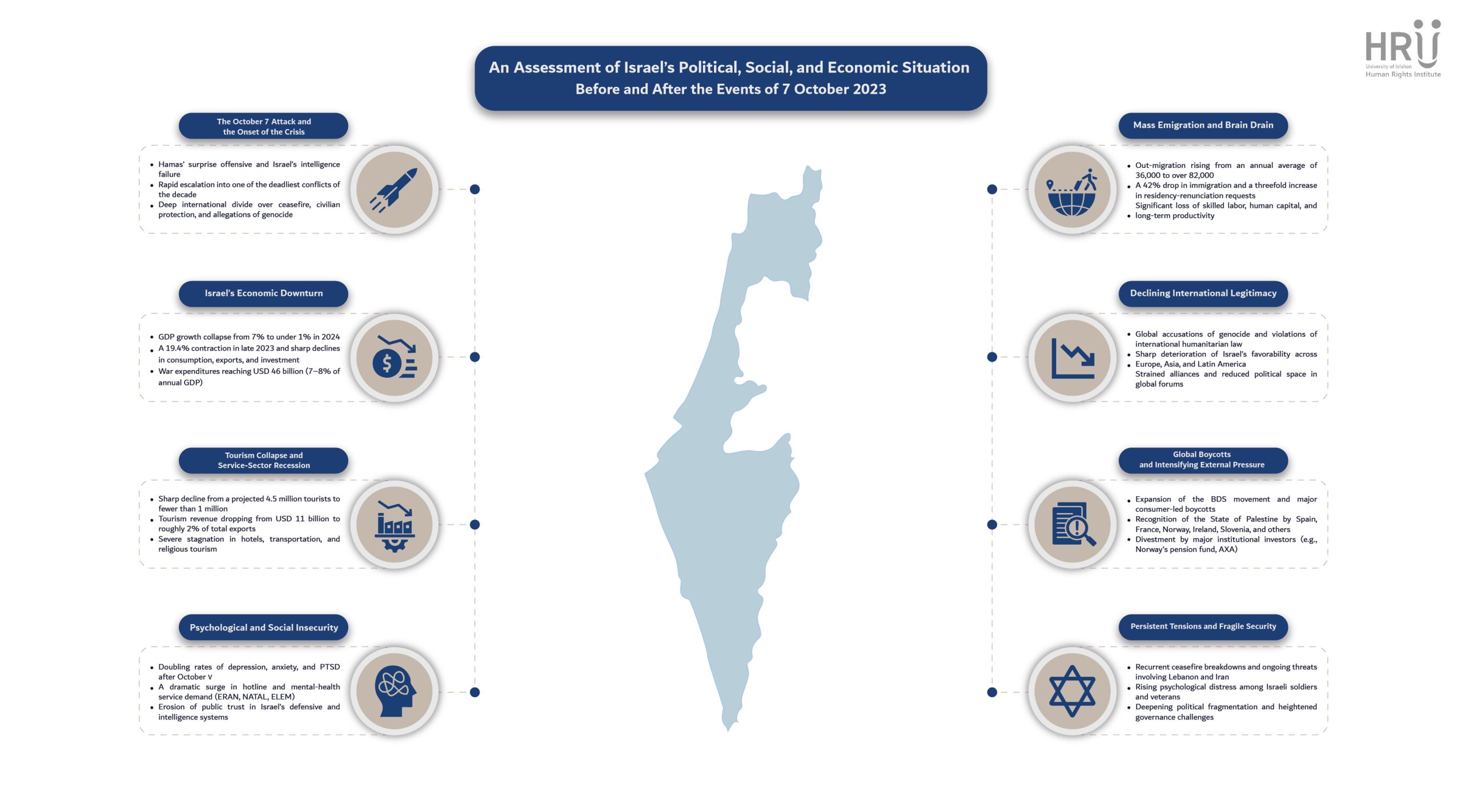
The events of 7 October 2023 and the costly Gaza war delivered a serious and multidimensional blow to Israel’s economy. Prior to the onset of this crisis, Israel’s 580-billion-dollar economy[1] was considered one of the most dynamic in the Middle East, and its GDP growth had reached approximately 7 percent in 2021 and 6.5 percent in 2022. However, with the outbreak of the war and the persistence of political and security uncertainties, economic growth slowed sharply and nearly came to a halt in 2024. According to official data, Israel’s economic growth rate in 2024 was only 0.9 percent[2]—an amount that, compared to the pre-war average of approximately 5 to 7 percent, represents a significant decline.
According to reports by the Bank of Israel and national statistical institutions, in the final quarter of 2023—immediately after the confrontation with Hamas—Israel’s economy experienced its most severe contraction since the COVID-19 pandemic, with GDP shrinking by approximately 19.4 percent on an annualized basis[3]. During the same period, consumer spending dropped by 26.9 percent, and imports of goods and services fell by more than 40 percent[4], while exports contracted by roughly 18 percent. Both private and public investment also plummeted, with some estimates placing the decline at more than 60 percent[5]. In 2023, foreign direct investment in Israel fell to its lowest level since 2016, as shown in the chart below.

This sudden recession reflected widespread psychological shock, security instability, and a sharp decline in public confidence regarding the economic outlook. The Gaza war diverted a large share of government spending toward military expenditures, reduced industrial output, decreased tourism, and triggered an outflow of labor.
From the beginning of the Gaza conflict in October 2023 to October 2025, the direct costs of Israel’s military operations and security measures increased significantly. Based on official reports and economic estimates, these costs reached approximately 46 billion dollars by the end of 2024[6]—an amount equivalent to roughly 7 to 8 percent of Israel’s annual GDP[7], placing enormous pressure on the state budget. By comparison, before the war Israel’s defense spending accounted for about 3 to 4 percent of GDP. As a result, an economy once characterized by stable growth and steady foreign investment found itself, after the events of October 2023, facing one of the most severe economic and social crises of the past two decades.
- Tourism
One of the sectors most severely impacted by the war was Israel’s tourism industry. The year 2023 was expected to be a landmark year for this sector, and tourism officials had predicted that the number of foreign visitors would surpass 4.5 million—higher than pre-pandemic levels[8]. Up until the end of September 2023, the inflow of tourists was significantly strong; according to official data, approximately 304,000 visitors entered Israel in that month alone.
However, following the 7 October attack and the start of the Gaza war, the trend reversed entirely. According to statistics published by the Israel Ministry of Tourism, the number of foreign visitors dropped dramatically to around 89,700 in October 2023, and in November 2023 only 38,000 people traveled to Israel[9]. These figures indicate that normal tourism flows had almost completely collapsed, with the majority of leisure and pilgrimage trips to Israel canceled.
As a result, a sector that was expected to serve as one of Israel’s key engines of economic growth in 2023 instead became one of the primary casualties of the war. Widespread financial losses, rising unemployment in the services sector, and stagnation across hotels and transportation services reveal the economic crisis that unfolded after 7 October.
According to Yossi Fattal, one of Israel’s senior tourism industry officials, incoming tourism had ranked as Israel’s fifth-largest source of national income, generating approximately 11 billion dollars and accounting for 7 percent of all export revenues. However, this figure has now fallen to 2 percent[10].
This drop in tourism revenue due to the war is also evident in other data. Israel’s tourism income in December 2023 amounted to approximately 4 billion dollars, representing a significant decrease compared to the previous year, in which tourism revenues had reached nearly 6 billion dollars[11]. Additionally, reports indicate that in 2024 only about 961,000 foreign tourists visited Israel—a decline of more than 68 percent compared to 2023[12].
- Psycho-Social Security
The outbreak of the war on 7 October and its subsequent developments left a profound and lasting impact on the psychological sense of security among Israeli citizens, in addition to physical safety concerns[13]. According to available statistics, the prevalence of post-traumatic stress disorder (PTSD), depression, and anxiety in Israel nearly doubled after Hamas’s attack[14]. Prior to this event, most Israelis—despite periodic threats—had largely adapted to the status quo and believed that the country’s defensive systems and military capabilities would shield them from any serious danger. Confidence in domestic stability and in the effectiveness of security institutions had become embedded in the collective mindset of Israeli society.
However, the surprise attack of 7 October severely undermined this fundamental sense of safety. The suddenness of the assault, the infiltration of Hamas fighters into Israeli territory, the initial inability of the security apparatus to respond quickly, and the significant vulnerabilities of Israel’s air defense systems when exposed to Iranian missiles together created a psychological shock that far exceeded the material and military losses. In the aftermath, feelings of insecurity and vulnerability permeated daily life, and the sense of ease in public spaces sharply declined.
Furthermore, the prolonged duration of the war has meant that a large number of individuals are now suffering from mental-health disorders, and Israel’s mental-health system is not adequately equipped to handle the surge in demand[15]. Reports indicate that during the period from 7 October until the end of the war, contact with remote counseling and psychological support services increased dramatically. The hotlines and mental-health clinics operated by Israel’s three main service providers—ERAN, NATAL, and ELEM—have all reported severe spikes in demand since 7 October 2023.
Digital-platform contacts through ELEM tripled. NATAL now treats more than 3,000 individuals per week, compared to around 350 before the war. Volunteers at ERAN have responded to more than 500,000 phone calls since the start of the conflict, averaging between 1,200 and 1,500 calls per day[16].
Months after 7 October, psychological recovery has still not been fully achieved. In everyday life, fear of renewed attacks, diminished trust in the effectiveness of protective institutions, and anxiety about the country’s political and military future remain constant in the minds of many citizens. In other words, the 7 October crisis was not merely a military or intelligence failure; it was a pivotal moment in Israel’s collective psychology—an event that blurred the boundary between safety and danger and transformed a sense of vulnerability into a central element of social reality.
- Migration
One of the prominent problems that emerged following the recent wars was the sharp increase in emigration from Israel, particularly among educated and younger segments of the population. The phenomenon of reverse migration is not new for Israel, but over the past two years it has reached unprecedented dimensions. A combination of overlapping factors—including insecurity stemming from the ongoing Gaza war, economic recession, and widespread dissatisfaction with the political and social climate—has led many citizens, especially those from the middle class and the academic community, to decide to leave the country. Some have departed for temporary stays abroad, while others have emigrated permanently.
According to the Israeli Central Bureau of Statistics, only 11,314 people moved to Israel during the first seven months of 2025—a 42 percent decrease compared to the same period in 2024, and nearly 60 percent lower compared to the first eight months of 2023[17].
Based on data from the Central Bureau of Statistics, the average annual number of Israelis leaving the country between 2009 and 2021 was around 36,000 people. Starting in 2022, this number rose sharply: 55,000 Israelis emigrated that year—an increase of 46 percent compared to 2021. The number rose again in 2023, with approximately 82,700 people leaving the country, representing another increase of about 50 percent. Meanwhile, the number of Israelis returning after extended stays abroad has remained low, averaging around 24,000 people per year[18]. In contrast, the number of returnees has remained stable or declined slightly over the same period.
Michelle Harel, who emigrated to Toronto, Canada in 2019 with her husband, reported that almost immediately after the 7 October attacks, the phone began ringing frequently as other Israelis sought advice on moving to Canada. Harel and other Israeli immigration specialists explained that on 23 November 2023, the couple launched a website to help Israelis with relocation—a process that can cost at least 100,000 Israeli shekels, or approximately 28,000 USD[19].
Legally, Israel’s National Insurance Institute can revoke an individual’s residency status after five years of living abroad, although citizens may also voluntarily request the cancellation of their residency. According to attorney Danny Zaken, the number of such requests has more than tripled, rising from an average of around 2,500 cases prior to 2021 to 8,400 cases in 2024[20].
Although Israel has experienced population movements on a limited scale for decades, the intensity and speed of this new wave of emigration are unprecedented. Many analysts warn that the continuation of this trend—especially the departure of skilled professionals—could produce long-term consequences for Israel’s economic structure, human capital, and social identity.
- Politics and the Decline of International Legitimacy
After the 7 October attacks and two years of war in Gaza—as well as Israel’s broad confrontations with Lebanon, Iran, and Yemen’s Houthis—the country found itself in an unprecedented state of international isolation. What was initially presented as a military operation against Hamas gradually evolved into a profound humanitarian and ethical crisis that tarnished Israel’s global image. The extensive civilian casualties, destruction of urban infrastructure, the complete siege of the Gaza Strip, and attacks on civilians or dual-use (military–civilian) facilities in the conflict with Iran led many governments and international organizations to view Israel’s policies as violations of human rights and international humanitarian law.
According to Amnesty International, Israel has committed the crime of genocide in Gaza by killing Palestinian civilians, causing them serious physical or mental harm, and deliberately inflicting living conditions intended to bring about the physical destruction of Palestinians—through widespread forced displacement, obstruction of life-saving aid, and damage to or destruction of essential infrastructure[21]. As a result, Israel’s moral standing and political legitimacy at the global level have sharply eroded, and even within Western public spheres, traditional support for Israel has weakened.
In academic, media, and civil society circles, critical discourse against Israel expanded, and many universities and cultural institutions in Europe and Latin America suspended their cooperation with Israeli institutions. Mass protests in major world capitals—from London and Paris to Washington and Sydney—reflected a deep shift in global public perception of Israel, which increasingly came to be viewed not as a victim but as a perpetrator of human rights violations.
Statistics show that Israel’s popularity fell sharply in Western Europe during the Gaza war. Surveys indicate that only 13 to 21 percent of people in each Western European country hold a favorable view of Israel, while 63 to 70 percent view it negatively[22]. Newly published data from the research firm Morning Consult, reported by TIME magazine, show that Israel lost a substantial portion of its global support after the outbreak of the Gaza war. In a survey conducted across 43 countries, the average global favorability rating toward Israel dropped by 18.5 points in just three months. Among these countries, 42 recorded a noticeable decline in favorable views. China, South Africa, and Brazil shifted from positive to negative perceptions of Israel, and in wealthy countries such as Japan, South Korea, and the United Kingdom, attitudes fell to their lowest levels in recorded history[23].
According to findings by the Pew Research Center, in 20 out of 24 countries surveyed, about half or more of adults hold an unfavorable view of Israel. In countries such as Australia, Greece, Indonesia, Japan, the Netherlands, Spain, Sweden, and Turkey, three-quarters or more of the population express negative views[24].
At the diplomatic level, Israel’s relations with the Global South—and even with several Western allies—entered a phase of tension and mistrust. Multiple countries downgraded their relations or recalled their ambassadors. Reuters interviewed 13 current and former Israeli officials and experts who acknowledged that the humanitarian consequences of the Gaza war have significantly damaged Israel’s credibility[25].
Economically and culturally, symbolic boycotts and reduced investments contributed to Israel’s growing isolation in the international system. Overall, two years after the war’s outbreak, Israel found itself more politically, morally, and culturally isolated than at any other moment in its contemporary history.
Challenges and Responses
- Fragility of Ceasefires
One of the serious challenges arising for Israel after 7 October is that tensions remain unresolved and ceasefires are highly fragile. Under such conditions, Israel has entered a cycle of political and military insecurity that has not only made the restoration of internal trust difficult but has also obstructed the path toward regional stability in the Middle East. This situation has left Israeli society in a state of chronic anxiety and continuous mistrust.
For example, despite a fragile ceasefire with Lebanon, Israeli officials continue to threaten the country. At the opening of a cabinet meeting on 2 November 2025, Prime Minister Benjamin Netanyahu stated that if Lebanon does not take steps to prevent its territory from becoming a new front, Israel “will act if necessary[26].” In addition, deep political divisions within the government, the inability to achieve national consensus, and the social pressures resulting from the war have all intensified the crises generated by the conflict.
- Domestic Reactions
The Israeli website Ynet published a report examining the rise of depression among Israeli soldiers after the Gaza war. According to the findings of a recent study conducted at Tel Aviv University, among the reserve soldiers who participated in the Gaza war, approximately one in every eight soldiers (12 percent) has developed symptoms of post-traumatic stress disorder (PTSD)—a figure that represents a sharp increase compared to pre-war levels.
This six-year study, conducted in cooperation with the Israel Defense Forces, tracked the development of psychological symptoms from military training through post-service periods. The research shows that the longer the duration of combat service, the more likely soldiers were to develop psychological symptoms.
Yair Bar-Haim, head of the National Center for Trauma and Resilience, has warned that Israel is facing a state of “mental-health emergency” and must develop serious plans for the next two decades. He emphasized that these statistics reflect only infantry soldiers in regular service and do not include data from special operations or separate wartime missions; therefore, the real number could be significantly higher[27].
- International Reactions
The prominent media outlet Al Jazeera published a report on 28 October 2025 addressing the global boycott of Israel by supporters of Palestine. According to this report, following two years of war in Gaza and the intensification of the humanitarian crisis, an unprecedented wave of boycotts and global disengagement emerged against Israel—spanning from grassroots street movements to economic and cultural networks.
The report shows that the Boycott, Divestment, Sanctions (BDS) movement has become one of the most effective tools of civic pressure worldwide. By leveraging social media platforms and shopping applications, BDS mobilized millions of people to boycott goods and companies associated with Israel. This global boycott resulted in a significant decline in the sales of multinational corporations such as McDonald’s and Starbucks, and forced major retailers like Carrefour to withdraw from Middle Eastern markets.
In addition to grassroots boycotts, political pressure also intensified. Several European countries—including Spain, Norway, Ireland, Slovenia, and France—recognized the State of Palestine, and the European Union granted political legitimacy to this trend by cancelling military contracts and imposing restrictions on trade relations with Israel. At the same time, major financial entities such as Norway’s sovereign pension fund and the French insurance company AXA divested from companies linked to Israeli settlement expansion.
Experts argue that these sanctions and boycotts carry significance beyond the economic sphere. They represent a fundamental shift in the “global collective conscience,” which increasingly views Israel’s conduct in Gaza as a form of genocide. Analysts emphasize that this movement has driven Israel into unprecedented political and moral isolation, while simultaneously generating new alliances among nations in defense of human dignity and global justice[28].
The Turkish state news agency Anadolu, another reputable international outlet, also reported on Israel’s growing isolation due to its actions in Gaza. According to diplomats and analysts cited in the report, two years after the Gaza war, Israel is experiencing unparalleled diplomatic isolation and a severe decline in its international image. Experts note that Israel’s continued attacks on Gaza and the resulting humanitarian catastrophe have sparked a global wave of opposition, prompting countries including Spain, Norway, Ireland, Slovenia, and France to recognize Palestine.
Analysts described this recognition as a “soft retaliation” against Israel—an alternative to imposing full-scale sanctions. Former Israeli diplomat Alon Liel called these developments a “historic turning point” and warned that the recognition of Palestine by major Western powers, particularly France and the United Kingdom, is a profound shock to Israeli public opinion.
He added that Israelis are increasingly encountering hostile reactions during international travel, and that the country’s global image has suffered substantial damage. Former adviser to Shimon Peres, Nadav Tamir, stated that ongoing war and occupation have eroded Israel’s moral and strategic standing and caused even traditionally supportive countries and societies to distance themselves from it. Tamir stressed that global criticism does not stem from hatred toward Israel, but rather from opposition to occupation policies and the inhumane treatment of civilians in Gaza and the West Bank[29].
The Australian-based newspaper The Jewish Independent also reported—citing the Knesset—on the surge in emigration following 7 October. The article stated that a recent Knesset report on the dramatic rise in emigration paints a troubling picture of Israel’s social and economic future. According to the report, emigration has accelerated at an unprecedented rate since 2023 and has become a strategic threat to the stability of Israeli society.
Experts argue that a combination of political, security, and economic factors—such as the crises triggered by the Gaza war, the 7 October attacks, internal political divisions, and the government’s controversial judicial reforms—has driven this wave of departures. As a result, public trust in the government and the security establishment has severely eroded, pushing many citizens to seek their future abroad.
Members of the Knesset have warned that this wave of emigration is no longer a temporary trend but resembles a “social tsunami” capable of undermining Israel’s demographic and economic foundations. Domestic media outlets describe it as evidence of a rupture in the “unwritten pact between the state and its citizens”—a pact that once relied on promises of security, prosperity, and stability but has, in the eyes of many Israelis, collapsed.
Analysts believe that the departure of skilled, educated, and younger populations will inflict significant damage on Israel’s human capital and productive capacity, potentially impairing long-term economic growth and scientific innovation. The government has yet to introduce an effective plan to counter this trend, and officials from the Ministry of Immigration admit that they do not possess an operational mandate to prevent emigration[30].
Conclusion
The events of 7 October 2023 were not merely a military incident; the widespread military response in the Gaza Strip and the multiple rounds of simultaneous confrontations with Iran and Lebanon produced an accumulation of long-term costs. The severe economic contraction at the end of 2023 and the decline in economic growth in 2024 went beyond a cyclical downturn and resulted in a sustained weakening of confidence among businesses and households. The surge in defense expenditures—to approximately 7 to 8 percent of Israel’s GDP—had a substantial impact on both public and private investment. At the same time, tourism shifted from being a source of revenue to becoming a crisis, and the psychosocial shock marked by rising anxiety and depression placed overwhelming pressure on Israel’s health and mental-care system.
Simultaneously, the acceleration of elite emigration and the decline in the return of Israelis living abroad contributed to a depletion of human capital and a reduction in potential productivity and innovation. Alongside falling investment and fiscal strain on the government, this made patterns of prolonged recession and structural deficits more likely in the medium term.
At the international level, the intensity of human-rights criticism and changing global public perceptions increased the costs of Israel’s scientific, economic, and cultural engagements. The expansion of boycotts and the diplomatic recognition of Palestine by several states added further pressure on Israel and complicated the management of its foreign alliances.
In the security arena, the fragility of ceasefires and the continuation of border threats intensified doubts regarding long-term stability and kept economic planning highly risky. Domestically, deep political divisions and difficulties in achieving national consensus have increased governance costs.
Overall, the repercussions of 7 October have reshaped Israel’s political, economic, social, and international landscape—producing a prolonged period of uncertainty, vulnerability, and declining legitimacy.
References
[1] Alias, A.F. (2025, October 9). Israel’s economy faces an uncertain truce dividend. Reuters. From: https://www.reuters.com/commentary/breakingviews/israels-economy-faces-an-uncertain-truce-dividend-2025-10-09/
[2] Trading Economics. (n.d.). Israel full year GDP growth. Trading Economics. From: https://tradingeconomics.com/israel/full-year-gdp-growth
[3] Reuters. (2024, February 19). Israeli economy plunges 19.4% in Q4 amid Gaza war. Calcalist. From: https://www.calcalistech.com/ctechnews/article/byiarnx2p
[4] Mehr News Agency. (2024, February 19). Israel’s economy shrinks by 19% in Q4 2023. Mehr News Agency. From: https://en.mehrnews.com/news/212172/Israel-s-economy-shrinks-by-19-in-Q4-2023
[5] Scheer, S. (2024, February 19). Gaza war hits Israeli economy with 19.4% Q4 drop. Reuters. From: https://www.reuters.com/world/middle-east/gaza-war-hits-israeli-economy-with-194-q4-drop-2024-02-19/
[6] Scheer, S. (2025, March 26). Bank of Israel chief critical of 2025 wartime budget. Reuters. From: https://www.reuters.com/world/middle-east/bank-israel-chief-critical-2025-wartime-budget-2025-03-26/
[7] Scheer, S. (2025, March 17). Israeli war spending in Gaza, Lebanon tops $30 billion in 2024 -Finance Ministry. Reuters. From: https://www.reuters.com/world/middle-east/israeli-war-spending-gaza-lebanon-tops-30-billion-2024-finance-ministry-2025-03-17/
[8] Setton, K. (2024, June 18). Israel’s tourism sector struggles under strain of lengthy war. The Media Line. From: https://themedialine.org/life-lines/israels-tourism-sector-struggles-under-strain-of-lengthy-war/
[9] Spirlet, T. (2024, August 18). Israel’s tourism industry is struggling under the weight of the war. Business Insider. From: https://www.businessinsider.com/israels-tourism-industry-is-struggling-under-the-weight-of-war-2024-7
[10] Zomer, N. (2025, September 6). Israel’s tourism industry remains on brink of collapse despite ceasefire, sector chief warns. Y Net Global. From: https://www.ynetnews.com/travel/article/hjqikf47gx
[11] CEIC Data. (2023). Israel Tourism Revenue. CEIC Data. From: https://www.ceicdata.com/en/indicator/israel/tourism-revenue
[12] Xinhua. (2025, January 6). Tourist visits to Israel drop by 68.1 pct in 2024. Xinhua net. From: https://english.news.cn/20250106/2a6b89d1410c4929bf04894ed80bcc79/c.html
[13] Salamon, MJ. & Libin, L. (2025, July 13). Mental health on the front lines: Israel’s parallel crisis amid war – opinion. The Jerusalem Post. From: https://www.jpost.com/opinion/article-860773
[14] Columbia University Department of Psychiatry. (2024, January 5). PTSD, depression, and anxiety nearly doubles in Israel in aftermath of Hamas attack. Columbia University Department of Psychiatry. From: https://www.columbiapsychiatry.org/news/ptsd-depression-and-anxiety-nearly-doubles-israel-aftermath-october-7-2023-terrorist-attack
[15] Neria, Y. & Markowitz, JC. & Amsalem, D. & Levi-Belz, Y. & Roe, D. & Lurie, I. Bitan, DT. & Wainberg, ML. & Mendlovic, S. (2025). Israeli mental health in the aftermath of the October 7 terrorist attack: risks, challenges, and recommendations. Isr J Health Policy Res, 16 (14), 1-25. Doi: 10.1186/s13584-025-00682-8.
[16] Sudilovsky, J. (2025, July 3). Israeli mental health experts raise alarm of impending ‘tsunami of war-related psychiatric illness’ after 20 months of conflict. eJP. From: https://ejewishphilanthropy.com/israeli-mental-health-experts-raise-alarm-of-impending-tsunami-of-war-related-psychiatric-illness-after-20-months-of-conflict/
[17] Stub, Z. (2025, September 14). Even as Western aliyah picks up, new arrivals replace fewer than half of Israeli emigrants. The Times of Israel. From: https://www.timesofisrael.com/even-as-western-aliyah-picks-up-new-arrivals-replace-fewer-than-half-of-israeli-emigrants/
[18] Arnaout, A. & Sio, M. (2025, October 21). Official figures show record number of Israelis emigrating abroad. Anadolu Agency. From: https://www.aa.com.tr/en/middle-east/official-figures-show-record-number-of-israelis-emigrating-abroad/3721991
[19] CBS News. (2024, December 20). Thousands of Jews have left Israel since the October 7 attacks. CBS News. From: https://www.cbsnews.com/news/thousands-jews-leave-israel-after-october-7-attacks/
[20] Stub, Z. (2025, October 20). Hidden cost of war: 125,000 Israelis emigrated between 2022 and 2024. The Times of Israel. From: https://www.timesofisrael.com/hidden-cost-of-war-125000-israelis-emigrated-between-2022-and-2024/
[21] Amnesty International. (N.d.). Israel And The Occupied Palestinian Territory 2024. Amnesty International. From: https://www.amnesty.org/en/location/middle-east-and-north-africa/middle-east/israel-and-the-occupied-palestinian-territory/report-israel-and-the-occupied-palestinian-territory/
[22] Smith, M. (2025, June 3). Net favourability towards Israel reaches new lows in key Western European countries. YouGov. From: https://yougov.co.uk/international/articles/52279-net-favourability-towards-israel-reaches-new-lows-in-key-western-european-countries
[23] Gordon, A. (2024, January 17). New polling shows how much global support Israel has lost. Time. From: https://time.com/6559293/morning-consult-israel-global-opinion/
[24] Silver, L. (2025, June 3). Most people across 24 surveyed countries have negative views of Israel and Netanyahu. Pew Research Center. From: https://www.pewresearch.org/short-reads/2025/06/03/most-people-across-24-surveyed-countries-have-negative-views-of-israel-and-netanyahu/
[25] Bayer, L. (2025, October 18). Ceasefire offers Israel opportunity to end its international isolation. Reuters. From: https://www.reuters.com/world/middle-east/ceasefire-offers-israel-opportunity-end-its-international-isolation-2025-10-17/
[26] Ramadan, T. (2025, November 2). Israel urges Lebanon to disarm Hezbollah under ceasefire terms. Reuters. From: https://www.reuters.com/world/middle-east/israeli-defense-minister-says-lebanese-government-must-fulfill-commitment-disarm-2025-11-02/
[27] Gueta, T. (2025, July 5). One in eight IDF reservists reports PTSD after Gaza war, study shows. Y Net Global. From: https://www.ynetnews.com/health_science/article/ry9dep00gex
[28] Chughtai, A. (2025, October 28). The rise of global boycotts against Israel’s genocide in Gaza. Aljazeera. From: https://www.aljazeera.com/news/2025/10/28/the-rise-of-global-boycotts-against-israels-genocide-in-gaza
[29] Hanedar, F. & Canli, E. & Demir, G. (2025, July 30). Israel faces growing global isolation over Gaza war: Experts. Anadolu Agency. From: https://www.aa.com.tr/en/middle-east/israel-faces-growing-global-isolation-over-gaza-war-experts/3644192
[30] Burla, S. (2025, October 23). Growing emigration wave threatens Israeli society: Knesset report. The Jewish Independent. From: https://thejewishindependent.com.au/israel-emigration-gaza-war