Introduction
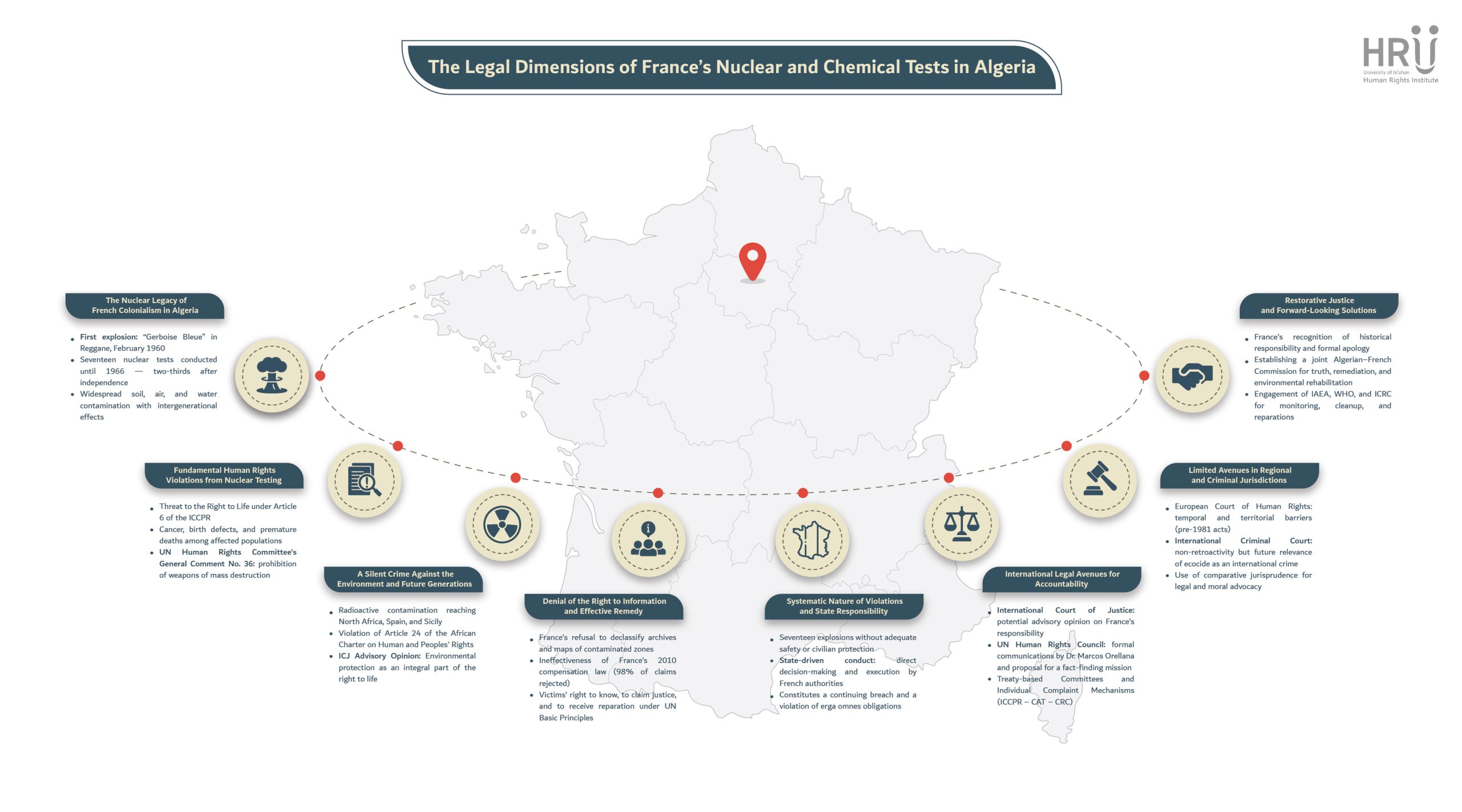
In the 1960s, the French government conducted a series of nuclear tests in the Algerian Sahara Desert. The first detonation, known as “Gerboise Bleue”, took place on 13 February 1960 in the Reggane region. It marked the beginning of a sequence of nuclear experiments that continued until 1966, totaling approximately 17 tests. Nearly two-thirds of these experiments were carried out after Algeria’s independence in 1962, pursuant to bilateral agreements between the newly established Algerian government and France, which allowed the latter to retain its nuclear facilities and equipment on Algerian soil for up to five additional years.
In addition to these major explosions, several secondary tests were conducted, leading to widespread environmental contamination and serious harm to local villagers and nomadic populations, some of which have manifested as intergenerational health disorders. These tests not only had devastating ecological and humanitarian consequences, but also triggered prolonged political and diplomatic tensions between Algeria and France.
Numerous human rights and environmental organizations, including international advocacy groups, have condemned these actions as violations of human rights and as evidence of disregard for the health and dignity of future generations. In the ensuing decades, survivors and victims of the tests repeatedly demanded transparency, an official apology, and reparations from the French state. Despite some legal reforms in France intended to compensate victims, many experts and affected communities maintain that these measures have been inadequate. The lingering radioactive contamination remains visible in parts of the Algerian desert to this day, and the issue continues to represent a major point of contention in the historical relationship between Algeria and France.
Legal Dimensions of Human Rights Violations
- Violation of the Right to Life and Health
The right to life is the most fundamental of all human rights and is enshrined in Article 6 of the International Covenant on Civil and Political Rights (ICCPR)[1]. No State may arbitrarily deprive individuals of their lives. Conducting nuclear tests in inhabited areas without proper evacuation or protective measures constitutes a flagrant endangerment of human life and an arbitrary deprivation of the right to life.
The UN Human Rights Committee, in its General Comment No. 36 (2018) interpreting Article 6 of the ICCPR, explicitly affirmed that the threat or use of weapons of mass destruction—including nuclear weapons—is inherently incompatible with the right to life, and that States Parties are under an obligation to refrain from any testing of such weapons.
In the present case, medical and scientific evidence indicates that residents of the Reggane and In Ekker regions suffered from cancers, severe health complications, and premature deaths as a result of exposure to radioactive fallout. Nomadic Tuareg tribes, as well as local farmers and villagers, quickly experienced symptoms such as burning headaches, mysterious illnesses, and the birth of children and animals with congenital deformities[2]. These outcomes constitute arbitrary deprivation of life and a violation of Article 6 of the ICCPR.
- Violation of Environmental Rights and the Right to a Healthy Environment
In contemporary international law, it is now firmly recognized that human beings have the right to live in a clean, healthy, and sustainable environment. The UN Human Rights Council, through Resolution 48/13 (2021), formally affirmed the right to a clean, healthy, and sustainable environment as a human right[3].
France’s nuclear experiments in Algeria caused massive contamination of soil, water, and air across parts of the Sahara and even beyond, affecting North Africa and Southern Europe. Radioactive particles did not stop at Algeria’s borders. According to the Algerian newspaper El Watan, these tests impacted much of North Africa and Sahel countries, while toxic radioactive clouds reached Morocco, Libya, Niger, Chad, Ghana, Côte d’Ivoire, and Mali, and even crossed the Mediterranean Sea to reach the coasts of Spain and Sicily[4].
This constitutes a clear violation of the Algerian people’s right to a healthy environment, as articulated in Article 24 of the African Charter on Human and Peoples’ Rights, which guarantees that “All peoples shall have the right to a general satisfactory environment favorable to their development[5].” Although France is not a party to this regional instrument, the principle of non-transboundary environmental harm and the duty of States to consider environmental implications of their actions were already emerging norms in the 1960s and were later reaffirmed in the 1972 Stockholm Declaration and the 1992 Rio Declaration.
The International Court of Justice (ICJ), in its 1996 Advisory Opinion on the Legality of the Threat or Use of Nuclear Weapons, emphasized that States must respect environmental principles in their use of weapons, and that widespread environmental destruction contradicts both humanitarian law and human rights law. The Court underscored that “the environment is not an abstraction but represents the living space, the quality of life, and the health of human beings, including generations unborn[6].”
Therefore, from an international legal standpoint, France’s creation of large-scale contamination and the abandonment of radioactive waste in Algeria constitute a breach of its environmental obligations and a violation of the Algerian people’s human rights.
- The Right to Access Information and to Effective Remedy
From a human rights perspective, victims and the public at large have the right to be informed about health risks and life-threatening events, as well as the right to access related documentation. Furthermore, individuals whose rights have been violated are entitled to an effective remedy.
According to Article 9 of the Basic Principles and Guidelines on the Right to a Remedy and Reparation for Victims of Gross Violations of International Human Rights Law, adopted by the UN General Assembly in 2006, compensation must be proportionate to the gravity of the violation and the harm suffered[7]. A State is obliged to provide reparation to victims for acts or omissions attributable to it that amount to gross violations of international human rights law or serious violations of international humanitarian law[8].
In analogous cases, such as the complaints of British soldiers exposed to nuclear testing on Christmas Island, the European Court of Human Rights (ECHR) held that States are obliged to provide victims with access to relevant information necessary for pursuing their rights. The Court underlined that when States engage in hazardous activities—such as nuclear testing—that may have hidden and serious health consequences, Article 8 of the European Convention on Human Rights obliges them to establish accessible and effective mechanisms for victims to obtain related information[9].
States Parties to the ICCPR are likewise required, under Article 2(3) and the principles of state responsibility, to provide adequate redress to victims whose right to life has been violated or endangered due to nuclear testing or the use of weapons of mass destruction.
France last submitted its periodic report on the implementation of the ICCPR to the Human Rights Committee in 2012. In its concluding observations, the Committee requested France to clarify what measures had been taken to address deficiencies in the implementation of Law No. 2010-2 of 5 January 2010, concerning the recognition and compensation of victims of French nuclear tests, as identified in Fact-Finding Report No. 856 (2012–2013). That report, presented to the French Senate on 18 September 2013, revealed that 98.7% of claims submitted to the Committee of Compensation of Victims of Nuclear Tests (CIVEN) had been rejected[10].
Algerian jurists have since sought to classify France’s nuclear testing as a crime against humanity. Prominent lawyer Fatima Zohra Benbraham, in an interview with the Algerian news outlet Jeune Indépendant, revealed that numerous legal obstacles hinder this process — notably France’s continued refusal to declassify its archives, leaving scientific data from the era effectively locked away. This deliberate withholding of information constitutes a violation of Algerians’ right to truth and access to information.
- The Systematic Nature of the Human Rights Violations
An examination of France’s conduct indicates that these violations formed part of a state-organized and systematic policy during and after the colonial period. The execution of 17 nuclear explosions over six years, without adequate protective measures and with full knowledge of the presence of significant civilian populations[11], reinforces the conclusion that the harm inflicted on non-combatants and the long-lasting legacy of radioactive contamination were systematically produced.
According to Article 15 of the 2001 Draft Articles on the Responsibility of States for Internationally Wrongful Acts, a breach of an international obligation may result from a series of acts or omissions that, taken together, constitute a systematic pattern of conduct[12]. There is no doubt that the planning and execution of nuclear tests in Algerian territory were carried out by the governmental and military organs of the French State, and are therefore attributable to France under international law.
Possibility of International Litigation
- International Court of Justice (ICJ)
The International Court of Justice (ICJ) serves as the principal judicial organ of the United Nations, competent to adjudicate disputes between States and provide advisory opinions on legal questions. Theoretically, the Algerian government could bring a case against France before the ICJ for the conduct and consequences of its nuclear testing on Algerian territory.
However, two major obstacles stand in the way of such proceedings:
First, the issue of compulsory jurisdiction. France withdrew its declaration recognizing the Court’s compulsory jurisdiction in 1973, following lawsuits filed by Australia and New Zealand regarding French atmospheric nuclear tests in the South Pacific. France declared that it no longer recognized the Court’s jurisdiction[13] and refused to participate in any further proceedings. Therefore, for Algeria to bring a case, France must either consent to the Court’s jurisdiction or there must exist a treaty clause conferring jurisdiction, which in this case does not apply.
Second, there is a temporal limitation: the Court may only hear disputes concerning acts or situations that exist at the time of the filing or have continuing legal effects. France could argue that these nuclear tests were historical events occurring before or shortly after Algeria’s independence (1962) and that no current legal dispute exists.
Nevertheless, Algeria could invoke the doctrine of a “continuing breach”, arguing that the radioactive contamination, health impacts, and lack of reparations constitute ongoing violations that persist to this day, thereby maintaining the Court’s temporal jurisdiction. Algeria could frame its claim around France’s continuing breach of obligations concerning transboundary environmental harm and the human rights of the Algerian people.
Moreover, UN General Assembly resolutions from that period could serve as evidence of breaches of obligations erga omnes—a doctrine first recognized by the ICJ—referring to obligations owed to the international community as a whole, whose violation concerns all States, not merely the directly injured one[14]. Hence, in principle, any State could raise the responsibility of France for such wrongful acts.
While the likelihood of France’s consent or the ICJ’s acceptance of jurisdiction remains low, an alternative approach would be to seek an advisory opinion. The UN General Assembly or the African Union could request an advisory opinion from the Court regarding the legal consequences of France’s colonial-era nuclear tests in Algeria. If such a resolution were adopted by a majority of the General Assembly, the ICJ could provide an advisory interpretation of France’s international obligations and responsibilities. Although advisory opinions are not legally binding, they often generate moral and political pressure and can lay the groundwork for reparations or bilateral negotiations.
Historical precedents such as the 1971 Namibia Advisory Opinion, which addressed South Africa’s continued occupation of Namibia[15], illustrate how ICJ opinions can play a transformative role in shaping international norms and compelling accountability.
- United Nations Human Rights Council (UNHRC)
The UN Human Rights Council (based in Geneva) serves as the primary international body responsible for promoting and protecting human rights and offers an important forum for advancing this issue. One of its mechanisms is the Special Procedures, through which independent experts investigate specific themes or country situations.
This mechanism has already been activated in the case of Algeria and France: in September 2024, the UN Special Rapporteur on Toxics and Human Rights, Dr. Marcos Orellana, sent formal communications to both governments regarding the lasting human rights and environmental impacts of France’s nuclear tests in Algeria. These letters called for accountability, transparency, and reparation for victims, urging France to declassify all documents and maps detailing the locations of contaminated zones and radioactive waste disposal sites[16].
The correspondence also urged France to acknowledge its historical responsibility, provide compensation to victims, and ensure full transparency concerning affected communities.
A stronger step would be the establishment of an international fact-finding commission under the Council’s authority to investigate human rights violations linked to nuclear testing and issue an official report with recommendations. Such a commission, however, would require a majority vote in the Council.
Given France’s political influence and recent tensions with Algeria, no formal proposal has yet been introduced. Nevertheless, if bilateral relations improve or pressure mounts from disarmament-supporting States, the Human Rights Council could adopt a resolution condemning the colonial-era nuclear tests and urging France to take reparative actions.
Even without a commission, the Council could still pursue the matter through general debates, thematic discussions, or recommendations, thereby keeping international attention alive. Although the Council’s decisions lack direct enforcement power, they can exert substantial political and moral pressure.
France’s failure to respond to the 2024 letter by the Special Rapporteur has already drawn public criticism, highlighting how international scrutiny can raise the cost of inaction. Ultimately, the Council represents a politico-legal arena through which the matter can be advanced on both ethical and institutional grounds.
- Treaty-Based Human Rights Mechanisms
Several UN treaty bodies oversee the implementation of specific human rights conventions and can be invoked in relation to different aspects of this case.
The most relevant among them is the Human Rights Committee, which monitors compliance with the ICCPR. France is a State Party to the Optional Protocol allowing individual communications, although it maintains a restrictive interpretation limiting admissibility to individuals within its jurisdiction[17].
In theory, Algerian victims could submit individual complaints against France, alleging violations of their rights under the Covenant. However, several challenges arise:
First, complainants must demonstrate that, at the time of the violation or its continuation, they were within France’s jurisdiction. France would likely argue that after independence, the victims were subject to Algeria’s jurisdiction, not France’s. Nonetheless, the “continuing violation” argument could again be employed, asserting that France’s failure to decontaminate and compensate perpetuates ongoing breaches.
Second, applicants must exhaust domestic remedies before turning to the Committee. France would likely point to Law No. 2010-2 and the CIVEN committee as existing avenues for redress, arguing that some victims either did not apply or were unsuccessful.
If the Committee determines that these remedies were ineffective or futile (given the 1–2% acceptance rate in early years), it may waive the exhaustion requirement. In such a case, the Committee could issue Views finding France in violation of Articles 6 and 2(3) of the Covenant and recommend appropriate reparations and guarantees of non-repetition.
Although such Views are not legally binding, they carry strong moral and political authority, and France has historically shown sensitivity to the Committee’s recommendations.
- European Court of Human Rights (ECHR)
France has been a party to the European Convention on Human Rights since 1974, and has recognized the jurisdiction of the European Court of Human Rights (ECHR) since 1981. In principle, the Court could hear individual complaints against France.
However, several jurisdictional barriers make this unlikely.
First, temporal jurisdiction: the acts in question occurred before 1981, meaning they fall outside the Court’s competence ratione temporis.
Second, territorial jurisdiction: according to established case law, the Convention applies to areas under a State’s effective control or authority. Algeria was considered part of metropolitan France during the colonial period (as “overseas départements”), which might theoretically place the victims within France’s jurisdiction. Yet, after Algeria’s independence in July 1962[18], subsequent tests (1965–1966) occurred outside the territory covered by the Convention.
Even if jurisdiction were arguable, victims would still have to exhaust domestic remedies, and to date, there is no record of successful litigation by Algerian victims in French courts (such as the Paris Administrative Tribunal).
Therefore, the ECHR is not a practical forum for obtaining justice in this case. Nonetheless, the Court’s jurisprudence on environmental rights, access to information, and the protection of life can still serve as persuasive precedents in other international fora.
- International Criminal Court (ICC)
In principle, the International Criminal Court lacks jurisdiction over these historical events. The Rome Statute does not apply retroactively, and the acts in question predate its entry into force in 2002.
Moreover, although France is a party to the Rome Statute, the relevant crimes — use of nuclear weapons outside armed conflict — are not explicitly codified in the Statute. The only potentially relevant provision would be crimes against humanity, which require proof of a widespread or systematic attack against a civilian population as part of a State policy.
While it could be argued that France’s colonial nuclear policy constituted a systematic assault on the Algerian population, such an interpretation is unconventional in current international criminal law. As such, efforts by human rights organizations to refer the case to the ICC would likely be symbolic and advocacy-oriented, rather than judicially viable.
However, international efforts are currently underway to recognize ecocide—the deliberate destruction of the environment—as a fifth core international crime. Should this norm be adopted in the future, intentional large-scale contamination and endangerment of populations through radioactive pollution could become prosecutable under international criminal law. Nonetheless, such a development would not apply retroactively to France’s actions in Algeria.
Recommendations
- Acknowledgment of Responsibility and Voluntary Action by France
It is recommended that the French government take the initiative to formally acknowledge its historical and legal responsibility for the nuclear tests conducted in Algeria. Such acknowledgment could take the form of an official governmental declaration or the adoption of a resolution by the French National Assembly, explicitly recognizing past wrongdoings and offering an official apology to the victims and the Algerian nation.
Following this acknowledgment, France should fully declassify and disclose all relevant documents and data without preconditions. This includes maps of waste burial sites, scientific radiation measurements, medical reports, and technical records related to the tests. These disclosures must be made available to both the Algerian authorities and relevant international organizations, enabling a transparent and comprehensive understanding of the scope of harm caused.
- Legal Action by Algeria at the International Level
The Algerian government should move beyond a purely political approach and adopt concrete legal initiatives to pursue accountability and reparation.
First, Algeria could introduce a draft resolution before the UN General Assembly, in cooperation with other States, condemning the lingering effects of colonial nuclear testing and calling on France to cooperate in remediation and compensation efforts. The resolution could also request the UN Secretary-General to prepare a detailed report on the issue. Even if such a resolution is non-binding, it would carry significant moral and political weight and could pave the way for future legal or diplomatic steps.
The next step would be to seek an advisory opinion from the International Court of Justice, as previously discussed. Such a request could be sponsored by the General Assembly or the Human Rights Council, with Algeria mobilizing support from like-minded States and disarmament advocates.
Furthermore, Algeria should take a more active role in the Human Rights Council, for instance by raising the situation of nuclear test victims during Council sessions and proposing the establishment of a monitoring mechanism (such as a Special Rapporteur or a Commission of Inquiry). While such initiatives may face political resistance, the mere act of introducing them would increase pressure on France to accept its historical responsibility.
To enhance credibility, Algeria should present these actions as humanitarian and justice-oriented, rather than politically motivated. Demonstrating that the primary objective is to restore victims’ rights and rehabilitate contaminated territories, rather than gain political advantage, would garner broader international support — including sympathy from within French civil society itself.
Comprehensive documentation and legal dossiers, prepared in collaboration with international lawyers, would further strengthen the legitimacy and impact of these efforts.
- Establishment of a Joint Commission for Cooperation and Reconciliation
Parallel to legal and diplomatic initiatives, both States should engage in direct bilateral dialogue. One prominent proposal—put forward by 30 civil society organizations in their joint statement of February 2025—is the creation of a Franco-Algerian Joint Commission to address the humanitarian and environmental aftermath of the nuclear tests.
This Commission should operate under the highest governmental authority of both countries and include independent experts, medical professionals, and representatives of victims’ associations.
Its key objectives would include:
- Conducting comprehensive scientific and medical assessments of contaminated regions and affected populations;
- Developing an action plan for environmental remediation and restoration;
- Establishing a joint medical database and health surveillance system for long-term monitoring of survivors and residents of affected areas; and
- Formulating reparative recommendations for France concerning individual or collective compensation to victims.
Such a mechanism could serve as a model of restorative justice and historical reconciliation, bridging the gap between acknowledgment and concrete remedy.
- Engagement of International Technical and Scientific Organizations
Finally, for impartial and evidence-based support, it is recommended that Algeria and France engage international technical bodies to ensure scientific credibility and transparency.
The International Atomic Energy Agency (IAEA) could provide technical cooperation in monitoring residual radioactive materials and advising on decontamination techniques.
The World Health Organization (WHO) could conduct an epidemiological study to assess health impacts and identify the correlation between nuclear explosions and disease prevalence, particularly cancers and blood disorders, in the exposed regions.
The findings of such studies would provide solid scientific evidence to support legal claims and negotiations, reducing ambiguity and strengthening demands for accountability.
In addition, the International Committee of the Red Cross (ICRC) and Red Crescent Movement could play an observer and verification role, drawing on their longstanding expertise in the humanitarian consequences of nuclear weapons. Their participation would enhance the neutrality and legitimacy of any truth-finding or remediation processes.
Conclusion
A historical and legal analysis of France’s nuclear testing in Algeria reveals that the issue is far more than a bilateral historical dispute; it embodies a deeper crisis of transitional justice in the international legal system. These tests, conducted in the absence of oversight and with full awareness of their devastating consequences, exemplify the persistence of colonial practices disguised as scientific and military endeavors—actions that simultaneously violated the core principles of international human rights law, international humanitarian law, and environmental law.
France, relying on political immunity and decades of legal silence, has long evaded full accountability and effective reparation. Yet, in light of recent legal and normative developments—such as the recognition of the right to a clean, healthy, and sustainable environment as a human right, and the strengthening of the doctrine of State responsibility for historical and continuing violations—this case can now be reframed within the broader context of erga omnes obligations owed to humanity as a whole.
The ongoing radioactive contamination and the continued suffering of victims qualify, under international law, as a continuing breach, meaning that the passage of time cannot serve as a barrier to accountability. The issue, therefore, is not limited to demands for compensation, but raises a broader moral and legal question concerning the credibility of a State that proclaims its commitment to human rights and universal values, yet remains silent and inactive in addressing the colonial injustices and human suffering resulting from its own actions.
France’s refusal to open its archives and its delayed acknowledgment of truth amount to a double violation—not only of the victims’ right to justice, but also of their right to know. The revival of this case within international institutions—though challenged by jurisdictional and procedural limits—can serve as an instrument of moral and political pressure, compelling France toward scientific transparency, historical accountability, and joint reparative mechanisms with Algeria.
Utilizing the capacities of the Human Rights Council, seeking an advisory opinion from the International Court of Justice, and activating treaty-based human rights mechanisms are not punitive measures but rather processes of restorative justice aimed at recognizing truth, repairing historical harm, and reaffirming the universality of human dignity.
Ultimately, the case of France’s nuclear tests in Algeria stands as a test of the collective conscience of the international community—a test that will determine whether historical justice and human dignity can prevail over political interest and selective memory. France’s responsibility, therefore, is not merely a legal obligation, but an ethical imperative — one that challenges the moral integrity of the global human rights discourse itself.
References
[1] UN General Assembly. (1966, December 16). International Covenant on Civil and Political Rights. The UN Refugee Agency. From: https://www.refworld.org/legal/agreements/unga/1966/en/17703
[2] El Atti, B. (2025, February 20). 65 years after France turned their land into a nuclear test site, Algerians seek justice. The New Arab. From: https://www.newarab.com/news/algerians-seek-overdue-justice-colonial-french-nuclear-tests
[3] The UN Human Rights Council. (2021, October 18). The human right to a clean, healthy and sustainable environment. The UN Human Rights Council. From: https://docs.un.org/en/A/HRC/RES/48/13
[4] Courrier international. (2025, February 18). Diplomacy. Nuclear tests in the Sahara: a poison for the populations… and for Algerian-French relations. Courrier international. From: https://www.courrierinternational.com/article/diplomatie-essais-nucleaires-au-sahara-un-poison-pour-les-populations-et-les-relations-alger-paris_227854
[5] The African Union. (1981, June 1). African Charter on Human and Peoples’ Rights. The African Union. From: https://au.int/en/treaties/african-charter-human-and-peoples-rights
[6] ICJ. (1996, July 8). Legality of the Threat or Use of Nuclear Weapons. ICJ. From: https://www.icj-cij.org/sites/default/files/case-related/95/095-19960708-ADV-01-00-EN.pdf
[7] UN General Assembly. (2006, March 21). Basic Principles and Guidelines on the Right to a Remedy and Reparation for Victims of Gross Violations of International Human Rights Law and Serious Violations of International Humanitarian Law. UN General Assembly. From: https://docs.un.org/en/A/Res/60/147
[8] OHCHR. (2005, December 16). Basic Principles and Guidelines on the Right to a Remedy and Reparation for Victims of Gross Violations of International Human Rights Law and Serious Violations of International Humanitarian Law. OHCHR. From: https://www.ohchr.org/en/instruments-mechanisms/instruments/basic-principles-and-guidelines-right-remedy-and-reparation
[9] Europian Court of Human Rights. (1998, June 9). Case of McGinley and Egan v. the United Kingdom. Europian Court of Human Rights. From: https://hudoc.echr.coe.int/eng#{%22itemid%22:[%22001-58175%22]}
[10] Lawyers Committee on Nuclear Policy. (2021, May 5). France, Nuclear Weapons Policy, and the Right to Life. United Nations Human Rights Committee. From: https://ccprcentre.org/files/documents/INT_CCPR_ICS_FRA_44849_E.pdf
[11] Reaching Critical Will. (2025, February 13). Joint Statement by 30 Organisations on the 65th Anniversary of the First French Nuclear Explosion in Algeria: A Global Call for Accountability and Justice. Reaching Critical Will. From: https://www.reachingcriticalwill.org/news/latest-news/17307-joint-statement-by-30-organisations-on-the-65th-anniversary-of-the-first-french-nuclear-explosion-in-algeria-a-global-call-for-accountability-and-justice
[12] UN International Law Commission. (2001). Responsibility of States for Internationally Wrongful Acts. UN International Law Commission. From: https://legal.un.org/ilc/texts/instruments/english/draft_articles/9_6_2001.pdf
[13] ICJ. (1973, May 9). Nuclear Tests (New Zealand v. France). ICJ. From: https://www.icj-cij.org/case/59
[14] Oxford University Press. (n.d). erga omnes obligations. Oxford University Press. From: https://www.oxfordreference.com/display/10.1093/oi/authority.20110803095756413
[15] ICJ. (1970, August 5). Legal Consequences for States of the Continued Presence of South Africa in Namibia (South West Africa) notwithstanding Security Council Resolution 276. ICJ. From: https://www.icj-cij.org/case/53
[16] Aouine, R. (2025, January 6). Unveiling a hidden tragedy: the devastating legacy of French nuclear testing in Algeria. War Resisters’ International. From: https://wri-irg.org/en/story/2025/unveiling-hidden-tragedy-devastating-legacy-french-nuclear-testing-algeria
[17] United Nations Treaty Collection. (1966, December 16). Optional Protocol to the International Covenant on Civil and Political Rights. United Nations Treaty Collection. From: https://treaties.un.org/pages/viewdetails.aspx?src=treaty&mtdsg_no=iv-5&chapter=4&clang=_en
[18] Chanderli, A. & Brown, C. (2025, October 12). The Algerian War of Independence
in Algeria in History. Britanica. From: https://www.britannica.com/place/Algeria/The-Algerian-War-of-Independence