

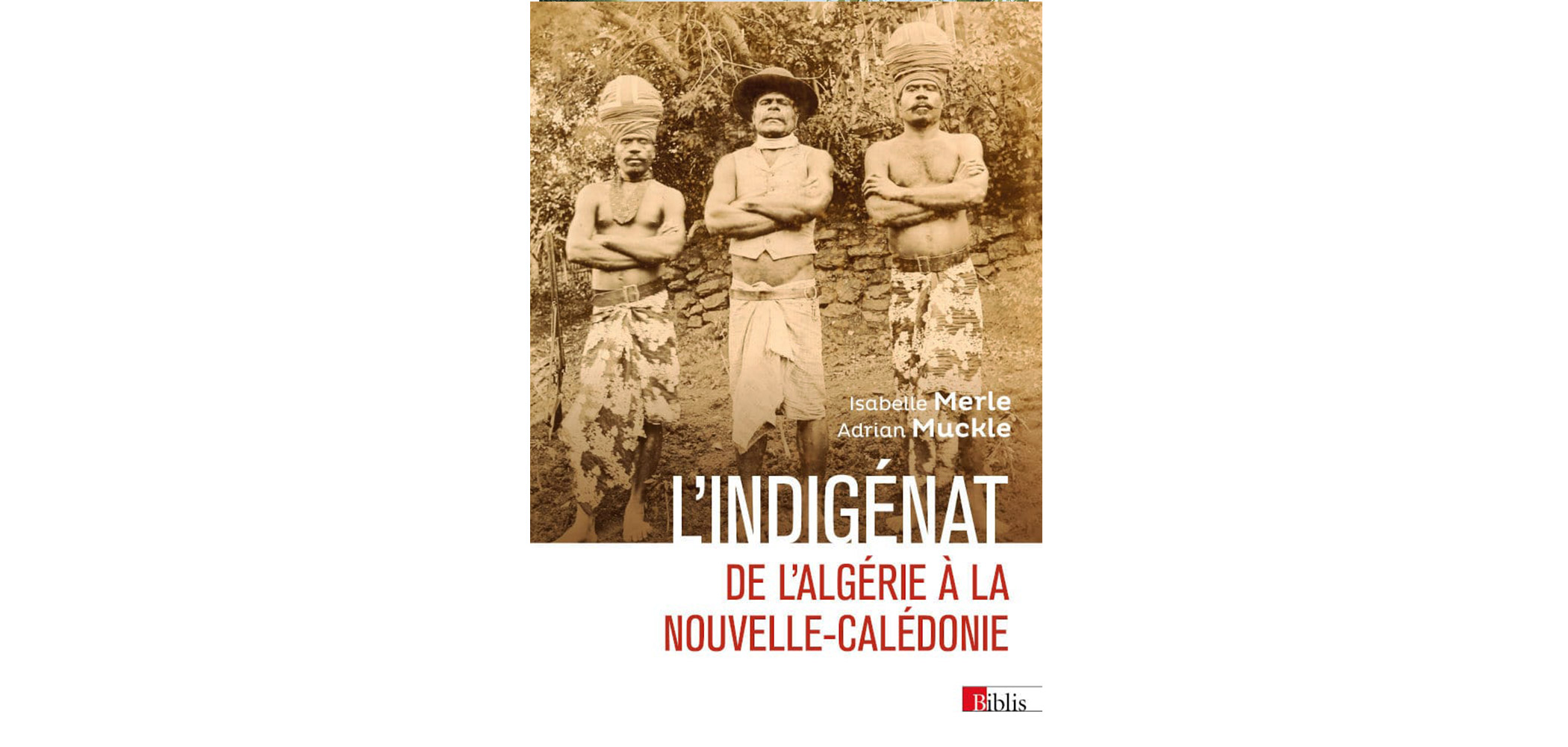
Book Title: The Indigenous Status: From Algeria to New Caledonia
(L’indigénat: De l’Algérie à la Nouvelle-Calédonie)
Authors: Isabelle Merle & Adrian Muckle
Publisher: CNRS Éditions
Publication Year: 2025
The Indigenous Status: From Algeria to New Caledonia, authored by Isabelle Merle and Adrian Muckle and published by CNRS Éditions in 2025, is a major scholarly work consisting of nine chapters and 584 pages. For the first time, the book offers a long-term, comparative history of the indigénat system—from its earliest roots in Algeria during the period of conquest to its most enduring and contemporary legacies in New Caledonia. Known variously as the Code de l’indigénat or simply the indigenous regime, this legal system was among the most consequential juridical mechanisms of the French colonial empire, leaving perhaps the deepest and most lasting imprint on the collective memory of colonized populations.
The authors demonstrate that the significance of the indigénat extends far beyond its formal abolition. As a legal regime that institutionalized inequality, coercion, and differentiated citizenship, it continues to resonate politically and symbolically. The book situates this legacy within France’s long imperial history, emphasizing how memories of the indigénat are mobilized in tense and ongoing dialogues between former colonies and the metropolitan center. While Algeria—under French rule from 1830—was formally emancipated from this system, which was applied there between 1881 and 1944, the indigénat nonetheless persists as a historical reference point rather than a closed chapter. Its afterlives are particularly visible in New Caledonia, where colonial legal categories remain central to contemporary political and social debates.
Structure and Chapter Content
- Introduction
The introduction highlights a striking asymmetry in postcolonial memory. In former French territories such as West Africa, Madagascar, or even Vietnam, Laos, and Cambodia, references to the indigénat system are rarely invoked by political authorities today. In contrast, New Caledonia stands out as a space where the indigénat remains a recurring and operational reference in contemporary debates. Since 1988, New Caledonia has undergone an initial decolonization process that culminated in the referendum on self-determination held on 4 November 2018—a process that may be revisited in the years to come.
Among the remaining overseas territories of the former empire, New Caledonia is the only one to have experienced the indigénat regime in its full form. Other French territories—such as French Polynesia, Wallis and Futuna, the French Antilles, Réunion, and French Guiana—escaped its application for historical reasons. In New Caledonia, however, the system was introduced in 1887, six years after its establishment in Algeria and Cochinchina, and it endured until its abolition in 1946. The authors emphasize that behind the term “indigenous” lies a deeply complex, multifaceted, and analytically demanding object of study—one that must be examined simultaneously at imperial and local levels.
- A Classical Chapter of Colonial Law
Until the Second World War, the indigénat constituted a canonical chapter of colonial law and served as the subject of numerous legal dissertations. With the advent of decolonization, this field of legal study was largely abandoned, as the colonial context that gave it meaning collapsed and colonial law itself was relegated to the margins of scholarly attention. Nonetheless, anthropologists, political scientists, and historians continued to investigate the practical operation of the system in specific territories. French colonial historians, in particular, focused on its foundational political principles.
The authors argue that the very complexity of the indigénat—and the sharp contradictions it generated with the fundamental principles of French law—renders it a particularly fertile object of analysis. The system exposes deep tensions inherent in the simultaneous construction of a unified nation and a sprawling empire in the nineteenth century.
- The Fundamental Paradox of Colonization
This section examines how the denial of political rights—rooted in the exclusion of indigenous populations from citizenship—was intrinsically linked to the imposition of an exceptional repressive regime. This regime explicitly authorized the legal use of violence against indigenous populations. The legal status of indigenous peoples and the question of citizenship are shown to be tightly interwoven, yet constantly destabilized by debates over customary law, formal law, and competing definitions of political belonging.
These tensions reveal the full complexity of state-building in colonial contexts. Colonies emerge as exceptional spaces in which the core principles of the nation are tested, suspended, or reconfigured. Although the specific lists of offenses varied from one colony to another, they were animated by common concerns: the defense of colonial public order, respect for authority, obedience to commands, compulsory labor, taxation, and population control. Together, these elements constituted a new social order in which the indigénat played a central regulatory role.
- A Gradually Constructed Exceptional Legal Regime
Rather than opposing legal texts and practices or imposing a retrospective definition of indigénat, the authors adopt a deliberately historical approach. They trace, as precisely as possible, the gradual process through which an exceptional legal regime was constructed in Algeria between 1840 and 1881. This involves following the twists and turns of debates, interactions, disagreements, advances, and setbacks that shaped the system.
The objective is not to produce an exhaustive conceptual history of indigénat, but rather to progressively delimit the scope of inquiry by identifying what the authors term the “paths of indigeneity.” This methodological choice allows for a more nuanced and empirically grounded understanding of how the regime took shape over time.
- The Central Role of the Indigenous System in New Caledonia
The analysis then turns to New Caledonia, where the indigénat formed the backbone of a spatial and social organization that was preserved between the two World Wars, survived the post-war period, and continues to structure social relations today. This organization constitutes a fundamental colonial legacy and has been, since 1946, at the heart of debates concerning the future of Kanak society in a postcolonial context.
Unlike other colonial territories, the notion of “indigenous status” in New Caledonia played a pivotal role in legally defining who counted as indigenous, almost as if the regime itself were sufficient to constitute the indigenous subject as an object of law. Notably, the first explicit legal definition of an indigenous person in the colony was introduced in 1915, during a revision of the list of offenses specifically targeting violations of indigenous status.
Conclusion
The indigénat system is rooted in a historical past that the descendants of colonizers still struggle to confront openly, while continuing to function as a constraining force for Kanak society. At the same time, it operates as an active reference point within nostalgic memories of an alleged “old order” or a mythic “greater New Caledonia.” On the Kanak side, this nostalgia often takes the form of reverence for elders and chiefs who commanded obedience within a structured social hierarchy. On the European side, it manifests as an idealized image of a distinctly French territory, free of crime and governed by metropolitan norms, implicitly celebrating the superiority of French lifestyles and Western values.
Ultimately, Merle and Muckle seek to advance historical knowledge grounded in rigor and impartiality. They call for the restoration of justice and accountability to past actors so that their descendants may engage with their history consciously, responsibly, and without enduring pain. The book stands as a major contribution to the study of colonial law, memory, and decolonization, offering critical insights into the enduring legal and social legacies of empire.


