

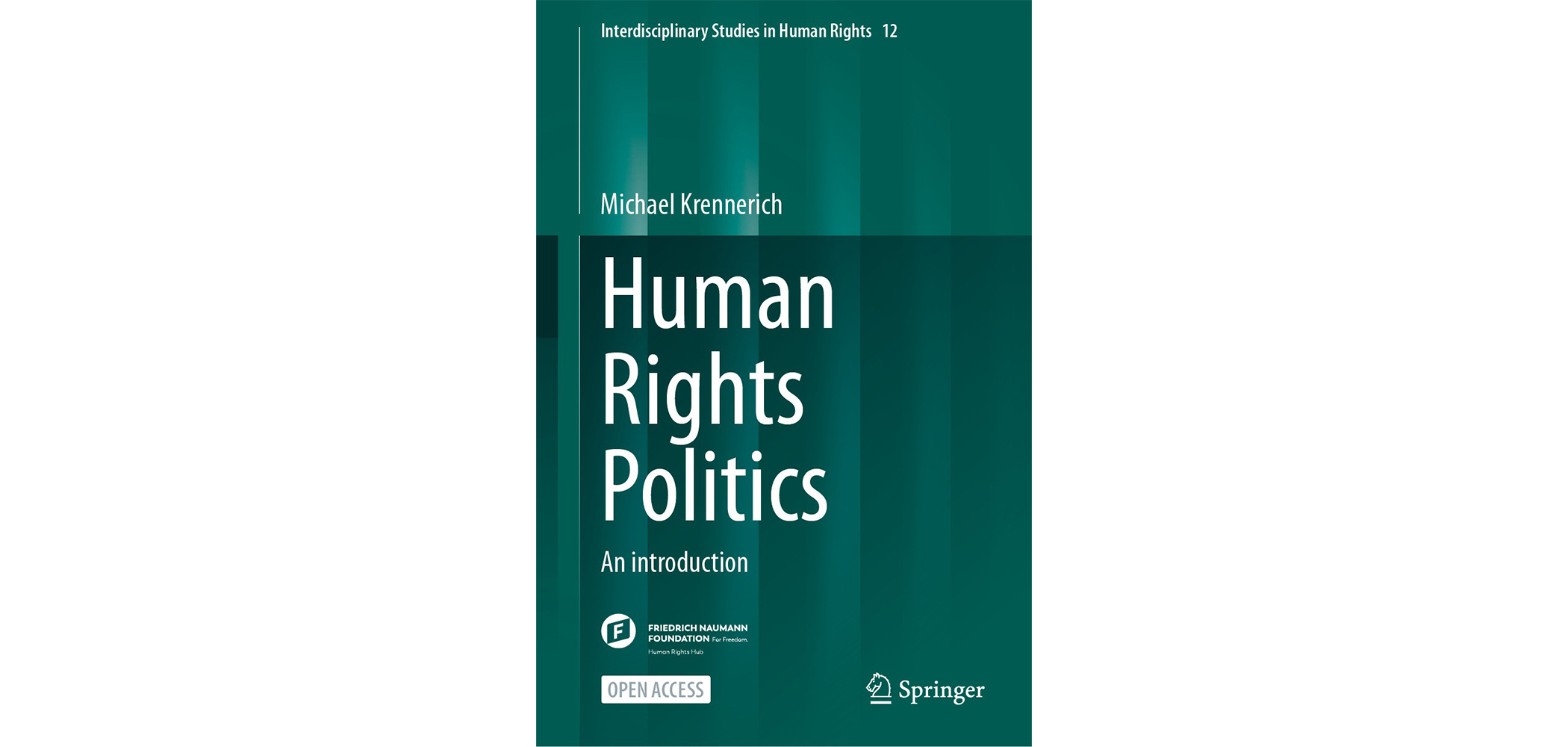
Book Title: Human Rights Politics: An Introduction
Author: Michael Krennerich
Publisher: Springer
Publication Year: 2024
Human Rights Politics: An Introduction, authored by Professor Michael Krennerich and published by Springer in 2024, offers a rigorous, analytical, and critically engaged examination of the political nature of human rights and the complexities surrounding their implementation in practice. Written against a historical and political backdrop in which the late twentieth-century optimism for a global human rights–based order has encountered significant structural and political obstacles, the book confronts the persistent challenges to the realization of civil, political, economic, social, and cultural rights.
Krennerich situates his analysis within the twenty-first century resurgence of illiberal and authoritarian regimes, arguing that human rights are not a declining project but, rather, an increasingly urgent and indispensable political endeavor. From his perspective, human rights must not be reduced to a body of moral principles or legal instruments alone; they constitute a field of power struggles, policymaking processes, and social contestation. Human rights are thus presented as both a normative framework and a deeply political arena in which meanings, priorities, and modes of implementation are continuously negotiated.
The central focus of the book lies in examining how human rights policies manifest in practice and how they can be assessed through the analytical tools of political science. By bridging theory and implementation, Krennerich demonstrates how human rights policies are formulated, enacted, monitored, and evaluated, and what consequences they generate. The work adopts a comprehensive, interdisciplinary, and practice-oriented approach, addressing overlooked gaps while amplifying the voices of marginalized groups whose rights remain structurally sidelined.
The book also engages substantively with feminist, anti-neoliberal, and postcolonial critiques, illustrating how these perspectives open new horizons for rethinking and reinterpreting human rights. Furthermore, it addresses emerging global challenges—most notably the climate crisis—and explores their implications for the rights of future generations and even the rights of nature, thereby pushing the boundaries of traditional human rights discourse.
Structure and Chapter Content
- Chapter One: Human Rights and Human Rights Politics
The opening chapter lays the conceptual foundation of the book and invites readers to engage deeply with the nature and functioning of human rights. Krennerich begins by offering a precise and analytical definition of “human rights,” demonstrating that they are not abstract moral propositions but historically situated, multilayered phenomena shaped by power struggles, social movements, and institutional transformations.
Human rights are portrayed not as static, universally fixed norms but as dynamic outcomes of ongoing political and social processes. They are continually redefined through interactions among states, civil society actors, international organizations, and marginalized communities. In this sense, human rights operate simultaneously as a normative ideal and as a political battleground where meanings and priorities are constantly contested.
A substantial portion of the chapter develops a conceptual framework for understanding “human rights politics.” Drawing on political science methodologies, the author illustrates how human rights policies can be analyzed across multiple levels—from national governance to international institutions—covering agenda-setting, policy formulation, implementation, monitoring, and evaluation. This approach highlights the intrinsic link between normative theory and practical consequences.
Overall, the first chapter provides a critical and holistic lens through which readers can grasp the complex relationship between human rights ideals and the realities of power politics.
- Chapter Two: Civil Society Engagement
The second chapter turns to one of the core pillars of human rights politics: the role of civil society and non-state actors in promoting, protecting, and institutionalizing human rights. The author introduces the concept of “human rights empowerment,” explaining how legal awareness, collective action, and social organization transform individuals and groups from passive subjects into active rights claimants.
Human rights are presented not as rights merely granted from above, but as outcomes of interactive and socially embedded processes. Particular attention is devoted to human rights NGOs and social movements. Krennerich analyzes their organizational structures, internal governance patterns, advocacy strategies, and mechanisms of influence at local, national, and international levels. He demonstrates how transnational networking, strategic litigation, media engagement, and interaction with international institutions expand the reach and impact of civil society actors.
Drawing on social movement theory, the chapter explores both internal and external dynamics of mobilization, including social grievances, resource mobilization, issue framing, political opportunity structures, protest repertoires, state repression, and the role of collective emotions in sustaining activism. The author emphasizes that civil society action cannot be understood independently of broader cultural, socio-economic, and ecological contexts.
Through this multidimensional analysis, the chapter underscores civil society’s decisive and dynamic role in shaping human rights politics.
- Chapter Three: State Domestic Human Rights Politics; The Implementation of Human Rights at Home
Chapter Three addresses the core responsibility of states in implementing human rights within their national jurisdictions. The author begins by clarifying states’ obligations—not only to respect rights, but also to protect them and ensure their effective realization. Comprehensive legal recognition of human rights in constitutional frameworks, statutory law, and institutional structures is presented as a fundamental precondition for meaningful policy development.
The chapter then analyzes ambitious human rights policies that go beyond minimal compliance and adopt proactive, preventive, and developmental approaches to civil, political, economic, social, and cultural rights. Implementation is framed not merely as a response to violations but as an ongoing project aimed at improving quality of life and guaranteeing structural equality.
Attention is given to the wide spectrum of human rights policy domains, from fundamental freedoms and rule of law to welfare policies, education, health, housing, and social justice. The author highlights the differentiated roles of the legislative, executive, and judicial branches and demonstrates how their interaction and balance of power directly influence policy effectiveness.
To deepen the analysis, the chapter draws on key political science frameworks, including the policy cycle model, partisan theory, advocacy coalition theory, policy learning, lesson-drawing, and policy transfer. These theoretical tools illuminate how human rights policies evolve, adapt, and improve over time.
- Chapter Four: State Human Rights Foreign Policy; Protecting Human Rights Abroad
Chapter Four expands the analytical lens to states’ foreign human rights policies. The author introduces the concept of extraterritorial obligations, demonstrating that state responsibility extends beyond territorial borders in contexts such as military interventions, development cooperation, foreign investments, and the activities of multinational corporations.
The chapter examines the diversity of national approaches to human rights in foreign policy, showing how normative commitments interact with national interests, economic capacities, and geopolitical considerations. While some states position human rights at the core of their foreign identity, others pursue more instrumental or conditional approaches.
As a case study, Krennerich analyzes Germany’s human rights foreign policy, examining institutional actors, decision-making processes, and policy instruments, including diplomacy, sanctions, monitoring mechanisms, development cooperation, and economic conditionality. The chapter highlights tensions between normative aspirations and security or economic interests.
Theoretical perspectives from foreign policy analysis—including cognitive, psychological, bureaucratic, and domestic political approaches—are employed to explain how leaders’ perceptions, institutional structures, and internal power dynamics shape external human rights policies.
- Chapter Five: Regional and Global Human Rights Policy
Chapter Five shifts to the regional and global architecture of human rights governance. Beginning with Europe, the author analyzes the European Union’s internal and external human rights roles, the Charter of Fundamental Rights, and the interplay between norms and power. The Council of Europe and the European Court of Human Rights are examined as key guardians of regional protection mechanisms, alongside the human dimension of the OSCE and comparative regional systems worldwide.
At the global level, the chapter maps the institutional landscape of the United Nations human rights system, including the Human Rights Council, Universal Periodic Review, treaty bodies, and the Security Council’s engagement with severe human rights crises. The author highlights both opportunities for accountability and structural political limitations.
The chapter also addresses international criminal jurisdiction and the role of international courts in prosecuting grave violations. Drawing on international relations theories—realism, liberalism, and constructivism—as well as the spiral model of human rights change, the author explains how domestic and international pressures can gradually transform state behavior.
- Chapter Six: Closing Words
The final chapter moves beyond summary to offer a forward-looking and critical reflection. Krennerich reiterates that human rights constitute a dynamic political project embedded in power structures rather than a static normative system. He returns to a central question: how can human rights become an effective force for justice in an unequal and rapidly changing world?
Addressing contemporary challenges—including renewed authoritarianism, climate crises, economic inequality, and geopolitical transformation—the author emphasizes resilience, innovation, and solidarity as prerequisites for sustaining human rights as an emancipatory project. Human rights are framed as an ongoing collective responsibility requiring continuous theoretical reflection and practical commitment.
Conclusion
Human Rights Politics: An Introduction stands as a comprehensive, analytical, and strategically oriented contribution to the study of human rights politics. By applying political science perspectives to the inherently political and contested nature of human rights, Krennerich offers a multidimensional portrait of contemporary human rights governance—from civil society activism to domestic and foreign policymaking, and from regional frameworks to global institutions.
Its focus on practical mechanisms, policy instruments, theoretical frameworks, and emerging global challenges renders the book an invaluable resource for policymakers, human rights practitioners, scholars, and students alike. The work not only deepens understanding of the complexities of human rights politics but also proposes concrete pathways for advancing human rights at local, national, regional, and global levels.
Supported by the Friedrich Naumann Foundation, the publication reflects its relevance within contemporary debates on freedom, rule of law, and empowerment of marginalized communities. Ultimately, the book constitutes a compelling invitation to critically rethink human rights politics and to renew collective commitment to building a more just, accountable, and inclusive world.


