

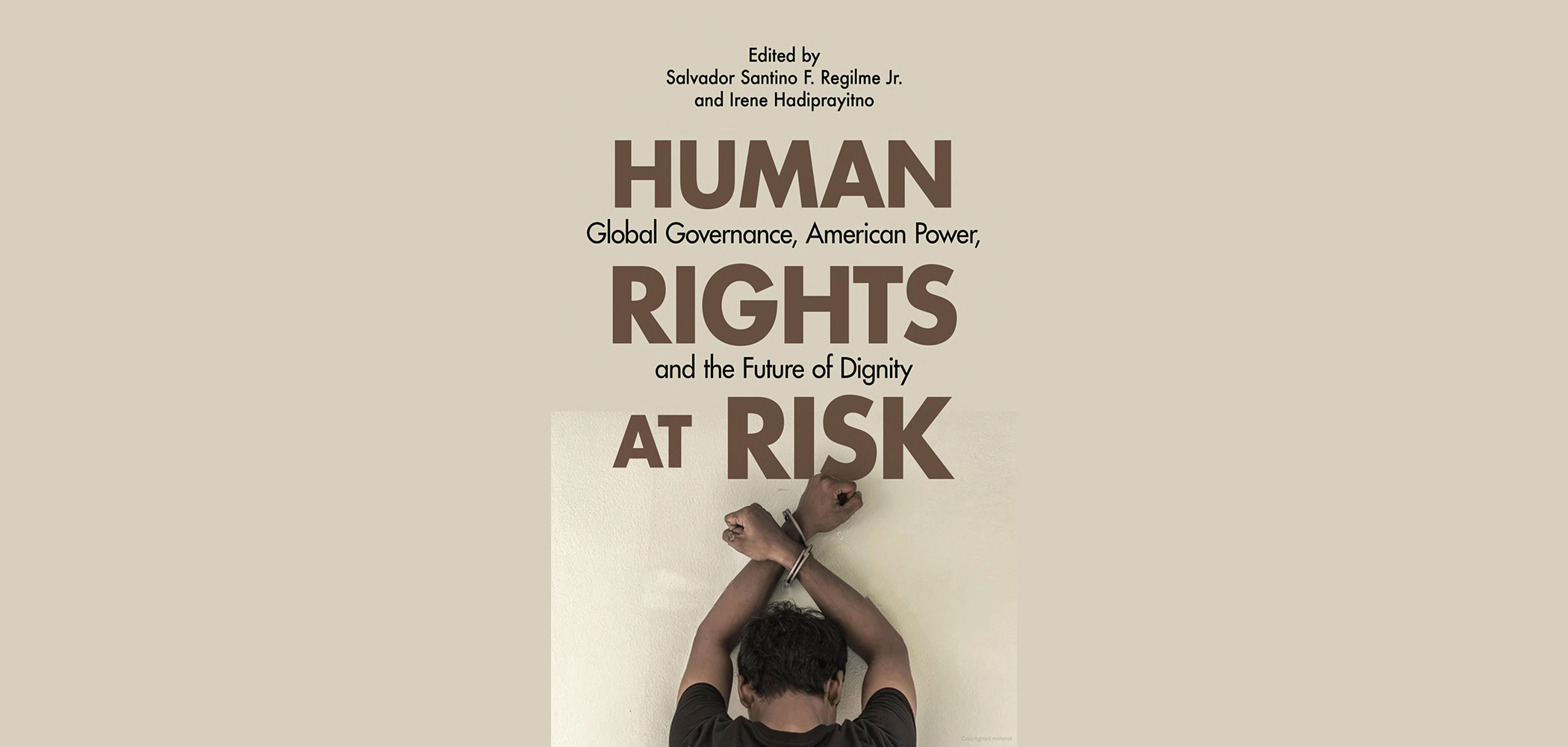
Book Title: Human Rights at Risk: Global Governance, American Power, and the Future of Dignity
Editors: Salvador Santino Regilme & Irene Hadiprayitno
Publisher: Rutgers University Press
Publication Year: 2024
This interdisciplinary volume offers a multifaceted portrayal of the structural, discursive, and practical crises confronting the global human rights regime. Through a synthesis of theoretical analysis and detailed case studies, the contributors examine the dysfunction of international institutions, the double standards of Western powers—particularly the United States—and the marginalization of lived experiences among peripheralized communities. The book’s central objective is to critically revisit the concept of “human dignity” and to design pathways for reimagining the human rights discourse in today’s multipolar global order.
Structure and Chapter Content
- Part One: Introduction
The introductory section presents the international human rights system as situated within a fragile and contested landscape. Rather than safeguarding human rights, international institutions are often entangled in geopolitical rivalries, political expediency, and structural constraints. With a historical analysis of the global human rights regime’s evolution, this section illustrates how successive global crises—from the Iraq War to the COVID-19 pandemic—have eroded trust in the system’s emancipatory potential.
- Part Two: Effectiveness of International Human Rights Institutions
This part focuses on institutional analysis, critically evaluating the failures of formal mechanisms in addressing serious human rights challenges:
- The Universal Periodic Review (UPR) mechanism of the United Nations, despite its aspirational goals, has devolved into a decorative instrument due to its diplomatic formalism, superficial reporting, and lack of enforcement capabilities. The book presents empirical evidence showing how states manipulate the UPR process to whitewash their human rights records.
- The African Group’s role within the Human Rights Council is analyzed through the lens of power dynamics between emerging and established actors. While the group has sought to expand its influence, the authors argue that internal divisions and financial dependencies on Western donors have severely limited its effectiveness.
Collectively, this section contends that the undemocratic design, political pressure, and institutional impotence have transformed global human rights bodies into arenas of power bargaining rather than platforms for justice.
- Part Three: Thematic Blind Spots in International Human Rights
This section addresses the neglected or underrepresented experiences within the dominant global human rights discourse:
- The disregard for cultural rights and heritage in mainstream human rights analysis perpetuates cultural imperialism and erases the historical memory of communities. The book offers examples from Afghanistan, Iraq, and Syria, where the destruction of cultural artifacts has not been recognized adequately as crimes against collective identity.
- Repressive security policies, such as the “war on drugs” in the Philippines, are examined as cases where state violence is legitimized under the banner of law and order, while existing human rights frameworks lack the tools to effectively challenge such systemic brutality.
- The neglect of race, gender, and class intersections in human rights frameworks has led to the exclusion of marginalized groups from decision-making processes. The book highlights cases of police violence against Black communities, suppression of feminist movements, and the invisibility of Indigenous demands as evidence of this structural oversight.
This part calls for an intersectional and localized approach to human rights policy-making and argues that without epistemic transformation, global human rights discourse cannot achieve inclusive emancipation.
- Part Four: The United States and Human Rights Challenges
This part scrutinizes the United States both as an international actor and a domestic case study:
- The Trump era is analyzed as a paradigmatic case of liberal democratic decline. The contributors particularly highlight the U.S. withdrawal from multilateral bodies, its neglect of migrants, attacks on independent media, and the erosion of judicial autonomy as signs of the country’s deteriorating democratic legitimacy.
- American exceptionalism is identified as a major impediment to the country’s commitment to international human rights norms. The United States has consistently refused to recognize the jurisdiction of the International Criminal Court and has not ratified core conventions such as CEDAW. This behavior, the authors argue, undermines the credibility of a Western-centric human rights discourse.
- Part Five: Rethinking the Future of Human Rights
Rather than merely diagnosing the crisis, this section seeks to chart emancipatory futures for human rights:
- A return to natural law theory is proposed as a foundational framework for reimagining human dignity within legal systems. Philosophical grounding, the authors argue, can act as a safeguard against the instrumentalization of human rights.
- Historical and future-oriented analysis underscores that without conceptual reconstruction, human rights discourse will remain ill-equipped to address emerging global challenges such as climate catastrophe, mass displacement, and digital authoritarianism.
- Emancipatory rights are introduced as a theoretical alternative that centers the political, economic, and cultural demands of marginalized communities. This framework insists that human rights must be not only legalistic but also rooted in resistance, social transformation, and democratic participation.
Conclusion
Overall, this book offers a precise and cautionary portrayal of the future of the human rights discourse should current trajectories persist. From the authors’ perspective, restoring the legitimacy of the system requires a fundamental transformation of global power structures, the reform of international institutions, the expansion of socio-economic rights, and the active participation of marginalized groups. Without such a transformation, human rights risk devolving from a liberatory ideal into an ideological and ineffectual instrument.


