

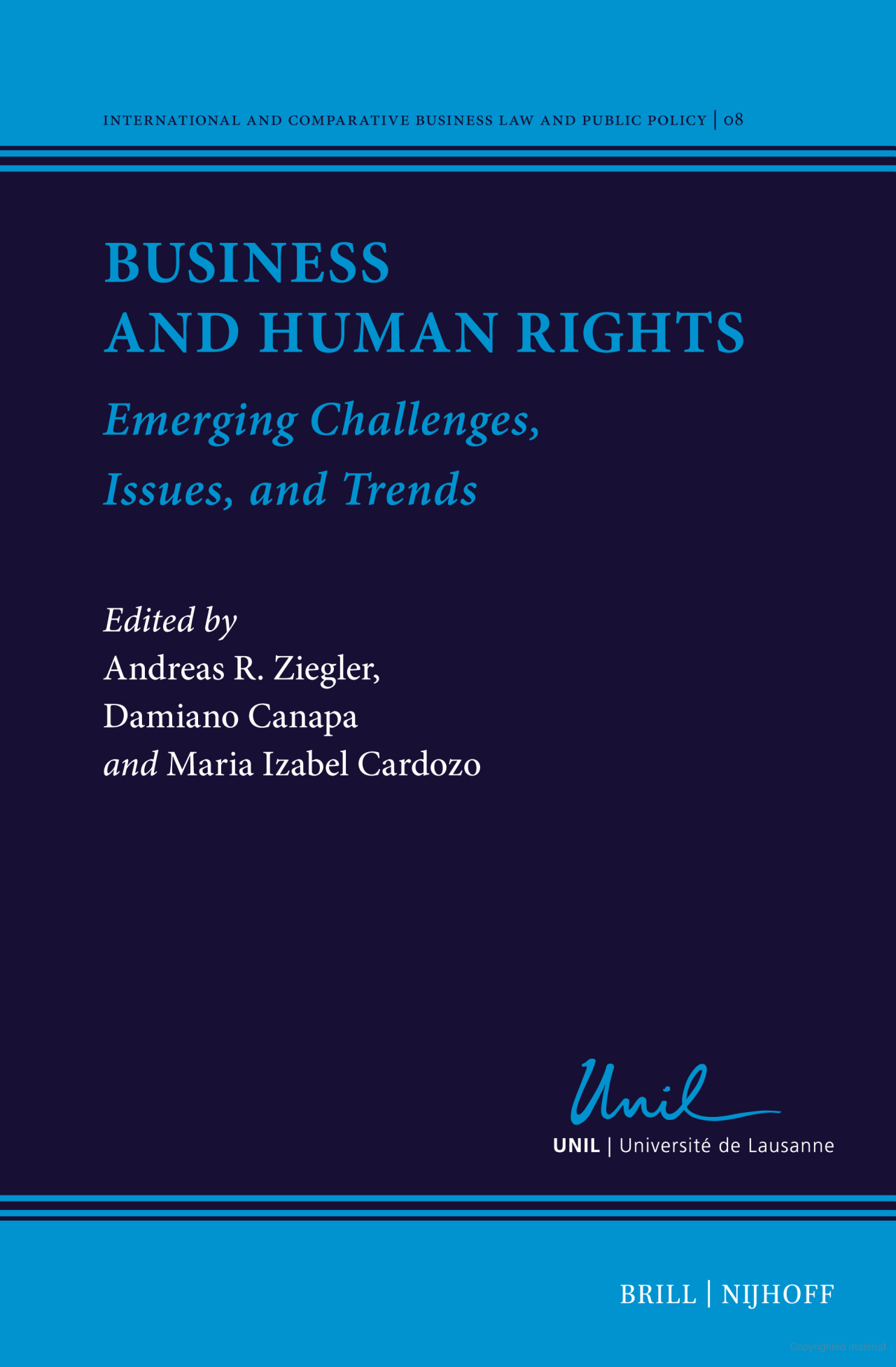
Book Title: Business and Human Rights: Emerging Challenges, Issues, and Trends
Editors: Andreas R. Ziegler & Damiano Canapa & Maria Izabel Cardozo
Publisher: Brill
Publication Year: 2024
The book Business and Human Rights: Emerging Challenges, Issues, and Trends is a collection of scholarly articles that explore various dimensions of the relationship between business activities and human rights. Published by the Swiss National Science Foundation, the book focuses on developments and debates that emerged in the year 2023.
It begins with an introduction that offers an academic overview of the intersection between business and human rights. Business-related human rights violations often raise questions that cut across multiple legal domains, including environmental law, investment law, constitutional law, labor law, antitrust law, and even sports law. Overall, the book serves as a practical guide for understanding the multifaceted nature of business and human rights, presenting real-world examples and case studies applicable in academic and professional settings alike.
Structure and Content of the Chapters
- Chapter 1: From International “Soft” Law to Law in Business and Human Rights: The Role of the ungps in the Development of Formal Sources of International Law
This chapter examines the role of the UN Guiding Principles on Business and Human Rights (UNGPs) in shaping formal international legal sources. It discusses the push toward developing a global multilateral treaty aimed at addressing the limitations of non-binding frameworks. The chapter also reviews the process of treaty negotiation, the mandate of the open-ended intergovernmental working group, and alternative approaches to strengthening domestic implementation of key treaty provisions, highlighting the shift from soft to hard law in this field.
- Chapter 2: Corporate Lawyers and Climate Change: Perspectives from Professional Ethics and Business and Human Rights
This chapter explores the ethical and legal dilemmas faced by corporate lawyers in addressing climate change. The authors argue that focusing solely on individual decisions is insufficient, and systemic institutional challenges must also be addressed. It presents two frameworks—professional legal ethics and business responsibility for human rights—and analyzes the tensions between them, such as access to justice versus independence of counsel. The chapter concludes with policy recommendations including regulatory reform, practical guidance, and fostering public dialogue.
- Chapter 3: Learning from the Conflict Dynamics in Ukraine: Towards a Conceptual Framework for Heightened Human Rights Due Diligence
The focus here is on the need for enhanced human rights due diligence in conflict-affected areas. Using the war in Ukraine as a case study, the authors argue that companies must account for factors such as size, market position, and proximity to conflict. The chapter proposes a conceptual framework to assess escalated responsibilities, ensuring that business operations in such areas meet minimum human rights standards.
- Chapter 4: The Relevance of Mandatory Human Rights and Sustainability Due Diligence for the Greening of EU Antitrust Law
This chapter analyzes how mandatory human rights and sustainability due diligence could influence EU antitrust law. It contends that fully integrating sustainability concerns into competition law is essential to addressing the climate crisis.
- Chapter 5: Shared Responsibility for Human Rights in the Algorithmic Age: Why Business Should Be the States’ally to Eliminate Discrimination
This chapter investigates the role of businesses in ensuring human rights-compliant algorithmic governance. As both governments and companies increasingly invest in AI-driven decision-making systems, the risk of algorithmic bias and discrimination grows. The chapter advocates for shared responsibility and proposes a legal framework featuring voluntary AI principles and standards tailored for corporate implementation.
- Chapter 6: Reasonable Accommodation as a Tool for States and Businesses to Cope with the ungps
The chapter discusses reasonable accommodation as a strategic tool to promote diversity and equality in the workplace. Emphasizing the importance of fairness and inclusion, the author illustrates how reasonable accommodation can serve as an effective mechanism to address structural discrimination and support vulnerable groups.
- Chapter 7: Venture Capital and Human Rights Due Diligence: Time to Act
This chapter highlights the role of the tech industry in both violating and promoting human rights. Examples include Facebook’s involvement in the Arab Spring, unrest in Myanmar, labor law violations in digital platforms, and the Wirecard scandal. It argues for greater accountability within the technology sector.
- Chapter 8: Risk-Creating Industries’ Obligation to the Right to Health
The focus here is on industries that endanger public health. The chapter explores the strategies employed by private sector actors to promote harmful products and defines “commercial determinants of health” as key factors in undermining the right to health.
- Chapter 9: From Non-discrimination to the Guiding Principles and Back: How the Olympics Have Addressed Human Rights until Today
This chapter traces the evolution of the relationship between the Olympic Games and human rights across four major periods: the 1936 Berlin Olympics, the anti-racism movements of the 1960s and 1970s, critiques of China’s 2008 and 2022 Olympic hosting, and the most recent developments.
- Chapter 10: Business and Human Rights: Issues of Private International Law
This chapter analyzes the challenges of implementing human rights and corporate social responsibility obligations through private international law. It also addresses the divergences between national and transnational approaches and discusses ongoing treaty-making efforts.
- Chapter 11: Civil liability in the EU Corporate Sustainability Due Diligence Directive: A “Brussels Effect” on International Investment Law?
The chapter assesses civil liability provisions in the EU’s Corporate Sustainability Due Diligence Directive and considers whether they might produce a “Brussels Effect” on global investment law.
- Chapter 12: Is Arbitration the Answer? An Analysis of Applicable Substantive Law under the Hague Rules on Business and Human Rights Arbitration in the Context of the ict Manufacturing Industry
This chapter explores the applicability of different substantive legal regimes—ranging from soft international norms to domestic laws and contractual standards—within the context of international arbitration in the ICT supply chain.
- Chapter 13: Human Rights Compliance in Investment Activities: Some Challenges from the New Latin American Constitutionalism
Focusing on Latin America’s new constitutional frameworks, this chapter examines human rights compliance in investment activities, with an emphasis on indigenous rights, environmental protection, and state sovereignty over natural resources.
- Chapter 14: Interface between the Judiciary and National Human Rights Institutions: A Means to Ensure Effective Remedies for Business-Related Human Rights Abuses?
The chapter discusses the potential of judicial systems and national human rights institutions to guarantee access to remedies for victims of corporate human rights abuses.
- Chapter 15: Foreword to the Updated iba Guidance Note on Business and Human Rights: The Role of Lawyers in the Changing Landscape
This chapter highlights recent developments in national and international legal standards on human rights reporting and due diligence, offering guidance to lawyers advising clients on compliance.
- Chapter 16: Updated iba Guidance Note on Business and Human Rights: The Role of Lawyers in the Changing Landscape
The final chapter presents the updated guidance by the International Bar Association, focusing on the three pillars of the business and human rights framework: the duty of states to protect, the responsibility of businesses to respect, and the right of stakeholders to access effective remedy. It outlines practical strategies for legal professionals to navigate these evolving responsibilities.
Conclusion
In conclusion, Business and Human Rights: Emerging Challenges, Issues, and Trends is a comprehensive, rigorous, and multi-dimensional work that stands at the intersection of theory and practice, law and economics, and responsibility and profitability. Employing an interdisciplinary approach and drawing from both theoretical analysis and real-world case studies, the book constructs a nuanced and cohesive understanding of human rights obligations within contemporary business operations. It is an invaluable resource for human rights advocates, policymakers, academic researchers, and corporate leaders seeking a deeper, strategic engagement with the evolving legal and ethical landscape of international commerce.


