

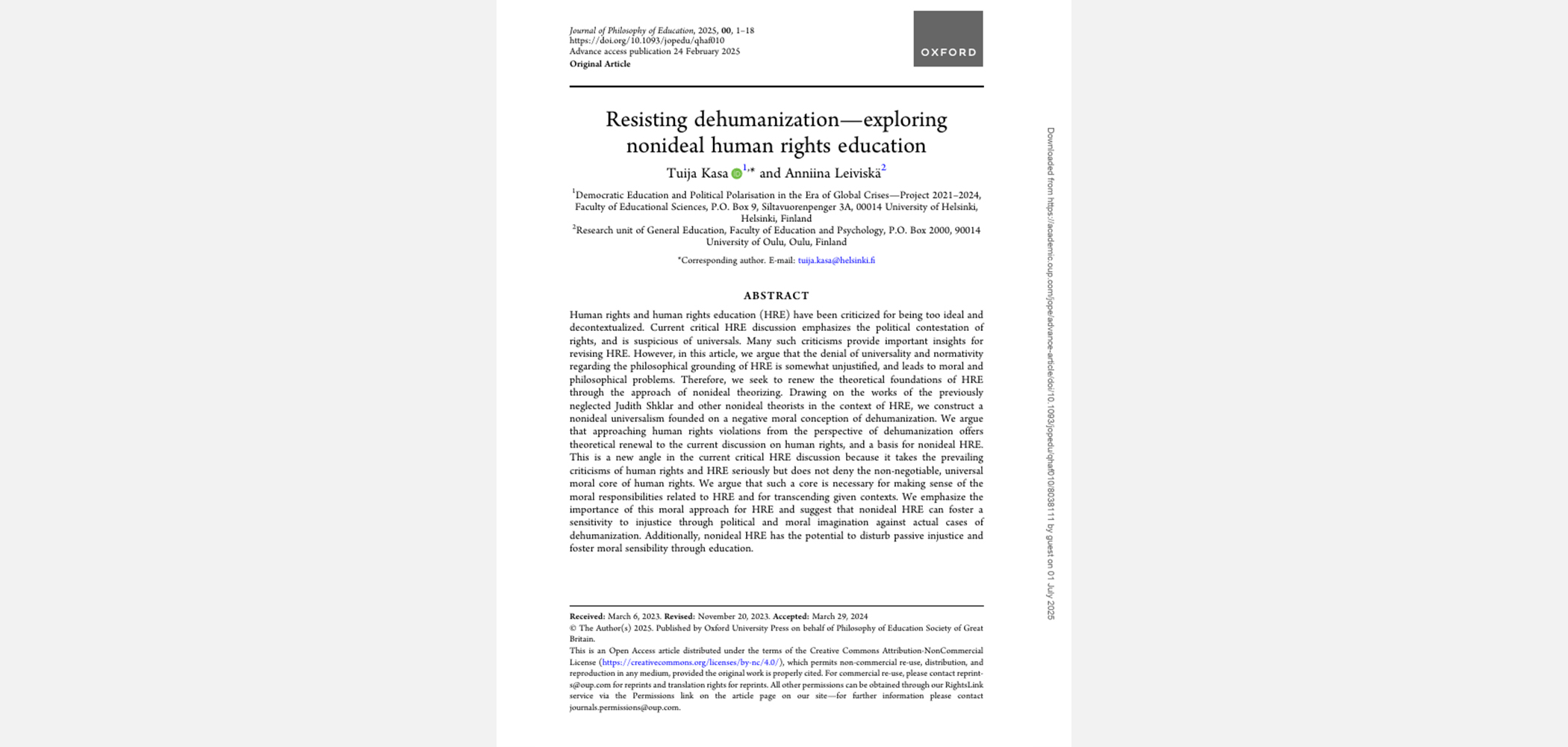
Article Title: Resisting Dehumanization—Exploring Nonideal Human Rights Education
Authors: Tuija Kasa & Anniina Leiviskä
Journal: Journal of Philosophy of Education
Publication Year: 2025
This article, the result of a scholarly collaboration between Tuija Kasa and Anniina Leiviskä from the University of Helsinki, was published in 2025 in an 18-page format. The research revisits the theoretical and ethical foundations of human rights education, with a particular focus on the concept of dehumanization and the framework known as nonideal theorizing. The authors argue that traditional approaches to human rights education, due to their excessive reliance on idealistic frameworks, have been the subject of serious criticism. In response to these critiques, the article seeks to simultaneously affirm the necessity of maintaining the universality and ethical foundations of human rights while proposing an alternative pedagogical model grounded in a nonideal approach.
Kasa and Leiviskä contend that human rights education—particularly in its conventional, document-based forms—has grown increasingly detached from real social conditions, resulting in both theoretical and practical disillusionment among activists and educators. While the critiques of idealistic human rights frameworks offer valuable insights, the authors caution that some of these critiques—particularly those that reject the moral universality of human rights—may themselves give rise to ethical and philosophical problems. They advocate for a critical, nonideal re-evaluation of the foundations of human rights education, without abandoning the legitimacy or normative authority of the human rights project itself.
Methodology
The article adopts a nonideal theoretical approach. Unlike ideal theories that emphasize abstract principles of justice and humanity, nonideal theory focuses on analyzing concrete realities, actual cases of human rights violations, and the lived experiences of victims and activists. Rather than proposing an ideal order, this approach seeks to critique existing structures of injustice and enable practical interventions aimed at their reduction.
Rethinking Disillusionment and Possible Pathways
The authors acknowledge that while human rights are indeed an aspirational ideal that has, for decades, provided a powerful legal and political foundation for global justice movements, official human rights education often suffers from overemphasis on abstract principles and legal texts. This abstraction has led to a disconnect from the lived experiences of communities and individuals, thereby generating widespread disillusionment. The tension between human rights ideals and socio-political realities has been the subject of sustained criticism, particularly in the past two decades. According to the authors, at a time when global human rights are being challenged by elites, authoritarian regimes, populists, and nationalists, denying their ethical basis risks undermining their normative goals—namely, social and global justice.
The Role of Dehumanization and Moral Imagination
Building on this foundation, the authors focus on the concept of dehumanization and argue that human rights education must be redefined by invoking a sense of injustice in students, educators, and youth. This sense should arise through direct engagement with real-life examples of human rights violations and through the use of moral and political imagination. Rooted in a form of negative moral stance, this approach does not aim to affirm abstract human virtues or ideals, but instead seeks to cultivate moral awareness through sensitivity to manifestations of dehumanization. In doing so, it promotes the formation of critical, empathetic, and ethically engaged citizens.
Moral Universalism and Nonideal Theory
According to Kasa and Leiviskä, ideal theories often fail to address structural violence because they abstract away from social inequalities and the real agents of injustice. They emphasize that human rights violations predominantly occur in nonideal conditions, which necessitates an approach that is grounded in reality and attuned to power dynamics. Nonideal theorizing, therefore, must engage with field-based experiences, listen to victims’ voices, and undertake a critical re-reading of the political, educational, and cultural structures in which these violations are embedded.
Dehumanization as the Foundation for Human Rights Thought
In the article’s proposed framework, dehumanization is not merely an outcome but a point of departure for analyzing human rights. The authors propose that rather than defining humanity through positive traits such as rationality or autonomy, we should begin by identifying and analyzing what constitutes the denial of humanity—such as racism, systematic violence, social exclusion, and cultural erasure. This shift in perspective enables a deeper understanding of inequality and fosters a more responsive moral and political consciousness.
Key Critiques of Traditional Human Rights Education
The authors identify three core criticisms of conventional human rights education:
- Legalism: An exclusive focus on legal documents without analyzing the power structures that violate them.
- Moralism: Treating human rights as the sole valid moral language, which may silence marginalized or alternative moral discourses.
- Eurocentrism: Ignoring non-Western cultural and historical contexts and reproducing a singular, often Western-centric, narrative of humanity.
Why This Theoretical Shift Matters for Human Rights Education
Kasa and Leiviskä argue that traditional human rights education, with its focus on international instruments and abstract concepts such as “human dignity,” often fails to resonate with the lived realities of students and communities. In contrast, nonideal theory—by focusing on tangible experiences of discrimination, exclusion, and violence—links education to everyday life. This linkage enhances learners’ critical thinking, moral responsibility, and agency.
Features of Nonideal Human Rights Education
According to the authors, nonideal human rights education should:
- Be organized bottom-up, grounded in lived experiences.
- Begin by listening to survivors and victims—including migrants, refugees, and marginalized groups.
- Include historical re-examinations, such as analyzing how educational institutions have perpetuated colonialism or cultural erasure.
- Cultivate sensitivity to injustice: Students should learn how to identify and resist hidden forms of injustice, such as structural discrimination.
Conclusion
In this article, Kasa and Leiviskä demonstrate that human rights education can serve not merely as a theoretical framework, but also as a political tool to counteract dehumanizing structures. By embracing existing critiques and emphasizing moral realism, nonideal human rights education offers a path toward reimagining justice, strengthening political agency, and educating a generation of morally alert and socially engaged citizens. The authors stress that resistance to dehumanization is not achieved by reiterating abstract ideals, but by directly confronting the darkest dimensions of the human experience.


