Introduction
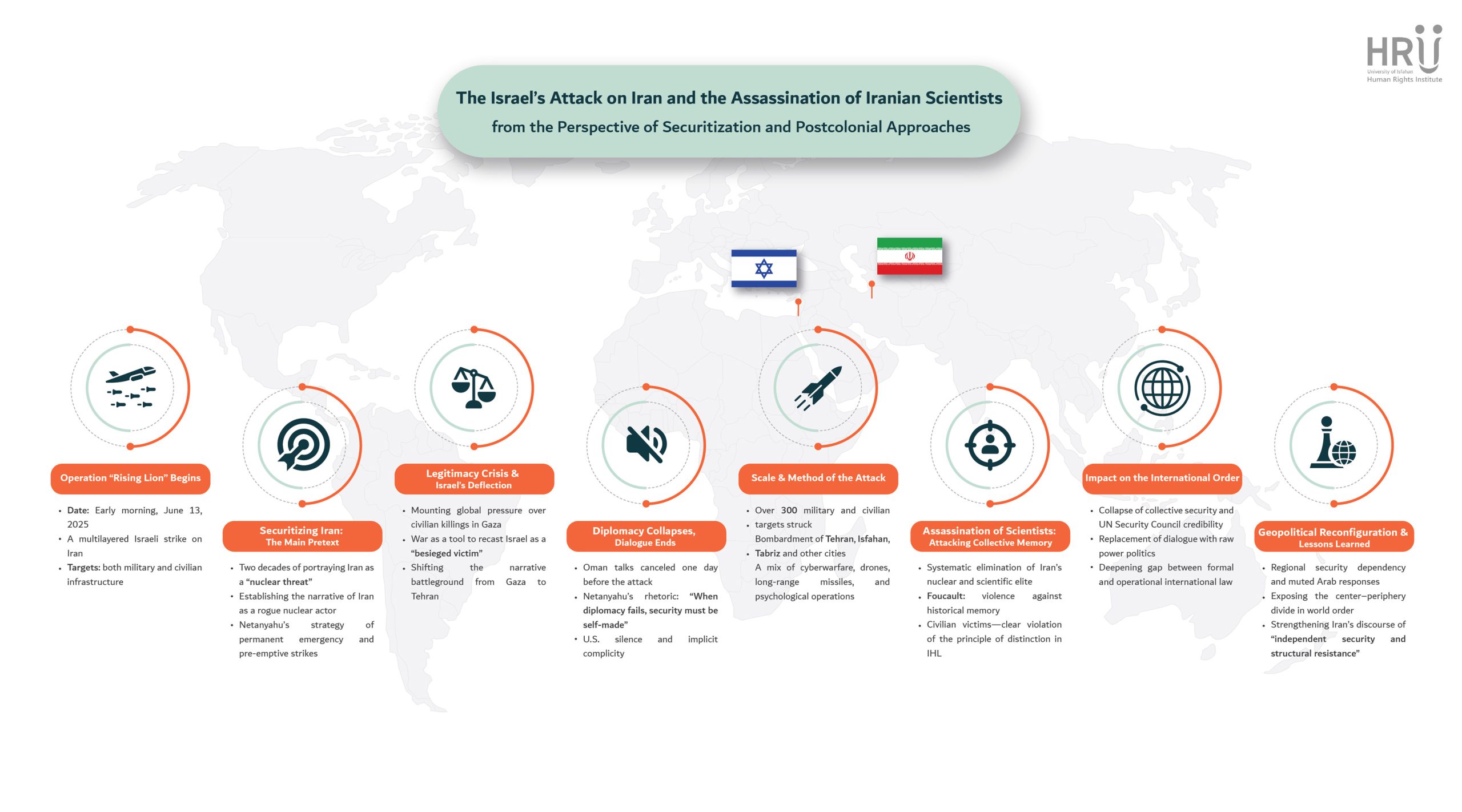
In the early hours of June 13, 2025, the Israeli military launched a multi-layered and systematically organized assault against Iran’s military and civilian infrastructure. An operation that the Israeli official narrative labeled “Rising Lion,” but which, in the security memory of the region, will be remembered as the apex of a systematic policy of physical elimination and the politicization of scientific activity in the Middle East. This event—which resulted in the assassination of key Iranian military and scientific figures—must be understood not merely as a military incident or a tactical response to a security threat, but rather as the concrete manifestation of a broader securitization project and the reproduction of geopolitical domination by a structurally disruptive political actor.
While the Israel sought to frame the attack as a preventive act in the name of national security, in reality, the operation unfolded within a complex network of power equations and the collapse of international deterrence mechanisms. It emerged from a discourse that has been institutionalized over decades by the Israel, the United States, and segments of the European bloc, and which is now routinely deployed to justify direct intervention and the exercise of so-called “legitimate violence” against independent nations.
The Motives and Strategic Logic Behind the Direct Military Attack
To grasp the political logic behind Israel’s direct military assault on Iran, one must move beyond the frame of tactical calculations or immediate security considerations. Rather, this attack should be analyzed as the final stage of a systematic securitization chain—one that, over the past two decades, has progressively constructed and reinforced the narrative of the “Iranian nuclear threat” across global public opinion, international institutions, and regional alliances. Through this sustained discursive effort, Israel not only succeeded in anchoring its threat narrative within the Western bloc of the international order, but also positioned itself as the sole actor authorized to undertake preventive action—even in the absence of any actual military aggression from its adversaries.
The first key element in understanding this assault lies in the continuity of Israel’s project to securitize Iran’s nuclear program. Since the early 2000s, Tel Aviv, leveraging diplomatic, intelligence, and media channels, has sought to depict Iran as a “nuclear rogue actor”—a constructed identity through which any hostile act can be legitimized under the pretext of self-defense. This discourse, particularly during the repeated premierships of Benjamin Netanyahu, became a central pillar of Israeli foreign policy. Netanyahu repeatedly portrayed Iran as being on the brink of a nuclear strike in international forums, often relying on speculative or unverifiable claims rather than independently confirmed data. In 2025, this same logic of hyper-securitization was reactivated: Israel claimed Iran was nearing an irreversible nuclear weapons capability and insisted that diplomacy had become ineffective. These assertions were made despite U.S. intelligence reports acknowledging that Iran had no active program to build a nuclear bomb. But within the logic of securitization, factual accuracy is subordinate; what matters is the ability to convince the audience and fabricate a sense of emergency that justifies exceptional action.
Beyond the security rationale, the attack also carried profound political and media dimensions. In recent years, Israel has faced a legitimacy crisis stemming from the continued killing of civilians in Gaza, increasing international isolation, and deep internal socio-political divisions. In this context, striking Iran served not only as a military maneuver but as a discursive intervention aimed at resetting public perception, rebuilding national unity, and rebranding Israel as the “besieged victim of the Middle East.” This strategy, widely discussed in critical international relations theory as crisis externalization, has historical precedents in Israeli policy—such as the 1982 Lebanon War and the 2014 Gaza conflict. Once again, by shifting the battlefield from Gaza to Tehran, Israel sought to escape mounting moral pressure over the humanitarian crisis in Gaza and reposition Iran as the existential threat.
A third layer involves the diplomatic void and the breakdown of dialogue. The Oman-hosted negotiations between Tehran and Washington—which had been regarded as the last diplomatic opening—collapsed precisely one day before the Israeli assault. This timing was not coincidental. Israel deliberately seized the moment to justify its attack as a response to the failure of peaceful engagement. Netanyahu, in speeches following the assault, reinforced the narrative that “when diplomacy fails, we must ensure our own security.” Such rhetoric, which effectively abandons multilateralism, is in line with Israel’s long-standing strategy of circumventing collective agreements in favor of unilateral military action. The implicit support—or at least the silence—of the United States played a reinforcing role; a silence that, far from neutrality, functioned as passive participation in structural violence, and later materialized in the form of U.S. airstrikes against Iranian nuclear sites.
On a deeper level, the attack must be analyzed within a broader geopolitical project aimed at redefining the regional balance of power in the Middle East. Through this military operation, Israel sought to reaffirm its position as the region’s sole operational and internationally accepted nuclear power—a status fundamentally at odds with any scientific or technological competition from non-allied states. In this light, the targeted assassination of Iranian nuclear scientists was not merely a tactical measure, but an embodiment of technological exceptionalism: the notion that, backed by hegemonic global powers, Israel is entitled to rights and privileges that are categorically denied to others. This is precisely the discriminatory structure that postcolonial theorists identify as selective morality or asymmetrical ethical construction in the international system.
In sum, the Israeli military strike on Iran cannot be understood as a mere reaction to an alleged security threat or a response to diplomatic deadlock. It constitutes the culmination of a long-term ideological securitization campaign in which Iran has been transformed—from a regional actor into an ontological threat to Tel Aviv’s political identity. A threat perceived as containable only through the physical elimination of its scientific elite and the dismantling of its technological infrastructure. This worldview is a testament to the dominance of a warfare exceptionalism logic within Israeli foreign policy—one in which international law, ethics, and human rights hold value only insofar as they do not contradict Israel’s security doctrine.
Mode of Execution and Tactical Dimensions of the Attack
The method of execution adopted in this assault far exceeded the parameters of conventional military engagement. Designed with acute spatial and temporal precision—and implemented through an integrated deployment of cyber, aerial, psychological, and intelligence warfare—the operation must be analyzed as a paradigmatic instance of state-performative violence. This form of violence, rather than being solely concerned with physical destruction, seeks to produce a calculated display of deterrence and disciplinary messaging aimed at multilayered audiences: the Islamic Republic of Iran, neighboring states in the Middle East, international institutions, and the global public.
Within the logic of securitization, this offensive unfolded under the operational principle of instantaneous impact and visual domination. The targeting of over 300 sites—many of which included not only military facilities but also civilian infrastructure, scientific centers, and residential districts—indicates that Israel’s objective was not merely to neutralize Iran’s defense capabilities, but also to fracture the psychological cohesion and collective sense of security of Iranian society. The synchronized bombardments of Tehran, Isfahan, Tabriz, Khorramabad, and other urban centers were not just tactical strikes; they were visual demonstrations of Israel’s ability to penetrate Iran’s geographical core with impunity. This level of force served primarily a symbolic function: to exhibit that Israel, unimpeded by multilateral constraints, can operate as the self-appointed executor of a regional order.
The strikes on nuclear facilities, in particular, were not limited to the dismantling of hardware. Rather, they formed part of a broader technological terror theater, engineered to communicate Iran’s vulnerability and send a transregional message: any movement toward technological sovereignty in the Global South will be met with physical annihilation. This logic aligns with what postcolonial theorists term colonial techno-supremacy—a modern form of imperial dominance in which access to strategic technologies, especially in the nuclear domain, is monopolized not through open scientific competition, but through preemptive destruction and structural denial.
The operational configuration of the assault also revealed the architecture of a transregional intelligence and military network, comprising the overlapping deployment of offensive drones, long-range missiles, and the infiltration of domestic assets in the initial phase, followed by the incursion of manned fighter jets into Iranian airspace in the subsequent stage. Complementing this arsenal was the extensive use of cyber and psychological warfare tools. Coordinated cyberattacks on Iran’s communication systems, command-and-control networks, and data centers—leading to the partial incapacitation of the country’s air defense infrastructure and nationwide internet disruptions on the first day—indicate Israel’s intent not only to debilitate Iran’s military hardware, but also to disrupt its informational ecosystem. While such disruptions may be tactically justified within the scope of modern electronic warfare, they also constitute, in the postcolonial lens, silent forms of aggression against the digital capacities of peripheral societies. This is a form of cyber-colonialism, where information flows are weaponized and the collective memory and agency of a population are rendered governable through enforced informational silencing.
The most consequential strategic dimension of this assault, however, lies in its systematic collaboration with international power brokers, particularly the United States. According to multiple international media outlets, the U.S. had prior knowledge of the operation and, at the very least, provided intelligence support to the Israeli military. U.S. bases in the region likely played a critical role in radar tracking and geolocation targeting. In this context, Washington’s official silence not only implied tacit consent, but also functioned as a clear manifestation of the “allyship without accountability” model—an unequal alliance structure in which one state is both complicit in aggression and insulated from responsibility. This pattern, historically repeated in relations between hegemonic powers and their regional proxies, underscores the ethical fracture within the global order, wherein some states are permitted to exercise unchecked violence, while others remain under constant scrutiny by double standards.
Ultimately, the Israeli offensive can be interpreted as a condensed enactment of a strategic rationality wherein war is no longer the last resort but rather a calculated moment of reputational consolidation, hegemonic demarcation, and performative dominance in the absence of just global structures. The violence enacted during this operation was not purely security-driven—it was architected to reassert Israel’s identity as an uncontested actor in regional geopolitics. In this optic, neither the United Nations Charter, nor the Geneva Conventions, nor the moral codes of warfare function as effective constraints. They become optional instruments in the hands of a state shielded from accountability. What remains is a brutal spectacle of enforced order—an order in which each missile obliterates not only physical bodies, but also the residual legitimacy of human rights and international law.
Targeted Violence Against Scientific and Collective Memory
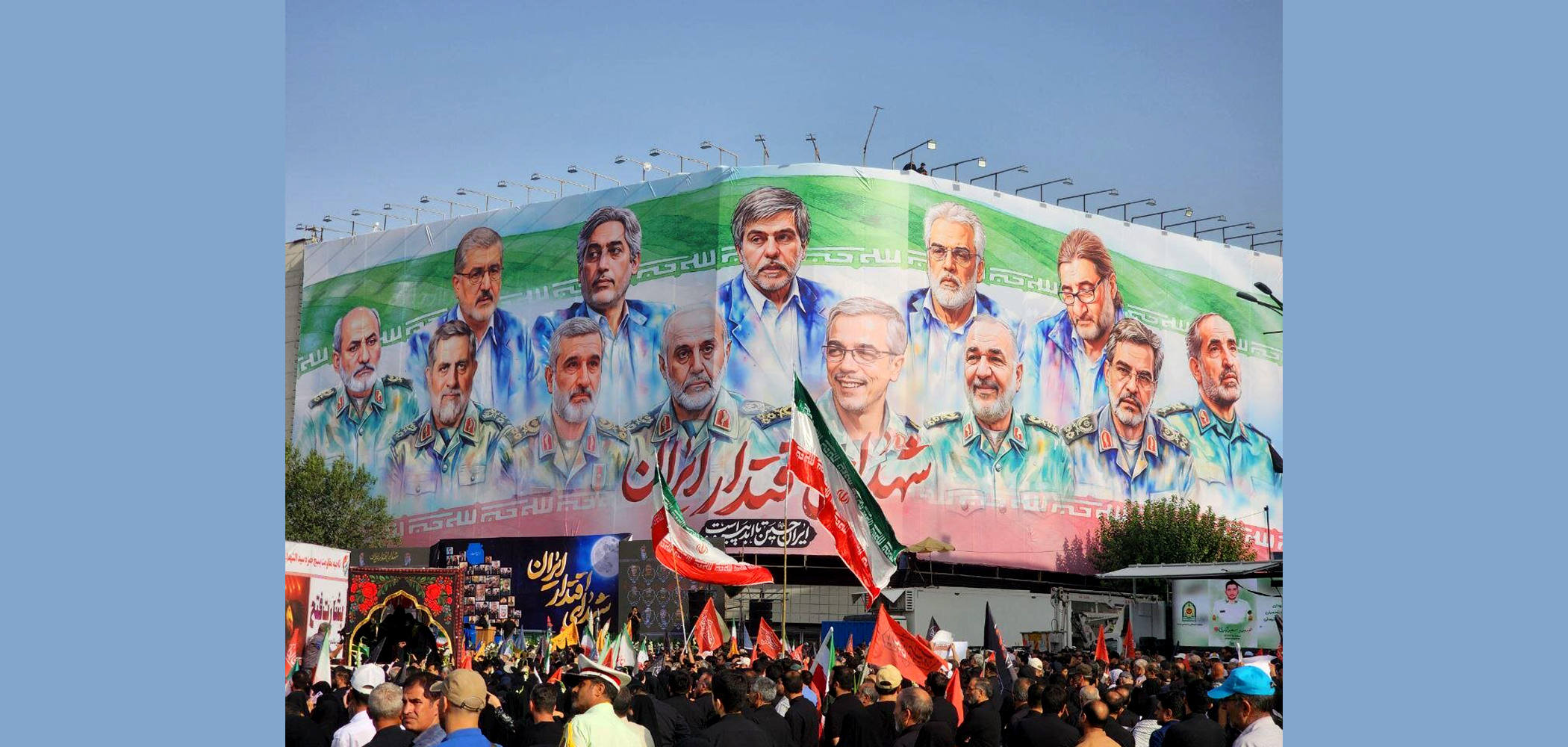
Whereas traditional warfare has historically focused on neutralizing military infrastructure and degrading the enemy’s combat readiness, the Israeli military operation of June 2025 against Iran unveiled a more sophisticated and alarming form of violence: the premeditated assassination of scientific elites as the soft infrastructure of national power. This level of violence goes beyond physical elimination of individuals; it constitutes a calculated dismantling of a nation’s scientific memory. In this framework, casualties are not mere statistics; what is under assault is the very corpus of independent knowledge production within an unequal global order.
Accordingly, the targeted assassination of senior Iranian nuclear scientists must be interpreted as a deliberate purge of Iran’s symbolic capital. Within this framework, such acts represent the type of violence Michel Foucault referred to as “violence against historical memory”—the erasure of memory bearers in order to sever a nation’s link to its conceivable futures. From this standpoint, the slain scientists were not only experts but living junctions of technology, sovereignty, and national dignity. Their elimination represented a unsuccessful strategic effort to nullify Iran’s prospective scientific future.
While the Israel sought to justify these assassinations under the rubric of “threat prevention,” they in fact embody a blatant dehumanization of the Iranian subject within the logic of Israeli hegemony. The prevailing constructed narrative within Israel’s security apparatus casts the Iranian nuclear scientist as a future architect of genocide, thus rendering his elimination not only permissible but necessary. This rationale, compounded by the systematic denial of scientific capacity to sovereign non-Western states, exemplifies epistemic discrimination and selective ethics in the international system: where the assassination of a scientist in Tel Aviv is framed as an attack on peace, but in Tehran as a legitimate preemptive strike.
Simultaneously, the civilian victims of the attack must not be reduced to mere collateral damage. The deaths of young poets, independent journalists, athletes, the children of scientists, homemakers, students, and educators constitute the logical output of a militarized doctrine that makes no substantive distinction between civilian life and military infrastructure. In line with its asymmetric targeting theory, Israel framed its strikes on residential neighborhoods as legitimate due to their proximity to strategic facilities. Yet such logic represents a flagrant violation of the principle of distinction under international humanitarian law and a broader ethical rupture from human-centered conduct in warfare. Entire districts such as Narmak, Farmanieh, and Tajrish in Tehran may have been physically devastated, but symbolically, they were saturated with fear, injustice, and moral injury.
Beyond the loss of life, what remained in the wake of the assault was a deep wound inflicted on Iran’s technological and psychological capital. The destruction of nuclear reactors, the bombing of military facilities, and damage to radar and air-defense installations were not merely attempts to impose a tactical setback—they constituted a strategic assault on Iran’s sovereign capacity for autonomous action in the region and the world. Technological infrastructure, viewed through the lens of critical security studies, is the physical body of national power. Its destruction, then, can be interpreted as a form of geopolitical sterilization—the deliberate neutralization of indigenous capacities for strategic relevance.
Meanwhile, the damage to civilian spheres extended well beyond the collapse of buildings or the closure of airports. The simultaneous cyberattacks on banking infrastructure, the disruption of information flows, strikes on media institutions, and early efforts to control the narrative all constitute a form of knowledge-based violence against nations. In this paradigm, the aggressor targets not only physical infrastructure but also the victim’s capacity to narrate and sustain everyday life. This policy is unequivocally a step beyond physical occupation: it is discursive occupation, wherein even the suffering of the dead is only permitted within the narrow boundaries that do not challenge hegemonic structures.
It is also critical to highlight the glaring asymmetry in casualties between the aggressor and the defender—a metric that reflects the structural inequality embedded within the international order. Israel succeeded in assassinating dozens of Iran’s military and scientific elites, striking numerous military and civilian targets, and even attacking the families of victims, without facing any meaningful deterrent response from the global system. This violence without consequence, often referred to as structural impunity, represents not merely the failure of international justice, but a systemic incentive for hegemonic powers to persist in criminal acts with assured protection.
In conclusion, the human and infrastructural toll of the Israeli assault must not be interpreted as unintended collateral; rather, it was an integral element of a militarized logic premised on epistemic terror and violent deterrence. Israel, in this offensive, did not merely target individuals; it targeted the future, memory, and collective hope of the Iranian people. Though this violence may have been buried beneath statistical tables, it endures in the historical memory of a nation that watched its scientific vanguard eliminated under the indifferent gaze of the international community.
Implications for the International Order
Regardless of its battlefield outcomes, the Israeli military operation of June 2025 against Iran carries profound structural consequences for the architecture of the international order. More than merely violating established norms, the attack exposed the underlying fractures within contemporary global governance: the gradual collapse of the legitimacy of intergovernmental institutions, the erosion of accountability mechanisms, and the entrenchment of militarized international politics within a deeply unequal and selectively applied system.
- Collapse of Collective Security and the Return to Tribal Logic of Power
A cornerstone of the post–World War II international system has been Article 2(4) of the United Nations Charter, which prohibits the use of force and reserves lawful recourse to it exclusively to the Security Council. Yet, Israel’s unilateral attack on Iran—without any UN authorization and in the absence of a confirmed threat—effectively marked a return to a natural right to force based on unilateral threat perception. This form of legitimated violence, rationalized under the preemptive self-defense doctrine, has long been rejected by legal scholars, yet continues to serve as a justificatory device for powerful states.
In response to the assault, the UN Security Council convened an emergency session but failed to issue any binding statement or resolution condemning or halting the aggression. As such, Israel was neither censured, nor restrained, nor held accountable. This silence made it clear that collective security has become a discretionary, hierarchical concept, subordinated to geopolitical weight. In theory, the collective security framework was designed to prevent rogue acts of violence; in practice, Israel enacted precisely the kind of aggression Saddam Hussein was globally punished for in 1990, yet faced only symbolic rhetoric. This paradox, as postcolonial analysis suggests, is not accidental but structural: states aligned with global hegemons are effectively granted license for extralegal violence without fear of retribution.
- Acceleration of Regional Instability and Breakdown of Diplomatic Conflict Resolution
The assault not only failed to contain tensions, but rapidly pushed the region to the brink of full-scale war. Any direct or indirect retaliation by Iran risked activating a chain of escalatory responses that could spiral beyond control. This state of instability is part of the hidden cost of hegemonic violence: immediate security for the aggressor is achieved at the price of long-term insecurity for the entire region.
Simultaneously, the diplomatic track concerning Iran’s nuclear program suffered a significant blow. At the time of the attack, tentative negotiations between Tehran and Washington—mediated by Oman—were beginning to take shape. The assault obliterated what little trust remained between the two sides. Iran threatened to withdraw from the Nuclear Non-Proliferation Treaty (NPT), and the discourse around strategic deterrence surged back into prominence in Iranian domestic policy. Thus, the logic of coercion supplanted that of dialogue, and the resulting precedent sent a dangerous message to other actors: adherence to legal regimes does not ensure immunity.
The regional implications are equally severe. For Middle Eastern states, the message was unambiguous: security acquired through peace is worthless in the face of stealth fighters and drones. This recalibration of the security equation will likely fuel an arms race, further destabilizing the region. While Israel portrayed its actions as anti-proliferation, the real consequence has been a deep erosion of confidence in multilateral mechanisms and international oversight.
- The Gradual Erosion of the Universal Human Rights System and International Law
One of the most prominent dimensions of this attack lies in the deepening rift between “formal international law” and “operational international law”—a gap that some scholars interpret as the embodiment of selective applied ethics. While the Israeli regime brazenly targeted critical infrastructure, civilian sites, and Iranian scientists without any regard for legal or humanitarian constraints, no effective or independent mechanism was established to investigate the truth or initiate legal accountability. This institutional vacuum once again challenged the legitimacy and efficacy of bodies such as the Human Rights Council, the International Criminal Court, the UN Security Council, and even the General Assembly, raising fundamental questions about their neutrality, independence, and universality in the eyes of the public and legal communities alike.
In such a global order where core principles—such as the right to life, justice, national sovereignty, and the protection of civilians—are recognized selectively and reserved only for certain nations, the logic of resistance acquires greater social and moral legitimacy. When international institutions fail to act in the face of blatant violence, or choose silence in alignment with the interests of dominant powers, non-state and marginalized actors gain increased space to propose alternative paradigms that are grounded in distributive justice, identity-based autonomy, and a redefinition of political legitimacy.
Within this context, the stark duality in global reactions to similar atrocities has heightened public awareness of the systemic discrimination entrenched in the international order. Russia’s military invasion of Ukraine provoked widespread global consensus, international indictments, and Moscow’s political isolation. In stark contrast, Israel’s aggression against Iran was met with vague, ineffective declarations devoid of legal consequences. This glaring disparity not only illustrates the structural dysfunction of international law, but also reflects the absence of universally shared values and the selective application of justice.
From this perspective, Israel’s attack on Iran must be understood as part of a broader pattern of structural inequality within the global order—an inequality that manifests not only in material terms, but also in ethical, epistemological, and identity-based dimensions. If this trajectory remains unchecked, its impact will extend beyond the current global order to shape future normative frameworks—where authority will no longer be derived from international law or human rights, but from the will of dominant powers, making force rather than justice the ultimate arbiter of legitimacy and governance.
- Geopolitical Realignment and the Crisis of Security Dependency
From a geopolitical standpoint, the attack marked a pivotal moment in the reconfiguration of global power alignments, simultaneously exposing latent fractures in the architecture of the international system. Although the United States did not initially assume formal responsibility for the assault, it effectively acted as a strategic enabler through intelligence sharing, deliberate diplomatic silence, and media narrative management. This form of involvement constituted a model of “targeted passive intervention,” whose strategic consequences were in essence indistinguishable from overt aggression.
Conversely, countries such as China, Russia, and a number of Middle Eastern states issued what appeared to be forceful condemnations. Yet these reactions, lacking tangible institutional follow-through, ultimately reflected discursive rifts and ideological positioning within the broader global system rather than constituting meaningful structural counteraction. In the absence of enforcement mechanisms, these responses amounted to symbolic protests incapable of reshaping the balance of power or influencing security decision-making processes.
At the regional level, the attack exacerbated internal fractures within the Middle East and laid bare the entrenched dynamics of security dependency. Several Arab governments that had recently embarked on normalization processes with Israel found themselves compelled to issue statements of condemnation—mostly performative and driven by domestic public pressure rather than by genuine strategic will. Their refusal to confront Tel Aviv directly or adopt assertive stances revealed the persistence of “borrowed security” arrangements and the lack of an independent regional security doctrine.
More broadly, the majority of Middle Eastern states—despite long histories of suffering from Israeli military aggression and extraregional interference—responded with either silence or neutral, ineffectual condemnations, with only a few exceptions such as Pakistan. This pattern not only undermined the prospects of forming anti-colonial regional alliances, but also accentuated the historical divide between the geopolitical “center” and “periphery” in diplomatic discourse and praxis. Ultimately, what emerges clearly from these developments is a deepening crisis of trust among Middle Eastern states—a crisis rooted in structural insecurity, fragmented solidarity, and the erosion of regional agency in shaping their own futures.
Conclusion
The Israeli military strike on Iran in June 2025 was not merely a battlefield episode; it marked a historic rupture in the logic of power, ethics, human rights, and international law, exposing deep contradictions that have long been embedded—but often veiled—within the contemporary global order. This operation does not belong simply in the catalogue of military interventions; rather, it stands among those transformative events—like the Iraq War, the Gaza blockade, or the invasion of Afghanistan—that redefine the grammar of post–Cold War international relations. The assault on Iran thus serves as an emphatic confirmation that we have fully entered a new epoch of power-driven delegitimation in world affairs.
This event illustrates how hyper-securitization of a political actor (Iran), when reinforced by decades of discursive construction and synchronized with geopolitical opportunity, can produce military actions that bear no direct relationship to actual threats. In other words, threat is no longer what exists—but what must be imagined in order to activate the logic of war. This new paradigm of threat perception lies at the heart of what may be termed “future-oriented violence”: the elimination of those who might one day possess the capacity to disrupt hegemonic stability.
In this particular case, the violence landed squarely upon the bodies of Iranian scientists and elites. The systematic assassination of nuclear experts was not merely a tactic to delay Iran’s technological program; it was a strategic maneuver designed to erode national memory, destabilize epistemic infrastructure, and instill a perception of sovereign impotence. These assassinations belong to a long tradition of colonial eliminations of peripheral capabilities, a lineage stretching from Congolese intellectuals in the 1960s to Iraqi scientists in the post-2003 era—victims of the same imperial grammar of exclusion.
Equally significant was the international community’s response—or lack thereof—which affirmed a deeper crisis within the system of power and justice representation. Institutions tasked with preserving order, upholding human rights, and guaranteeing collective security either remained silent or issued largely symbolic declarations. This paralysis is not a product of inertia or delay; it is the direct symptom of a malfunctioning architecture, one in which violence is deemed illegitimate only when committed by those outside the circle of hegemonic actors.
Thus, what occurred in June 2025 was not just the destruction of key military installations or the assassination of scientific figures. It was the collapse of the final layers of trust in the international order, the delegitimation of multilateral institutions, and the exposure of the selective application of human rights discourse. If this trend is not reversed—if global institutions fail to transform from tools of hegemonic convenience into authentic regulatory frameworks—then the future of global relations will be defined less by norms and more by cycles of retaliation, lawless competition, and reciprocal delegitimation.
For Iranian policymakers, the attack delivered a stark lesson: in the absence of a guaranteed system of collective security, concepts such as international commitments, legal ethics, or mutual trust lose substantive meaning. Such a realization is likely to reinforce discourses of autonomous security, indigenous deterrence, and structural resistance not only in Iran but among similarly situated states. Conversely, while Israel may believe it has consolidated its strategic posture through this assault, the long-term consequence may be the continuous erosion of its political and moral legitimacy—especially as this event joins the growing ledger of regional atrocities, targeted assassinations, and globally exposed double standards.
In sum, the Israeli assault on Iran must be read as a mirror of the deficient global order—a system where violence, if cloaked in the rhetoric of national security and executed by the powerful, is rendered not only permissible but exemplary. In such a world, where scientific assassination is normalized, the UN Security Council is immobilized, and human suffering is narratively regulated, the only enduring force is the demand for a radical redefinition of order itself. That order—if it is to avoid drowning in the blood of future crises—must be rebuilt upon the foundations of justice, law, and a truly universal human dignity.