Introduction
Over the past several decades, Iran’s nuclear program has consistently been subjected to multilayered threats and organized acts of sabotage—operations that, according to numerous pieces of evidence and international reports, have been predominantly attributed to Israel and its allies. These actions have encompassed a wide spectrum: from the targeted assassination of nuclear scientists and the deployment of sophisticated cyberattacks against sensitive infrastructure, to sabotage operations at enrichment facilities and a series of explosions within electricity distribution networks linked to the nuclear industry. Such a pattern demonstrates a sustained strategy aimed at weakening Iran’s technological capacity in the nuclear field.
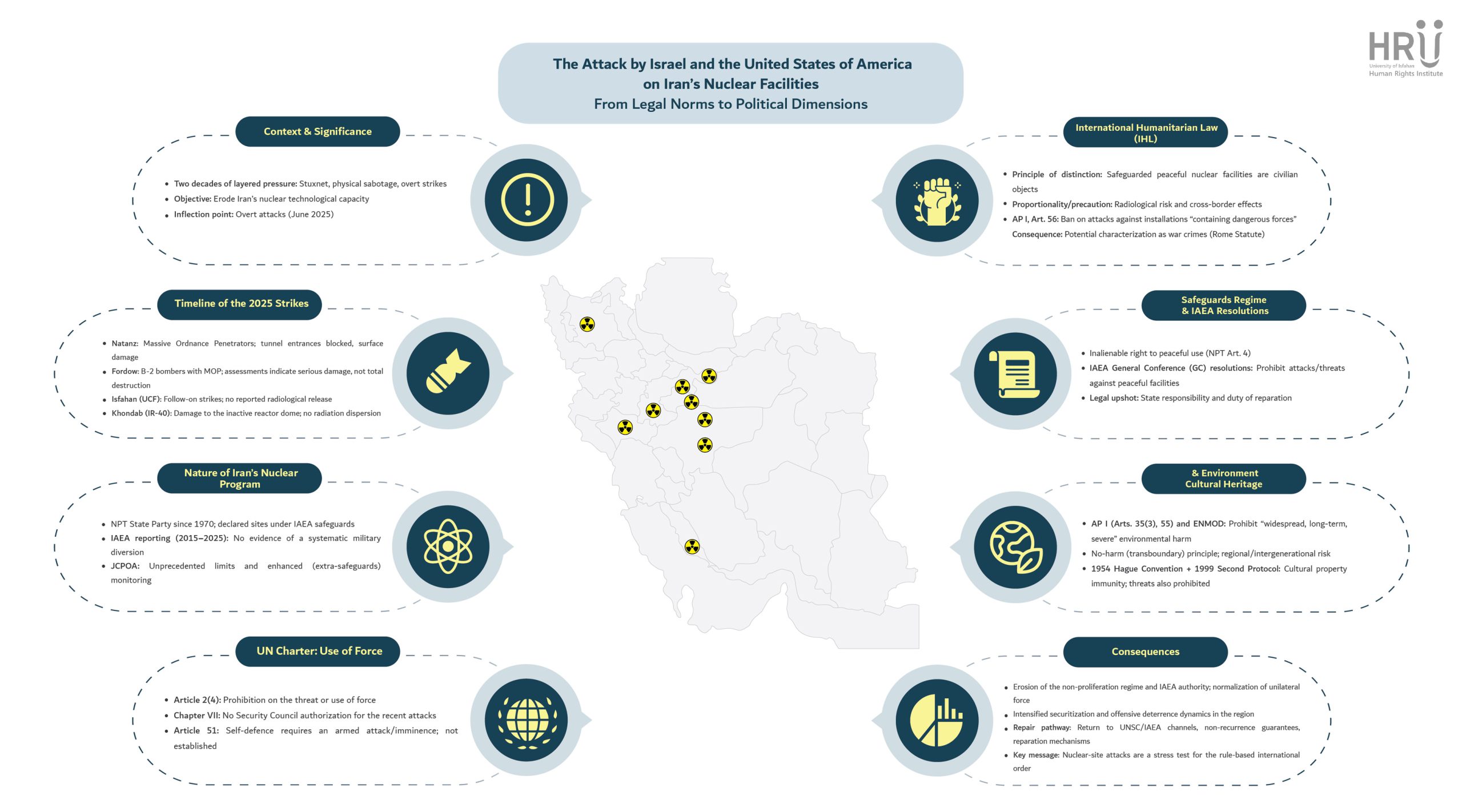
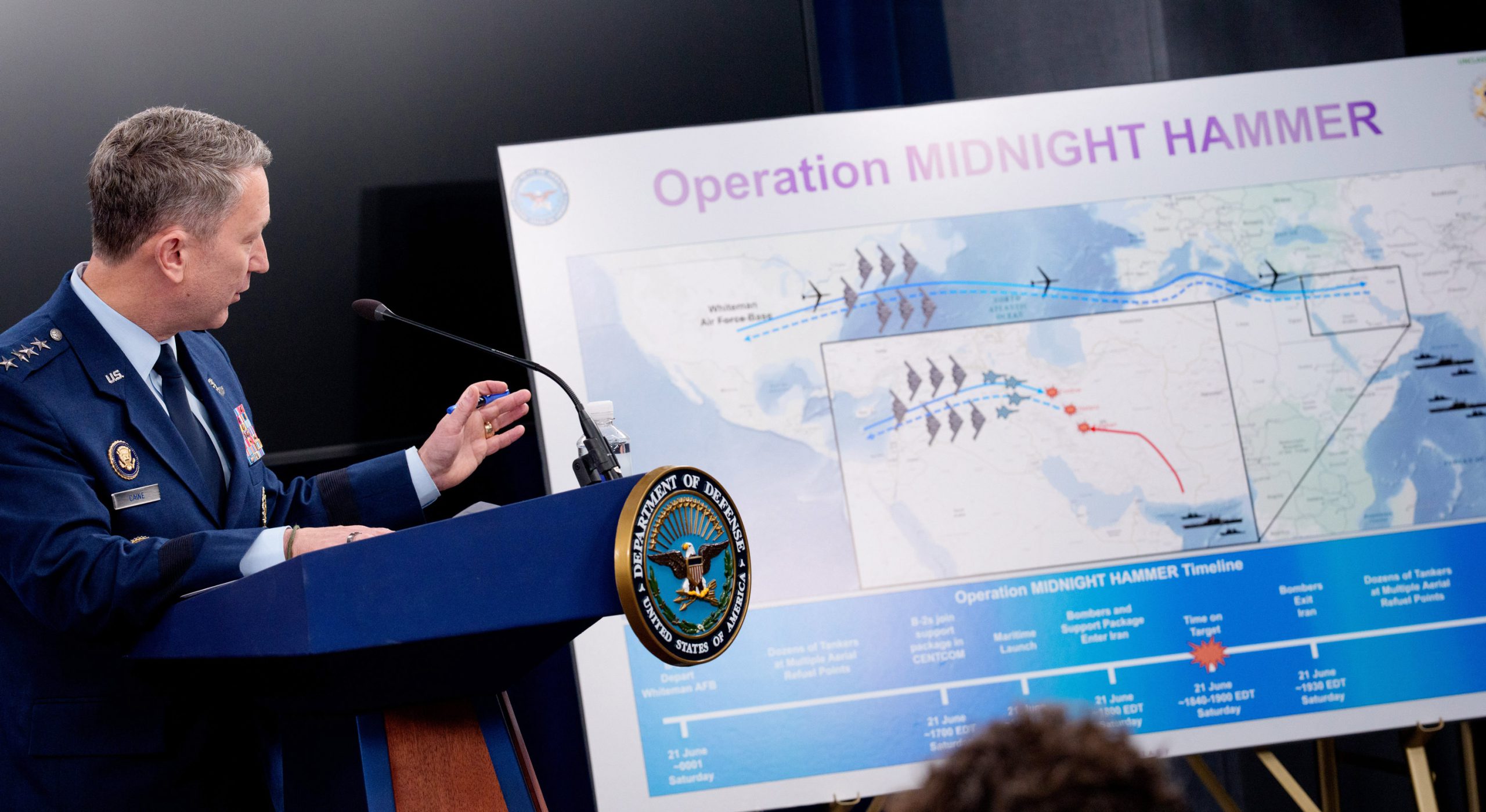
However, the watershed moment in this confrontation can be identified in the direct military assault carried out by the Israeli armed forces, with the support of the United States, in June 2025. This operation, surpassing previous methods of covert sabotage, amounted to an overt act of military aggression against Iran’s national sovereignty. During these attacks, key facilities—including the Natanz enrichment site, the Khondab heavy water complex in Arak, uranium enrichment centers in Isfahan, and the Fordow facilities—were targeted, resulting in tangible and widespread damage to the country’s nuclear infrastructure.
The dimensions of these attacks are not confined to the military and security domains alone; they also raise fundamental questions within the framework of international law. These include issues concerning the legitimacy of resorting to the use of force, the legal boundaries of self-defense, and the conformity—or conflict—of these actions with customary and treaty-based rules of international humanitarian law. Moreover, the geopolitical implications of these strikes, both in terms of regional security in the Middle East and the structure of the international order, hold particular significance. Accordingly, a comprehensive examination of these events, in light of the foundational principles of international law and broader political considerations, emerges as an unavoidable necessity—one that not only aids in clarifying the immediate consequences of the attacks but also contributes to mapping their long-term impact on the global security and legal order.
Nature of Iran’s Nuclear Program
From legal and technical standpoints, Iran’s nuclear program is situated within the framework of international treaties and regimes and has consistently been presented by Tehran as a peaceful enterprise. Since 1970, Iran has been a State Party to the Treaty on the Non-Proliferation of Nuclear Weapons (NPT) and is thereby committed to using nuclear energy exclusively for peaceful purposes in accordance with international rules. For instance, the Natanz facility is among the sites declared to the International Atomic Energy Agency (IAEA) and has consistently been subject to this international body’s safeguards inspections. In practice, enrichment activities at this complex are regularly verified by IAEA inspectors to ensure that no nuclear material is diverted toward military ends.
Credible evidence supports the peaceful nature of Iran’s nuclear program. The IAEA Director General’s final report of December 2015 (concluding the inquiry commonly known as the Possible Military Dimensions, or PMD, of Iran’s program) determined that no evidence had been found of the diversion of nuclear material toward a weapons program in the period after 2009. Furthermore, Iran’s adherence to its international commitments in the years following the 2015 nuclear agreement provides additional corroboration of the program’s peaceful character. Under the Joint Comprehensive Plan of Action (JCPOA), concluded that year between Iran and the P5+1, Iran agreed to unprecedented limits on the number of operating centrifuges, the level of uranium enrichment, and the size of enriched uranium stockpiles, while also accepting extensive supplementary (beyond-safeguards) monitoring. According to the IAEA’s quarterly reports, from January 2016 through May 2019, Iran fully complied with its JCPOA nuclear obligations, and each of the Agency’s three-monthly assessments affirmed this compliance.
At the jurisprudential and political levels as well, Iran has consistently emphasized its lack of intent to acquire nuclear weapons. The country’s Supreme Leader has issued a religious decree (fatwa) declaring the production, possession, and use of weapons of mass destruction—including nuclear weapons—religiously forbidden. Although such a fatwa is not a legally binding instrument under international law, it has been cited in diplomatic fora and international venues as indicative of Iran’s official policy. Iranian officials have repeatedly stated that the purpose of uranium enrichment is to provide fuel for nuclear power plants, research reactors, and medical applications, not to manufacture nuclear arms. In support of this position, Rafael Grossi, the IAEA Director General, stated in June 2025: “We have no evidence of a systematic effort to move toward building a nuclear weapon in Iran.” Likewise, in another IAEA communication dated 25 June 2025, it was noted that “the Agency has observed no credible indications of a structured, active and undeclared nuclear program in Iran.” This official statement once again confirms the absence of evidence indicating military diversion within Iran’s nuclear activities.
Accordingly, from both legal and technical perspectives, Iran’s uranium-enrichment activities are interpretable within the scope of the right to the peaceful use of nuclear energy under Article 4 of the NPT—provided that such activities are accompanied by transparency, full cooperation with the IAEA, and regular implementation of safeguards oversight.
Assessment of the Attacks under International Humanitarian Law (IHL)
International Humanitarian Law (IHL), also known as the “laws of war,” constitutes a body of binding norms aimed at mitigating the suffering caused by armed conflicts through the protection of civilians and the limitation of means and methods of warfare. These rules apply in any armed conflict—whether international or non-international—regardless of the political or moral legitimacy of the parties involved. In this context, although Iran and Israel have not officially or formally declared a state of war, the repeated offensive actions against Iran’s nuclear facilities—particularly in the form of cyberattacks, explosions, and aerial bombardments—can be understood as amounting to an undeclared armed conflict. Under such circumstances, the foundational principles of IHL, which are customary and universal in nature, remain fully applicable.
Among the multiple rules of humanitarian law, four key principles occupy a central position in the legal evaluation of the recent attacks against Iran’s nuclear installations:
- The Principle of Distinction
This fundamental principle requires that parties to a conflict must always distinguish between legitimate military objectives on the one hand and civilian persons or civilian objects on the other.
- Legal Basis: Article 48 of Additional Protocol I of 1977 and Article 51(2) of the same Protocol.
- Application to Iran: Nuclear facilities under IAEA safeguards and operating for peaceful purposes cannot be presumed to serve an immediate military function. No credible evidence has been provided of such facilities being diverted to weapons-related use. Accordingly, they fall within the category of “protected civilian objects.”
- Implication: Striking these facilities constitutes a direct violation of the principle of distinction and, by extension, amounts to a war crime under Article 8 of the Rome Statute of the International Criminal Court.
- The Principle of Proportionality
Even when a legitimate military objective exists, an attack is unlawful if it is expected to cause excessive incidental loss of civilian life, injury to civilians, or damage to civilian objects in relation to the concrete and direct military advantage anticipated.
- Legal Basis: Article 51(5)(b) of Additional Protocol I of 1977.
- Application to Iran: Attacks on facilities containing radioactive materials carry the risk of radiological release, environmental contamination, and mass casualties across the region and beyond. In comparison, the alleged military benefit (a temporary delay in uranium enrichment cycles) is wholly disproportionate.
- Implication: Such operations breach the proportionality principle and give rise to aggravated international responsibility, particularly as the harmful effects could extend to neighboring states and populations far removed from the immediate theater of conflict.
- The Principle of Precaution
Belligerents are obligated to take all feasible measures to avoid or minimize incidental harm to civilians and civilian objects.
- Legal Basis: Article 57 of Additional Protocol I of 1977.
- Application to Iran: Launching strikes against nuclear facilities despite expert warnings about the catastrophic radiological consequences reflects a blatant disregard for this principle and constitutes reckless endangerment.
- Implication: This failure erodes the attackers’ moral and political legitimacy and provides a basis for Iran or affected third states to seek reparations before international fora.
- The Principle of Humanity
As the cornerstone of IHL, this principle prohibits the infliction of unnecessary suffering.
- Legal Basis: The Martens Clause in the preamble to the 1907 Hague Conventions and customary international law.
- Application to Iran: Attacks on nuclear facilities heighten the risk of displacement, long-term illness from radioactive exposure, and widespread environmental destruction—outcomes that run counter to the dictates of humanity.
- Implication: Beyond their legal invalidity, such acts carry immense political costs for the perpetrators in the court of global public opinion.
Taken together, the application of these four principles—distinction, proportionality, precaution, and humanity—leads to the conclusion that the Israeli and U.S. attacks on Iran’s nuclear facilities constitute manifest violations of IHL and amount to war crimes. Politically, these operations also represent a grave threat to international peace and security under Article 39 of the UN Charter and may trigger Security Council involvement as well as proceedings before the International Court of Justice or the International Criminal Court. Furthermore, the environmental consequences of such strikes contradict fundamental principles of international environmental law, including the precautionary principle set forth in the 1992 Rio Declaration.
One particularly salient aspect of IHL concerning dual-use or inherently dangerous infrastructure is the absolute prohibition on attacking installations containing dangerous forces. Article 56 of Additional Protocol I to the 1977 Geneva Conventions—though not ratified by Israel but widely regarded as reflecting customary law—explicitly forbids attacks on nuclear power plants, dams, or major refineries where such strikes could cause severe civilian casualties, save for narrowly defined exceptional cases subject to stringent precautions. In June 2025, Rafael Grossi likewise underscored in an official statement that nuclear installations, regardless of political or military context, must never be targeted since their compromise could produce transboundary consequences.
It is crucial to note that claims of suspected military use of Natanz, Fordow, or other facilities—even if advanced by actors such as the United States or Israel—are insufficient under humanitarian law. The rules of IHL require that suspicion be substantiated by verifiable, credible, and objective evidence. Moreover, proportionality and precautionary assessments remain decisive in any evaluation of lawful targeting. Thus, justifying the strikes on the basis of speculative or unproven allegations of weaponization—absent clear and imminent threats—lacks legal validity. The attacks on Iran’s nuclear installations, therefore, stand as unambiguous violations of both treaty-based and customary rules of international humanitarian law.
Assessment of the Attacks in Light of IAEA Norms and Resolutions
The legal and political evaluation of the recent Israeli and U.S. strikes on Iran’s nuclear facilities, when considered through the lens of International Atomic Energy Agency (IAEA) documents and resolutions, reveals a flagrant breach of international obligations, a threat to regional peace and security, and the unlawful deprivation of Iran’s legitimate rights as a State Party to the Treaty on the Non-Proliferation of Nuclear Weapons (NPT).
- Legal Status of Iran’s Nuclear Facilities within the Safeguards Regime
Since 1970, Iran has been a signatory of the NPT, committing itself to the peaceful utilization of nuclear technology. Article 4 of the Treaty explicitly affirms the inalienable right of States Parties to use nuclear energy for civilian purposes. According to successive IAEA reports between 2020 and 2025, inspectors consistently confirmed that they had access to Iran’s declared facilities and found no credible evidence of diversion of fissile material toward military objectives. As previously noted, even in the controversial resolution of the IAEA Board of Governors dated 12 June 2025, Director General Rafael Grossi unambiguously stated: “We have no evidence of a systematic program for nuclear weapons production in Iran.”
Furthermore, earlier IAEA resolutions stressed the necessity of protecting peaceful nuclear facilities under international law and prohibiting any form of threat or harm to civilian nuclear infrastructure.
- Key IAEA Resolutions on the Protection of Nuclear Installations
Over the decades, the IAEA General Conference has adopted a series of landmark resolutions that explicitly reject armed attacks or threats against peaceful nuclear facilities, deeming them violations of fundamental principles of international law. Among the most significant are:
- GC(XXVII)/RES/407 (1983): Affirming the absolute prohibition of armed attacks on nuclear facilities with civilian uses.
- GC(XXIX)/RES/444 (1985): Declaring that any threat or armed attack against peaceful installations constitutes a clear breach of the UN Charter and the IAEA Statute.
- GC(XXXIV)/RES/533 (1990): Warning of the humanitarian and environmental consequences of potential radioactive releases and obliging states to uphold principles of civilian protection.
These instruments, grounded in the consensus of IAEA member states, provide a robust legal framework for evaluating the legitimacy of the recent assaults. Taking into account these resolutions, alongside customary and treaty-based rules, the Israeli and U.S. strikes on Iran’s nuclear facilities clearly amount to violations of the legal regimes designed to safeguard peaceful infrastructure.
- Responsibility and Consequences
Given the blatant disregard for IAEA safeguards obligations and Iran’s rights under the NPT, it follows that the recent military actions against Iranian nuclear facilities constitute acts of aggression and explicit breaches of general international law, international human rights law, and international humanitarian law.
As such, the attacking states incur international responsibility, and their conduct is justiciable before mechanisms of arbitration and international dispute settlement. Moreover, the principle of reparation—articulated most clearly in the 2001 International Law Commission’s Draft Articles on State Responsibility—obliges states committing internationally wrongful acts to make full restitution for the injury caused, including material and moral damages, as well as restoration of the situation to its prior state wherever possible. This duty is not merely moral but legally binding and may be pursued through interstate claims and judicial processes.
Assessment of the Attacks under the United Nations Charter
The United Nations Charter, as the foundational document of the international legal order, establishes a clear framework governing the lawful use of force in relations between states.
- Violation of the Fundamental Principle of the Prohibition of the Use of Force
Article 2(4) of the UN Charter provides:
“All Members shall refrain in their international relations from the threat or use of force against the territorial integrity or political independence of any state, or in any other manner inconsistent with the Purposes of the United Nations.”
On this basis, any military strike on the territory of a sovereign state—absent authorization by the Security Council or the occurrence of a prior armed attack—stands prohibited. Iran’s nuclear facilities, according to IAEA reports, were subject to safeguards and verified as being for peaceful purposes. The targeting of these installations was therefore inconsistent with any legitimate military objective and constituted a violation of Iran’s territorial integrity. The attacks thus amount to an unequivocal breach of Article 2(4) and of one of the cardinal principles of the UN Charter.
- Absence of Security Council Authorization
Under Chapter VII of the Charter, only the Security Council has the authority to determine threats to peace, breaches of peace, or acts of aggression, and to authorize collective measures, including the use of force.
- Article 39 provides that the Council shall determine the existence of any threat or breach and decide what measures should be taken.
- Article 42 authorizes the use of military force only where non-military measures prove inadequate.
With regard to the strikes by Israel and the United States against Iran, no Security Council resolution authorized such action. Consequently, these military operations lack international legitimacy and contravene the Council’s exclusive prerogative over decisions involving recourse to force.
- Lack of a Valid Claim of Self-Defense
Article 51 of the Charter recognizes self-defense as the only legitimate exception to the prohibition on unilateral use of force:
“Nothing in the present Charter shall impair the inherent right of individual or collective self-defense if an armed attack occurs against a Member of the United Nations, until the Security Council has taken measures necessary to maintain international peace and security.”
In the case of the attacks on Iran’s nuclear facilities, there was no armed attack launched by Iran against either Israel or the United States that could have justified a retaliatory strike. Claims of potential threats or preventive action to avert future risks are not accepted under contemporary international law, except where there is proof of an imminent armed attack. In this instance, no such imminence, necessity, or proportionality existed.
- Conclusion under the Charter Framework
In light of these factors, the strikes on Iran’s nuclear facilities:
- Violate Article 2(4) of the Charter (prohibition of the use of force),
- Were unauthorized under Articles 39 and 42, given the absence of Security Council approval, and
- Do not meet the conditions of Article 51 governing self-defense.
Accordingly, the actions constitute unlawful acts of aggression within the international system and a serious breach of the Charter’s foundational principles.
Assessment of the Attacks from an Environmental Perspective
One of the most critical dimensions of the recent U.S. and Israeli military strikes on Iran’s nuclear facilities lies in their environmental consequences, which threaten human health, natural resources, biodiversity, and even food security—not only within Iran but across the wider West Asian region.
- Binding Principles of International Environmental Law in Armed Conflict
According to authoritative sources of international law, the protection of the natural environment during armed conflict constitutes a binding obligation for states. No circumstance, including war, can justify derogation from this duty. The most important legal foundations in this regard include:
- Articles 35(3) and 55 of Additional Protocol I to the Geneva Conventions (1977): These provisions explicitly prohibit methods or means of warfare expected to cause widespread, long-term, and severe damage to the natural environment.
- The 1976 Convention on the Prohibition of Military or Any Other Hostile Use of Environmental Modification Techniques (ENMOD): This treaty bans the manipulation of environmental processes with effects of a severe, lasting, or widespread nature for hostile purposes.
- The customary principle of “no transboundary harm”: Established in international jurisprudence—most notably in the Trail Smelter case—this principle obliges states to refrain from activities causing environmental damage beyond their borders.
- Article 8(2)(b)(iv) of the Rome Statute of the International Criminal Court: This provision classifies intentional attacks expected to cause excessive, long-term, and severe environmental harm as war crimes.
- Application to the Iranian Case
In light of these legal standards, the attacks on Iran’s nuclear facilities entail clear international responsibility:
- Strikes on facilities containing radioactive materials risk triggering uncontrolled radiological release, with irreversible consequences for ecosystems and human populations across borders.
- The resulting contamination could devastate agriculture, undermine water security, and generate chronic health crises throughout the region.
- The magnitude and persistence of such damage far exceed any conceivable military gain, rendering the attacks incompatible with both humanitarian and environmental norms.
- Broader Implications
Accordingly, both the United States and Israel are accountable not only for violations of treaty and customary rules of IHL, but also for breaching binding obligations in international environmental law. Their actions expose them to potential legal proceedings before international courts and tribunals on the grounds that these hostile acts generate impacts extending far beyond the immediate theater of conflict, thereby imperiling environmental and human security on a regional and transboundary scale.
Assessment of the Attacks as a Threat to Cultural Heritage
Cultural heritage represents not only the identity and historical memory of each nation but also a civilizational asset of humanity as a whole. The protection of such heritage—particularly in times of armed conflict—is not merely a domestic duty but also an international legal obligation grounded in both customary and treaty-based international law. Foremost among these instruments is the 1954 Hague Convention for the Protection of Cultural Property in the Event of Armed Conflict, which remains the cornerstone of the global legal regime safeguarding cultural heritage.
- Incendiary Statements Targeting Cultural Heritage
In one of his recent controversial remarks, Rafael Grossi, in a June 2025 interview with Fox News, implied that “nearly 900 pounds of enriched uranium may have been moved to an archaeological site near the city of Isfahan.” Although he immediately acknowledged that the Agency had “no precise or conclusive information about the exact location of the material,” even this vague suggestion provided psychological justification for hardline actors favoring military scenarios against cultural and historical areas in Iran.
Such statements, issued amid heightened regional tensions, risk paving the way for deliberate strikes on cultural and civilizational landmarks—acts that are manifestly inconsistent with established principles of IHL and cultural property protection norms. It must be noted that Isfahan, one of the oldest centers of civilization in Iran and the Middle East, hosts invaluable World Heritage Sites inscribed by UNESCO, including Naqsh-e Jahan Square, the Jameh Mosque of Isfahan, the Chahar Bagh School, and Safavid-era bridges and monuments. Baseless insinuations about nuclear activity in such sites indirectly confer a false sense of legitimacy to the targeting of cultural property.
- Precedent of Threats against Iran’s Cultural Heritage
The menace to Iran’s cultural heritage is not unprecedented. In January 2020, then-U.S. President Donald Trump publicly declared, in the context of escalating tensions, that 52 sites in Iran had been identified as targets, several of which held great cultural significance. These statements provoked a wave of global condemnation, including from UNESCO, the UN Human Rights Council, cultural-rights advocates, and leading international media. Importantly, both Iran and the United States are States Parties to the 1954 Hague Convention and its Protocols; thus, threats or actions against cultural property are not only morally reprehensible but also legally prosecutable under international law.
- Role of the 1954 Hague Convention in International Law
As noted, the 1954 Hague Convention constitutes the first and most foundational binding international instrument for the protection of cultural property during armed conflict. Article 4 obliges States Parties not only to refrain from direct attacks on cultural property but also to prevent any military use of such sites and to take all feasible measures to protect them from harm. This principle—often referred to as the doctrine of cultural immunity—is grounded in the recognition that historical, religious, and artistic monuments must be shielded from military logic, as their destruction inflicts irreparable damage on cultural identity and humanity’s collective memory. This rule has gained heightened importance with the proliferation of modern weaponry and asymmetric conflicts, where the risks to cultural property have multiplied.
- The 1999 Second Protocol to the Hague Convention
The 1999 Second Protocol was designed to close implementation gaps and strengthen international standards. It introduced the concept of “enhanced protection” for cultural properties of outstanding universal value, such as UNESCO World Heritage Sites. Under this regime, States Parties are strictly obliged to protect such properties from not only physical destruction but also military use, threats, and psychological warfare—unless confronted with an imperative and immediate military necessity, a threshold subject to a high evidentiary burden. Violations of these obligations, particularly with respect to World Heritage Sites, constitute serious breaches of international law and may give rise to international legal accountability. Given that Isfahan is home to multiple World Heritage properties, any deliberate or incidental attack would qualify as a blatant violation of the Second Protocol and engage the international responsibility of the aggressor state.
- Consequences of Threats against Cultural Sites
The explicit terms of the 1954 Hague Convention and its 1999 Second Protocol clarify that even threats to attack cultural property amount to serious breaches of international law.
- Article 4 of the Convention requires States Parties to abstain from any form of attack or military exploitation of cultural sites.
- Article 8 of the Second Protocol prohibits threats to cultural property.
- Article 9 explicitly outlaws reprisals against cultural property.
- Article 11 obliges states to actively respect cultural property under enhanced protection.
From the standpoint of international criminal law, such threats or attacks—when perpetrated in the context of armed conflict—may fall under Article 8(2)(b)(ix) of the Rome Statute, constituting war crimes subject to the jurisdiction of the International Criminal Court (ICC).
- Overall Assessment
Threats or actual harm to Iranian cultural property constitute unequivocal violations of binding international obligations enshrined in the 1954 Hague Convention and its Protocols. Such conduct undermines the principle of cultural immunity and, depending on circumstances, may rise to the level of war crimes. In addition to individual criminal liability, these actions carry severe diplomatic costs, tarnish the international reputation of the perpetrators, and invite widespread condemnation from cultural, human rights, and international bodies. Beyond Iran’s sovereign rights, such threats imperil the shared heritage of humanity and erode the collective cultural memory of humankind.
Assessment of the Attacks in Relation to the Right to Development and Scientific Progress
In addition to violating multiple norms of international law, the U.S. and Israeli military assaults on Iran’s nuclear facilities raise a deeper concern: the systematic undermining and denial of Iran’s right to benefit from scientific development, technological advancement, and peaceful nuclear energy. This right is firmly recognized in various international instruments and forms an integral component of the broader framework of human rights in the twenty-first century.
- Legal Status of the Peaceful Use of Nuclear Energy under the NPT
Article 4 of the Treaty on the Non-Proliferation of Nuclear Weapons (NPT), one of the cornerstones of the global nuclear non-proliferation regime, explicitly affirms the inalienable right of all States Parties—whether nuclear-armed or non-nuclear—to develop, research, produce, and utilize nuclear energy for peaceful purposes. The article stipulates that no provision of the NPT may be interpreted in a way that restricts or deprives States Parties of this right, provided that their activities comply with Articles 1 and 2, which concern non-proliferation obligations.
This article rests on the principle of equality and non-discrimination in access to nuclear technology, ensuring that non-nuclear-weapon states may pursue scientific and industrial development through peaceful nuclear energy in the context of international cooperation. The recent strikes on Iran’s safeguarded nuclear facilities at Natanz, Fordow, and Isfahan—each under IAEA monitoring—represent not only an obvious breach of Article 4, but also a coercive attempt to deprive a non-nuclear-weapon state of one of its fundamental rights under the international nuclear order. Such actions contravene the central aim of the NPT, which is to foster the peaceful use of nuclear energy and promote cooperative scientific exchange.
- The Right to Benefit from Scientific Progress under the ICESCR
Article 15 of the International Covenant on Economic, Social and Cultural Rights (ICESCR) enshrines the right of everyone to “enjoy the benefits of scientific progress and its applications.” States Parties to the Covenant are obligated not only to respect this right but also to actively facilitate and promote it. Supplementary provisions of Article 15 further stress the importance of fostering international scientific and technical cooperation, safeguarding academic freedom, and strengthening the indigenous scientific capacities of states.
The deliberate targeting of Iran’s peaceful nuclear infrastructure—facilities serving as hubs of advanced technology, scientific training, and international collaboration—runs counter to these obligations. Such acts deprive a nation of the institutional and technological foundations necessary for sustainable scientific progress. By undermining research, disrupting technological development, and instilling fear among the scientific community, these attacks constitute a coercive intervention in violation of the ICESCR and threaten the long-term scientific autonomy and development of the Iranian people.
- The Right to Development and the Prohibition of Coercive Measures
The Declaration on the Right to Development (1986), adopted through UN General Assembly Resolution 41/128, recognizes development as an inalienable human right. It affirms that every people has the right to freely determine its economic, social, cultural, and scientific trajectory. Central to this right is the principle of permanent sovereignty over natural resources, technology, and pathways of scientific advancement.
Under this framework, coercive actions such as scientific sanctions, the assassination of nuclear scientists, and the destruction of research facilities directly infringe upon the collective right of nations to development. The 2025 military assaults on Iran’s nuclear and research infrastructure must therefore be viewed as a continuation of a systematic pattern—including the targeted killings of nuclear scientists, acts of sabotage against research centers, and external pressures to curtail technological progress—amounting to an unlawful interference with a nation’s independent development trajectory. Such actions are incompatible with the goals of equality, mutual respect, and non-intervention that underpin international law.
- Overall Assessment
The military strikes against Iran’s nuclear program go beyond material destruction: they represent a deliberate attempt to obstruct Iran’s scientific progress and curtail its developmental rights. By breaching Article 4 of the NPT, Article 15 of the ICESCR, and the principles of the 1986 Declaration on the Right to Development, these actions qualify as violations not only of international legal norms but also of collective human rights with intergenerational consequences. They undermine global trust in scientific cooperation, discourage transparency, and risk normalizing coercive interference in the scientific and technological development of states.
Assessment of the Attacks in Relation to the Assassination of Nuclear Scientists
Amid the series of Israeli and U.S. operations targeting Iran’s nuclear infrastructure, one of the most salient—and troubling—features has been the targeted killing of Iranian scientists and scientific elites. From the assassinations of Dr. Majid Shahriari and Dr. Mostafa Ahmadi Roshan in earlier years to the physical elimination of scientists during the military strikes of June 2025, a discernible pattern emerges: the direct targeting of civilian individuals whose roles are scientific in nature within Iran’s nuclear program.
- International Criminal Law (ICL) and ICC Practice
Scientists—akin to physicians and health professionals—are civilian experts whose work is central to technological advancement and public welfare. In the instruments and practice of the International Criminal Court (ICC) and other criminal tribunals, attacks on medical personnel are recognized as war crimes; by parity of reasoning, the same protective logic extends to scientists engaged in peaceful technology. Targeting these individuals violates the principle of civilian immunity and constitutes a systematic deprivation of a nation’s fundamental rights to science and sustainable development. Where such acts are repeated and organized, they may, through the requisite actus reus and mens rea, amount to a policy of systematically eliminating scientific elites and rise to the level of crimes against humanity under international criminal law.
- Violations of the Right to Life, Human Dignity, and Personal Security
Article 6 of the International Covenant on Civil and Political Rights (ICCPR) protects the inherent right to life and prohibits arbitrary deprivation of life. The targeted killing of Iranian scientists—absent judicial process and predicated solely on their scientific or political roles—constitutes a clear violation of this foundational principle. Moreover, the principle of human dignity (Article 7 ICCPR), which forbids terrorizing, threatening, or degrading treatment, and the right to personal security (Article 9 ICCPR), which protects individuals against persistent threats and unsafe professional environments, have been gravely infringed. These operations not only violate the individual rights of victims, but also the collective rights of the scientific and educational community: by targeting elites, public trust in academic and research spaces erodes, national progress is disrupted, and the public’s right to sustainable development and scientific self-reliance is jeopardized. From this perspective, the assassinations must be treated as multilayered human rights violations with deep, systemic consequences for society as a whole.
- Overall Assessment
Whether carried out covertly or during direct military operations, the assassinations of Iranian nuclear scientists constitute manifest breaches of core rules of international law. On the one hand, they violate international humanitarian law concerning the protection of civilians, since scientists—being non-combatant specialists—are afforded specific protections in wartime regulations. On the other hand, these killings clearly violate fundamental human rights, including the inherent right to life (Article 6 ICCPR). Furthermore, where such acts form part of a widespread or systematic attack directed against a civilian population, they may be prosecutable as crimes against humanity and/or war crimes under Articles 7 and 8 of the Rome Statute of the International Criminal Court.
Assessment of the Attacks from Security–Political Dimensions
The Israeli and U.S. military strikes on Iran’s nuclear facilities are not a limited tactical affair; rather, they represent egregious violations of foundational principles of international law and a direct threat to collective security at regional and global levels. As noted, these operations were undertaken without any authorization from the UN Security Council and in direct contradiction to Article 2(4) of the UN Charter, which proscribes the threat or use of force against the territorial integrity and political independence of states. Moreover, the facilities in question were declared nuclear infrastructure under full IAEA safeguards; targeting them undermines the legitimacy of international oversight institutions and inflicts profound damage on the non-proliferation regime—one of the principal pillars of international peace and security in the contemporary era. Consequently, these attacks, by flouting the principle of pacific settlement of disputes, erode international trust, intensify arms competition, and revive a dangerous logic of coercive deterrence in a region (the Middle East) already beset by chronic tensions.
- Erosion of the Global Non-Proliferation Regime and a Drift Back to Arms-Race Logic
The recent strikes deal a structural blow to the legal and political foundations of the NPT, weakening its status as a cornerstone of collective security in the post–Cold War international order. The Treaty rests on three pillars—non-proliferation, disarmament, and the inalienable right to peaceful nuclear use. Its implicit bargain assures that, in exchange for forgoing nuclear weapons, non-nuclear-weapon states will receive support and assurances for peaceful nuclear development. Unprovoked attacks on declared, safeguarded facilities—absent evidence of clear, verifiable breaches—shatter this bargain and project a dangerous message: even full compliance with the NPT affords no immunity from military aggression. This outcome undermines confidence in oversight bodies like the IAEA, encourages concealment of nuclear activities, and catalyzes emergent arms races in the Middle East and beyond. The non-proliferation regime thus risks being reduced from a cooperative, transparency-based legal framework to a politicized instrument serving the strategic aims of nuclear powers, forfeiting its essential function of sustaining collective security and preventing arms races.
- Resurgence of Offensive Deterrence and Heightened Nuclear-Conflict Risk
The strikes exemplify a reversion to offensive deterrence doctrines, favoring pre-emptive operations aimed at disabling critical infrastructure and imposing strategic costs on adversaries. By normalizing pre-emptive action, the operations facilitate the diffusion of preventive-war doctrines regionally and elevate the risk of a new security hegemony predicated on unilateral force. They convey an alarming signal to non-nuclear states: even full treaty compliance offers no protection against aggression. The predictable responses—hardening defenses, hedging through covert capabilities, and dispersing sensitive infrastructure—further degrade the structural credibility of non-proliferation, diminish trust in institutions like the IAEA and the Security Council, and entrench unilateral, force-centric approaches at the expense of legal and multilateral mechanisms. The net effect is an acute threat to regional and international peace and security.
- Destabilization of Middle Eastern Security
These attacks must be recognized as a pivotal moment in reproducing structural insecurity in the Middle East and a clear danger to international peace and security. The region’s historically fragile geopolitical setting—marked by ethno-sectarian rivalries, territorial disputes, identity cleavages, and extra-regional power projection—renders any pre-emptive military action by nuclear-armed or advanced military actors especially escalatory.
From the vantage point of securitization theory, the peaceful nuclear program has been discursively reframed as an existential threat, thereby legitimizing “extraordinary measures,” including military strikes. The consequence is a self-reinforcing insecurity spiral: Iran and other regional actors, seeking to reduce vulnerability, are driven to expand defensive capabilities and possibly pursue opaque deterrent capacities. Regionally, this spiral can trigger nascent arms races, intensify inter-bloc tensions, and deepen geopolitical cleavages.
Geopolitically, the strikes may recalibrate power balances. Gulf Arab states exposed to cross-cutting threats could seek new security alignments or access to deterrent technologies. Rival global powers—such as Russia and China—may exploit eroding trust in international institutions to consolidate influence in regional security architectures. Extra-regionally, these dynamics risk degrading the rules-based order and replacing it with fragmented regional orders defined less by cooperative security and more by geopolitical competition and great-power intervention.
Conclusion
The June 2025 strikes on Iran’s nuclear facilities cannot be reduced to a mere military episode or a safeguards dispute; the issue reproduces itself across interlinked legal, institutional, and security planes, carrying worrisome implications for the international order at three levels: normative, enforcement-mechanism, and systemic.
- Normative Level: The intersection of three legal regimes—the UN Charter (prohibiting the use of force except in self-defense or with Security Council authorization), international humanitarian law (principles of distinction, proportionality, precaution, and humanity, alongside specific prohibitions on attacking installations containing dangerous forces), and the non-proliferation/safeguards regime anchored in the IAEA—creates a triangle of obligation that renders attacks on declared, safeguarded nuclear facilities unjustifiable in aggregate legal terms. The focal point of this triangle is the principle of non-discrimination and the inalienable right to peaceful use under Article 4 of the NPT: any curtailment of that right must rest either on proven, verifiable breaches or on collective Security Council action. The absence of both corrodes core norms.
- Enforcement-Mechanism Level: Council-unauthorized strikes normalize the substitution of coercive military tools for pacific dispute-settlement. Institutionally, this erodes the IAEA’s authority as an impartial technical fact-finder and shifts the dispute from a safeguards-technical domain to geopolitical confrontation. Such a platform shift diminishes incentives for transparency and cooperation among non-nuclear-weapon states and raises the compliance costs of the non-proliferation regime.
- Systemic Level: Attacking peaceful nuclear infrastructure strengthens offensive-deterrence patterns and intensifies securitization cycles: the targeted state (Iran) is impelled to harden and disperse infrastructure; third states infer that maximal transparency is not security-enhancing. The predictable outputs are heightened strategic uncertainty, growth in covert behavior, and shrinking bargaining space in arms-control regimes.
Environmental and Cultural Heritage Dimensions: The structural risk of cross-border, long-term harm is central. IHL standards (Articles 35(3) and 55 of Additional Protocol I), the no-harm rule, and the dedicated cultural-property regime (1954 Hague Convention and the 1999 Second Protocol) together impose a high threshold of precaution. Even discursive threats to cultural assets—especially where scientific-cultural sites coexist with industrial infrastructure—engage duties of active respect and heighten sensitivity under international law.
Human Rights of Science and Development: The right to enjoy the benefits of scientific progress (Article 15 ICESCR) and the 1986 Declaration on the Right to Development mean that the destruction or degradation of safeguarded scientific infrastructure is not a mere technical loss; it is a violation of a collective right with intergenerational effects. The same logic elevates the targeted killings of scientists from isolated breaches to a structural pattern, which—given the requisite material and mental elements—may fall within crimes against humanity/war crimes.
Framing this episode as a stress test of the rules-based order is analytically more precise than one-dimensional labeling. If the Charter–IHL–safeguards triad yields to geopolitical pressure, the result is not merely elevated risk in a single dossier; it is a shift in behavioral expectations that magnifies systemic risk across densely infrastructured regions (from the Middle East to East Asia). An effective response requires more than rhetorical condemnation: it calls for sharper enforcement instruments, reinvigorated impartial technical authority, and multi-level confidence-building arrangements that simultaneously restore normative credibility and incentives for compliance. Absent such measures, a self-reinforcing securitization loop will continue to marginalize peaceful nuclear cooperation and the protection of humans, environments, and cultures— a loop that can only be broken by coupling evidence-based rights-centrism with institution-savvy statecraft.