Introduction
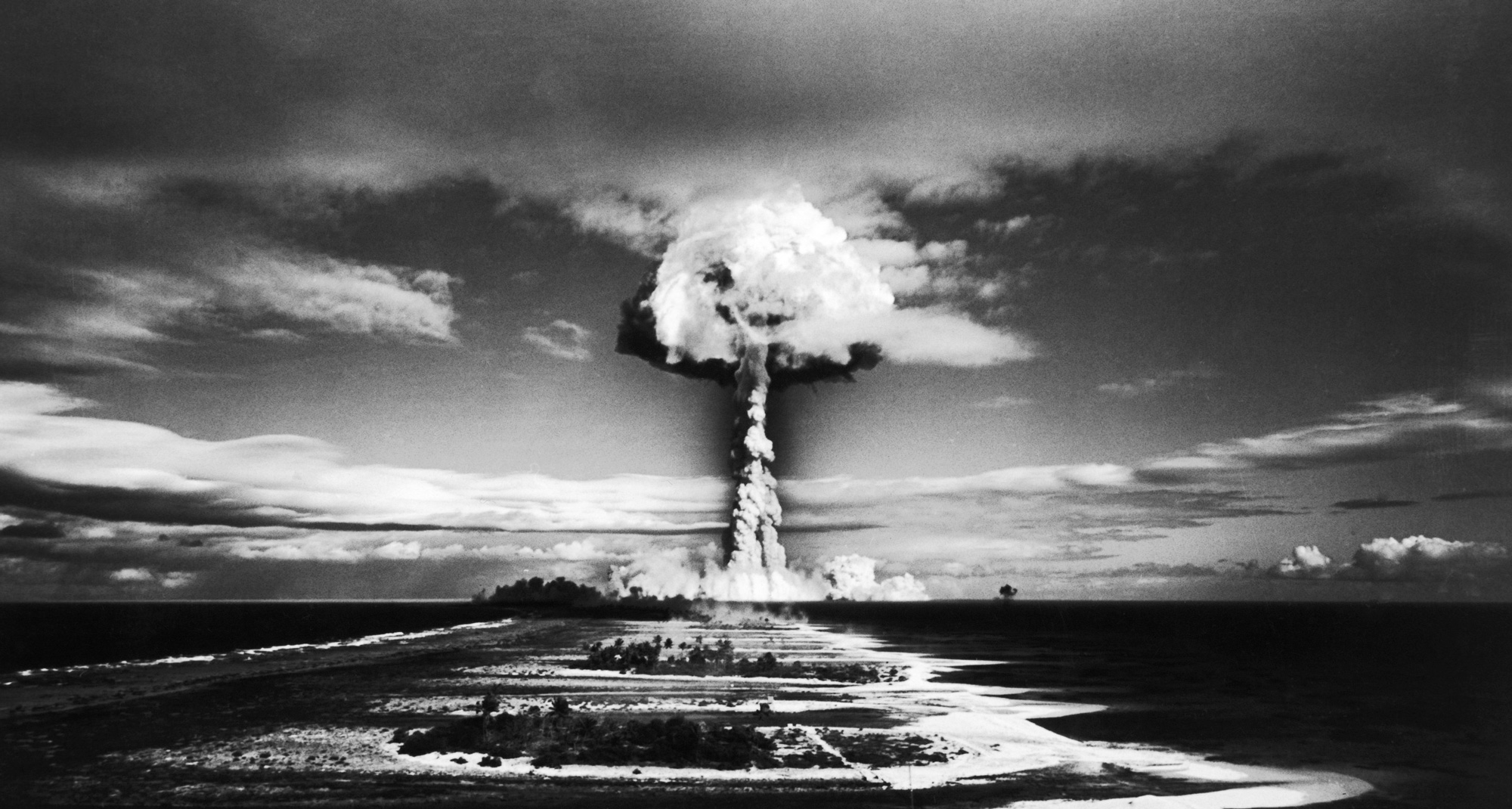
France’s nuclear and chemical testing in its former colonies represents one of the lesser-explored intersections of military science, colonial policy, and the geopolitics of power in the twentieth century. These tests, which were primarily implemented between the 1960s and 1990s, were not only justified by the strategic logic of nuclear deterrence and France’s international positioning but also clearly reflected the continuation of a colonial mindset within the post-World War II international order. The selection of sites such as the Algerian Sahara and the Polynesian archipelago for conducting these tests reveals an unequal global division of technological power and the human costs it entails.
Despite the gradual expansion of critical literature surrounding the colonial legacies of nuclear powers, political-security analyses of these actions remain largely marginalized. This report aims to focus specifically on France, analyzing its nuclear and chemical testing through the lens of key security policy concepts such as threat level, active stakeholders, national interest logic, and governance structures. Ultimately, it evaluates the strategic and international consequences of these actions. Additionally, the report examines the role of international institutions, local movements, and legal developments in redefining the legitimacy of such actions, introducing emerging analytical frameworks such as “nuclear colonialism” and “transitional justice” into the discourse of security politics.
- Nature and Level of Threat
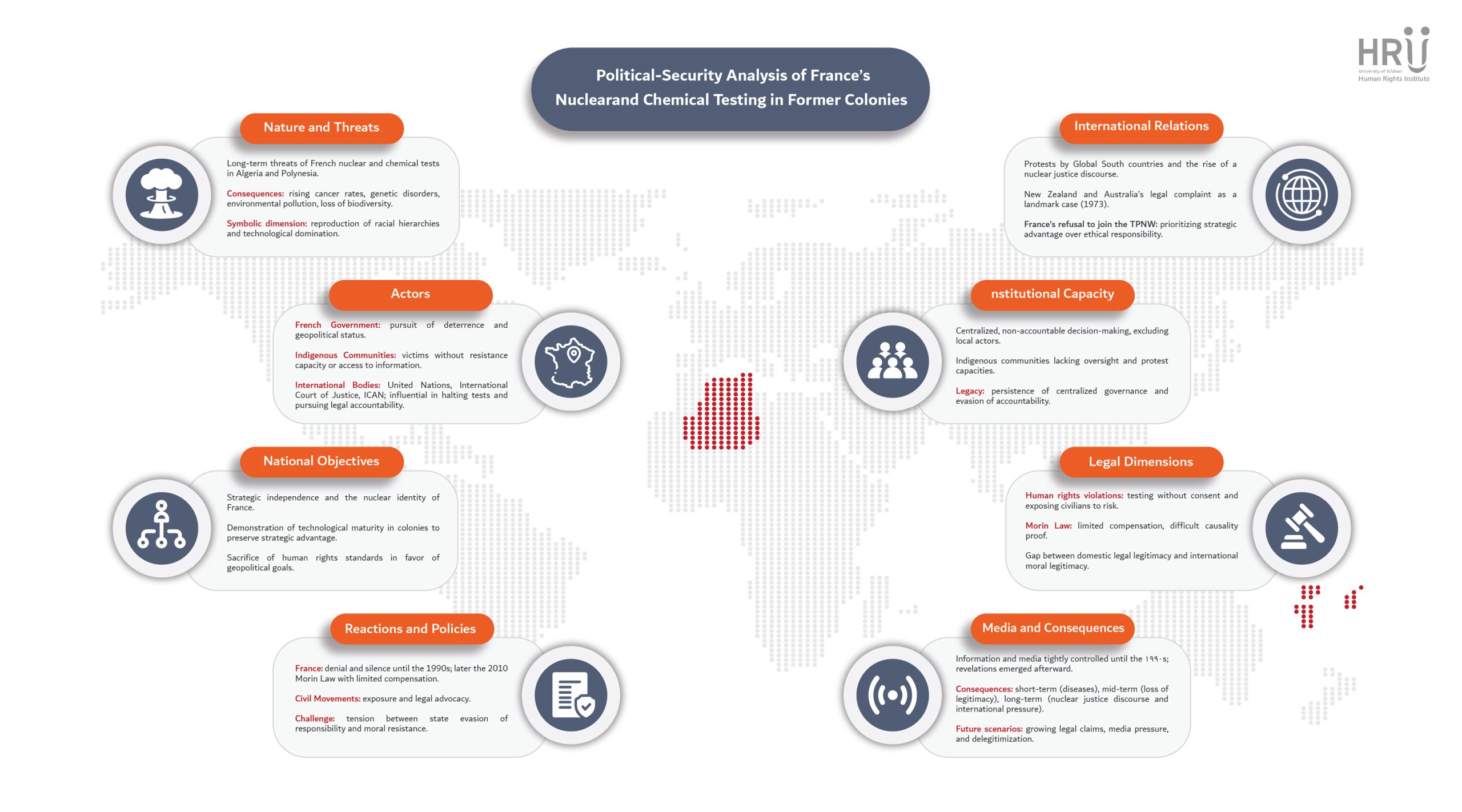
France’s nuclear and chemical testing in its former colonies—particularly in the desert regions of Algeria and the islands of Polynesia—embodied a clear manifestation of systemic and hybrid threats against human security, the environment, and even the legitimacy of governance structures within indigenous communities. Contrary to the prevailing perception that views these actions merely as short-term military operations, the reality reveals long-term, chronic, and self-replicating effects that persisted over several decades (especially from the 1960s to the 1990s), impacting public health, social structures, and the quality of life for subsequent generations.
At the human level, increased rates of cancer, genetic disorders, and congenital abnormalities among local populations near test sites have been well documented. Environmentally, the long-term persistence of radioactive and chemical contamination, the weakening of biodiversity, and widespread pollution of groundwater and soil have chronically disrupted the region’s biosafety. In addition, the symbolic and identity-based consequences of these tests must not be overlooked: the fact that the tests were conducted not on French soil but in former colonies populated by non-white communities implicitly reproduced the racial hierarchy embedded within the international order.
Such actions can be analyzed through the framework of technostructural violence, a concept employed by Gabrielle Hecht in her examination of France’s nuclear colonialism. Within this analytical model, military technology is not merely a tool of deterrence but a mechanism of political domination and a fundamental threat to the lifeworlds of peripheral societies. These threats, despite the physical cessation of testing, persist through contaminated legacies, political distrust, and ongoing public health crises among indigenous populations.
- Actors
The framework of France’s nuclear policies in its former colonies, from the perspective of political sociology and international relations, consisted of a spectrum of actors occupying divergent institutional roles and driven by differing motivations, each contributing—whether through cooperation, conflict, or submission—to the execution of this vast project.
At the core of this structure stood the French Republic, acting as the principal actor, pursuing military deterrence and geopolitical elevation through a highly technocratic and security-oriented program. The state, relying on elite military and scientific institutions—particularly the Ministry of Defense, the French Alternative Energies and Atomic Energy Commission (CEA), and research networks affiliated with the National Centre for Scientific Research (CNRS)—carried out extensive nuclear and chemical testing with institutional coordination.
On the other end of the spectrum were the indigenous populations of the former colonies—from the Tuareg communities of southern Algeria to the inhabitants of Moruroa and Fangataufa islands in Polynesia—who functioned as silent victims of this program, effectively excluded from any form of bargaining power or participation. These communities were not only deprived of the means for active resistance but, in most cases, were even denied basic information about the tests. The consequences only became apparent to them through delayed effects such as disease, infertility, and environmental degradation.
In addition to these two primary poles, international institutions also played a role in responding to this issue. The United Nations, the International Court of Justice (ICJ), and the Conference on Disarmament engaged with France’s testing practices in various ways. In a historic 1974 ruling, the ICJ addressed a lawsuit filed by New Zealand and Australia against France’s atmospheric tests in the Pacific, ultimately leading to their cessation—albeit based on France’s unilateral commitment rather than a binding court order. Organizations like the International Campaign to Abolish Nuclear Weapons (ICAN) have, in recent decades, connected these testing experiences with the global call for disarmament, thereby engaging in critical activism and legal capacity-building.
These developments show that the actors involved in this issue form part of a multi-level network of power, knowledge, and resistance—a network whose balance has been shifting since the 2010s in favor of civil society and international advocacy groups.
- National Interests and Objectives
France’s nuclear policy in the latter half of the twentieth century was deeply rooted in the doctrine of deterrence—a geopolitical doctrine formulated in the aftermath of World War II, and particularly shaped during the presidency of Charles de Gaulle, in response to the bipolarity of the Cold War era. France, as a nation with superpower ambitions yet marked by historical experiences of occupation and humiliation during the Second World War, sought to assert its strategic autonomy by acquiring nuclear technology and conducting tests in peripheral arenas.
This strategy, especially in defiance of U.S. dominance within NATO, carried symbolic and political significance. Nuclear weapons were seen as a cornerstone of national identity and autonomous decision-making in foreign policy. Within this framework, French national interests were redefined not merely in terms of territorial security, but as an expression of identity and civilizational prestige. Scientific and military power became indicators of international status and instruments of exerting authority in the global order.
From this perspective, the nuclear tests conducted in Algeria and Polynesia served as functional tools to demonstrate France’s nuclear maturity to the world—particularly within the structure of the United Nations Security Council, where permanent membership was implicitly linked to possession of nuclear capabilities.
However, the pursuit of these interests came at the expense of human rights standards, the principle of indigenous consent, and ethical obligations. Rather than utilizing metropolitan French territory, policymakers deliberately chose former colonies as spaces of “silence and full discretion,” where programs could proceed without media oversight, political cost, or meaningful civil resistance. This prioritization of geopolitical security over human life highlights the dominance of realist paradigms in France’s definition of national interest during the Cold War—a model in which technological instruments derived legitimacy from existential competition and survival imperatives, rather than legal or moral principles.
- Reactions and Policies
The official response of the French Republic to criticisms and revelations concerning its nuclear and chemical testing in former colonies followed a classic pattern of denial, delay, and narrative control. Until the 1990s, the dominant strategy of the French government relied on institutional silence, the classification of information, and denial of direct responsibility for the human and environmental consequences of the tests. It was only after mounting domestic public pressure and international protests that France was compelled to revise its stance. In 2010, with the adoption of the Morin Law, the state took its first formal step toward limited acknowledgment of responsibility and the provision of compensation.
Named after then-Defense Minister Hervé Morin, this law established a legal framework for victims of nuclear testing to apply for reparations. However, due to strict eligibility criteria and burdensome evidentiary requirements, the law was widely regarded by scholars and activists as insufficient—even symbolic—in nature. From a transitional justice perspective, France’s compensation policy failed to uphold the principle of “presumption of causality in favor of the victims”, instead placing the burden of proof on survivors. By 2017, fewer than 10% of claims submitted by victims had resulted in successful outcomes.
Moreover, the French government resisted releasing maps of radioactive waste burial sites and documents detailing the actual scale of contamination, making environmental remediation exceedingly difficult for local governments and civil society actors.
In contrast to this state-driven narrative control, local civil movements in Algeria and Polynesia, along with international campaigns, pursued strategies rooted in exposure, testimonial advocacy, and legal redress. In Algeria, organizations like Shoaa launched campaigns using archived documents to reveal the long-term impacts of radioactive exposure. In Polynesia, political figures like Oscar Temaru and groups such as Moruroa e Tatou mobilized collective memory and indigenous institutions to elevate the anti-nuclear discourse from the social level to international legal platforms.
Ultimately, from the standpoint of governance legitimacy theories, France’s response illustrates the tension between state-driven evasion of responsibility and the moral-civil resistance of victimized communities. This tension remains unresolved and continues to manifest in contemporary demands for transparency, reform of the Morin Law, and France’s accession to the Treaty on the Prohibition of Nuclear Weapons (TPNW).
- International Relations and Balance of Power
France’s nuclear and chemical testing programs in its former colonies had long-lasting repercussions on the country’s international standing and on the broader dynamics of power distribution in the global system. The conduct of radioactive explosions in non-European territories not only provoked the anger of regional states in the Pacific and Africa but also came to symbolize France’s double standards in relation to the principles of the international order—principles such as national sovereignty, public health, and regional peace, which were sidelined in favor of nuclear deterrence and strategic dominance.
Between the 1960s and 1990s, countries such as New Zealand, Australia, Fiji, and Algeria repeatedly took a stance against France’s nuclear testing in international forums. The 1973 lawsuit filed by New Zealand and Australia at the International Court of Justice (ICJ) marked a turning point in the legal challenge against France’s atmospheric tests. Although the case was discontinued following France’s unilateral declaration to end such tests, it nonetheless helped shape a global critical discourse against nuclear unilateralism by powerful states.
In the decades that followed, regional anti-nuclear movements in the Pacific, along with global non-governmental organizations such as ICAN, continued to push for transparency, legal documentation, and a justice-based discourse in international relations.
Despite the adoption of the Comprehensive Nuclear-Test-Ban Treaty (CTBT) in 1996 and its wide ratification across the globe, France—like other nuclear powers—has not signed the more recent and radical treaty’s like TPNW. This refusal reflects not only a legal but also a symbolic commitment to power-centric logic in French foreign policy—a paradigm in which the preservation of strategic advantage takes precedence over ethical responsibility and the commitment to a WMD-free international order.
While this stance may be framed as strategically justifiable, it significantly undermines France’s self-image as a champion of multilateralism and human rights within international institutions.
From a theoretical perspective, France’s position in international politics on the issue of nuclear testing exemplifies the nuclear paradox in global relations: the tension between survivalist deterrence strategies on one hand, and the ethical, legal, and legitimacy demands of the global community on the other. This paradox has become a driving force behind the growing demands for nuclear justice among countries of the Global South.
- Governance Structures and Institutional Capacity
The governance model underpinning France’s nuclear and chemical testing program was based on centralized, bureaucratic, and largely unaccountable structures that emerged from the confluence of military, scientific, and political interests concentrated in Paris. Decision-making in this domain did not stem from democratic and transparent parliamentary processes but was instead shaped within institutions such as the French Atomic Energy Commission (CEA), the Ministry of Defense, and intelligence agencies—entities that often operated beyond the reach of public or media oversight. This decision-making centralization, accompanied by the exclusion of civil actors and a lack of transparency, significantly limited the potential for institutional resistance or legal accountability at the time.
At the local level, due to the colonial nature of governance structures in former colonies, indigenous communities lacked effective institutional capacity to monitor, complain, or object to the tests. In militarily-occupied Algeria and administratively-subordinated Polynesia, local governmental bodies and councils were effectively extensions of the French central authority, bound by pre-set directives that left no room for dissent. Even after Algerian independence, secret provisions within the Évian Accords allowed France to maintain a military and technical presence on Algerian soil without any public oversight of these arrangements.
This situation is particularly amenable to analysis through the theoretical frameworks of security states and knowledge-power, as developed by Michel Foucault. In such frameworks, modern sovereignty asserts itself through monopolization of specialized knowledge (in this case, nuclear and military expertise) and through the management of bodies and territories, imposing discipline and order in areas devoid of political representation. As Gabrielle Hecht explains, nuclear colonialism operates not only through technological deployment but also through the neutralization of local institutions and the elimination of protest capacity.
In recent decades, with the expansion of media platforms, human rights courts, and the emergence of independent institutions in former colonies, parts of this institutional void have been filled. However, the traces of centralized governance and avoidance of accountability remain visible in France’s nuclear policies to this day.
- Legal Dimensions
France’s nuclear and chemical testing program in its former colonies stands in clear violation of core principles of human rights and international humanitarian law. Conducting these tests without the free and informed consent of indigenous populations, and subjecting civilian communities to deadly radiation or chemical agents, constitutes a direct breach of Article 7 of the International Covenant on Civil and Political Rights (ICCPR), which prohibits any medical or scientific experimentation without consent. From a humanitarian law standpoint, the principle of precaution—which mandates the protection of civilians in both wartime and peacetime—was also flagrantly disregarded.
Nevertheless, France’s legal response—especially in its domestic legal framework—has been markedly limited and defensive. The 2010 Morin Law, which created a formal mechanism for compensating victims of nuclear testing carried out between 1960 and 1996, was France’s first legal attempt to assume partial responsibility. However, experts have pointed out significant shortcomings in the law’s eligibility criteria, causality standards, and judicial enforcement.
For instance, applicants were required to provide proof of direct presence at test sites or a diagnosis of a specific recognized illness—despite the fact that much of this documentation was either never recorded or has been lost in the former colonies. Moreover, prior to the 2017 amendments, the law presumed government non-liability and placed the burden of proof on the victims to demonstrate a causal link between their illness and radiation exposure. Although this presumption was later revised to ease the claims process, nearly half of all applications continue to be denied due to technicalities or lack of documentation.
Even the language of the law itself proved to be an obstacle: for example, the Arabic version of the Morin Law was not made available to Algerian victims until 2023, impeding access to justice for years.
In essence, from the standpoint of legitimacy, it appears that France has attempted to construct a formal legal legitimacy for its past actions through minimal compensatory measures—without addressing the underlying ethical and political dimensions. The gap between international legitimacy, which demands full transparency, accountability, and comprehensive reparation, and France’s limited domestic recognition, reflects the continuing legacy of legal inequality in how former colonial powers engage with the consequences of their historical actions.
- Informational and Media Dimensions
France’s information policy concerning its nuclear and chemical testing—especially during the early decades of the program—was deeply intertwined with national security logic and information classification mechanisms. The French government, invoking reasons of national interest, kept a significant portion of technical details, the locations of radioactive waste disposal sites, and documents related to the health of local populations and deployed military personnel classified as confidential for many years. This approach led to the creation of an “information blackout zone” that prevented public opinion from gaining a comprehensive picture of the tests’ consequences—a form of consciousness engineering aimed at controlling political discourse and suppressing the formation of a critical collective memory.
Major French media institutions, including the state-owned ORTF (Office de Radiodiffusion Télévision Française), rarely provided critical coverage of nuclear testing in former colonies until the 1990s. This reflected, in part, the structural relationship between the media and the central government under the Fifth Republic—where media outlets functioned less as independent platforms for public debate and more as legitimizing instruments for nuclear policy. For example, during the Polynesian tests, French national television focused on showcasing technical success and national advancement rather than exposing the radioactive impact on local communities.
A significant shift in this pattern began in the 1990s, driven by archival revelations, investigative journalism, and academic research. Reports published in newspapers like Le Monde and studies by scholars documenting radiation victims revealed to the European public that the human and environmental consequences of the tests had been far more severe than official narratives suggested. The release of classified military documents—such as geological fault maps of Moruroa and evidence of food chain contamination in Mangareva and Tahiti—demonstrated that the French government had, in numerous instances, deliberately withheld danger warnings from the public.
Since the 2010s, civil society organizations, through multimedia reporting and testimony–centered advocacy, have sought to break this historical silence and strengthen mechanisms of transparency. However, a substantial portion of archival material remains inaccessible for security reasons, and many key documents can only be retrieved with special authorization or after prolonged legal waiting periods.
In sum, France’s experience demonstrates that nuclear policy is exercised not only in the physical realm but also within the domain of information, operating on the basis of knowledge monopoly and discursive control. This model of information governance can only be effectively challenged through a combination of civil pressure, scientific exposure, and judicial pursuit.
- Consequences and Scenarios
The consequences of France’s nuclear and chemical testing in its former colonies can be analyzed across three temporal dimensions—short-term, medium-term, and long-term—intersecting the domains of public health, political legitimacy, and global normative order.
In the short term, the human toll in test-affected regions became immediately apparent. Data from medical institutions, such as France’s National Institute of Health and Medical Research (INSERM), indicate a significant rise in specific types of cancer—including thyroid, blood, and lung cancers—among the local populations of Polynesian islands. In Algeria, field reports and independent studies have confirmed the spread of radiation-related diseases, genetic disorders, and birth defects, particularly in areas like In Ekker and Reggane, located in proximity to test sites. This public health crisis was not merely a biological disaster but also a stark manifestation of colonial inequality in the right to a healthy life.
In the medium term, these tests severely eroded France’s political legitimacy among states and peoples of the Global South. Countries with their own histories of colonization—such as Nigeria, Ghana, India, and Algeria—repeatedly criticized France’s discriminatory testing practices in international forums. This process contributed to a symbolic rupture between Southern nations and the western discourse and was reflected in regional anti-nuclear cooperation efforts across the Pacific and Africa. Moreover, France’s actions drew criticism even from its traditional partners in the European Union; for instance, when France resumed testing in the 1990s, some European governments temporarily suspended scientific collaborations with Paris.
In the long term, the testing legacy has become a key driver in the emergence of a global discourse on nuclear justice. A transnational network of civil society organizations, researchers, victims, and disarmament-aligned governments has advanced demands for transparency, accountability, and reparations, elevating them from local grievances to the realm of international law. The adoption of the Treaty on the Prohibition of Nuclear Weapons (TPNW) in 2017—particularly Article 6, which obliges states to provide victim assistance and environmental remediation—was the direct result of such pressures. While France has not yet joined this treaty, continued advocacy by affected nations increases the likelihood of growing diplomatic pressure for it to assume new obligations.
From this perspective, the likely future scenarios involve the expansion of legal claims, intensification of media scrutiny, and the deepening delegitimization of nuclear powers—both in normative and legal arenas.
Conclusion
A political-security analysis of France’s nuclear and chemical testing in its former colonies reveals that these actions were not merely the byproducts of Cold War-era technological competition, but rather a continuation of colonial logic in a modern, technological guise. As an emerging nuclear power, France exploited territories such as Algeria and Polynesia as low-cost arenas for advancing its weapons program—regions in which the absence of institutional capacity, the monopolization of scientific knowledge, and the political exclusion of indigenous communities created optimal conditions for the unilateral exercise of power.
At the same time, the nuclear project served as a tool for redefining France’s geopolitical position in the post-colonial global order. More precisely, Paris sought to compensate for the symbolic decline associated with the fall of its empire through technological authority and military capability. Yet in doing so, it not only ignored fundamental human rights, but also transformed the bodies of colonized peoples into experimental subjects, further entrenching historical inequalities.
In recent decades, however, we have witnessed a shift in the discursive balance of power. Local resistance, civil society advocacy, journalistic revelations, and the emergence of justice-oriented discourses at the international level have broken the historical silence surrounding the tests. New concepts such as nuclear justice and postcolonial nuclearism have entered international literature, raising fundamental questions about the legitimacy of technological power, nuclear ethics, and the historical responsibility of states.
Ultimately, today’s challenge lies not only in the recognition of victims’ rights and the provision of reparations, but also in the redefinition of power relations based on the principles of human dignity and international law. Ratifying treaties such as the Treaty on the Prohibition of Nuclear Weapons, declassifying national archives, remediating contaminated environments, and ensuring medical care for victims constitute concrete steps toward fulfilling this historical responsibility. Undoubtedly, the future of this case, symbolically, will serve as a litmus test for France’s sincerity in rethinking its role in both the colonial legacy and the modern militarized world.