Introduction
In recent years, Europe has become the stage for one of the most complex contemporary challenges in the realm of freedom of expression and fundamental rights: the systematic overlap between criticism of Israel and criminal-security labels such as antisemitism and support for terrorism. This trend, which intensified to an unprecedented degree after October 7, 2023, is not merely a temporary political reaction but rather an indication of a broader pattern emerging within the domestic and foreign policies of certain European governments. In this model, critics of Israel—whether journalists, academics, civil society activists, or members of parliament—are subjected to processes of delegitimization that weaken the legitimacy of their activities and create grounds for social exclusion, professional restrictions, cancellation of public programs, and even legal prosecution.
The recent arrest of Mahdieh Esfandiari, an Iranian citizen residing in France, by the French police, marks a critical turning point in this process. Its political and legal implications extend far beyond a single individual case, reflecting the dominant logic in which criticism of Israel is portrayed as a threat to Europe’s public security. Through the expansion of legal frameworks against antisemitism and the vague, broad definitions of “support for terrorism,” the legal and political space has been reshaped in a way that potentially criminalizes any solidarity with Palestine or objection to Israeli policies.
This situation not only redefines the boundaries of political legitimacy in Europe but also raises fundamental questions about the relationship between freedom of expression, collective security, and the responsibilities of states under international human rights law. Thus, the case of Mahdieh Esfandiari must be analyzed within the broader framework of the politics of discrediting Israel’s critics in Europe—a policy whose consequences extend beyond activists and social actors, undermining Europe’s democratic structure and the foundational values of human rights.
Constructing an Imaginary
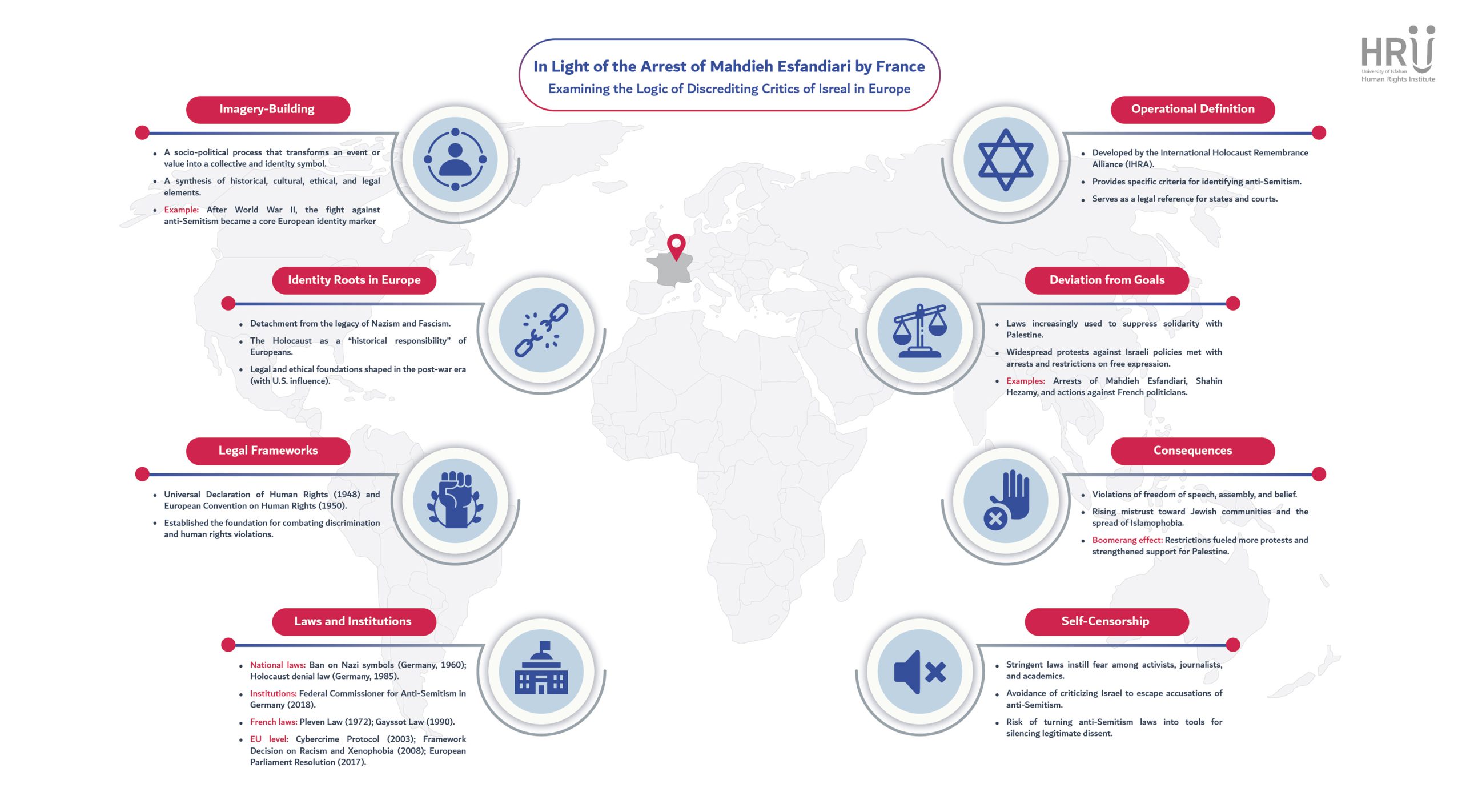
Constructing an imaginary refers to a social and political process whereby a phenomenon, event, or specific value transcends individual or temporary experience and becomes institutionalized as a shared semantic and identity-based framework within society. In this process, historical, cultural, moral, and legal elements intertwine to form a collective image or symbol that serves as a reference for political and social decision-making and action.
Imaginary construction typically arises when societies seek to redefine their identity, distance themselves from the past, or consolidate a fundamental value. A historical event can thus transform into an identity symbol with a lasting place in collective memory and public policies.
Across Europe, after the end of World War II (1945) and the gradual reintegration of Jewish communities into public life, the imaginary of “combating antisemitism” emerged in the minds of both society and policymakers within a relatively short period. Europeans argued that the historical shock of the Nazi regime’s extermination of Jews had engendered empathy and solidarity toward Jewish survivors who had dispersed or gone into hiding to escape death. The shared suffering of war—displacement, hunger, and destruction—helped reinforce this identification.
Moreover, postwar Europe sought to distance its identity from the intellectual underpinnings of Nazism and fascism. The remembrance of the Holocaust and the fight against antisemitism became symbolic and normative tools for such separation. In Germany and Italy, a sense of responsibility or even complicity in the events of World War II also shaped this commitment. Additionally, the universalist legal and moral frameworks developed after the war—deeply influenced by American political culture as one of the victors—pushed European societies and lawmakers to establish specific laws and regulations concerning antisemitism and the Holocaust. Over time, combating antisemitism was institutionalized not only socially and culturally but also politically and legally.
Anti-Antisemitism Laws
With the end of World War II and the adoption of the Universal Declaration of Human Rights (1948) and the Convention on the Prevention and Punishment of the Crime of Genocide, Europe independently established the European Convention on Human Rights (1950). Article 10 of this Convention states:
“Everyone has the right to freedom of expression. This right shall include freedom to hold opinions and to receive and impart information and ideas without interference by public authority and regardless of frontiers. This article shall not prevent States from requiring the licensing of broadcasting, television, or cinema enterprises. The exercise of these freedoms, since it carries with it duties and responsibilities, may be subject to such formalities, conditions, restrictions, or penalties as are prescribed by law and are necessary in a democratic society, in the interests of national security, territorial integrity, or public safety, for the prevention of disorder or crime, for the protection of health or morals, for the protection of the reputation or rights of others, for preventing the disclosure of information received in confidence, or for maintaining the authority and impartiality of the judiciary.”
This provision became a starting point for further legislation and institutions related to the Holocaust and antisemitism in Europe. It established a strong foundation for combating discrimination and human rights violations, creating the legal and ethical environment in which Holocaust remembrance could be anchored.
At the European level, several instruments were later adopted:
- The 2003 Additional Protocol to the Council of Europe Convention on Cybercrime,
- The 2008 EU Framework Decision on combating racism and xenophobia, and
- The 2017 European Parliament Resolution on antisemitism.
At the national level, countries like Germany, France, and the United Kingdom adopted their own measures: Germany’s Holocaust Denial Law (1985) criminalized denial or trivialization of the Holocaust; its Law on the Prohibition of Nazi Symbols (1960) banned Nazi insignia. In 2018, Germany established the Federal Commissioner for Jewish Life and the Fight against Antisemitism. France enacted the Pleven Law (1972) and the Gayssot Law (1990), both addressing racism, hate speech, and antisemitism.
In 2016, the International Holocaust Remembrance Alliance (IHRA) adopted its “working definition of antisemitism” in Budapest, Hungary. Many European states, including France, Germany, and the UK, incorporated this operational definition into their legal frameworks, giving judges, politicians, and media institutions clearer tools for identifying and combating antisemitism.
Deviation from Objectives
Despite these efforts, European societies eventually realized that antisemitism-related laws could easily become tools for delegitimization and criminalization. As Israeli actions against Palestinians—particularly in Gaza—intensified (e.g., cutting humanitarian aid, widespread destruction of civilian areas), European citizens, exposed through media to the severity of these events, began mobilizing in solidarity with Palestinians. Large-scale demonstrations across European cities, universities, and public spaces demanded justice for Palestinians.
European governments, however, responded primarily through political securitization, rapidly labeling such protests and condemnations as antisemitic or pro-terrorism. Social media posts, for example, could expose individuals to charges of hate speech or antisemitism, often leading to heavy legal penalties. After October 7, 2023, this criminalization intensified significantly. Israeli military operations in Gaza triggered mass European outrage, but arrests, police violence against demonstrators, and extensive surveillance of online speech became widespread. These measures targeted not only citizens but also foreign residents.
Mahdieh Esfandiari, an Iranian citizen living in Lyon, was among those arrested on charges of antisemitism and support for terrorism, based on her online activities. She is currently detained in the notorious Fresnes Prison. Her case illustrates how legal tools, originally designed for combating extremism, have shifted toward criminalizing speech and solidarity. The placement of her case under the “apology for terrorism” law—moved from press law to criminal law in 2014—signals a paradigmatic shift in French criminal policy.
Similarly, Shahin Hezamy, an independent Iranian journalist, was also arrested in France for pro-Palestinian advocacy. French politicians such as Rima Hassan (candidate of La France Insoumise) and Mathilde Panot (member of the National Assembly) were interrogated by Paris police for their pro-Palestinian remarks. On October 10, 2023, the French Minister of Justice announced that any public statements praising Hamas’s attacks, framing them as legitimate resistance, or presenting favorable assessments of Hamas, Palestinian Islamic Jihad, or similar groups would be punishable under this law—with prison sentences of up to 5 years and €75,000 fines, rising to 7 years and €100,000 if expressed online.
Security Paradox and Social Divides
While anti-antisemitism laws may have provided Jewish communities in Europe with a sense of psychological security, they have simultaneously deepened social divides by criminalizing pro-Palestinian expression. This has led to violations of the rights to freedom of expression, opinion, and peaceful assembly, and has fostered suspicion toward Jewish communities by associating governments’ one-sided policies with Jewish identity.
This dynamic can be analyzed through the “boomerang effect” theory, which describes cases where a law or policy designed to restrict a phenomenon produces the opposite result. Heavy-handed Holocaust denial and antisemitism laws risk creating feelings of discrimination among Europe’s Muslim migrant populations, who perceive double standards compared to protections afforded to Jewish communities.
One example occurred during a football match between Maccabi Tel Aviv and Ajax Amsterdam in the Netherlands: despite reports that Israeli supporters initiated the conflict with slogans endorsing genocide in Gaza and anti-Arab chants, Dutch authorities harshly suppressed Palestinian supporters and publicly sided with Israelis. Such double standards reinforce perceptions of bias and institutionalize resentment.
Self-Censorship
As Palestinian and Lebanese armed groups were added to terrorist lists under international pressure, European governments gained additional justification for silencing Palestinian supporters. The result was an environment in which fear of legal or security repercussions drove many individuals to silence.
This reflects the theory of the “chilling effect,” wherein individuals or groups refrain from exercising their right to free expression due to fear of consequences such as legal penalties, political repression, or social exclusion. In the European context, strict defamation, hate speech, and anti-terror laws contribute to this chilling effect, discouraging legitimate criticism of Israel.
Critics argue that instruments such as France’s Gayssot Law or the IHRA working definition of antisemitism risk creating self-censorship among journalists, activists, and academics, who fear being labeled antisemitic or prosecuted for expressing human-rights-based criticisms of Israel.
Conclusion
The analysis of Europe’s political and legal trajectory shows that the imaginary of combating antisemitism has shifted away from its original moral and identity-based function—a response to the horrors of World War II and the Holocaust—and has been reframed within a securitization paradigm. This transformation has turned a fundamentally ethical and human rights-oriented framework into a political tool for controlling criticism of Israel.
The consequences are profound: not only has freedom of expression, as enshrined in Article 10 of the European Convention on Human Rights, been significantly curtailed, but the overall social environment now fosters self-censorship and silences dissent. The arrest of Mahdieh Esfandiari in France epitomizes this trajectory, demonstrating how antisemitism frameworks have been politicized to suppress fundamental freedoms and stifle dissenting voices.
At a broader level, Europe faces a structural duality: on the one hand, formal commitments to universal human rights; on the other, the political-security imperatives of states. The dominance of the latter erodes democratic freedoms, undermines legal institutions, and risks producing cycles of discrimination and mistrust. Instead of safeguarding human dignity and preventing a recurrence of historical atrocities, Europe risks weakening its very legitimacy.
The future of anti-antisemitism policies in Europe depends on a return to a genuine human rights logic, disentangled from securitization frameworks. Only by distinguishing clearly between legitimate criticism and hate speech can European states simultaneously protect human dignity and preserve the democratic space necessary for fundamental freedoms. Without such a recalibration, countries such as France will not only face crises of legal and political legitimacy but also risk deepening social fragmentation and undermining the very foundations of democratic coexistence.