


Introduction
Following the commencement of military attacks by the United States and Israel against Iran on the morning of February 28, 2026, religious sites—alongside many other civilian facilities and institutions, including hospitals, schools, universities, and service infrastructures—were subjected to both direct and indirect attacks. During these operations, a number of Islamic religious centers across different parts of the country were targeted by bombardment or destruction. In addition, certain religious sites belonging to other faiths were not immune from the consequences of these attacks and also sustained damage.
Damage to religious sites in any armed conflict cannot be understood merely as the destruction of a building or a civilian gathering place. Rather, it constitutes an assault on a fundamental component of the cultural, spiritual, and identity-based life of societies. Beyond their religious function, such sites often play a crucial role in maintaining social cohesion, providing communal services, offering psychological and spiritual support to civilians, and sustaining the cultural continuity of society.
Accordingly, attacks against these sites—or the infliction of damage upon them—extend far beyond material loss and may produce profound human, psychological, social, and legal consequences. Recent developments have therefore once again raised serious questions and significant ambiguities regarding the extent to which the attacking parties adhere to the rules of international law, particularly international humanitarian law (IHL), as well as the degree of respect afforded to religious and sacred sites during armed conflicts.
Within this context, examining the condition of religious centers damaged during the attacks by the United States and Israel against Iran is of particular importance—not only for the purpose of documenting events, but also for conducting a legal assessment of the status of such sites within the framework of international law and the scope of protections afforded to them.
Incidents
Following the initiation of attacks against Iran by the United States and Israel, a number of religious centers—particularly mosques—were subjected either to direct strikes or to the effects of nearby explosions. It should be noted that, as of the time of drafting this report in mid-April 2026, no comprehensive aggregated statistics regarding the total number of affected sites have yet been officially released. Accordingly, this report focuses only on those sites that are more prominent and have received greater media attention.
- Hosseinieh Azam Zanjan
At approximately 5:00 a.m. on Tuesday, March 31, 2026, the religious-cultural complex of the Hosseinieh Azam Zanjan was targeted in an airstrike. As a result of this attack, the administrative and cultural sections of the complex—including the library, the charitable loan fund (Qard al-Hasanah), and the assembly hall located adjacent to the main courtyard—were destroyed[1].
In this incident, four individuals were killed and twenty-six others were injured[2]. According to provincial authorities, the financial damage, based on initial estimates, exceeded 3 trillion Iranian rials (approximately 300 billion tomans)[3].
It is noteworthy that the historical complex of Hosseinieh Azam, which itself sustained partial damage, is listed among Iran’s National Heritage Sites, with its origins dating back to 1845 CE[4].

- Rafi’-Nia Synagogue
In the early hours of Tuesday, April 7, 2026, the Rafi’-Nia Synagogue, located on Palestine Street in Tehran and considered one of the important centers of the Jewish community in the capital, sustained significant damage and destruction following bombardments. This area has traditionally been known as one of the Jewish-inhabited neighborhoods in Tehran.
The building of this synagogue dates back to the Pahlavi II era (1940s). Although it is not officially registered on Iran’s National Heritage List, it contained notable architectural decorations and housed Torah scrolls several centuries old[5].
Pirhossein Kolivand, Head of the Iranian Red Crescent Society, stated to reporters that the synagogue building was completely destroyed, and that neighboring buildings were also damaged. He further noted that rescue teams managed to extract a significant number of individuals from beneath the rubble and transfer them to hospitals[6].
According to media reports, the attack occurred at approximately 3:00 a.m., resulting in casualties. Additionally, numerous sacred Jewish texts were buried under the debris.

- St. Nicholas Orthodox Church
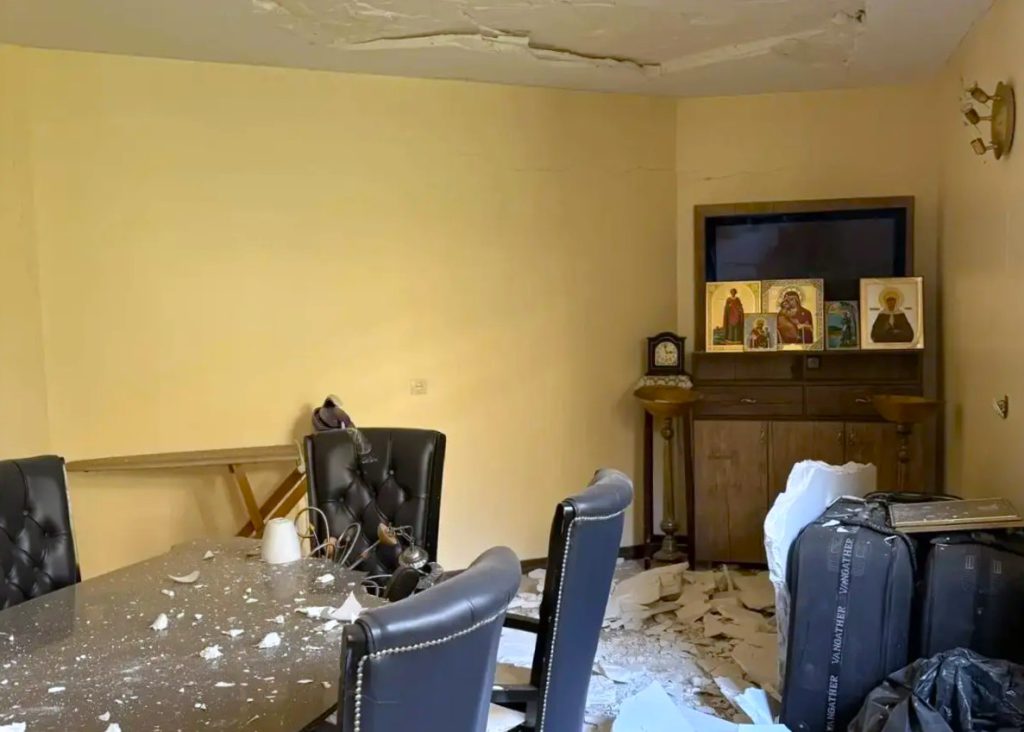
During two attacks carried out on the morning of Wednesday, April 1, 2026, in the vicinity of the St. Nicholas Orthodox Church in Tehran, the site sustained damage due to nearby explosions.
According to the official website of the Russian Orthodox Church, the attack occurred precisely at 5:37 a.m., with the main explosion taking place approximately 150 meters from the church[7].
As a result, both the main church building and adjacent service structures suffered damage, including shattered windows and doors[8]. Furthermore, a nearby Russian nursing home—where elderly residents still reside—sustained considerable structural damage, including the collapse of parts of its roof; however, no fatalities were reported[9].
It is important to note that the damage inflicted upon this Christian religious site resulted from the bombardment of the former United States embassy compound, located in close proximity.
- Greek Orthodox Church of Saint Mary
In addition to the aforementioned Russian Orthodox Church, during repeated attacks by the United States and Israel on Tehran, the historic Greek Orthodox Church of Saint Mary also sustained damage due to bombardments in surrounding areas.
The damage primarily affected the doors and windows of this sacred Christian site. According to Sajjad Asgari, Secretary of the Committee for the Follow-up of Tehran’s Historical Houses, although the church is not officially registered as a national heritage site, it nonetheless possesses significant historical value[10].
Challenges and Responses
- Emergence of a Recurrent Pattern
The existence of multiple reports documenting damage to religious sites during the recent hostilities—including mosques, churches, and other places of worship in Iran—alongside extensive media coverage and statements issued by domestic and international bodies regarding the targeting or damage of such sites, does not merely indicate the occurrence of isolated incidents. Rather, it reveals meaningful indications of the emergence of a recurrent pattern.
This pattern reflects the reproduction of similar consequences across different locations and timeframes. In this context, even if establishing the “systematic” nature of such acts in the strict sense of criminal law—namely, proving the existence of a deliberate policy targeting religious sites—would require additional evidence, the available indications nonetheless point toward a discernible operational consistency.
In particular, repeated instances such as strikes occurring in the immediate vicinity of religious sites, the destruction of places of worship within civilian urban settings, and numerous reports concerning damage to religious symbols collectively suggest a degree of behavioral coherence and an identifiable operational pattern.
In this regard, a review of prior precedents in other conflict zones—especially in Gaza, Lebanon, and the West Bank—demonstrates that attacks on Muslim and Christian religious sites by Israel are not a novel phenomenon, but rather possess a traceable historical continuity.
In the Gaza Strip, various reports indicate extensive damage to mosques during multiple military operations. In some cases, churches—such as the Greek Orthodox Church of Saint Porphyrius in Gaza—have also suffered severe destruction. In Lebanon, particularly in southern regions, damage to both mosques and churches as a result of airstrikes has been documented.
On April 19, 2026, an image circulated widely in international media showing an Israeli soldier striking and damaging a statue of Jesus Christ in a village in the town of Deir Siriane in southern Lebanon[11].

Additionally, in the West Bank, beyond military attacks, incidents of encroachment upon religious sites—including both mosques and churches—have been recorded in the context of security tensions and settlement expansion. In some cases, coercive non-military measures have also targeted such sites; for instance, bank accounts belonging to the Patriarchate Church and the Greek Orthodox Church of Jerusalem were reportedly frozen by the Israeli government[12].
In another recent incident in April 2025, Israeli settlers attacked the Christian village of Taybeh (also known by its Greek name Ephraim) in the West Bank, setting fire to Christian-owned property and causing extensive financial damage[13].
The recurrence of such incidents across diverse temporal and geographical contexts reinforces the proposition that damage to religious sites is not merely the result of accidental encounters or isolated errors. Rather, it can be analyzed within a reproducible framework, bearing identifiable features of a broader operational practice.
- Domestic Reactions
Council on American-Islamic Relations (CAIR), based in Washington, issued a statement on April 7, 2026, condemning Israel’s attack on a synagogue in Tehran and calling on pro-Israel groups to withdraw their support for the war. The statement declared:
“We strongly condemn Israel’s bombing of a synagogue in Tehran—an act that represents the predictable outcome of the unrestrained U.S.-Israeli bombing campaign targeting mosques, hospitals, schools, apartment buildings, and other civilian locations across Iran. We call on pro-Israel organizations and policymakers who support this war in the name of defending Israel to condemn this attack on a synagogue and to demand an end to this illegal and immoral war of choice. Their continued support for this war, and their silence regarding Israel’s attack on the Iranian Jewish community, will stand as further evidence that the primary priority of the Israel lobby is shielding the Israeli government from legitimate criticism—even at the cost of endangering Iranian Jews[14].”
The independent U.S.-based media outlet A Public Witness, in its report, examined global Christian reactions to the attacks on Iran. The report highlights responses from mainstream, Catholic, and Middle Eastern Christian leaders, demonstrating that—contrary to certain pro-war religious figures—a significant portion of Christian institutions has condemned these attacks.
The report begins by addressing the instrumentalization of religion to justify war by figures such as Franklin Graham and Pete Hegseth, and then emphasizes critical positions adopted by institutions such as the World Council of Churches, the United Church of Christ, Episcopal bishops, and the Presbyterian Church. These actors characterize the attacks as threats to civilians, violations of international law, and drivers of regional instability. Catholic leaders, including the Pope, have also called for an end to the cycle of violence and a return to dialogue.
The report further describes the situation of Middle Eastern Christians directly affected by the war—from the closure of churches to disruptions in the daily lives of religious communities. Ultimately, it concludes that a substantial segment of global Christianity regards the war as illegal, dangerous, and inconsistent with faith-based principles of peace, emphasizing the necessity of its termination[15].
Similarly, the independent New York-based outlet Mondoweiss addressed Israel’s attack on a synagogue in Iran. The report interprets the incident as indicative of internal contradictions within extremist strands of Jewish political discourse.
The author argues that despite Israel’s claim of protecting Jewish people, its actions in practice place Jewish lives—particularly non-Zionist communities such as Iranian Jews—at risk. In this framework, the bombing of the synagogue is presented as evidence of disregard for Jewish diversity and existence outside the Zionist project.
The report also refers to the historical presence of Iranian Jews and the opposition of some segments of this community to Zionism, presenting this as a challenge to Israel’s official narrative. By invoking the concept of “collateral damage,” the author situates the attack within a broader logic in which political objectives take precedence over human life. Ultimately, this approach is criticized as reflecting an erosion of human and ethical values in Israeli regional policies[16].
- International Reactions
The Jewish community of Iran issued a statement condemning the attack and destruction of the Rafi’-Nia Synagogue. The statement declared:
“In the name of the One God and in the name of the people and the brave defenders of our sacred homeland, we announce that in the early hours of Tuesday, April 7, 2026, following relentless attacks by Israel on our beloved homeland, the Rafi’-Nia Synagogue—one of the active and historic synagogues of Tehran—was completely destroyed as a result of enemy attacks. Once again, it has been demonstrated that their rulers harbor hostility toward the people of Iran without distinction of ethnicity or religion. We, the Jewish community of Iran, while condemning the enemy’s attacks on our homeland and the Rafi’ei-Nejad Synagogue, declare our historic unity with the leadership, the people, and the brave defenders of Iran, and proclaim with a resounding voice that we will stand alongside the people and the Islamic Republic of Iran until our last breath in defense of our homeland.”
This statement was signed by Jewish communities in Tehran, Shiraz, Isfahan, and Kerman, as well as by Younes Hammami Lalezar, the religious leader of Iran’s Jewish community, and Homayoun Sameh Najafabadi, the representative of Iranian Jews in the Islamic Consultative Assembly[17].
The Russian Embassy in Tehran also issued a statement condemning the attack on the Saint Nicholas Church. The embassy emphasized that the church was damaged during the period of Lent and on the eve of Easter. According to the statement, due to what it described as the “military adventurism of the United States and Israel,” the Orthodox Christian community in Iran has been unable to attend church services.
The embassy further noted that the church—designed by the renowned Russian architect Nikolai Markov—is registered as part of Iran’s national cultural heritage. Condemning what it termed the “ongoing aggression of the United States and Israel against Iran,” the Russian diplomatic mission warned that such actions are increasingly affecting civilian infrastructure as well as religious and cultural heritage. The embassy also released images showing structural damage, including collapsed roof sections, debris, and shattered glass[18].
Finally, the media outlet The New Arab reported on the reaction of Iranian Jews to the destruction of the Rafi’ei-Nejad Synagogue. The report indicates that the incident caused shock and concern among religious minorities.
Many members of the Jewish community in Iran viewed the attack not only as the destruction of a sacred site, but also as evidence of Israel’s disregard for Jews who are not aligned with Zionism. Interviewees emphasized the need to distinguish between Judaism as a religion and Zionism as a political ideology. They also underscored their Iranian identity, describing the war as imposed and inconsistent with ethical and religious principles.
Local residents likewise described the attack as a blow to peaceful interfaith coexistence in the neighborhood. In contrast, Israel claimed that the synagogue had not been the intended target and that the damage constituted “collateral damage.” Overall, the report suggests that this incident has challenged prevailing narratives about the status of Jews in Iran and has sparked renewed debates on the relationship between religion, identity, and politics[19].
Conclusion
What emerges from the examination of the overall set of events, field evidence, and domestic and international reactions is not merely a series of isolated instances of damage to religious sites. Rather, it indicates the formation of a concerning pattern in the manner in which military operations impact religious and identity-based spaces.
Even in cases where such sites have not been identified as direct targets, the occurrence of strikes in close proximity to religious centers, the destruction or damage of religious symbols, and the positioning of these spaces at the center of the consequences of military attacks collectively reinforce the assumption that the practical distinction between military and civilian objects—particularly within densely populated urban environments—has been seriously challenged.
From the perspective of IHL, such a trend raises not only critical questions regarding compliance with the principles of distinction, proportionality, and precaution, but also suggests that—even in the absence of demonstrable direct intent—the recurring pattern of damage to religious sites may carry significant legal consequences and implications of responsibility.
In other words, the continuation of such conditions blurs the boundary between what is characterized as “collateral damage” and what may amount to a form of structural disregard for the protection of civilian objects, thereby elevating legal assessments from the level of isolated incidents to that of an identifiable pattern of conduct.
At a broader level, the range of responses—from statements issued by religious and civil institutions to analyses presented in international media—demonstrates that attacks on or damage to religious sites are not perceived merely as technical or military issues. Rather, they are evaluated as deeply normative concerns, closely tied to the political and moral legitimacy of actors operating within the international system.
The simultaneity of condemnations voiced by Islamic, Christian, and Jewish institutions, along with critical perspectives emerging from within diverse religious communities themselves, indicates that such actions or their consequences may contribute to the erosion of the symbolic and moral capital of states at the international level.
Within this framework, what becomes essential is not only the reconstruction of material damage, but also a reconsideration of the relationship between military power and legal and ethical responsibility toward sacred spaces. The continuation of such a trajectory, in the long term, risks undermining the normative frameworks that protect religious sites and, consequently, weakening one of the fundamental pillars of human order in times of armed conflict.
References
[1] Asriran. (2026, March 31). Attack to the Zanjan Grand Mosque (Photo). Asriran. From: asriran.com/004q1D
[2] Salahshoor, K. (2026, March 31). U.S. and Israeli attacks on the Hosseiniyeh Azam Zanjan; 4 killed and 26 injured. Anadolu Ajansi. From: https://v.aa.com.tr/3886731
[3] SNN. (2026, April 15). 300 billion tomans in damages inflicted by the US–Zionist enemy on the Hosseiniyeh Azam Zanjan. SNN. From: https://snn.ir/005qaU
[4] Mojerasa. (2018, September 18). A look at the history of the Hosseiniyeh Azam Zanjan / Today, the eyes of the world are on Zanjan. Mojerasa. From: http://www.mojerasa.ir/khabar/8240/
[5] Nournews. (2026, April 7). Destruction of a historic synagogue in an airstrike on Tehran. Nournews. From: https://nournews.ir/n/308291
[6] Anadolu Ajansi. (2026, April 7). Iranian media: A synagogue was damaged in U.S. and Israeli attacks on Tehran. Anadolu Ajansi. From: https://v.aa.com.tr/3895549
[7] DECR. (2026, April 1). St. Nicholas Cathedral of Russian Orthodox Church in Tehran was damaged in missile strike. DECR. From: https://mospat.ru/en/news/94146/
[8] Ana News Agency. (2026, April 1). Damage to the Saint Nicholas Orthodox Church in Tehran and a Russian nursing home in Tehran following a missile attack. Ana News Agency. From: https://ana.ir/004Nki
[9] Jamaran. (2026, April 1). Damage to an Orthodox church and a Russian nursing home in Tehran in an attack by the U.S.–Zionist enemy / Russian Embassy provides details + photos. Jamaran. From: https://www.jamaran.news/fa/tiny/news-1703420
[10] Rokna. (2026, April 3). Damage to at least 61 historic buildings in Tehran during recent military attacks; from the former U.S. Embassy to two churches + table of site names. Rokna. From: https://www.rokna.net/fa/tiny/news-1214741
[11] Amori, S. (2026, April 20). Israeli soldier filmed smashing Jesus statue in southern Lebanon: Report. Anadolu Ajansi. From: https://www.aa.com.tr/en/middle-east/israeli-soldier-filmed-smashing-jesus-statue-in-southern-lebanon-report/3911654
[12] Ambrosino, S., & Robinson, C. (2025, September 8). This church was rebuilt during the crusades. Now under a modern siege, clergy and nuns are refusing to abandon displaced civilians. Greek Orthodox Archdiocese of America. From: https://www.goarch.org/-/gaza-city-porphyrios
[13] Borger, J. (2026, April 5). A strategy ‘to make life intolerable’: Israeli settlers are driving Christians out of West Bank. The Guardian. From: https://www.theguardian.com/world/2026/apr/05/israeli-settlers-driving-christians-out-west-bank
[14] CAIR. (2026, April 7). CAIR Condemns Israeli Bombing of Iranian Synagogue, Challenges Pro-Israel Groups to Rescind Support for War. CAIR. From: https://www.cair.com/press_releases/cair-condemns-israeli-bombing-of-iranian-synagogue-challenges-pro-israel-groups-to-rescind-support-for-war/
[15] Kaylor, B. (2026, March 2). Attacks on Iran Draw Fire From Mainline, Catholic, and Middle Eastern Christian Leaders. a public witness. From: https://publicwitness.wordandway.org/p/attacks-on-iran-draw-fire-from-mainline
[16] Sacks, J. (2026, April 15). How Zionism’s anti-Jewish logic led Israel to bomb an Iranian synagogue. Mondoweiss. From: https://mondoweiss.net/2026/04/understanding-the-anti-jewish-logic-that-led-israel-to-bomb-an-iranian-synagogue/
[17] Tabnak. (2026, April 7). Statement of the Jewish community of Iran following the attack on a synagogue in Tehran. Tabnak. From: https://www.tabnak.ir/005jK9
[18] Mohabat News. (2026, April 1). Russian Embassy: St. Nicholas Church in Tehran was damaged as a result of the attacks. Mohabat News. From: https://mohabatnews.com/n/44081/
[19] Salehi, P. (2026, April 9). Iran’s Jews say Israeli strike on Tehran synagogue is an ‘attack on anti-Zionist Judaism’. The New Arab. From: https://www.newarab.com/news/irans-jews-israel-strike-synagogue-attack-anti-zionism


